HISTORICAL SKETCH OF THE CATHOLIC CHURCH IN NEW MEXICO

HISTORICAL SKETCH OF THE CATHOLIC CHURCH IN NEW MEXICO

by

The Very Rev. James H. Defouri, SJ

Pastor of the Church of Our Lady of Guadalupe, Santa Fe

First Published in 1887 by McCormick Bros. – San Francisco, CA. No copyright restrictions.

Redacted 2024 © by Rev. Juan Romero – The Taos Connection

In memory of two Jesuit mentors Fathers Tom Steele and Edmundo Rodriguez

CHAPTER I

First Attempt to Found a Mission

  It is customary for a certain class of men to always assert that this continent is indebted entirely to the Saxon or Anglo-Saxon race for its population, its civilization, and its progress. These men, doubtless, forget that this is an injustice of the gravest nature. Many others who do not think for themselves follow them, ascribing to the Anglo-Saxon people the honor of winning for civilization and the glorious destiny being worked out here, a continent

[Santafeians place the population of America at 57,000,000 souls; native whites 38,601,676; native Negroes 6,566,776; native Indians 64,587; Germans 1,966,742; Irish 1,854, 5r2; British 917,598; Canadians 275,000; Scandinavians 449,262; French 106,971; Chinese 104,468, making a total of 50,907,652. I call ” natives” the sons of any of these nationalities, who are born in the United States. The other 7,000,000 are of scattered nationalities, such as Italians, Mexicans of old Mexico, Spaniards, etc. How many Anglo-Saxons are there?]

that is the inspiration and spur of both. The world forgets too often that it was a child of the Latin race, a stanch Catholic, a pious hero, who conceived the idea of the Western continent, and it was a Spanish Sovereign, a stout Catholic, Isabella surnamed ” the Catholic,” who placed at his disposal the means necessary to pursue his researches in the pathless and unknown Western Ocean. Later, the Spanish people won through the gallantry of Cortez the Mexico of today, and the splendid Territory of New Mexico is but the hopeful progeny of the civilization he planted there. If we consult the best historians of those times, we find the hero Cortez, after burning his vessels, for he must conquer or die — marching at the head of his five hundred warriors, preceded by a banner, on which was wrought in gold, a beautiful cross on a black field, and beneath the cross these memorable words: “Amici Seqamur Crucem, Friends, let us follow the Cross.”

[The best periodical in the whole West, the Monitor, published in San Francisco by the true hearted S. J. McCormick, in its No. of December 29, 1886, has the following: The Standard or Cortez. — Among the prized relics which are shown in the National Museum at Mexico, is the banner under which Cortez conquered the Empire of the Montezumas. It is of red damask, with a very beautiful picture of the Blessed Virgin painted upon it. She wears a gold crown and is encircled by twelve gold stars; a blue cloak and red dress, her hands united, as if to implore her Son to aid in overthrowing the idolatrous dynasty. On the other side are the arms of Castile and Leon. It is about three feet square and was preserved in the University in a frame under glass to prevent decay. A few years ago, it was removed to the National Museum for better preservation. Its authenticity is sustained by a series of accounts, beginning with that of Bernal Diaz, who describes how it was borne in the procession when Cortez returned thanks to God at Coyocan for the capture of the city of Mexico in 1519. (Some writers consider the history of Montezuma mythical. Others consider him a powerful monarch; it is all an error. Mexico was a confederacy, and he was the principal chief, or president. Montezuma means the “Great Chief” or “Worthy Chief”. He recited a tribute from all the States or Provinces of the Confederacy.)]

 Horror-stricken at beholding the human sacrifices offered everywhere by the natives, he destroyed their idols satiated with human blood, and in their stead, he planted the Cross and built churches where devoted priests sacrificed themselves to the welfare of the Indians. Soon after the death of Moctezuma, the last of the Incas, the Spaniards were attracted towards what is now New Mexico by the wonderful tales they heard from the Indians about its great riches in gold and silver.

  Cortez conquered Mexico in 1521 and crossed Mexico in 1525. Traditions still exist among the Pueblos of New Mexico as well remarks Hon. W. G. Ritch, ex-Secretary of New Mexico made in his Chronological Annals of New Mexico, that the Pueblo Indians came originally from Salt Lakes, Lagunas Saladas, far to the north. The traditions continue that Montezuma, mounted upon an eagle, subsequently led them from Pecos, where he was born, or at least where he dwelt, to the city of Mexico. They called what is now New Mexico, the ”Seven Cities,” relating in glowing terms the wealth and greatness, as well as the beauty of that country. Among these “Seven Cities” was one, pre-eminent even in those remote times, called Tiguex or Tegua, now Santa Fe.

[More than one writer doubts the identity of Tiguex with Santa Fe. But so far nothing has been brought forward, but mere assertions. On the other hand, many others are of the opinion which I follow. I regret the loss of the “List of taxes imposed upon the various pueblos,” as it was a document of real value which would go far towards proving my opinion.]

  That Santa Fe was renowned at the time of the founding of the Aztec Confederacy in 1426 is very plain from the taxes it had to pay toward the general government, an account of which I have read but cannot now find. It belonged to the Province of the Tainos (or Tanos) which contained forty-thousand inhabitants. Tiguex played a prominent part at the time of the expedition I of Coronado in 1541. The land of the “Seven Cities” was called also by the name of Cíbola. Under this name, the origin of which is uncertain, it was known by the Spaniards, ten years before the expedition of Coronado. Davis says it means “The Buffalo” but searching Spanish lexicons he finds it translated “a quadruped called the Mexican bull”. Mexico was then known as the country of the buffaloes.

  It would carry us too far back to speF ]. Nuño de Gusman was the first to start, but he never reached it, and after numberless difficulties he founded the Kingdom of New Galicia, establishing the seat of his Government at Xalisco and Tolona. After eight years he was deposed by the Viceroy, Don Antonio De Mendoza, and thrown into prison. Subsequently Francisco Vasquez Coronado, a gentleman from Salamanca, in Spain, but for some time established in Mexico, was appointed Governor of New Galicia. It was then that Cabeza de Vaca gave Mendoza so bright an account of Cibola that a new expedition was decided on.

[Cabeza de Vaca had, as is well-known, crossed with four companions the whole Continent from Florida to the Pacific Ocean. The learned Bandelier is of my opinion that he never crossed Cíbola, but far more to the south. Be this as it may, he nevertheless spoke as if he had visited the country.]

 This expedition was placed by Mendoza, under the direction of a Franciscan friar named Marcos de Nizza, an Italian by birth, of the city of Nice. He was a man full of zeal and inured to hardship and danger. Marcos and his little army set out. from Culiacán, Friday, 7th of March 1539. He went no further than Cibola–deterred as he was by the dangers surrounding him, for he had been threatened by the Indians, if he proceeded on his journey. He planted a cross and took possession of the country, “In the name of Mendoza, for his Majesty the Emperor,” and called the country of El Nuevo Reino de San Francisco — The New Kingdom of St. Francis. s

  After the return of Marcos, Coronado grew excited at the accounts of the Friar [Marcos de Nizza], set out for Mexico, and was appointed Captain-General of a new expedition. Several priests joined Coronado, and Castañeda, the historian of the expedition, was probably one of them. In any case, he was a man of education and accustomed to writing, and his narrative is far superior to most of the histories composed at that period. His book was translated into French by Terriaux Capmans, in 1838.

  Coronado, having appointed his officers, mailed to the place of rendezvous, Compostela, in the State of Jalisco, in separate columns, and arrived there on Shrove-Tuesday 1541. Soon after leaving Compostela, the troops which had started in high spirits became discouraged. The soldiers did not know how to pack horses; the most refined gentlemen were obliged to be their own muleteers, and necessity obliged the noble and low-born to perform the same menial services. Difficulties increased, but Father Marcos, who was the very spirit of the expedition, encouraged the troops; thus, they advanced by slow journeys to the New Kingdom of Saint Francis.

  Soon Coronado quartered his troops at Cibola, and sent before him Hernando Alvarado, who with twenty men was to accompany some Indians who had come from Tiguex [Tigue] and Cicuye [Kikue], to invite them to visit their pueblos. Alvarado treated the pueblo of Tiguex, in a very harsh manner, compelling them to leave their houses, and forbidding them to take anything with them; he sent word to Coronado to come there to make his winter quarters. This action of Alvarado was the commencement of that terrible hatred of the Indians for the Spaniards which, after centuries of suffering, culminated in the overthrow of the Spanish rule at Tiguex and of the whole of the territory.

  In the Spring of 1542, Coronado set out for Cicuye and thence proceeded on the plains, and reached the river of Seven Leagues, i.e., “covered with vessels,” as told by the Indians. It appears he reached Missouri, at the place where now stands Fort Leavenworth. When, discouraged at not finding the gold he sought, he started on his homeward journey, foot sore, tired and soiled by travel, he reached again Tiguex

for the winter of 1542, and wintered there. Many soldiers and even officers, unwilling to return to Mexico, deserted the service and remained at Tiguex, and formed the first white settlement in that renowned place. These events happened at the beginning of April 1543, a date to which we can well assign, the foundation of Santa Fe as a

Mission, although it was not called by that name until 1598, when we see it called so by Juan de Onate in his Discurso de las Jornadas que Hizo el Capitán de su Majestad desde la Nueva España, a la Provincia de la Nueva Mexico, Septiembre 9,1598; a la Ciudad de San Francisco de los Epañoles que al Presente se Edifican. (Discourse of the Journeys Made by the Captain of His Majesty from New Spain to the Province of

New Mexico, September 9, 1598, the City of Saint Francis of the Spaniards, which they are Now Building.) It was then that the city took the name of Santa Fe; some authors say that for five years it was called Yonque [Yunque], but this is probably a mistake; this was the first attempt at founding a mission.

[It is possible that in 1543 was built the celebrated church of San Miguel which stands today, at least as far as the lower walls are concerned, for it was destroyed by the Indians in 1680.]

CHAPTER II

History of the Mission of Santa Fe, 1543

  When Coronado returned from his expedition to the Missouri River in the Fall of 1542, he was perfectly discouraged; all discipline was at an end, and thus he passed the Winter at Tiguex. Early in the Spring he met with a serious accident, being thrown senseless from his horse, and was confined to bed for a long time, with his life in great danger. When recovering, hearing of the revolt of some Indians who had been goaded to it by the conduct of some of his officers in their regard, he was seriously affected and had a relapse. Anxious to return to Mexico, he caused his officers and soldiers to petition him to lead them back to New Spain. Soon the soldiers regretted this petition; they preferred to remain at Tiguex, and they begged him to revoke it, but he sternly refused, and shut himself up, not wishing to see anyone. They resolved to steal the petition they had given him in writing, but he kept it on himself day and night. The desertion of officers and soldiers became a stampede, and Coronado had not a hundred men to return to Mexico, which he reached only to find the Viceroy much displeased with the way he had conducted the expedition. Soon afterwards he was deprived of his province and fell into disgrace.

  The Spanish settlement at Santa Fe dates, therefore, from the leaving of Coronado in the Spring of 1543. This is so true that Coronado left with the deserters Brothers Juan de Padilla and Juan de la Cruz, with a Portuguese named Andres de Campo, to wait on them. Father Juan de la Cruz went on a mission to Cíbola and was killed by the Indians.

Juan de Padilla remained for some time at Tiguex; soon he extended the sphere of his missions, and hearing of the good disposition of the Indians of Quivira, he went to visit them, but he was killed by Tejas Indians while on his knees at prayer. The Tejas did not wish him to go to Quivira, because they were at war with that pueblo. Father Juan de Padilla was afterwards buried in the church of the Pueblo of Isleta. His coffin was made of a hollow álamo, and a strange rumor of him is current among the men of the Pueblo, and the country about. It is said that no matter how deep he is buried, he always rises in his coffin to the very surface of the ground; thus, he was found two or three times. His body is within the sanctuary, on the Gospel side, between the wall and the altar platform. Whatever be the cause of this, it is worthy of investigation, as there is but little doubt that he died the death of a martyr.

  Thus, for a while, the Spanish deserters and new settlers, the first Catholic mission at Tiguex, and for all that, in the whole of New Mexico, were left without the means of practicing their religion. They were not long without priests. The Franciscan Order sent more Religious to search for the lost Spaniards and to convert the Indians. Among many others are named Fathers Augustine Ruiz, Francisco Lopez, and Juan de Santa Maria. They were accompanied by twelve soldiers who came with them as far as the pueblo of Sandia, near Bernalillo. There they abandoned the priests and returned

home. Father Juan de Santa Maria came to Tiguex; he attended to the wants of the settlers, converted several Indians who had returned to their houses. He succeeded so well that he set out for Mexico to call more priests, and to give an account of his mission but he was killed by the Teguas Indians near a pueblo called San Pablo about El Paso. Father Lopez also was killed while at his devotions outside of the pueblo of Paguay on the Rio Grande, and Father Ruiz remained alone mourning the loss of his companions. Still, he was not discouraged and resolved to continue his mission. The governor of Paguay, much affected by the death of Lopez, resolved to save Ruiz by removing him to pueblos farther. up on the river, but his death was resolved, and it was impossible to save him. He was killed a few days afterwards and his body thrown into the river, then in flood, as food for the fishes. Thus, the Tegua Indians completed their bloody and unholy work, putting to death three men of God, who had come only with the strength of their charity and their zeal for the salvation of souls.

  Here is the time for saying, “Fear not, little flock, for it is well known that the blood of martyrs is the seed of salvation.” The work of saving souls was progressing everywhere, and priest succeeded priest in this arduous work. Old chroniclers tell us that by the year 1629, there were baptized, thirty-four thousand six hundred and fifty Indians, and many others were in a state of conversion, and at that time there were already forty-three churches in New Mexico, all built by the Indians, except San Miguel, in Santa Fe, built possibly about or soon after 1543, and afterwards destroyed and rebuilt again, and

Our Lady of Guadalupe, also in Santa Fe, which may have been built by the Spaniards about 1598, as also other churches, now forgotten. A sure fact is that in February 1614, the body of Lopez was disinterred and solemnly deposited in the church of the pueblo of Sandia, with great ceremonies. “A number of priests” having come from Santa Fe, and the surrounding pueblos, “all marching on foot and dressed in full vestments.”

[The Franciscan Order, alarmed at the return of the soldiers to Mexico, knowing well that their priests were without help in a heathen country, immediately appealed to men of good will to go out and rescue them. Antonio de Espejo, a man of courage and faith, offered his services to the Franciscans. They accepted them, and with the royal permission, an army was fitted out, which left San Bartolomeo, in Mexico, on the 10th of December 1582.]

  Espejo everywhere pacified the Indians; everywhere the numerous priests, who accompanied him, made conversions. He destroyed no property and persuaded all of the Indians to stay in their houses and be friendly with the Spaniards. All over he built churches, erected crosses, and formed settlements of white people, alongside of the Indian settlements. Espejo did much for the pacification of the Indians. Having fulfilled his engagement with the Franciscans–the three Fathers having been put to death as we have seen above–he nevertheless remained in New Mexico, visiting many provinces, making staunch friends of the Indians, establishing parishes, and forming Settlements. He returned to Mexico in the beginning of July 1584. He there wrote the Narrative of his Journey for Conde de Caruna, the Viceroy, who forwarded the same to the King of Spain and the Lords of the Council for the Indians. These documents, with many others

before and after, were deposited in the royal library of Seville, and I understand that the government of Spain is about to publish the whole, with magnificent charts, under the name of Cartas de las Indias.

[See (William Watts Hart) Davis, Spanish Conquest of NM (1869) <https://archive.org/stream/spanishconquest00davigoog/spanishconquest00davigoog_djvu.txt>]

  It would be out of my purpose to write in detail the successive expeditions of Humana, who on account of his cruelty, had his army almost annihilated by the Quiviras; of Juan

de Onate, who brought over three hundred families to settle them in the territory and established most of them in the country about Santa Cruz and Santa Fe but obtained permission to reduce “the native to a slate of obedience, which he interpreted by reducing them to slavery.” All these facts were written by Padre Geronimo de Yamate Salmeron, a Franciscan who remained eight years in New Mexico, visited all the Pueblos, and went personally to Mexico to lay before his superiors the result of his mission. His journal was approved in the year 1629 by Father Francisco de Apodaca, his Superior General.

  It seems that all or almost all the Indians being Christians, as well as their rulers, the Spaniards, things should have gone on smoothly. The simple-minded natives were generally of an amiable disposition, helping the Spaniards in the cultivation of their fields, and performing other menial duties. But in a few years the Spaniards began to assume the prerogatives of masters; a rule of tyranny and slavery was established. Instead of letting the priests alone to see to the conversion of the Indians, fanatical Spaniards tried to convert them with the sword. In a brief time, they looked upon the Spaniards with intense hatred; low murmurs followed, and then open revolt. They were arrested and severely punished but never resigned. Thus, it went on for centuries; the Church suffered much in those times, and the conversion of the Indians was retarded. Finally, it culminated in the great Rebellion of 1680, which shall be treated separately.

CHAPTER III

The Great Revolt of 1680

  In the year 1680, Popé, a native of the pueblo of San Juan, a man of decided ability and great eloquence, visited all the pueblos of New Mexico, and pictured to them the wrongs they were suffering, and roused them to a desire of throwing off the

yoke. Popé imposed absolute secrecy on all; the pueblos were all invited, except that of Piras. Helping Popé in his endeavors were Catite, a half-breed Queres Indian, Tacu of San Juan, Taca of Taos, and Francisco of San Ildefonso. San Juan, however, remained faithful to the Spaniards, and was on that account called San Juan de Los Caballeros — The Gentlemanly San Juaneros. Nicholas Bua, governor of San Juan, Popé’s son-in-law, was put to death at the hand of Popé himself, for fear he would betray him to the Spaniards.

[Popé visited Bua at night, and under the pretext of communicating to him important secrets, drew him out of the pueblo into a dark place, and while speaking to him, plunged a knife into his heart. Bua did not expect such treatment and was unarmed. He fell with a faint cry and was soon dispatched and buried secretly by the treacherous Popé. It was reported that he had gone to Santa Fe to confer with the Spaniards. When he did not return, it was said he was held in captivity by the authorities.]

  The time fixed for the Rebellion was the 10th of August; all preparations were made

to massacre every Spaniard — priest and layman in the country. But the Indians of Tesuque, a few miles from Santa Fe, although they had participated in the plot, came to the governor two days before, and divulged the scheme. The Indians, being apprised of this, resolved upon the work of destruction without delay, and all Christians, priests and seculars, women and children fell under their blows, except a few of the handsomest maidens whom the warriors reserved for wives. General Otermín, the governor, was unprepared and paralyzed with fear; the capital was besieged by an army, and Otermín with a few followers, unable to defend Santa Fe, resolved to leave it to its fate, and with all the Spaniards fled, and never rested till he reached El Paso, where the Franciscans supported him and his followers for a whole winter. Some of the Spaniards settled in Socorro, desiring to return to Santa Fe within a brief me.

  In the meanwhile, Santa Fe was given up to pillage. The churches were desecrated and partly pulled down. San Miguel and the Castrense churches suffered much; Guadalupe being somewhat outside of (the center of) town fared better for a while but was sacked the following year. The Indians, putting on priestly vestments, were seen riding about the city, drinking from sacred vessels, which could not be carried away. In other pueblos and villages, the priests, and Spaniards, not being aware of the uprising, remained quietly in their houses, and were all massacred with great cruelty and wantonness; then the churches were razed to the ground; the worship of the serpent, with its dances, including the indecent Moki

<https://en.wikisource.org/wiki/The_Moki_snake_dance>

were prescribed anew to all good Indians, the estufas were reopened, and they were ordered to abandon even the names of their baptism and take new ones. It was decreed in solemn council that “God the Father and Mary Mother of the Spaniards were dead, and that the Indian gods alone remained.” They made offerings of flour, feathers, corn, tobacco, and other articles to propitiate their heathen deities. After this, all those grim warriors repaired to the little Santa Fe River, and there, divesting themselves of their scant clothing, washed their whole bodies with amole or soap-weed, to “Wash off their baptism.”

  Hundreds of Spaniards, among whom were eighteen priests, besides civilized Indians, fell during the Rebellion and the withdrawing of Otermín. The loss to the Indians in the villages which defended themselves was much more considerable. In Santa Fe alone, with the scanty means that the Spaniards had, more than four hundred were killed, and many more were wounded.

  On the 5th of November of the following year, Otermín, equipped by the Franciscans of El Paso, started with an army to reconquer New Mexico. All the old inhabitants of Santa Fe, eager to recover their property, went with him. They suffered greatly while crossing La Jornada del Muerto, where for ninety miles, water is not to be found, except what collects in holes after a rain.

  La Jornada del Muerto is properly a tableland between mountains and is shaped like a canoe. Its width varies from five to thirty miles; a high range of mountains in the west

shuts up all approach to the Río Grande, which makes an exceptionally long bend to the west. It has been named the “Journey of Death,” on account of the number of persons killed, either by Mescalero Apache Indians, by want of water, or by storms while crossing it. Today the ATSF [Atchison, Topeka (Kansas) and Santa Fe] railroad passes through it, and water has been found in its center.

  Otermín, following the Rio Grande, marched towards Santa Fe; some Pueblos submitted, but only while the troops were present. Still the priests, and particularly Father Abeyta, of El Paso, who accompanied the expedition, baptized many at

La Isleta and Sandía, but when the army reached the Pueblo of Cienegilla, near Santa Fe, Juan, a Tesuque Indian, advised them of a plot to destroy them. Afraid of remaining any longer in the country, they set out on their homeward journey and reached El Paso on the 11th of February 1582.

  Several other attempts at conquest were made in 1685 by Domingo Jeronza Petrez de Cruzate, the newly appointed governor. Only fragments of Cruzate’s journal remain in the archives of Santa Fe. We know that he was governor until 1689 but never reached his capital.

  In 1692, a new expedition was entrusted to Don Diego de Vargas Zapata Luján by the Viceroy, Count Galvas. He left El Paso on the 31st of August, and by rigid marches reached Santa Fe on the 12th of September. Diego de Vargas deserves more than a passing notice. It has been said that he was an avaricious and ambitious man.

It is true that later, when he had conquered all the Pueblos, and placed them under the Spanish rule, he seemed to incline to those vices, but he was a man of faith, feared by the Indians who remained his enemies, but kind and generous to those who acknowledged his rule. All of these were placed in pueblos, with the best lands which the country could afford.

  Vargas carried everywhere with him a statue of the Blessed Virgin Mary, and wherever he stopped, a little sanctuary was built, and devotions were offered by the army. We may meet yet several of those places, called by the people Los Palacios, among others one near Agua Fria, five miles west of Santa Fe. He entered the city by the road called El Camino de Vargas and stood with his troops near the church of Our Lady of Guadalupe.

[The reason Vargas crossed the river was the greater facility he had of attacking the Indians from the northwest, the ground being higher and the plaza being more open on that side. Besides, what is now Lower San Francisco Street, was a grove of trees in low, swampy ground, the bed of the river not being as deep as it is now.]

  Thence, crossing the Rio Santa Fe at a place called yet — Puente de Vargas, he went to the very spot where now stands the Chapel of Our Lady of the Rosary, and there

he erected a Palacio. On the next day, September 13th, Vargas with his small troop, attacked the Indians, who were centered on a waste, which is now the beautiful plaza of Santa Fe; they had fortified themselves, and were reinforced by the neighboring pueblos, to the number of ten thousand. The battle raged with great ardor on both sides from four in the morning until nightfall, without apparent result. Then Vargas, in the name of his troops on their bended knees before the statue of Mary, made the solemn vow that should he take the city, every year that same statue should be brought in a

solemn procession from the principal church in the city to the spot on which they were camping, where he should build a sanctuary, and there be left for nine days, the people flocking to the chapel to thank Mary for this victory, attributed to her.

  On the dawn of day, the next morning, he attacked with impetuosity the fortified Indians and drove them from the plaza; at eight o’clock they retired upon the loma [hill] north of the city where he attacked them, and by noon not an Indian was seen in the neighborhood.

  Faithful to his promise, Vargas built the Sanctuary of Our Lady of the Rosary, and the fulfilment of the vow, commenced then, still continues every year on the Sunday after the Octave of Corpus Christi, by carrying what is most probably the identical statue possessed by Vargas, and called by the people Nuestra Señora de la Victoria, Our Lady of the Victory,

[“in great pomp, with music and pious chanting, from the Cathedral of St. Francis to the Chapel of the Rosary, and for nine days Mass is chanted there, all the people making daily pilgrimages in thanksgiving for the favor received.” [[The image is also called La Conquistadora. There seems little doubt that it is Vargas’ statue. It was repaired a few years ago, and the repairs have spoiled the natural beauty of her face, for it is of fine execution.

[The church built in baste by Vargas fell into a ruinous state, and the one standing there now was commenced over the old one in the year 1807 and solemnly blessed in 1808.]

(In 1975, Fray Angelico Chavez wrote La Conquistadora: The Autobiography of an Ancient Statue, a history of this famous image, the first Marian image in what is now the United States. Bishop J.B. Lamy built St. Francis Cathedral of Santa Fe that much later became a Cathedal-Bsil iastically

surrounding pueblos submitted at once and were taken possession of in the name of the King of Spain. The priests baptized in Santa Fe seven hundred and sixty-nine persons. The work of pacifying the territory became easy, and soon universal peace reigned in New Mexico. Vargas then repaired the churches, and among the first the old church of San Miguel, but did not complete it. It remained in that state until 1710 when the front tower was built by the Marquez de la Penuela, as an inscription in the church testifies, “He (M. de la Penuela) built the Rosario (Chapel – Permissions granted 1806, building completed by 1868 – adjacent to the hillside Santa Fe National Cemetery donated to U.S. Government by the Archdiocese of Santa Fe in 1870 after the Civil War. – JR) and no doubt, repaired for his own use the old Castrense. This church (used as military chapel was located a short distance west from the cathedral-basilica, and south across the Palace of the Governors in the Santa Fe Plaza – JR) was on the spot occupied now by the great merchant houses of Spiegelberg and Don Felipe Delgado. The Cathedral of San Francisco was rebuilt later, I think about 1730, long after the removal of Vargas. The church of Guadalupe, as mentioned above, being a short distance from the center of the city, seems to have suffered less than the other churches at the time of the Rebellion.

  We may well say that the conquest of Mexico terminated there, and that the power of the Indian nations was broken forever. At that epoch, the authority of the Spaniards, both ecclesiastical and civil, was acknowledged in all the pueblos.

CHAPTER IV

Los Pueblos

  The question has been often raised, “Were the Pueblos placed in villages by the Spaniards, or did the Spaniards find them in pueblos or towns upon coming into New Mexico?” It requires but slight reading and examination to be satisfied that, on their arrival, the Spaniards found these people living in villages, many of which still exist. The old descriptions given by Castañeda and others about the villages of the Moquis, Zuni, Acoma, Jemes, Tiguex, Oicuye and others, are too plain to be mistaken. The people of these pueblos were doubtless of the old Mexican stock. There is no doubt of identity of race, religion, and customs between the indigenous population of Old and New Mexico. Neither is there any doubt that the description of Baco and Castañeda equally establishes the identity of the Pueblos they found with those of today. The Pueblos, then as now, were a distinct people from the wild, roaming savages. They lived in villages, cultivated the soil, and had trades and manufacturing.

  The Navajos and Apaches of today, are as easily distinguished from the Pueblos as in the time of the earliest conquerors of New Mexico. Again, we find the village life of the native Mexican recognized in the earliest Spanish records of the conquest; and within four years after the landing of Cortez, provision by royal decree was made for the protection of the system. It is true that the language of the decree gives the impression that the Pueblos were then for the first time to be placed in villages; but a careful scrutiny of subsequent decrees, and of the accounts left by Cortez, will show that they were, in fact, already living in small and scattered villages, and that for safety, defense, economy of government and facilities for religious instruction, they were brought into larger communities.

  We possess an edict dated June 26, 1523, one of 1533, one of 1538. Charles V, on the 21st of March 1551, also issued a decree from Cigales as it can be found in La Ley Ide la Encapilación de las Indias. Philip II, because of the intention of Emperor Charles, published a statute on the founding of settlements. It would be entirely too long to quote any part of these decrees, thus issued from time to time

by the Kings of Spain, down to the time of the revolt of Mexico. I pass to the origin of the Pueblos. The most acceptable opinion concerning the origin and race of the Pueblos is

that they are of the same people and stock as the Mexicans found by Cortez. Separated from their more favored brethren of the Valley of Mexico (and who far surpassed them in the arts of civilization) by two thousand miles of mountains and uninhabited regions, yet they were of the same origin, religion, and language. When the ancestors of those who fought Cortez were progressing southwardly, they were left, doubtless, in the Valley of the Rio Grande.

  Learned treatises have been written on the subject; some contending that the Pueblos are of Aztec, others that they are of Toltec origin. But the question remains as obscure as before. Their traditions say that they came from the north. How did they come to the north? I think the opinion which says that they are the Ten Lost Tribes of Israel, mixed with some Tartars, is not at all improbable.

[According to the Chihuahua Enterprise, about four leagues south of Magdalena in Sonora, a pyramid cut in the. rock has been found with a height 750 feet and a base of 1,350 feet [about the height of the Empire State Building], with a winding roadway from the bottom, easy of ascent, and large enough for carriages; the walls are covered with debris, and the sahuaro and other indigenous plants cover the whole; the rocks about half way up are of gypsum; there are no windows and the entrance is at the top; the rooms are one above the other, but so as to leave a terrace in front of each dwelling. The next one receding several feet, and so on to the top; the rooms are eight feet from floor to ceiling. The great question is, who were the people who lived there? At what period did they live there? Some say they were the ancestors of the Mayas, a race of Indians who still inhabit southern Sonora, who have blue eyes, fair skin, and light hair. They are said to be a moral, industrious, and frugal race of people, who have a written language and know something of mathematics.]

 I lately saw a work in which the author tries to prove they were Phonicians and not Jews. Classed by dialects the pueblos of New Mexico, at the period of the arrival of the Spaniards, spoke four separate and distinct languages, called the Tegua, the Piro, the Queres and the Tagnos, This classification has passed away, and today all the Pueblos of New Mexico are divided, as to dialect, into five classes:

1) Sandia, Isleta, Picuris, and Taos

2) Cochiti, Santo Domingo, San Felipe, Santa Ana, Laguna, and Acoma

3) Jemes

4) Zani

5) San Juan, Santa Clara, Nambe, San Ildefonso, Pojuaque and Tezuque.

  Thus, by language, these Indians are nearly all cut off from verbal communication, not only with Mexicans, but with Pueblos of a different dialect. Some of them speak Spanish, and this is their mode of communication with other Pueblos of a different native tongue. It does not follow, however, that the groups by dialect correspond with their geographical grouping, and this is owing to the massing the Indians in larger pueblos, for the sake of economy and the facilities of instruction.

  The Pueblo’s manner of building is very peculiar, and the fact that the houses of some of the primitive races, still existing in parts of Old Mexico, and those now found in the pueblo villages of New Mexico, are of perfectly similar construction and distribution, goes far to fix the identity of the modern pueblo with the primitive Mexican race.

  I have visited several pueblos in New Mexico; everywhere you find a square, small or large, according to the size of the village. Around the plaza, the dwellings are erected close together to present outwardly an unbroken line of wall to the height of two or three stories. Viewed from the inner square, it presents the appearance of a succession of terraces with doors and windows opening upon them. To go to the house of the governor of Tesuque, for instance, you go up a ladder of about ten feet. There you meet a terrace about six feet wide, and the door of the sleeping apartment opens on that terrace”, which has another ladder to go higher. To go to the lower apartments, you place the ladder and descend through a hole; these apartments have no windows, and this hole is the door and the chimney. This description, with slight variations, is applicable to all the pueblo villages, however they may differ in size, position or nature of the ground.

  Time, decay and want of proper care, are rapidly carrying off forever many documents of significant importance, sole survivors of many more, which formed a part of the archives of Santa Fe. Papers of value, known to have existed there some years since, have disappeared; many others are in a perishing condition, and it is said that in 1846, Governor Armijo used up a large quantity of them for cartridges; and alas! He was not the only one that did it. Among these documents the statistical ones are particularly numerous and satisfactory. Under the Spanish governments the whole military, civil and ecclesiastical administration was admirably carried out, and the official reports are models of completeness and brevity.

  Father J. B. Francolin, lately parish priest of Santa Cruz de la Canada has yet in his possession a circular letter from one of the Superiors of the Franciscans to his brethren to gather up all the statistics, all facts worth preserving, and forward them yearly to the mother house at Mexico. No doubt the order was strictly obeyed. Each pueblo has a separate and independent organization of its own. Their officers are a Cacique or Governor, Alcalde, War Captain, and Fiscal Major. These officers are elected and receive their confirmation from the Indian agent in Santa Fe. The Alcalde answers to our Justice of the Peace, but his decision is without appeal. All the pueblo disputes are settled within their own villages, without any recourse to our tribunals.

  The results of the impression made upon the Pueblo Indians by the early Spanish missionaries are quite marked, but sadly damaged and disfigured by the neglect of the Mexican government and priesthood, and the almost total absence of missionaries for many years. Nevertheless, every village has its Catholic church; some of them are incredibly old. For instance, at the Pueblo of Tesuque you can read the date 1745 on a roughly-painted altar piece.

  Many stories are told of what passes in their Estufa (hearth in kiva?), but all this is exaggeration. However, it must be acknowledged that they have several superstitious practices and many secret societies that no one outside of the pueblo can ever penetrate. They are good tillers of the ground, and some pueblos have great herds of cattle and horses; their principal manufacture consists of pottery. The vases and other articles they make are all of classic and Biblical shapes. These vases are extensively used throughout the territory.

CHAPTER V

Governors of New Mexico

It will not be amiss here to give the names of those who have had for centuries the civil direction of New Mexico. The oldest papers found in Santa Fe bear the date of 1682, so that before that time it is difficult to form the classification needed. If anyone finds the present chapter tiresome, he may pass it over; it will be valuable to the historical student.

  In 1595, Onate conquered the country, and subdued the Indians. He was the first regularly appointed and resident governor of New Mexico. For sixty-one years, down to 1656, no records can be found in Santa Fe. The reports of the governors during those years must be full of interest, showing the precise condition of the country and its inhabitants. It is highly probable that many of these reports might yet be found in the archives of Seville and Madrid. It is a common belief that Otermín carried these papers with him to El Paso, but they cannot be found there as I know from the Rev. Ramon Ortíz, for forty years parish priest of El Paso.

  In the year 1600, Pedro de Peralta was governor, and lkely the first who used that title. During that period, according to Shea’s Catholic Missions [John Dawson Gilmary Shea <http://www.newadvent.org/cathen/13753b.htm>, History of Catholic Missions1529-1854 – <http://www.newadvent.org/cathen/13753b.htm>, the country was nearly abandoned by the Spaniards. Still, we find General Arguello as governor in 1640, and* he defeated the first great insurrection of the Indians. In 1650, General Concha was governor, and he was called upon to quiet the second revolt of the pueblos. He administered the Territory till 1656, when he was relieved by Enrique de Abreú y Pacheco, of whom little is known. General Villanueva administered after him, and his administration which lasted to the year 1675, was disturbed by constant uprisings of the Indians who had found refuge with the Apaches in the Magdalena Mountains. In the year 1675, Juan Francisco Francenia, who had succeeded Villanueva, had still

greater difficulties to contend with than his predecessor. He left the government in the hands of Antonio de Otermín. Forced, as we saw, to return to El Paso in 1680, he endeavored to regain Santa Fe; but deterred by the fear of the Indians, be returned to El Paso, and resigned his commission. In 1683, Bartolomeo de Estrada Ramirez was Governor and Captain General from 1684 to 1692; he filled as Governor, Don Domingo Jironza Petrez de Cruzate.

  From 1692 to 1694, and again in 1703, New Mexico was ruled by General Don Diego de Vargas Zapatoz Lujan Ponce de Leon, who signs himself, Marquez de la natal de Brazinas, gobernado, capitán, restorador, conquisiador, a la Casta, reconquistador y poblador castellano, por su Majestad, etc., etc. (Marquis of the root of Brazinas, governor, captain-general, restorer, conqueror at his cost, re-conqueror, Castilian and Oastilian founder for His Majesty, etc. etc.)

  Don Gaspar de Sandaval Zerda Silva y Mandoza succeeded Vargas in 1694; he was succeeded himself in 1697 by Don Pedro Rodriguez Cubero, who gave way for the second term of Vargas in 1703. From 1704 to 1710 the Duke of Albuquerque governed the Territory; but during the absence of the Duke of Albuquerque in 1705 we find a governor ad interim in the General Francisco Cuerbo y Valdez. The Marquis de la

Penuela was another governor ad interim in 1708 and succeeded the Duke of Albuquerque in 1710 to 1712 He was the first to use the word Nuevo Mexico; all the documents so far give the name feminine La Nueva Mexico.’*’ Juan Paez de Hurtado was governor for a short time in 1712 and was ad interim at different other periods. In 1712 Don Fernando de Alencaster Morena y Silva, etc., the Viceroy of New Spain, administered the Territory and visited New Mexico, when he confirmed, as governor, the appointee of King Phillip himself. Juan Ignacio Flores Magallon, who governed for five years, entered office October 5, 1712. In 1721, he was tried at Santa Fe for malfeasance in office, and condemned to pay one hundred dollars in costs, but no effects were found wherewith to satisfy the bill of costs, and as the document says: “The governor himself non est inventus (cannot be found), supposed to be absent in the city of Mexico.”

  Magallón, however, did not remain governor to the time of his trial; he left in 1714 .and was succeeded by General Don Antonio Valverde Cassio, who remained only one year, when

[It is he who in 1710 rebuilt the church of San Miguel, Santa Fe, and completed it, as is clear from the inscription on the principal beam of the gallery. His full name and title was: Admiral Don Jose Chacon Medina Solajar I, Villaseñor, Knight of the Order of Santiago, Governor and Captain-General of this Kingdom of New Mexico.]

King Philip in October 1715 appointed Governor Martinez, who was qualified at Santa Fe, December 1, 1715. In 1721, Juan de Estrada y Austria, judge for his Majesty, was acting governor at the trial of Magallon. Juan Domingo de Bustamonte was then appointed by the King and remained in office until 1730. Gervacio Cruzate y Gongora governed from 1730 to 1736, and was followed for two years by Henrique do Olaride y

Michelena. His successor did not take possession until 1739; this was Don Gaspar Domingo y Mendoza. In 1744, Don Joaquin Codallas y Eabal, was governor until 1747 when he was succeeded ad interim by Francisco Huemes y Horcasitas. The following Capuchin Friar, Don Thomas Velez, was three-time governor from 1749 to 1773, at intervals.

  In the year 1761, we find as governor, Francisco Antonio Maria del Valle; also at various times from 1762 to 1778 Don Pedro Fermin de Mendineita. In 1780 Juan Bautista de Anaya, and subsequently for several terms to 1800, Fernando de la ‘

Concha. His service seems to have been alternate with Fernando Chacon, who finally superseded him from 1800 to 1805.

[Joaquin del Real Alencaster, followed him to 1808. Then for several terms ad interim to 1819, Don José Manrique came. Still in 1811, we see as governor with headquarters at Chihuahua, Nemecio Salcedo; in 1815 Alberto Mayanez, and ” in 1816, Pedro Maria de Allande.]

  Finally, from 1818 to 1822, Facundo Melgares governed the Territory. He is the last, governor under the Spanish rule. He is represented by Pike, whom he imprisoned for being an officer under Alencastro, as a “gentleman and gallant soldier”. Although Facundo Melgares remained in the Territory till 1822, the New Mexican government sent as “Commanding and Political Chief,” (Jefe Superior Político) Don Alejo Garcia

Conde, in the start of 1821. He was succeeded as political chief by Antonio Viscarra, who was removed at the end of 1823, and in 1824, Bartolomé Baca took the gubernatorial chair to September 13, 1825; when Antonio Narbona, a Canadian by birth, took the chair, followed by Manuel Armijo in 1827; Jose Antonio Chavez in 1828; Santiago Abreu, 1831; Francesco Sarracino, 1833; Mariano Chavez, 1835; Albino Perez, 1837. In January of that year, New Mexico, until then a Territory, was made a department of the Republic, and Perez confirmed as governor. He was assassinated in Santa Fe by the Pueblo Indians on the 9th of August 1837, and on the following day, Jose Gonzales, a Pueblo Indian was proclaimed governor of New Mexico by the insurgents, and as such placed in possession of the ” Palace” in Santa Fe.

[Manuel Armijo. at the head of the military, had him (Albino Perez) executed on the 27th of January 1838. Armijo then took the power in his hands but was subsequently confirmed by the national government of Mexico. He remained govern or till 1844, when in January of that year he was suspended from office by the Inspector-General, and Mariano Martinez acted as governor to September 18th, when Jose Chavez superseded him to December, at which epoch Manuel Armijo was again chosen governor.]

  Manuel Armijo is the last governor under the Mexican rule. He remained in office till August 18, 1846, when the United States troops took formal possession of New Mexico. By proclamation from General S. W. Kearny, who commanded the troops, Charles Bent was duly appointed the first U. S. Governor of New Mexico. Charles Bent was assassinated at Taos, July [Correct month: January – JR] I7, 1847, and Donaciano Vigil was confirmed in his place; the following years to March 1851 were without a civil governor, the Ter-

* Albino Perez deserves a passing notice. He was a native of the city of Mexico; a man of education, he established schools everywhere. He never missed church on Sunday, going as military commander to the Castrense, or military chapel, and as political chief to the church of San Francisco, now the Cathedral. It is known that the garrison, who lived in the Oratorio near the palace, said their Rosary every day.

  To sustain his schools, he established a commission to levy taxes to pay half of the salary of the teachers, the general of Ternmeut [?] paying the other half. This angered some men of weight in the Territory, and they formed a plot against him in Tans[?] and Rio Arriba. They roused all the Pueblos, of the north, persuading them that the Governor desired all to learn the language of the Americans, to deliver them to the strangers. In a short while a thousand men were under arms, massed at Santa Cruz. They marched upon Santa Fe; Perez with twenty-five soldiers went to meet them, and he had the courage to attack them at a place called Puertecito. Two of his officers and some soldiers fell on the field; Perez fled to Santa Fe with some of his officers, closely pursued by the rebels. They at once mounted horses, and started for Mexico on the large road called Camino de Vargas, but the Indians of Santo Domingo were

[territory?] being successively under the command of J. M. Washington and John Monroe, commandants of the Department.

  On the 3rd of March 1851, the Organic Act passed Congress, and the Territory came again into the hands of civil governors as follows: 1851-52, James Calhoun who died

June 30, 1852, and Secretary John Greiner, served by virtue of his office; 1852-53. “William Carr Lane; 1853-57, David Mariwether; 1857-61, Abraham Rencher; 1861-66, Henry Connelly; 1866-69, Robert B. Mitchell; 1869-71, William A. Pile; 1871-75, Marsh Giddings who died June 3, 1875 and W. G. Ritch, Secretary, served by virtue of his office; 1875-78, Samuel B. Axtell; 1878-81, Lewis Wallace; 1881-85, Lionel A. Sheldon; 1885, E. G. Ross who now occupies the “Palace” as governor.

This list is as complete and as reliable as possible [<https://en.wikipedia.org/wiki/List_of_Governors_of_New_Mexico>] and could be found in the office of the Surveyor General, H. M. Atkinson when he was in office. [Gen. Atkinson resigned his office in 1883, and after a long sickness died in October, 1886.]

CHAPTER VI

Religious State of New Mexico Under Mexican Rule

Spanish rule in her fair domain. Like the surge of the ocean, deep, low murmurs were heard on all sides, and penetrated far into the Provinces. The year 1810 witnessed the first struggle for Independence under Hidalgo. It had been quickly repressed. But the spirit of Independence had penetrated the very people. Too often the proud Spaniard had made the Mexican feel that he was of pure Castilian blood; it could

be borne no longer.

  In Europe, Napoleon Bonaparte, like a “bright meteor, illuminating the heavens for a moment, and then passing away in total darkness, had run over Europe as over his own domains; he had set crowns over the brows of all the Bonapartes, and Spain did not escape. But when Napoleon had passed away, pining on the ” Forlorn rock,” amid the billows of the Mediterranean, the Bonapartes of Spain had quickly descended the steps of the throne, and the Treaty of Paris had restored to the bourbons the throne of Isabella, the “Catholic,” but — oh! what ruins! what weakness!

  Now was the time. The Mexicans assembled in ayuntamientos, and ordered away all Spaniards from Mexican soil, and on September 28th, 1821, Mexico published her Declaration of Independence of the Spanish rule. The [up]rising succeeded at once; it became general, and no Spaniard was left in the country unless identified with his adopted country. It was not a bloody revolution, although a few lives were lost here and there, and many a Caballero returned penniless to the mother country.

  Even before the uprising of 1821, New Mexico had felt the commotions of the volcano upon which the country stood. In 1812, Knights Baird and Chambers brought merchandise overland, but were treated as spies and their goods were confiscated. No serious troubles were felt, however, owing to the strength of the governor, Joaquin del Real Alencaster. One of the first acts of the new Republic was from the Legislature, called ” Provincial Deputation” [of] April 27th, 1822, which issued a decree to establish public schools, as follows:

Resolved: That the said ayuntamientos be officially notified to complete the formation of primary public schools, as soon as possible, according to the circumstances of each community.

  On April 5th, Francis Xavier Chaves reached Santa Fe as political chief, and with him a government was inaugurated. The overland trade with the United States virtually dates from the same year. In the year 1824, Bartolome Baca was sent as political chief, with the instruction of forming one State of Durango, Chihuahua, and New Mexico. Baca resided at Chihuahua for a short time. New Mexico became dissatisfied about the new arrangement and listened to overtures made by the United States to join the American Union.

  From its first settlement, the Province of New Mexico had been under the Bishop of Guadalajara. But about 1730, the See of Durango having been erected by the Holy See, all the churches of New Mexico were placed under the care of its Bishop, who for the first time in 1737 visited’ this vast Province, the northern part of his diocese. From that time, for nearly one hundred years, hardly any Bishop visited this country, till the Most Rev. Zubiria who at great peril and hardship visited the New Mexican part of his diocese.

  After the Mexican Revolution of 1821 and the expulsion of the Spanish Franciscans, the wants of the parishes at first so flourishing under the saintly Friars, were supplied by secular priests sent from Durango. It is easy to understand that all the missions could not be supplied, and that living thousands of miles away from the bishops of the diocese, the discipline must have considerably relaxed.

  Early in the eighteenth century, the erection, of a See at Santa Fe had been urged upon, and although a royal decree later and a special bull of the Pope, in 1777, ordered the “Erection of a College,” nothing was done. In 1798, the Franciscans had eighteen Fathers with twenty-four missions; in 1805, they had increased to twenty-six Fathers and thirty missions; and when they fled the country in 1821, there were twenty Indian Pueblos and one hundred and two Spanish towns or ranches, all attended by Franciscan Fathers, except Santa Fe, Albuquerque and Santa Cruz de la Cañada, where secular priests were stationed. When the Most Rev. J. B. Lamy, D. D., reached Santa Fe in 1851, he found twenty-five churches and forty chapels, many in a ruinous condition. The priests, all Mexicans, were very few. In those thirty years the Church experienced great losses in New Mexico. Through the want of care of both the Mexican government and Mexican clergy, the province was destitute of educational establishments of any kind. In 1832, Rev. Juan Felipe Ortiz, was appointed Vicar for the Bishop of Durango, with residence at Santa Fe. A fact to be noticed, notwithstanding the lack of education

during that sad period, is that on November 29th, 1835, the first printing press was brought to the Territory by Cura Martinez, of Taos. The first newspaper issued on that day was called El Crepúsculo (de Libertad — The Dawn of Liberty) It was issued for four

weeks; its size was letter sheet.

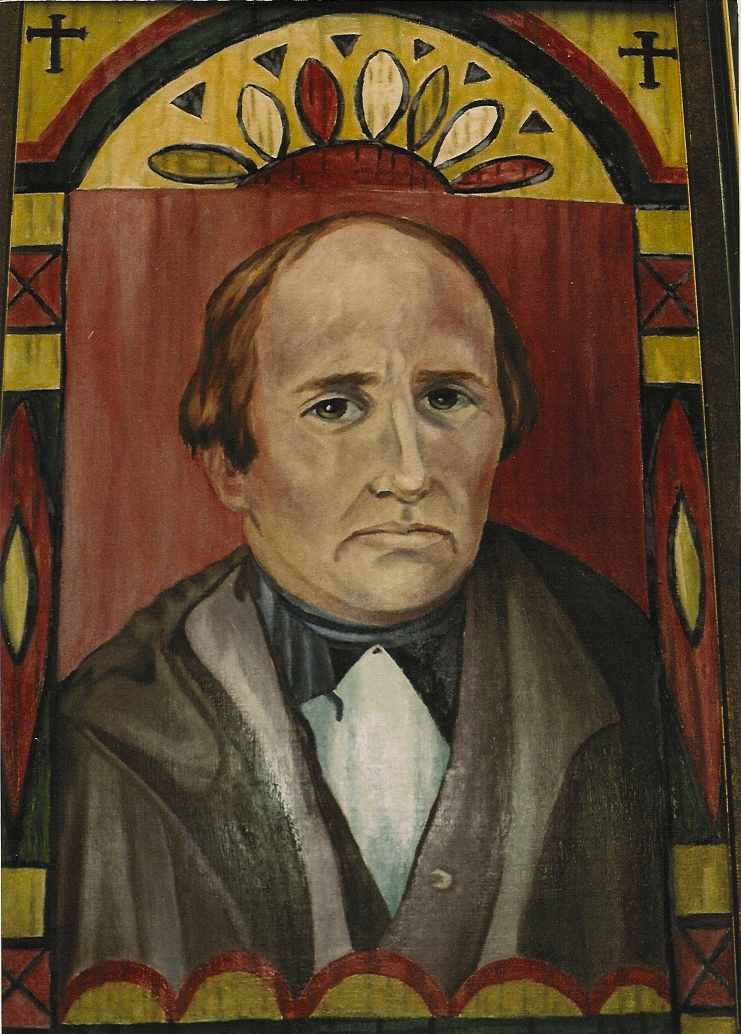
[Father Difouri notes that the short-lived El Crepúsculo was printed on Eitch (?) Blue Book. Although he credited the newspaper to Padre Martínez, Father Difouri fails to mention several other educational accomplishments of Padre Antonio José Martínez, Cura de Taos. In 1826, he founded at his residence an elementary school for girls and boys, a minor seminary in 1833, and a law school in 1846. In addition, the Padre published a speller for the children of the Martínez Family, and on his own printing press the first book in New Mexico (a Bilingual Ritual in Latin and Spanish), a variety of religious booklets and pamphlets, the first newspaper of the area (short-lived El Crepúscuo de La Liber tad), his autobiography, an account of the 1837 Taos Uprising as well as other items. Having been invited by General Kearny to become first citizen of NM in 1851, the Padre lent his printing press for the printing of the Kearny Code.]

  In the meanwhile, New Mexico suffered greatly from the frequent revolutions and pronunciamientos, issued in the mother country. The provincial deputation had given way as a power; a President of the Republic was created in 1825 and Guadalupe Victorio was inaugurated April 1. He was succeeded by Santa Anna in 1833, and was himself overthrown in 1835 and a new constitution adopted. All these revolutions

were felt in New Mexico both by the Church and the State,

and religious as well as civil progress was retarded.

Much dissatisfaction was felt with the new constitution and it culminated in a conspiracy by the Indians in 1837, against the governor Albino Perez, and he was assassinated -by them as we have seen, and the half-breed Indian Jose Gonzalez, proclaimed provisional governor.

It was this dissatisfaction of a part of the people of New Mexico, which gave rise to the famous Texas-Santa Fe expedition, which terminated so disastrously for the Texans. The expedition started from the Valley of Brush Creek, near Austin, June 21, 1841, under General McLeod. Many of those who composed it had nothing else in view than trading and brought a great amount of merchandise. But this was not the

view of General Lamar, the President of the ” Lone Star Republic.” Texas claimed the Rio Grande as her western boundary; many in that eastern half of New Mexico, seemed to desire their coming and throw off the galling yoke of Mexico, and Lamar with his associates, who kept their secret, wished these young men to reduce Santa Fe under the rule of Texas.

All know how they were roughly handled by General Armijo, when, after untold hardships, they were met at Apache Canon, made prisoners and tied together like cattle, sent to Mexico City. It is not my purpose to write the history of the

Texas-Santa Fe expedition. It has been well-written by George Wilkins Kendall, although he is somewhat inimical to the Catholic church, but I think more through ignorance than malice. No book can give a clearer idea of General Armijo than Kendall’s “Narrative.”*

August 18, 1846, brings us to the American occupation of New Mexico by General S. W. Kearny, and to an era of both religious and political prosperity for the Territory. New Mexico was so far back, on that year, that it is asserted that ” adobe palaces,” alone in the Territory had window glass. The Church and the Territory gained nothing by the Mexican rule, and it cannot be said that the government was favorable to religion, and there is no doubt that many of the leading men enriched themselves out of the funds of the Church.

* Kendall’s narrative may be somewhat strained, but it is certain that on the occasion referred to Armijo showed himself to be a cruel and cowardly tyrant. When the poor prisoners were chained to march on foot to Mexico City, he ordered his cruel lieutenant to shoot down anyone who could not keep up with the others, “and bring him the ears,” and it was done to the letter; five of them were shot, and their ears brought as trophies to Armijo.

CHAPTER VII

Erection of the See of Santa Fe

*The Most Rev. J. B. Lamy, the first Archbishop of Santa Fe, was born on the 11th of October 1814 at Lempdes in the Department of Puy-de-Dome, France. His parents were Jean Lamy and Marie Die. His venerable father belonging to one of the principal farming families in the country, was for years Maire of Lempdes, his native parish, and gained by his piety, generosity and unflinching rectitude, the esteem of both his fellow citizens and the French Government. His mother was known as a woman of refined attainments and great piety.

  Jean Baptiste was the youngest of eleven children, of whom eight died in infancy, three only remained, the joy and pride of their truly Christian parents, two boys and a girl. Etienne, the oldest of the three, entered the marriage state and handed down the religious traditions of the family, giving to the Church several of his children. Among them, we find the well-known Mother Francisca, the actual Superior of the Sisters of Loretto in New Mexico and the lamented Father Anthony Lamy, who in the vigor of his priesthood, died Feb. 6th, 1876, at Manzano, the victim of his untiring zeal, besides others who settled in the world and became ornaments to society

  John Baptist’s sister was named Margaret. Early in life she entered the house of the Sisters of Mercy in her native land, and received the name of Soeur Marie. Later, in 1848, she was sent to America with her brother who had made a journey to France, and she died at New Orleans, Louisiana, in 1851 whither she went to accompany her holy brother lately consecrated Bishop of Santa Fe.

John Baptist was at an early date sent to the Royal College and petit seminaire of Clermont. His progress in that truly religious institution was remarkable, both for science and piety. He followed the studies of the college with great success, was loved both by his superiors and companions for his strict obedience and kind disposition of heart, and his college course was a happy time for him and a blessed one for his good parents. He was naturally so kind, so innocent, that his little companions had named him ” the Lamb.”

  From the College of Clermont, where he successfully completed his course of philosophy, he passed to the Grand Seminary of Montserrad to commence his theological studies. If he had been a good and happy boy at college, he was at

Montserrad, no less a scrupulous and yet cheerful seminarian. The strict obedience to rule as practiced in French seminaries, and particularly in the seminary of Montserrad, is wonderful. The young seminarian followed all the rules with religious scrupulousness. It was there, amid retirement and meditation, that was developed that vocation for the

mission which he had already felt moving his heart at college while reading those wonderful acts of mortification, love of God and even martyrdom of Missioners, contained monthly in the “Annals of the Propagation of the Faith.” [At that time, these ” Annals” were called Zettres edifiantes.]

 It was there that he perfected those virtues which were to make of him not only a good priest, but an untiring missionary in the West, and which culminated in his rising to the highest post of honor, and of labor as well — in the vast Territory of New Mexico.

The pious seminarian, having completed his theological studies, was called successively to tonsure, minor and higher Orders, until finally on the Ember days of December1838, he received the priesthood at the hands of the venerable

and ever to be remembered Mgr. Ferron, more than forty years Bishop of Clermont, who appointed the new priest vicar at Chapare, where he remained only a few months.

  In 1839, the lamented Dr. J. B. Purcell, late Archbishop of Cincinnati, made a journey to France and Ireland, to supply with priests his new and vast diocese and increasing population. The burning desire for western missions, with all their sufferings and dangers, was revived in the heart of the young vicar; his zeal could not contain itself, he saw Dr. Purcell, applied for admission, obtained his Ordinary’s blessing, and in

the summer of that year started for the scene of his many labors, with his new Bishop, forming one of a large party of priests and levites. The holy band gave to America such men as Rev. de Goesbriand, Bishop of Burlington, Rt. Rev. A. Rapp the first bishop of Cleveland, Et. Kev. P. J. Machebeuf, bishop of Denver, Colorado, and those Fathers, who, without receiving the mitre, worked so hard in the American portion of the

Lord’s Vineyard: Fathers Navarron, Gacon and Cheymol. Some of these have received their reward in Heaven for leaving behind all they held dear, to work without ceasing for the glory of God, and the salvation of souls. The zealous young missionary was appointed to several missions in Knox, and three other counties in Ohio. For eight

years his labors were blessed by numerous conversions in Gambier, Mansfield, Ashland, Londonville, Wooster, Canal Dover, Massillon, as far as Canton and Mount Vernon, in particular, where he resided frequently, although he made his

home at Wooster. He was afterwards transferred to Covington, Kentucky, where he spent three years amid the most arduous duties. These missions were not, then, without much labor and danger. The settlements were extremely scattered, the means of traveling few and of primitive style, the rivers were bridgeless, and the people exceedingly poor and lonely. The Catholic church was viewed with distrust and even jealousy and anger by many non-Catholics, and its progress interfered with. It mattered not; the young missionary had come not io look back, holdingthe plow, but

to look steadily forward.

  Eleven years were thus spent for the Lord, when in 1850, Father Lamy was created by the Holy See, Bishop of Agathon in part. inf. and Vicar Apostolic of New Mexico. No time was to be lost, and so, with his usual energy, the young Bishop, only thirty-six years of age, repaired to Cincinnati, was consecrated by Dr. Purcell on the 24th of November 1850, and immediately after, set out to ” conquer” his See, if I may use

the expression. His trials at New Orleans, his shipwreck in the Gulf, his sickness, and his hardships through Texas, and the difficulties he met after his arrival, justify me in calling him a conqueror.

  Leaving his sister at the hospital of the Sisters of Charity, and his niece, Mother Francisca, then a young lady, at the Ursuline Convent in New Orleans–although these two were delayed and did not arrive immediately–he embarked alone on a vessel sailing for Galveston and went safely through the dangers of the deep sea. But when nearing the Port de LaVaca, a terrible northern windstorm arose, and the vessel was shipwrecked close to the shore. All on board were saved, but everything was lost; church articles, vestments, sacred vessels carried with much care for the missions, clothing, books— all were lost.

  Once, while a guest of Dr. Lamy, I espied some volumes in his library, that seemed to have received a thorough soaking, and looked like veterans battered in war, amid new recruits. I inquired of the venerable Archbishop the meaning of it. His

eyes sparkled; a smile lit. up his kindly face, and he told me that they were fished out of the waters of the Gulf. With great kindness, and even joy at the remembrance, he described to me his shipwreck, his desolation at having lost everything, until spying quite near the shore one of his trunks drifting seaward, he offered a small sum of money to a young negro boy, who swam to the trunk, and, pushing it before him

as he swam shoreward, brought it to land. It was opened. Oh! in what condition! The books in my hands were of those saved in that one trunk; all else was lost.

  Anxious to reach his destination and be at work in his immense field of labor, behold the young bishop, seated in a common cart, with his solitary trunk for baggage, driven by a Texan, starting for Santa Fe, on the then almost trackless desert, nothing daunted by the distance, the fear of wild beasts, rivers of brackish water, with precipitous banks, want of provisions, utter solitude, having to cross the haunts of wild Indians roaming over the prairies, always alert for booty and bloodshed.

  Nearing San Antonio, the cart being about to upset, the bishop jumped to the ground; but alas! he fell upon brambles and badly sprained his ankle. Happily, only a few miles

away was San Antonio. He was conveyed there and thanks be to God, he was received in the house of the priest, Father Calvo. Nearby was the residence of the worthy family of Dignowity, well-known throughout Texas, a family of stanch Catholics, and keeping up to the letter all the Catholic practices of their old European home. There he lay for eight months before he could set his foot on the ground and restart upon his arduous journey. This worthy family were untiring in their attention to the noble guest of their pastor, and it is owing to the care of the good priest and to theirs that he got well at all, and does not still suffer from this painful accident. Had it not been for them he would have been, most probably, a

cripple for the balance of his life.

  During his forced stay at the house of Father Calvo, an event happened which bound the Bishop still more closely to the family Dignowity. A son was born to them, and nothing would do but that he stand for the child. The Bishop assented and amid the rejoicings of the family and neighbors, Charles J. Baptist Dignowity, received the Sacrament of Baptism and the Bishop stood as godfather.

  Finding himself getting tired [?] and anxious to take his flight towards his expectant flock, he resolved to resume his journey and soon set out amidst the regrets and blessings of his friends. I pass over the untold toils, hardships, and dangers Dr. Lamy went through during this perilous journey. He reached Santa Fe in the summer of 1851, after a journey of nine months since his setting out from New Orleans.

  In Santa Fe, old persons relate a fact which shows their faith. The ground was parched for want of water, all the water courses and ditches were dried up, sheep and cattle were in a dying condition, and poverty was staring in the face of the people. But on the day of the Bishop’s arrival, a bountiful rain fell and animate and inanimate nature was refreshed, grass sprung up, and the year was one of plenty.

  Though arrived at his destination, the Bishop soon found himself surrounded by great difficulties. Both the clergy and the people were unwilling to acknowledge the new prelate’s authority. The reason given by authors who have spoken of

this fact is, they say, that before its annexation to the United States, New Mexico being under the jurisdiction [ecclesiastical authority] of the Bishop of Durango in Mexico, the latter, had not had time to inform this distant portion of his flock of the action of the Holy See, in erecting the new diocese of Santa Fe. This is not quite correct,

and the facts are contrary to it.

[It is true, as Father Difouri asserts, that it “is not quite correct” to assert that Bishop Zubiria of the Diocese of Durango “did not have time to inform” the faithful of northern New Mexico about the change in ecclesiastical jurisdiction, i.e., change in episcopal authority.

  American forces four years prior in August 1846 had occupied northern New Mexican territory under the church authority of Bishop Zubiria of Durango in the Republic of Mexico. After two more years, by February1848, this change was ratified in the 1848 Treaty of Guadalupe-Hidalgo between the United States and Mexico. Civil authorities of both nations accommodated to the new political situation within a brief period, but adjustment within the sphere of church-state took much longer. It was not for two more yars, in 1850, that the bishops of the United Sates met in Baltimore in1850. One of the items on the agenda was to petiiton Rome that New Mexico become a new diocese dististinct from its mother Diocese of Durango in Mexico and be attached to the Archdiocse of St. Louis, Missouri in anticipation of becoming a diocese in its own right.  attached to the, and one of their actions was to promote a bishop for New Mexico now part of the United States. y had taken place in August 1846, four years prior to the arrival of  had  two years yy American forcess after 1848 Treaty pf Guadalupe Hidalgo and the occupaiton bthe occupation of Father Dufouri lays out a narrative]

The saintly Bishop of Durango,

Dr. Zubiria, had been advised in time, and had immediately

set out for New Mexico, visitig every mission of the diocese,

and performing everywhere his episcopal duties. But he had

not been consulted in the dismemberment of his diocese, and

he felt quite unwilling to quietly stand by it. The clergy bad

another reason, they had been living at ease, twelve hundred

miles from their Bishop, and they dreaded the presence of

the new prelate among them; I might add, that many of them

were utterly opposed to American rule, either civil or ecclesi-

astipal.

The indefatigable Dr. Lamy set out on horseback, with a

solitary guide, for the city of Durango; he had an interview

with its Bishop, and everything was settled amicably. With-

out taking time for rest, he returned, having performed a

journey of three thousand miles on horseback.

In his new diocese he found but few priests, while it was

destitute of educational establishments of any kind. The

young bishop put his hand to the grand work of building up

Catholicity with an energy that cannot be overpraised. His

adventures and long, journeys over the vast plains extending

from Kansas City to Fort “Union, plains with no inhabitants,

then, save wild beasts and roving Indians, border on ro-

mance. Though about nine hundred miles in extent. Dr.

Lamy crossed these plains twelve times for the welfare of his

vast diocese.

HG CATHOLIC CHURCH I» NEW MEXICO.

CHAPTER VIII.

Dr. Lamy 0BTAl^fs Sisters of Loretto. — Their arrival at Santa

Fe. — Their Success.

Bishop Lamy, ever anxious for the good of his diocese, de-

sired to enrich it with devoted Sisters, to teach the young,

knowing well that this was the best way to reach the people.

Having heard of the sell-denial of Father Nerinckx’s spiritual

children, and of the severe training they had gone through,

he concluded that they were the very ones whom Divine Provi-

dence had designed for the laborious missions which the Holy

See had confided to his care. He applied for a colony of Sisters,

and his request was cheerfully griinted. Faithful to its tradi-

tions, and to the injunctions of its founder, Loretto could not

refuse a mission which seemed to promise nothing but hard-

ships and privations,

Early in the Spring of 1852, the missionary Bishop left Santa

Fe to assist at the First Plenary Council of Baltimore^ cross-

ing for the first time the dreary waste called with reason, the

” American Desert.”* In tue commencement of Jane ‘he

reached Bardstown, and prepaiations were soon made. But

before returning to New Mexico, the Bishop went to New Or-

leans, to visit his niece who was still at the Ursuline Convent,

since his departure for Santa Fe.

“On Sunday,” says Mother Magdalen in her “Annals of Our

Lady of Light,” June 27, 1852. after Mass, the Sisters destin-

ed for Mexico, left the Mother house of Loretto; Mother Ma-

tilda Mills and Sisters Catherine, Mary Magdalen, Monica,

Hilaria and Roberta. The same day they arrived at Bards-

town, and on Thursday morning, July 1st, they reached St.

Louis, and were kindly received by Archbishop Kenfick. In

the meanwhile they visited the Convent of St. Ferdinand, at

Florissant, and spent a few days with their own Sisters. As

soon as they heard of the Bishop’s return from New Orleans,

* It was at that Council thatu petition was made by the Fathers to the

Holy See, to have Dr. Lamy appointed titular Bishop of Santa Fe. The

Bulls were not delayed, and the Bishop of Agathon became Bishop of

Santa Ffe.

CATHOLIC CHURCH IN NEW MEXICO. 37

they joined him at St. Louis, and on the 10th of July left

by the steamer ” Kansas,” which was to convey them as

far as Independence. Wi4h them traveled a family and

some other’ persons belonging to the Bishop’s suite.

The Sisters had accepted the mission in a true spirit of

self-abnegation; yet they little dreamed, as the spires of

the city receded from vieWj how soon Providence was go-

ing to put their virtue to a test. There had already been

some cases of cholera on board,when, on Friday, the 16th,

at two A. M., Mother Mathilda was attacked; her sufferings

lasted till about two o’clock in the afternoon of the same

day, when she gave her soul into the hands of her Maker,

after having received the sacraments of penance and Ex-

treme Unction at the hands of the Bishop. Two hours

later the steamer landed at Todd’s Warehouse, six miles

from Independence. In the meantime Sister Monica had

also contracted the disease, and the landing was truly af-

fecting, the Sisters following the couch of their dying Sis-

ter and the coffin of their dear Mother. The inhabitants

stood in such dread of the cholera that the Sisters were

not allowed to enter their houses, and were therefore ob-

liged to remain in the warehouse.”

The next morning, July 17th, three of the Sisters, with

the Bishop and some other persons, accompanied the car-

riage which conveyed the corpse of Mother Mathilda to its

last resting place, in the graveyard of Independence. But

on the way they were met by a Sheriff who had been de-

puted by the authorities to forbid entrance into the town,

for fear of contagion. However, the Bishop’s firm atti-

tude, and perhaps, too, compassion for the sad spectacle,

caused this official to relent. They continued their way to

the graveyard, and there they saw the cold earth receive

into its bosom the remains of her whom they had loved and

reverenced.

” The Bishop,” continues Mother Magdalen, quoted by

Bishop Maes, ” now took the three Sisters, Catherine, Hi-

laria and Boberta, to the town and left them there, Vhilst

Sister Magdalen remained in the warehouse with Sister

Monica. But on the night of the following Monday, July

18th, Sister Magdalen herself was attacked with the chol-

38 CATHOLIC CHUECH IN NEW MEXICO.

era, and made what she believed to be her last confession.

The place being ill-suited for Jadies, especially religious

ones, sick unto death; the Bishop, unable to make better

arrangements, had the two dying sisters removed to tents

about two miles from the town. The poor Sisters were

much better oflf than in the warehouse, although they had

many inconveniences to bear, and had nothing but the

canvas tent to screen them from the heat of July.”

After a few days Sister Magdalen began to recover. On

Sunday, July 23d, the three Sisters came from Independ-

ence, and heard mass said ^by Bishop Lamy in a tent. It

was impossible for Sister Monica to proceed any further,

her recovery being doubtful, and in spite of her great de-

sire to pursue the journey to New Mexico, she returned to

Independence until her health should be sufficiently re-

stored to return to the convent at Loretto. As Sister Mag-

dalen could travel in a carriage, although very weak, they

left Independence on Saturday, July 31st, to go into camp

some four miles distant, where the Bishop and part of his

suite (tor the others were waiting at Willow Springs) had

already encamped. There the Sisters went to confession,

and the next iporning received holy communion at the

hands of the Bishop.

After the death of Mother Mathilda, Sister Magdalen

was chosen to fill the office of Superior, and this election

was promptly approved and confirmed at Loretto. Thus

was Mother Magdalen chosen in the designs of Provi-

dence to guide this young colony-of Sisters to Santa Fe;

to protect them against all the blasts of trials and difficul-

ties; to build for then) the material and spiritual edifice of

their order in Santa Fe; to create schools and academies

to the honor of Our Lady of Light, the finest edifice in

America, a chapel which can compare advantageously with

any of the kind, even in Europe — but more about it later.

Dear Mother Magdalen, after thirty years of untold toils

and privations, has been stricken down by palsy, but her

head and her heart are as warm and as sound as ever, and

although she gave up the charge of the flourishing commu-

nity into the hands of another self. Mother Francisca Lamy,

she is still the guiding spirit of the institution — a broken

CATHOLIC CHUBCH IN NEW MEXICO. 39

flower, but keeping all the perfume of virtues and science

■which animated her active life.

On the evening of August 1st they reached Willow

Springs, a fine watering place a fe\y miles from Westport,

and there found the other party ready to start. So they

lost no time, and started all together; but they had pro-

ceeded only a few miles when one of the wagons broke

down, and there they were obliged to camp in order to re-

pair the wagon.

That night was a terrible one for the travelers. A fear-

ful storm arose; the wind blew with violence; the rain fell

in-torrenta; the tents could not be pitched, and all, tha

Sisters and other liEidies of the party, had to remain in the

wagons and prptect themselves as well as they could against

the beating storm. It lasted the whole night, and the

warring elements seemed to bid each other defiance.

Mother Magdalen, who records the fact, says that the Sis-

ters were much terrified at the fury of the storm, which at

times seemed ready to shatter to pieces their frail tenement,

and they sought protection in prayer.

The Bishop, regardless of the storm, was everywhere,

with his usual and untiring energy, now encouraging the

frightened Sisters, then giving directions to the muleteers,

saving the party from another dreaded accident, the stam-

pede of the animals; visiting the traveling party, never

taking any rest until every one was as comfortable as pos-

sible, thus acting the part of a father with all.

Some time was spent the next day to repair damages.

On the following Sunday, the 8th, the Bishop said mass

near an Indian hut on the banks of the Hundred-and-Ten

creek. Thence they passed Burlingame, and on the eve of

the Assumption reached Council Grove. All confessed

that evening, and on the next morning received commun-

ion at the hand of the Bishop. The Sisters,, according to

their rules, renewed their vows at the time of mass. The

next day the march was resumed, and no mass was said

until they reached Pawnee Fork, on the spot where now

stands the town of Larned, at the junction of the Pawnee

river and the Arkansas. For the first time, buffaloes were

killed by the party, and fresh meat enjoyed.

40 CATHOLIC CHDBCH IN NEW MEXICO.

Eesuming their march, on the 7th of iSeptem|)er they

passed the then existing Fort Atkinson, and encamped

some miles beyond, but still in Kansas, when a parly of

Indian warriors four jjiuadred strong fell upon them and

surrounded them. All were terrified, particularly the la-

dies. This was the Indians’ hunting grQund, and when-

ever they could do so with impunity, they would attack

caravans. On this occasion they seemed peaceable; the

Bishop was even enabled to baptize the child of & captive

Mexican woman. Still as their intentions were not known,

and the Indian is often treacherous, the Bishop thought

prudent not to make any move, hoping they would retire;

but as they seemed disposed to remain, he ordered his

company to march in the evening, and the caravan trav-

eled all night, as the Indians do not generally make their

attacks in the dark.

The Arkansas was crossed, and on Sunday, 12th of Sep-

tember, Cimarron was -reached. On the 14th Very Rev.

P. J. Machebeuf*, then Vicar- General, with a party of

men and animals, met the caravan near Red Biver. I need

not say how agreeable and affecting was that meeting, and

the assistance it brought. Near Fort Union they were sup-

plied with fresh meat and fresh bread, a most welcome

food after the hard tack of the journey, which was fre-

quently rationed. Las Vegas was reached on the 18th.

This was the first Mexican town reached. The next morn-

ing the’ Bishop said mass in a private dwelling, not far

from the town. There he stopped to rest, and sent Father

Machebeuf with the Sisters to what was then called the

Bishop’s rancho or farm, a little over fifteen miles from

Santa Fe. This rancho was subsequently sold to Hon. F.

Manyanarez, Member of Congress, and the A. T. & S. F.

has established there a station called after the Archbishop.

To show the zeal of the Bishop for the spiritual welfare of

those under liis care, I must say that during the journey

he said mass and preached every Sunday but one, when it

*Bt. Eev. P. J. Machebeuf, now Vioar Apostolic of Colorado, had

followed his friend Bishop Lamy to his western diocese, and had been

appointed Yicar-General. He also had labored in Ohio with great

success.

CATHOLIC CHUSCH IN NEW MEXICO. 41

was absolutely impossible; but prayers were said in com-

mon.

The Bishop set out from Las Vegas on Wednesday, and

on Thursday, 23d of September, quietly entered his epis-

copal city, to prepare the way for the coming caravan, en-

tirely unmindful of his own comforts. On Sunday, 26th,

the party left the ranch and started for Santa Fe, where

they arrived at four p. m. The people, led by Father Ortiz*’

and other Mexican priests, went several miles to meet

them. As they approached the city, the crowd increased

so much that the carriages could scarcely pass through the

streets of the ancient metropolis. Triumphal arches had

been erected, and the bells of the different churches were

pealing. They were received at the door of the cathedral,

presented with holy water, and led to the foot of the altar.

The Te Deum was sung, accompanied by Mexican mujic,

violin, guitars, etc., and the ceremony terminated with the

episcopal blessing. Thence the Sisters were conducted by

the Bishop, Vicar-General and clergy to the house pre-

pared for them, and the priests who had accompanied the

party were lodged in the house of the Bishop, and thus

ended this long and painful journey, full of accidents and

dangers. All felt glad at being finally at home in Santa

Fe.

” The Sisters,” continues Mother Magdalen, ” did not

open school immediately, as they needed some time to ap-

ply themselves to the study of the language of the’ country,

Spanish. In November they received their first boarders,

fwo children who had lost their mother. When these were

admitted the Bishop remarked to Mother Magdalen; ‘ It is

well to begin with an act of charity.’ The Sisters, how-

ever, were amply rewarded, for the two children were bap-

tized the next Christmas, in the convent chapel, and when

their father withdrew them from school he paid for their

tuition, whereas the teachers had not expected to receive a

cent.

*Pather Juan Felipe Ortiz had been Vioar-General for New Mexico

nndei Bishop Svbiria of Durango, and was then residing at the Ca-

thedral.

I

42 CATHOLIC CHURCH IN NEW MEXICO.

” The school opened iu January, 1853, with ten board-

ers and three day scholars, but at the close of August the

number had increased to twenty boarders and twenty-two

day scholars.

” The house which the Sisters occupied had been ceded

to them by Bishop Lamy, who lived in ths same building,

but in another square or ‘plazita entirely separated from

them. As their house was now too small, he, in October,

1853, gave up the whole to them, and rented a house for

himself.

Afterwards the Sisters obtained, on very reasonable

terms, a piece of property in a secluded part of the city,

and containing the best looking house in town, and called

La Gasa Americana, the American house, becabse it had a

•shingle roof, all the other roofs in town being flat and cov-

ered with earth. An orchard and grounds were laid out,

and -the Sisters began to occupy their new home in Sep-

tember, 1855. Since then the new province has prospered

beyond all humaa expectations, and besides the -house of

Santa Fe.in which is the novitiate, and which has been called

the Convent of Our Lady of Light, it possesses the follow-

ing houses: The Convent of the Annunciation, in Mora,

was established in 1854:, whilst Father J. B. Salpointe,

now Archbishop of Santa Fe, was parish priest at that

place. In 1853 the Convent of St. Joseph was established

in Taos under the care of the Rev. Gabriel Ussel, the par-

ish priest of Taos. The Convent of Our Lady of Guada-

lupe was first established in Albuquerque in 1866, but that

mission was given up in 1869. In the same year was es-

tablished the Convent of the Immaculate Conception, iji

Las Vegas. In 1870 the Visitation Academy was estab-

lished at Loa Cruces, through the generosity of the Kt.

Eev. J. B. Salpointe, then Vicar Apostolic of Arizona, in

whose diocese Las Cruces was included. The Convetit of

Our Lady of the Sacred Heart was established in 1875 in

Bernalillo. Later, in 1879, the Convent of Mount Carmel

was established in Socorro.

In 1864 the Convent and Academy of Denver was estab-

lished. The zealous and untiring Father Machebeuf, the

pastor of that rising city, and now its worthy Bishop, came

CATHOLIO CHURCH IN NEW MEXICO. 43

himself to Santa Fe, and brought a colony of Sisters to

the capital of Colorado. Since then the novitiate of Santa

Fe, being unable to supply them with a sufficient number

of Sisters, they are supplied from Loretto, and have them-

selves formed missions at Pueblo, Conejos and elsewhere,

spreading everywhere the light of the knowledge of God

and the sweet odor of the most exalted virtues.

Before closing this subject, I could not pass over in silence

the fine chapel and the Academy of Our Lady of Light,

built entirely by the eriergy of Mother Magdalen and the

self-abnegation of the Sisters, who many times deprived

themselves of the necessary wants of life, in order to be

able to erect a suitable temple to the Almighty and an

Academy worthy of the high renown of the sister institu-

tion of Our Lady of Light. The chapel, comm enced in

1873, is built of stone, with veins and arches of the purest

Gothic style, constructed entirely of native material. This

chapel cost thirtj- thousand dollars, and is a monument to

the devotion of all interested in that great enterprise — a

chapel which can compare favorably with the finest in the

largest cities of the land. The Academy was commenced

in the spring of 1880.

In May, 1881, the first symptoms of a rheu nlatic affec-

tion manifested themselves in Mother Magda ien, but she

was heedless of the pains, confident that her hitherto ro-

bust constitution would eventually resist the disease; but

on the 28th of August she was obliged to keep her be

which she has been unable to leave since, leaving ‘

younger hands the active direction of the Convent and No-

vitiate, and Sister Francisca was appointed Mother; but

still Mother Magdalen remains, by her piety and business

qualities, as dear as ever to the good Sisters.

M CATHOLIC CHURCH IN NEW MEXICO.

CHAPTER IX.

Bishop Lamy goes jo Eome. — He beings with him, on his

EETUBNj THE FiBST CaRAVAN OF FbBNCH PbIESTS.

Ever anxious for the good of his diocese, the Bishop

took no rest. One year was spent in correcting abuses

which had crept, unconsciously as it were, into the church

during the period of the Mexican rule, which — Grod be

praised for it — was of short duration. The MexicanG-ov-

ernment did not strictly speaking persecute the church,

but its want of care for both church and state was unpar-

donable, and, alas ! that we must say” it, the clergy did not

rise much above the governing powers in striving to pro-

mote the glory of God and procure the salvation of souls.

Dr. Lamy, ably seconded by his Vicar General and bosom

friend. Father Machebeuf, went everywhere to see for

himself, and set to work to correct abuses, to establish

schools, to form religious associations ; and thus they were

employed during the winter and spring of 1853. Then it

was time for Dr. Lamy to visit Kome to obtain the approval

and the blessing of the Holy See upon his work, and also

to obtain clergy a more careful of the work of planting faith

and virtues in the hearts of the people than were those

priests who for years had led their flocks in pastures of

their own choice, but reproved of God. In the fall of 1853

the energetic young Bishop set out from Santa Fe with a

caravan to cross those formidable plains, the American

Desert, the home of the Indian and coyote — a desert ex-

tending nearly nine hundred miles in breadth, from New

Mexico to the Missouri river. He rested only a short while

at St. Louis, Cincinnati and Bardstown, from whence -he

made a flying visit to Loretto to give news of the saintly

colony of Santa I^e and to petition for more Sisters. This

time also his- request was readily granted, and arrange-

ments were made to start for Santa Fe the following

spring. The Bishop, losing no time, embarked at New

York, soon reached France, and at once visited Monsignor

CATHOLIC CHURCH IN NEW MEXICO. 45

Ferxon, the old bishop of Clermont, who had ordained him

priest and had blessed his vocation to the missions of Cin-

cinnati. From him also he received warm and fair prom-

ises to permit young apostles from his diocese to help him

in his missions of New Mexico. The young clergy were

anxious to seer him and to converse with him. The levites

in the Seminary were favored with his presence, and their

vocation matured more and more in their hearts.

In the meanwhile, the Bishop, having paid a flying visit

to his brother Etienne and other immediate relatives, set

out for Rome, where he was kindly received by Pius IX

and Cardinal Barnabo, Prefect of the Propaganda. He

received great praise and encouragement, and also direc-

tion from the Holy 3ee. He soon afterward left Eome,

visiting several renowned cities on his route, and early In

the spring of 1854, reached the city of*Clermoht. A num-

ber of young levites presented themselves to him, and

to him expressed their willingness to cross the ocean and

work under his careful direction. Without , regrets they

were willing to leave behind them the fair shores of their

beloved France to come to the almost desolate part of the

field of the father of family. No hope of reward crossed

their minds, but the thoughts of the future buoyed up their

spirits. If they ever reflected over the privations they

were to -endure, they cast these thoughts far away, placing

such prospects in the hands of God.

Among the saintly men who heard the voice of God in

their hearts were the Reverends Taladrid, a priest from

Madrid, Spain, whom the Bishop had met in Rome ; Mar-

tin of. the diocese of St. Flour, France, an old missionary

in Africa, met also at Rome ; Anthony Galiard, from Cler-

mont, who stayed three years and then returned to France,

where he soon died ; Stephen Abel of Clermont, who sub-

sequently died parish priest of Moro ; Peter Eguillon, the

actual Vicar-General of Santa Fe and parish priest of the

cathed£al, also a priest from the diocese of Clermont.

Among the Seminarians were the Reverend Joseph Gue-

rin, yrho died recently, parish priest of Mora. He was then

deacon-, and was ordained priest on the 23d of December

of the past year, at Santa Fe, by Bishop Lamy; Eugene

46 CATHOLIC CHURCH IN NEW MEXICO.

Pallet, parish priest of Belen, then a Subdeaconi and X.

Vaure, a cleric in minor orders, who became sick with dys-

entery on the plains of Kansas, and died on the day of

their arrival at Santa Fe.

Forming the caravan were also the Eeverend Eulogio

Ortiz, a priest from New Mexico, who had accompanied

the Bishop to Europe ; Messrs. Jesus M. Ortiz and Floren-

cio Gonzalez, who had been sent previously to France for a

course in the Seminary of Clermont; an Irish family named

Covington; and Mr; Maearthy, a lawyer, who acted as

major domo for the Bishop on the journey.

Dr. Lamy and his band of priests and levites arrived at

Louisville, Kentucky, towards the end of May, 1854.

Without going to Loretto, they reached Ctncinnati , thence

by boat to St. Louis, and in the summer arrived at Kansas

■City and Westport, being thence directed to camp at Willow

Spring, a romantic spot,with a fine spring pf icy water gush-

ing from under a huge boulder surrounded by trees, particu-

larly willows of good size, with ah abundance of grass for

the animals. There they remained for six. weeks waiting

for the colony of Sisters who were to come and join them.

In this, however, the Bishop was disappointed, as the Sis-

ters were unable to send any of their number to the mis-

sions of New Mexico. The .Bishop had his hands full buy-

ing animals, wagons and provisions, and perfecting all ar-

rangements for” a speedy departure.

During their stay at, Willow Spring a f serious accident

happened to Father Equillon, which threatened to destroy

his right hand forever, and hinder his holy zeal for the

missions. While waiting for the arrival of the Bishop, who

was away, the party in camp had more than once been

obliged to supply their larder by~ hunting for game, which

was then abundant in Kansas. Father Equillon, with the

rest, strove to do his best for the common good. But,

“alas ! one day, after returning from a successful hunt,

while putting his gun into the Vagon, it slipped through

an opening in the bed, exploded, and the unfortunate

priest received the entire discharge in his right hand.

Another incident worthy of remark, which happened

during their stay at Willow ■ Spring, can throw a ray of

CATHOLIC CHURCH IN NEW MEXICO. 4T

light upon the life of the early missionaries in the wild

West. One day they were surprised by the arrival in the

camp of a lonely stranger, with beard unshaven, wearing a

summer linen coat and carrying a gun upon his shoulder^

The stranger was tall and muscular, and there is no deny-

ing that they felt ill at ease. He spoke French to them,

and they were glad lo find an American with whom they

could converse. He asked them who they were, whi’her

they were going, why they were camping there instead of

being on their journey while the weather was fine. He

asked them many more questions, and thus rendered them

more uneasy. They told him all. He finally smiled and

told them he was acquainted with their Bishop. ” Who

are you,” they said. Smiling still more, he said, ” I am

Bishop Miege^ the Vicar Apostolic of these Territories.”

Oh ! the joy then !’ the petition for blessings ! the kissing

of the ring ! -Bishop Miege at that time was purely a mis-

sionary bishop, without any fixed residence, for he did not

settle in Leavenworth till the 15th of August, 1855. He

was on his way from the Osage Mission to that of the Pot-

tawattomies, and having heard of our party, had l6ft the

ambulance with its solitary driver to go to camp, while he

made a little turn to see the young levites and cheer them

in their dreary solitude. Of course he had no other means

. to provide for his evening meal than his gun. Thence the

surprise of the party at seeing a Bishop in that accoutre-

ment and engaged in such a work.

Hardly had Bishop Lamy arrived at Willow Spring,

after completing his preparations, and being sure that the

Sisters could not come, than,- although late in the after-

noon, he resolved to move the camp. An order was given

to that effect. All was bustle in the camp. Muleteers

gathered their animals and hitched them to the wagons,,

and after a short delay all together took the broad road

towards Santa Fe, their destination. But they had pro-

ceeded but a short “distance when one of their wagons

broke down, and there they were obliged to stop without

water to allow the repairing.

The caravan consisted of four wagons and three car-

riages, and strange to say, as soon as they had left Willow

48 CATHOLIC CHDRCH IN NEW MEXICO.

Springs, Father Equillon, who was very sick, and whose

hand had been in such a terrible condition that the physi-

cians had nearly resolved to amputate it, felt at once bet-

ter. He had refused to stay behind in Kansas City,

preferring, should such be the ease, to die going forward

to his mission, than to die among strangers, far away from

all he held dear. So, a mattress was brought, and the

future Vicar-General was stretched upon it in a carriage,

as a victim for the sacrifice. They left Willow Springs on

the 18th of September, 1854.

I will not follow the travelers in that dreary journey

over the plains, so often described by writers of those

times. They suffered greatly for want of provisions, much

of what they had having spoiled, and also from want of

water, and later in the season from snow and from cold

winds which sweep so sharply upon the bare plains of

Kansas and Colorado. They had no especial adventures

during the journey. At Fort Union the doctor of the fort,

a good Catholic, sent them a wagonful of fresh bread, and

the blessings of the whole party were showered upon his

head. They were now nearer home; their hearts were

elated, and their hopes higher. Finally they entered

Santa Fe at four o’clock in the afternoon, on the 15th of

November, 1854, having spent two months in crossing the

plains. On that evening young Vaure died at ten o’clock, ■

and the next day the young travelers laid their late com-

panion in his grave. It was sad for them to thus lose their

companion after the young cleric had reached the scene of

his labors. But God was satisfied with his good will, and

took him to his reward before those who had already stood

the brunt of the day and the heat. The priests were soon

placed on missions, and the levites, after completing their

theological studies, followed, and have worked most faith-

fully for years.

CATHOLIC CHCECH IN NEW MEXICO. 4S^

CHAPTER X.

Neoessitt fob More ScnooLs — Arkival of the Chbistias

Bbqthebs.

The Vicar- General, P. J. Machebenf, had until now re-

sided in Sante Fe ; but at this time it was found necessary

to take possession of Albuquerque, and he was sent there.

In January, 1854, he was given Eev. J. Guerin, a newly-

ordained priest, for an assistant. They experienced mucb

difficulty in their office, but thanks to the activity and:

kindness of Father Machebeuf , he had there a very suc-

cessful pastorate; performing at the same time the duties

of Vicar-General. The greatest trouble for the young”

Bishop and his faithful Vicar, was the great necessity of

schools. The girls were provided for in Santa Fe, but thfr

boys! oh, in what ignorance were they growing! Some-

thing must be done to remedy the evil.

Schools had been established in New Mexico by the earljr

missionaries among the descendants of the first Spanish

conquerors and the children of the converted Pueblo Indi-

ans. It was the holy practice of the Franciscans to estab-

lish schools along side of the churches they erected. But,,

alas! during the Mexican rule, every vestige of s,chool hacl

vanished; churches and school-houses were in a crumbling:

state, and ignorance reigned in the land. It is sad to re-

late all this, but it is the truth. This could not last under

the rule of the active and zealous Dr. Lamy. Something

must be done. He cast his eyes upon the learned and pi-

ous Congregation of the Christian Brothers. He received

some fair promises from them. He s€t about to prepare

for them, without neglecting a single one of his many;

episcopal duties.

There was then in existence on the plaza of Santa ¥£],,

the church of the Castrense, as has been mentioned al-

ready before. This church, which had been used by the.

goyernors and troops of SpaiOi as well as those of Mexico»^

had been closed to public worship since 1846. It had beea.

50 ‘ CATHOLIC CHURCH IN NEW MEXICO.

for a long time the only church opened in Santa Fe, par-

ticularly under the Mexican rule. But Father T. J. Ortiz,

in 1846, after the annexation to the United States, opened

the. Church, now Cathedral,, of Sin Francisco, and it be-

came the parish church.

The Bishop obtained from, the Holy See permission to

sell the Yglesia Gastrense, and in the year 1859 he conveyed

it in a legal form to Don Simon Delgado ‘ and his mother,

Dofla Maria de la Luy Baca de Delgado, for the consider-

ation of one thousand dollars and a parcel of land with

building thereon, adjoining the old church of San Miguel.

The land had a frontage of three hundred and twenty-eight

feet on what afterwards became College street, and six

■hundred and twenty four feet upon the Camino Real, or

Alto street. Having by this transaction secured a spacious

house, well adapted by its situatio^i for a college, his next

step was to procure the necessary teachers.

In the summer of 1858, the Very Rev. Peter Equillon,

who had succeeded as Vicar-General to the Very Eev. P.

J. Machebeuf, then in Arizona, was sent to France with

orders to treat with the Superior-General of the Christian

Brothers, the venerable Brother Philip, on the subject.

He at first met with very little encouragement, but finally,

through the influence of Brother Arteme, visitoT to the dis-

trict of Clermont, several brothers were found: willing, with

their superior’s permission, to go on the far-distant mis-

sion. The brothers were appointed by Brother Arteme,

subject to the Superior’s approval. He chose the follow-

ing: Brothers Hilarien, Director of the schools at Billom;

Gondulph, Director of that at Bamagnat ; Geramius, ‘

teacher cf the school of the Clermont Cathedral, and Gal-

mier-Joseph, teacher in the Orphanage of that city. They

set out in the summer of 1859 with Father Equillon and

nine priests and ecclesiastics. Without accident they ar-

rived in New York, where they were given another com-

panion in Brother Optatien,^ belonging to the Second

Street Community. Making haste, they reached Kansas

City, then the outpost of civilization. They crossed the

plains in caravans, exposed to every kind of danger, and,^

after untold wants and sufferings, reached Santa Fe on

the 27th day of October, 1859.

CATHOLIC CHURCH IN NEW MEXICO. 51:

The first night after their arrival, they were the guests

of the good Bishop. The next day they took possession of

the house prepared for them, and slept on mattresses laid

on the ground, for the house had no floor. Bepairs were

commenced at once, and in the meanwhile they took their

meals at the Bishpp’s house. On All Soul’s Day they en-

tered their new home, ” finding,” says Brother Hilarien,

“the four walls.” To furnish the apartment they were

presented with five chairs, five mattresses, five blankets,

two tables, a few benches and some old carpets. Board-

ers were received on the 9th of November, 1859.

Brother Hilarien was unwilling to assume the responsi-

bility of debts in establishing a boarding school, as furni-

ture and almost all kinds of provisions were of exorbitant

price, owing to the remoteness of Santa Fe from all com-

mercial centers, and also owing to the failure of crops in

that year. The Bishop, with his ordinary kindness, as-

sumed all the responsibility, paying the five Brothers eight

hundred dollars per annum; furnishing them with board,

lodging, washing of linen, etc. In the written contract

the Brothers were to have for breakfast, bread, meat and

cofl’ee; for dinner, bread, meat vegetables, dessert and oc-

casionally wine. The Brothers, on their side, were to

work for the Bishop as if it were on their own account,

and this agreement was made for two years.

The day school was opened December 22, 1859. The

number of day scholars varied from one hundred and fifty

to two hundred and fifty from 1859 to 1869. The boarders

for the first year were thirty; thus the number reached,

with slight variations, as far als fifty, to 1868.

Brother Hilarien was recalled February 7, 1862, and was

succeeded by Brother Gondolph. The house, owing to the

good management of Brother Hilarien, was without debts;

even a small sum of money was left, with provisions, books,

stationery, etc., laid up for future use.

In 1863, Brother Gondolph had an adobe class-room put

up, erected porticos around the inner court, repaired the

roofs of the houses, and laid a floor in San Miguel Church.

Brother Geramius was appointed’ to succeed him Septem-

ber 10, 1867. Under Brother Geramius the boarding school

52 CATHOLIC GHUBCH IN NEW MEXICO.

of San Miguel took the title of San Miguel College. His

administration was a great success. But in June 1, 1869,

Brother Geramius was sent to Quito, South America, where

he is still working with great zeal. He was succeeded by

Brother Domitian to November 1, 1870, when Brother Bo-

tulph, the present incumbent, was Sent as Superior of the

House of Santa Fe and Yisitor of Kew Mexico.

It was under the wise direction of Brother Botulph that

the College took rapid strides, and became an establish-

ment of much not4 in the West. In 1875 it became appar-

ent that, owing to the unsafe condition of the roofs and

the great number of scholars, a_new building was abso-

lutely needed. So, after consulting with the Superior-

General, and obtaining the approval of the Bishop, the

untiring Brother went to work, collecting not only in

Santa Pe but through the Territory, at some places meet-

ing with success, at others with nothing but rebuffs. Every

locality wished the College to be built there, or would not

help in the good work. In Santa Fe Brothers Botulph,

Baldwin and Morinus ‘canvassed the city and met with

quite a success, the amount so collected being the sum of

five thousand dollars, the Bt. Bev. Bishop heading the list

with five hundred dollars. The clergy and the citizens of

Santa Fe were indeed very liberal, without passing by the

mite of the poor, which helped to raise the above-men-

tioned sum.

Early in 1878 a formal application was made to the Su-

periors; the desired answer came by a cablegram. The

contract was awarded Messrs. Monnier & Coullondon. The

work of tearing down th6 houses fronting on College street

began on April 1, 1878, and was completed in four days.

On the 11th of April the corner-stone was laid with little

ceremony, but great rejoicings in the College. The work

went on briskly; masons, carpenters and others industri-

ously plied their trades, and the classes and dormitories of

the new College were occupied by the scholars in Novem-

ber, 1879. The cost of the building, all told, was nineteen

thousand nine hundred and ten dollars.

The College has continued to prosper, and new addi-

tions became necessary. The number of boarders for the

CATHOLIC CHUKCH IN NEW MEXICO. 53

year 1883 was ninety-four, and that number was increased

in the two following years. In the year 1879 there were

twenty-two Pueblo Indians attending school in a separate

department of the College. I have examined them myself,

and, like many others who had visited them, was aston-

ished at their remarkable proficiency in reading and writ-

ing English and Spanish. Their progress in arithmetic

was astonishing. I mention this because it is thought and

said by many who know not what they say that the Indian

is sluggish and slow in learning, whereas the reverse is the

case, and this can be proved conclusively by every Catholic

school established in pueblos throughout the Territory.

If, instead of insisting on sending these boys and girls

to Carlisle and Albuquerque, under the special direction

of Presbyterians and Methodists, where they are made to

forget their faith, the Government’would help the Church

to form schools in every pueblo, the race would in a short

time possess the requirements of civilization. I wi^ men-

tion one case in point, that of the Pueblo of Tezuque,

where Father Equillon, V. G. , had kept a teacher at his

own expense for two years, against the commands and

threats of the pliant tools who abuse their little authority.

The children in so short a time could spell and read well

the Spanish second and third books.

The venture made at Santa Fe was not supported by

the Government, notwithstanding the fairest promises,

and all the expensesof board, tuition, washing, etc., etc.,

for twenty-two children, for one year, fell heavily upon the

shoulders of the Most Eev. Archbishop and the Col-

lege of San Miguel. Promises were made by the late

Father Brouillet; the Very Eev. Father Defouri had a me-

morial sent to Congress for an appropriation. All was

useless. Commissioner Price writing that he could not enter-

tain the idea, and for years the children were rounded up

for the benefit of anti-Catholic institutions, by the very

ones who should have protected both their faith and their

temporal affairs.

Since their establishment in Santa Fe, the good Broth-

ers have established several schools through the Territory.

As early as 1864, Eev. Gabriel Ussel, then Pastor of Taos,

54 CATHOLIC CHUBOH IN NEW MEXICO.

visiting Prance, was authorized by the Bishop to bring

priests and Brothers for the missions of New Mexico. It

was desirable to open at once two houses, one in Taos and

the other in Mora. He came back with a simple promise

from Brother Facile, the assistant, that as soon as circum-

stances would permit, arrangements would be made for

the opening of those schools. Several months afterwards

four Brothers were sent for the purpose. They came under

the conduct of Brother Gondulph, who had gone East to

meet them. After a toilsome journey over the plains, they

reached Santa Fe August 14, 1865, and were heartily wel-

comed by their Brothers in religion as laborers in the same

field. Owing to that accession, both schools were opened

at once; Brother Domitian being appointed Director of

the school of Mora, and Brother Osmund of that of Taos.

Many difficulties obliged the Brothers to close this latter

school in the year 1867; that of Mora still continued doing

good for years, although much cramped owing to the hard

times and to the monetary crisis of the few past years, and

finally closed in September, 1884.

Later, in 1872, was founded the Brothers’ school at

Bernalillo, and Brother Galmier-Joseph was appointed its

first Director. It has continued to prosper under the

directorship of Brother Gabriel, and the fostering care of

the good pastor of Bernalillo, Father Stephen Parisis, and

promises to have a bright future in a few years. Thus

boys were given a splendid chance for learning, of which

the youth of many other localities are deprived. It is only

just to record here that both the Sisters’ and Brothers’ es-

tablishments in Bernalillo owe a great debt of gratitude to

the late Don Leandro Perea and his family.

Saint Michael’s College, after many vicissitudes, has

continued to grow, the number of boarders has increased

to hundreds, and, under the wise supervision of Brother

Botulph, now for years at its head, every day has witnessed

some improvement.* Thus it has done good for years; thus

many who claim Saint Michael as their Alma Mater have

been heard in the halls of our Legislature ; others are

prominent in different callings, and others, though follow-

*A $;L5,000 addition is now building.

CATHOLIC CHURCH IN KEW MEXICO. 55

ing humbler vocations, have honored the Territory by their

integrity and staunch virtues.

On the 29th of October, 1«84, the Silver Jubilee ol the

College was celebrated with great pomp. Extensive prep-

arations had been made in order to render the occasion as

solemn as possible. The day was clear and cool, and early

after the morning devotions the College band discoursed

sweet music, and soon after the bell of old San Miguel of

three centuries ago was heard tolling the people to mass.

The Eight Reverend J. B. Salpointe, then Coadjutor of

Santa Fe, celebrated a pontifical mass, as-<isted by the,

Reverends Roily “and Gatignol, as deacon and aubdeacon,

Mr. Jennings acting as master of the ceremonies, while on

a throne prepared for the occasion, was his Grace the Most

Reverend Archbishop, assisted by the Very Reverend Fath-

ers Equillon and Defouri. At the gospel, his Grace left

the throne and advancing to the rail of the sanctuary, de-

livered a feeling exhortation to tbe numerous congregation

present. He recalled with happiness the great good done .

in the Diocese by the Christian Brothers since their estab-

lishment at Saint Michael twenty-five years ago. The heart

of the good Father expanded at thus beholding his spiritual

children growing up under his eyes and spreading knowl-

edge and virtue around them. He terminated by wishing

for the Brothers a continued increase of all spiritual and

temporal blessings.

The mass was sung beautifully by the College orchestra, .

made up of the pupils, under the direction of the Brothers.

In the evening, after the dinner, which was had at four

o’clock (being the very hour at which the Brothers took

their first modest meal in Santa Fe twenty five years be-

fore), a grand display of fire-works took place around the

College under the direction of Brother Amian. The College

band played sonie stirring selections, the whole College

was illuminated to the very roof, while rocket after rccket

was sent skyward only to explode in mid air and fall around

like many beautiful stars, to the great delight and repeated

applause of the thousands who assembled there to witness

the display. All went weir ; the whole affair was a great

success, and no one forgot the good Brothers in the heart~

felt praise they gave.

■56 CATHOLIC CHtjRCH IN SEW MEXICO.

CHAPTEE XI.

Missions in Arizona.

There was no rest for the yet young Bishop of Santa Fe.

In the year 1859 the missions of Arizona were annexed by

the Holy See to the diocese of Santa Fe. Immedi-

ately his Vicar-General, the Eev. J. P. Machebeuf, was

«eat to take possession of them, calling at the same

time the Eev. Peter Equillon from Socorro to the Cathe-

<iral, with the title of Vicar-General, and as such sent him

to France to bring priests and Brothers. Before entering

into a description of the hardships, experienced by the

Ticar-General in taking possession of the mission, as well

as of his journey to Sonora, it is just to premise a few

“words upon those then humble missions, but destined to

play a great part in religious and civil history.

What I call Arizona missions are those contained within

the Territory of that name, which, before the treaty. of

Cruadalupe, in 1848, formed a part of the province of So-

nora in Mexico. The history of these missions, as of those

■of New Mexico, is naturally divided into three different

epochs, according to the different civil governments which

bave succeeded one another — the Spanish, the Mexican

:and the American, and I shall divide th«se notes accord-

ingly.

Spanish or Colonial Government.

ArousT 13, 1521. .

It was under this government that were founded the

missions in New Mexico and Arizona, but at different ep-

•ochsi for, whereas, while what is now northern Texas and

New Mexico received the light of faith as early as the ex-

pedition of Coronado, but more strongly in 1550, eight

years later, Arizona does not seem to have been taken pos-

session of by the missionaries until 1682. The difference

CATHOLIC CHCECH IN KEW MEXICO. 57

between these two dates is explained by the progressive

march of the government after the conjjtiest of Mexi6’6.

The march of the victorious armies took plStce first on tlie

eastern slope of the Sierra Madre, as it was by far the

more settled, from south to north, and it was over a celi-

tury later when it reached the western slope, to the banks

of the Gila river, The missionary, an angel of peace, fol-

lowed the conquering armies, ” carrying,” as well says

Archbishop Salpointe, “the consolations of the cross to

those who had been conquered by the sword.”

The first missionaries of the gospel, on the eastward

slope of the mountains, were religious of the Order of

Saint Francis, and those of the western, priests of the

Company of Jesus. Both by dint of undaunted zeal and

at the price of the greatest sacrifices, including the lives of

many of them, they succeeded in establishing missions in

the countries into which they had penetrated. These mis-

sions, in the course of years, passed through terrible or-

deals and acute sufferings, on account ‘ of the frequent

revolts of the natives, who repeatedly expelled, here and

there, the missionaries for longer or Shorter periods. The

Arizona missions in particular had to stand without ceas-

ing, from 1751 to 1754, the attacks of two cruel and war-

like tribes united in the bloody work, the Pimas and the

Seris, who caused them great damages. In 1754 order

was somewhat restored, and the missionaries commenced

anew their labor of love and salvation. Some of the de-

stroyed missions arose phcenix-like from their ruinsj and

others were founded, but only by continually meeting and

successfully combating numberless difiSculties down to the

day when the cry of independence was heard over the

mesas of Mexico, announcing the overthrow of Spanish

rule and the succession of the Mexican Grovernment.

Mexican Goveknment.

FEBKUAEr 24, 1824.

The fall of the Spanish rule caused the expulsion of the

religious orders which this government had introdaced into

58 CATHOLIC CHUECH IN NEW MEXICO.

its newly conquered realms. At that time the missions

were confided to the secular clergy established in Mexico.

The Bishops, no doubt, did their best to encourage zealous

priests to take the places left vacant by the missionaries,

but it was much more than they could do. The priests re-

sponded but feebly, and many missions, particularly the

mpst remote, were forcibly deprived of their spiritual di-

rectors, or compelled to see them at rare intervals and only

on short visits. It followed that in a few years many of

these missions disappeared entirely, the whole population

went back to the free life of the wilderness, and the church

buildings crumbled down rapidly. Out of the seven flour-

ishing missions in Arizona, six have completely dis-

appeared, and possess now only an historical interest to

the archeologist, testifying by their ruins to the sublime

labors of ancient missionaries^ Things were at that point

when the Treaty of Guadalupe, quoted above, placed the

country into the hands of the United States Government.

United States Government.

August 18, 1846.

At this time Arizona was inhabited solely by Indians

and a few Mexican families, who had settled here and

there upon the lands of the old missions. However, the

discovery of gold in California brought many people from

Mexico, who in their emigration had to cross Arizona,

many of whom, later, when tired of mining or despairing

of rich finds, came back to settle there.

When, in 1859, Vicar-GenTal Machebeuf came to take

formal possession, in the name of the Bishop of Santa Fe,

of the Arizona missions, recently annexed to the diocese of

Santa Fe, this missionary, full of zeal, braved a thousand

perils. Nothing daunted, he fearlessly went without delay

to the missions confided to him by his Bishop. The only

place of any importance was Tucson ^ which numbei^ed

about four hundred inhabitants, and that city was chosen

by the missionary for his place of residence. He did not

stay there long, for in November of the same year he went

back to Santa Fe.

CATHOLIC CHUKOH IN NEW MEXICO. 59

Although comparatively short, the stay of Vicar-General

Machebeuf at Tucson produced great fruits for the good

of souls. His memory now is fresh in the minds of the in-

habitants; they tell even now how the good missionary used

to preach on all occasions, and of the many confessions

which followed those instructions night after night, some-

times at an advanced hour. I imagine I see the zealous

priest, in all the strength of his manhood, with that activ-

ity which he received as a gift from Heaven, and which we

have all admired in him! How little all these instructions

and confessions cost him, day and night, in a field of labor

entirely new, in the midst of a people so desirous of hear-

the word of God, and of strengthening their souls in the

sacraments, of which many of them had been hitherto de-

prived.

But, alas! the roses without thorns are few. One day,

in the course of his instructions, he had occasion to speak

against the crime of homicide, and he did it with his usual

force of language, intending to make an impression. He

spoke, however, in a general manner. By a singular dis-

grace, the night before, a murder had been committed in

the town, but the speaker knew it not, and the murderer

was in thenumber of his hearers. Imagining the sermon

directed to himself alone, and on the other hand thinking

he had killed a man in self-defense, he resolved to take

revenge upon the preacher for his words. But immediately

after the ceremonies, the missionary started for San Xavier

del Bac, nine miles south of Tucson. On his return, the

angered man met him in a wood, having gone there on pur-

pose to meet him. After a” few commonplace words, the

guilty murderer came to the subject uppermost in his

heart, to the utter surprise of the good Father, who knew

nothing yet of the murder, nor of the offense he had given.

Explanations became useless; the excited man would hear

nothing, and the good missionary, perceiving that with his

hand trembling with anger he was attempting to draw his

revolver from his belt, he came to the conclusion to see

whether his faithful beast would be able to run a race.

The idea was a good one. His assailant was in a carriage,

he on horseback. He lost no time, and was at a distance

60 CATHOLIC dHOBCH IN SEW ilEXlOO.

before the man had tiine to turn his carriage to piii^sue

him. He started to pursue him, but it is not known hd\r

far he went, as the fleeing missionary did not look back,

but used the spurs and used them so well that the heels df

his boots came off, and in his rapid course the wind ble*

off his hat. It thus happened that the words of the poet

were realized: “Pileum et talos calceaminis in fuga per-

didit” — ” He lost his hat and the heels of his shoes in his

flight.”

From that day forth, while he remained in Tucson, the

missionary, without knowing or even suspecting it, was

guarded day and night by a number of Mexicans, who

were afraid of some bodily injury being inflicted upon him

by those who pretended to be affronted by his instructions.

It was at this time that, owing to numberless diMculties,

the Vicar General left Arizona for Sonora, to settle all

difficulties with the Bishop of that place, who had, until

then, jurisdiction over the missions of Arizona, as the

Bishop of Durango had had over those of New Mexico. I

kao w that the active missionary passed through a thousand

difficulties, both in going and in returning, and that he

straightened out all difficulties with the Bishop of Sonora,

I have had the happiness of receiving the details of that

journey from the lips of the traveler himself, and many

facts are thus brought to light, showing full well the excel-

lence of the Bishop of Sants Fe and the fitness of Father

Machebeiif to be his Vicar-General. It will be the subject

bf the next chapter.

There was then no church. in Tucson, that of the old

mission having long since fallen into ruins ; but the good

missionary knew how to improvise a church, at least for

the present. A good Mexican Catholic offered for that

purpose a lot on which there was a house with two rooms,

each of about twelve by fifteen feet. It was a beginning,

and one day after mass he invited the congregation to go

with him to a neighboring wood, the men to cut and the

women to carry the material for the construction of a/acdZ

or Indian hut. The same day saw the completion of the

new addition. The jacal with the two rooms gave a space

of about thirty-five feet by fifteen. It was a modest edifide

it must be acknowledged, and yet it had the honor of being

C&IBOUO CHDRCH IN N£W MEXICO. 61

ihe ooly &h,4Fch in Tucson till the year 1866. It must be

said that at these times the houses of the people were of

very simple construction, and they did not think much

of adorning the house of God in any better manner.

The San Xavier Indian mission was the object of the

particular care of the Vicar General during his stay in

Tucson. He visited it a number of times, and caused the

exterior of the grand church to be repaired in the places

which had suffered most injury by winds and rains. He

was on the point of starting for a complete journey through

all the missions in the different pueblos upon the Gila,

when he was recalled to Santa Fe by his Bishop.

At his return the Vicar General gave a good account of

the disposition of the Catholics of Tucson to Bishop Lamy,

and it was determined not to leave these missions without

priests. Father Manuel’ Chavez was sent there, but stayed

only about four or five months. Father Donato, an Italian

Franciscan friar, succeeded him, and laid the foundation

of the present cathedral of Tucson. The Jesuit fathers,

Luis Bosco and Carlos Mesea, succeeded him on the 5th

of April, 1863. In March, 1864, Bishop Lamy, always

indefatigable, went to Tucson on a pastoral visit, and cele-

brated the ofl&ces of Holy Week and of Easter within the

walls of the new church adorned with evergreens and with

an impromptu roof only over the sanctuary. From the

Book of Baptisms of the Tucson cathedral the Eight Rev-

erend J. B. Salpointe copies the following document which

I insert here :

” Hoy, dia de la festividad de la Pascua y 27 de Marzo

” del ano de 1864, hamos visitado esta parroquia de San

” Agostin del Tucson, siendo encargado de la administra-

” cion el Padre Dn Luis Bosco, S. J. Dimos la Confirma-

” cion y habiendo visto y ecsaminado este libro de partidas

” lo hemos hallardo en buen orden. Sigue la firma,

” J. B. Lamy, Obpo de Santa Fe.” *

* To-day, festival pf Easter, the 27th gf March of the year 1864,

ire have vlsited’^h^’ Parish of Saint Augustine of Tucson, the Bev.

Don Luis Bosco, 8. J,, having the charge of its administration. We

have given Confirmation, and having seen and examined this book oi

i^ouonnt;, we find it in gpod order- Attested,

‘ J. B. Lamz, Bishop of Santa F^.

62 CATHOLIC CHURCH IN NEW MEXICO.’

After this visit the Bishop went to the mission of San

Xavier del Bac, and judging a priest needed there, ap-

pointed Father Carlos Mesea to that post, and left Father

Luis Bosco sole administrator of the parish of San Agos-

tin, Tucson. Probably on account of the bad health of

Father Bosco, both Jesuit fathers l^ef t their missions on the

8th of August, 1864. Both worked faithfully in their res-

pective missions without having accomplished a great deal.

Intending to dedicate a. chapter to this great pastoral vi»t

of the Bishop of Santa Fe, amid hostile Indians and in

want of everything, I will say nothing of it here, and continue

my narrative.

The departure of the Jesuit fathers from Tucson caused

the good Bishop much trouble of mind upon the future of

the Arizona missions. These missions being dangerous on

account of the savage Indians, the Apaches, who infested

the country everywhere, the good prelate did not wish to

impose them upon any one. He manifested his desire to

see some zealous priest accept them, and three presented

themselves. Two were accepted. Fathers Lassaigne and

Bernal. These two missionaries started for their missions

in the spring of 1865, but after reaching Los Cruces they

could find no means of travel for that hundred miles of

desert which separated them from Arizona. They could

find no one willing to risk his life in bringing them through

the camps of the Indians, who at that time massacred all

white men found defenseless. After three weeks of fruit-

less and patient waiting, they returned to New Mexico.

Dangers awaited still. The good Bishop of Santa Fe

was alarmed for that portion of his flock left thus so long

without shepherds. He made a new appeal to the good

wiH of his clergy; three presented themselves, were ac-

cepted, and left Santa Fe on January 7, 1866, for their dis-

tant missions. This time measures were agreed upon with

General Carlton, post commander at Santa Fe, who had

them conveyed as far as Camp Bowie, the limit of his de-

partment. At Camp Bowie Major McFarland, post com-

mander, offered the missionaries his services, and under

his escort they reached Tucson safely on the 7th of Febru-

ary, one month after their leaving Santa Fe. There were

CATHOLIrt CHURCH IN NEW MEXICO. 63

no reception ceremonies, they quietly entered the city, to

the intense joy of the population, who did not know the

precise day of their arrival.

Don Juan Elias, a good, kind-hearted inhabitant of Tuc-

son, received them into his house till one should be pre-

pared for them, which was done a few weeks after. The ■

three heroes, who had thus left New Mexico for the wilds

of Arizona, were the now Most Key. J. B. Salpointe, D.D.,

and Fathers Boueart and Birmingham. According to the

directions given by Bishop Lamy, Father Salpointe was

given the mission of Tucson with the title of Vicar; Father

Boucard went to San Xavier, and Father Birmingham to

Yuma.

When Father Salpointe reached Tucson, he found there

about six hundred inhabitants. The only church’ which

could be used was the one improvised by Vicar-General

Machebeuf, two rooms and a jacal close together. The

church commenced by Father Donato had the walls up,

nothing more; the temporary roof on the sanctuary, put

up for the Bishop’s visit, had long ago disappeared. He

resolved at once to have it covered and rendered fit for ser-

vice. – He met- much^ good will among the inhabitants.

Collections were taken up, which only sufficed for the re-

pair of the walls injured by the weather. Everything was

excessively, dear, and the contributions became smaller.

Father Salpointe begged the inhabitants to fetch timbers

from the Santa Eita Mountains, at a distance of forty-six

miles. The zealous shepherd went with three cars and five

men, but the expedition did not succeed, owing to the

snow which covered the mountain; the high and necessary

pines could not be reached, and the cars returned almost

empty. This happened on the last days of 1866. It was

proposed to go on another expedition in the spring, but

the ill success of the first caused it to be put off from day

to day, till it was completely abandoned. The discouraged

Father covered the sanctuary of his church with canvas,

and commenced to have the offices there, leaving it to Pro-

vidence to find the means of putting a roof on the edifice. ‘

In 1867 a house was built with the intention of obtain-

ing Sisters to teach the girls of Tucson. The building of

6i CATHOLIC CHURCH IN NEW MEXICO.

tl^f^ vifkUe was accomplished without d^ffic^ultj, bu^ a roof

w^^ nece^^arj, a&d it is here that the dispositions of Di-

vine Providence became clear. The school became t^e

hejp of the church from thQ very commencement. The

pepple, anxious to have Sisters in their midst as soon as

possible, collected some money, which they gave to the

priest to have wood cut and hauled for the roofs of both

the Bchoolhouse and the church. Father Salpointe hast-

ened to send a number of men into the mountains of Hua-

chuca, sixty-five miles from Tucson. The timbers vrere cut

and hewed, but the same difficulty presented itself; no cars

could be found to haul them, and the Apaches were lying

in wait to burn them, should the wood-cutters abandon

their post. Three hundred dollars was spent in hauling

these timbers to Camp Wallow, and two merchants from

Tucson offered to haul them when their cars should go in

that direction. The lumber reached Tucson in the fall of

1868, and work was soon commenced upon both church

and school.

When the young and zealous missionaries had reached

Arizona, they at once tried to follow the directions of the

Ordinary, and open schools for children of both sexes.

Education has always been the great desire of Bishop

Lamy, everywhere, and he did not fail here. San Xavier

had a population of about four hundred souls, divided al-

most equally between Mexicans and Indians. There a

school was opened and confided to a layman, under the

direction of the pastor; but for want of means two months

afterwards it was closed. The same reason obliged the

priest at San Xavier to retire to Tucson, to live more eco^

nomically with Father Salpointe. The schoolmaster fol-

lowed, and opened his school at Tucson. In 1866 a church

had also been erected at Yuma, at the junction of the Gila

and the great Colorado rivers. But the fever attacked the

priests, and Fathers Boucard and Birmingham left Ari-

zona, and in 1867 Bishop Lamy sent Father Jouvenceau to

help the only priest left in Arizona, Vicar Salpointe. Fa-

ther Jouvenc^aux was at once stationed at Tuma.

Under the wise direction of Father Salpointe, the mis-

sipQS inpreased rapid,ly in number. om$. became so import-

OATHOLia CHURCH IN NEW MEXICO. 65

ant that Bishop Lamy conferred with the Propaganda on the

subject, and Arizona was erected into a Vicariate Apostolic

in September, 1868, but the Bishop elect, the Bt. Bev. J.

B. Salpointe, received official communication of the fact

only in February, 1869. Ho immediately started for

France, and was consecrated at Glermont-Ferraud on June

20th of the same year.

It would be foreign to my subject, were I to write the

history of the Vicariate Apostolic of Arizona from 1869 to

1884. Its interesting history of the past was necessary

as long as it was a part of the vast diocese of Santa Fe.

Suffice to say that it is in a most prosperous condition, and

its ^yorthy shepherd, the Bt.-Bev. J. B. Salpointe, could

look with pride upon his clergy, his churches, his missions

and his schools, when in May, 1884, he received his bulls,

transferring him from Arizona to Santa Fe, as coadjutor

with the right of succession to the Most Bev. Archbishop

Lamy, an appointment according to the heart of the ven-

erable prelate of Santa Fe, and one that caused the clergy

to welcome him with the utmost sincerity and happiness.

May he live many years, sowing the seed of Catholic Faith

and reaping bountiful harvests in New Mexico, as he has

done in Arizona.

66 CATHOLIC CHURCH IN NEW MEXICO.

CHAPTER XIII.

The Very Eev. P. J. Machebeuf Goes to Sonoea.

Dr. Lamy, having sent his Vicar- General, Father Mache-

beuf, to Arizona to take care of the missions in that terri-

tory, newly ceded by Mexico to the United States, the

latter left Albuquerqae, where he had resided till the slim-

mer of 1858. But having arrived there, he could not take

possession of the missions without having an interview with

the Ordinary. The States of Sonora and Sinaloa, along

with Arizona, had formed the diocese of Sinaloa, that epis-

copal see being then occupied by the saintly Dr. Losa, and

Father Machebeuf had to communicate to him the decree

of the Propaganda annexing Arizona to the diocese of

Santa Fe. He left Tucson on the 20th of Deceriiber, 1858,

and arrived in Sonora on the 24th. There he was received

‘with open arms. On Christmas day he celebrated mass in,

three different places. The midnight mass was chanted at

San Ignacio, the second was celebrated at Ymuris, and the

third at Magdalena, in a private chapel. He performed in

those places all the duties of parish priest, by request of

the pastor. Father Piniera, who, knowing the arrival of

the Vicar-G-eneral, had made all the arrangements before

leaving for some far off missions at the head of the Santa

Cruz Valley.

At Magdalena Father Machebeuf found a number of

travelers and tourists who wished to go further southwest,

but were deterred by the news> spreading on all sides of an

uprising of Indians. Seeing the ever active and fearless

Vicar determined to proceed on his journey, they resolved

to join him and form a caravan. Thus they started, ten in

number, with carriages, wagons and horses, and on the Slst

of December they reached the town of San Miguel. On

the next day, January 1, 1859, a great festival was to take

place there. All things were prepared, the church was

CATHOLIC OHUBCH IN NEW MEXICO. 67

adorned and the altars covered with the choicest of flowers.

But the priest who was to officiate did not come; so Father

Machebeuf was invited to conduct the services. The good

people were delighted. The first vespers were chanted in

the most-solemn manner, and the next day all went in the

grandest style. The major domo thanked him in the name

of the people, and several gentlemen on horseback accom-

panied him the greater part of his way.

The next day our travelers reached an hacienda nine

miles south of ban Miguel, and slept there. The owner of

the hacienda made the request that the Sefior Vicario, as

he was called, should on his return celebrate their annual

festival on the 2d of February. The Vicario readily granted

the request, and started on his journey. It must be re-

membered ihat now he was accompanied on his travels by

a youDg man of good family .named Pablo Analla, and by

the driver, for at San Miguel all the other tourists had dis-

persed in various directions, the country west of that place

being comparatively free from marauding Indians.

Thence the Vicario went to the magnificent hacienda of

La Labor, the residence of Governor Gandara. This gen-

tleman, having no chaplain, invited Father Machebeuf to

celebrate mass in his old but beautiful chapel, and after a

day’s rest he started for Hermosillo^ where he arrived , on

the 5th of January. There he met the Messrs. Camon,

French merchants. They numbered seven brothers, who

had all acquired considerable wealth in trade and in carry- ‘

ing on one of the most extensive establishments in that

country. The best church at Hermosillo was a private

chapel belonging to an old lady. Dona Trinidad, but a new

parish church was building in the most magnificent style.

The Vicario stayed there for the day of Epiphany, the guest

of his countrymen. The resident priest was a young man,

humble and pious, lately ordained by Bishop Losa, yet

having the -title and performing the functions of Vicar

Forane.

Father Machebeuf was glad to meet there a French priest,

Father Devereux, who resided at Ures, then the capital of

Sonora, but was acting while there as assistant priest of

the parish. This kind priest accompanied the travelers as

68 ■ CATHOLIC CHURCH IN NEW MEXICO.

far as La Cueva, another fine hacienda five miles from Her-

mbsillo, belonging to Padre Lacara, then Secretaiy of the

Bishop. Going out after supper, they were surprised to

find all the population on the plaza, and to behold an im-

mense pavilion where every preparation was made for the

famous play of “Los Pastores,” ” The Shepherds,” being

adted every day during- the week of Epiphany. It is a very

beautiful play, taking in all the scenes of the shepherds

and the Magi, at the stable of Bethlehem, to adore the new

born Savior. It was acted with great decorum and in a

spirit of faith and devotion.

The next day the Vicario, bidding farewell to the French

priest and promising to visit him at Ures, set out for Guay-

mas, a distance of one hundred miles to the southwest.

The road was on an immense plateau, without water ex-

cept in two small valleys, where there are two ranches or

stock farms. But the most important was distant a\iout

five miles irom Guaymas, in a beautiful valley called La

Noche Buena. Pressing onward he reached the city, and

was most kindly received by General Stone, who held the

rank of Brigadier-General under General Sumner. He was

then chief surveyor for a large company, and was at the

same time under a contract with the Mexican government

to explore the coast of Sonora as far up as the Gulf of

California. He had with him a company of engineers, car-

, penters and others, also some soldiers for protection. Gen-

eral Stone received Father Machebeuf with the utmost

kindness, having been received in the fold of the church

while residing in California, several years before, and hav-

ing since remained a fervent Catholic.

Just then an American steame.- was expected from Maz-

atlan. The Sefior Yicario thought this a fortunate circum-

stance for him to sail on the vessel, and afterwards to cross

the mountains to the city of Durango, to show to the old

Bishop Sobiria the decree of the Propaganda annexing to

the diocese of Santa Fe all the missions of Arizona. But

the expected vessel came not. In this emergency, General

Stone generously offered a sailing vessel, the property of

the company, for the use of the Vicario. He fitted it out

at his own expense, with an officer and four men and pro-

CATHOLIC CHUECH IN KEW MEXICO, 69

visions for four months, and appointed Father Machebeuf

captain of the Tessel. They sailed as far as the mouth of

the Bio Santa Cruz. There they left the vessel, and a son-

in-law of Don Jose Maria Almada, who by permission of

the captain was on board the vessel, being well acquainted

with the people, engaged saddle mules.

That night they reached the house of another son-in-law

of Don Jose Maria Almada, where they received the great-

est kindnesses, and the next day arrived at the mansion of

the venerable patriarch, who was surrounded by fourteen

of his married children, all living within a short distance

of one another, and forming a most picturesque village.

The residence^ of Don Jose Maria Almada is an immense

hacienda, worked by four hundred men. He owns the

richest mines of the country. The house has a magnificent

front about four hundred feet long, run in all its length

with a portico supported by marble columns and sculp-

tured capitals. The furniture, carpets and curtains are ex-

ceedingly rich. The house has no China ware — all silver.

The gardens are simply immense, and produce every kind

of flowers and fruit. The country for miles belongs to the

family, all his children being married in the neighbor-

hood. It would be impossible to relate all the kindness

done by Don Jose Maria Almada and his worthy family to

the Senor Vicario.

The day after their arrival there. Dr. Losa, Bishop of

Sinaloa and Sonora, arrived at a place called La Villa de

Ids Alamos, some three miles in the north, in order to ad-

minister Confirmation. Father Machebeuf hastened to go,

and, after presenting to him his respects, to settle the

business that brought him to Sonora. The Bishop, who

was lodged at the house of a gentleman named Don Mateo

Ortiz, received him with the utmost cordiality, and prom-

ised at once to write a document delivering into his hands

all the missions of Arizona, which had hitherto belonged

to Sonora, aitd in the meanwhile granted him all the facil-

ities necessary to practice his ministry within the limits of

the vast diocese of Sonora.

The next day being a Sunday, all the population of the

neighborhood came to hear the Bishop, who delivered an

70 CATHOLIC CHURCH IN NEW MEXICO.

eloquent sermon and, administered the sacrament of Con-

firmation to a large number of persons. After a few days,

all the documents necessary for the cession of the Arizona

missions to the diocese of Santa Fe were placed by Bishop

Losa in the hands of Father Machebeuf .

As there was nothing now to detain him, the Yicario

resolved at first to continue his journey by the means

of the boat waiting for him at the month of the Santa

Cruz, in order to reach Mazatlan, but Dr. Losa dis-

suaded him from it, as Mazatlan was then in a state of

siege, the liberal and the conservative parties being at war

with each other. On the other hand, navigation by sail

being very slow up the Gulf of California, owing to the

strong current caused by the influx of the great Colorado

river, it was xesolved that he should leave the boat, give up

his commission as captain, and go by land, crossing the

magnificent valleys of the Eio Mayo and Yaqui, occupied

almost entirely by Catholic Indians. However, the prefect

and the commander of the fort there tried to dissuade- him

from that step, saying that it was a very dangerous journey

ani it would be better to return by boat to Q-uaymas.

The Yicario believed this, and determined to return; and

with this determination he went to say farewell to good

Bishop Losa and communicate to him what he had been

told by the prefect. The prelate smiled, and told him to

fear nothing, that there was no danger whatever in passing

through the Indian country; that, on the contrary, he

would be well treated, and that he would learn on the

journey why the prefect had endeavored to dissuade him.

He therefore bought from the family Almada’s horses and

mules at a moderate price, and Don Mateo Ortiz furnished

him with a guide and also with all kinds of the best provi-

sions for the road. The officer who had been with him

from Guaymas insisted upon accompanying him some dis-

tance. Forming thus a caravan, they bade adieu to their

kind hosts, and started on their journey.

When at some distance from the Kio Mayo, the guide

started ahead, to announce the arrival of the Vicario of

Santa Fe. At once all was stirring in the village, and

twenty Indians on horseback came to meet the travelers

CATHOLIC CHURCH IN NEW MEXICO. 71

five miles from the place. The chief, and after him all the

Indians, leaped from their horses and begged the blessing

of the venerable Yicar, after which each one kissed his

hand, and, re-mounting, escorted him to the village.

There the whole population were assembled, and all fell

on their knees and received the Father’s blessing. The

old chief, or governor, invited him into his house, and the

greatest Joy reigned in the pueblo.

The next day mass was solemnly chanted, and the Vicar

addressed words full of fire and love to the fervent congre-

gation, telling them he ha’d been commissioned by their

Bishop to announce to them the coming of the latter among

thera in a short while. At these words their joy knew no

bounds, and after mass all fiocked around him to thank

him. He was astonished and deeply edified by the fervor

of thBse Indians.

In a village half Indian and half Mexican, it was learned

why the prefect of Sonora did not wish the Very Rev. Vicar

to pass through those populations. During the preceding

war between the liberals and the conservatives, the liberal

party, to which the prefect belonged, had sacked these vil-

lages, profaned several churches, burnt their altars and

confessionals, and converted the churches into stables for

their horses. At the sight of these desecrations the Indi-

ans revolted, drove the intruders away, attacked the haci-

endas and villas of gentlemen of the neighborhood who

belonged to the liberal party, sacked and burned them,

and several soldiers were slain.

Traveling on, our party, consisting yet of the officer and

guide, accompanying the Vicario and his men, reached,”on

a Saturday evening, the banks of the Yaqui river, and soon

afterwards arrived at the village of Torin. The governor

came to meet them with his Indians, and the reception was

of the kindest nature. Mass was said on Sunday morning,

and the governor insisted on waiting on the padre at his

meals, which consisted chiefly of milk and dried fish.

The journey through these populations took two weeks,

after which the carriage, which had been left in Guaymas

under the charge of the driver, met the Vicario, and the

officer and the guide departed for their homes.

Presently he reached Hermosillo, and said mass in the

72 CATHOLIC CHURCH IN NEW MEXICO.

beautiful chapel of Dofla Trinidad, where he found all

things necessary for mass, and all the members of the fam-

ily approached the sacraments.

Remembering his promise to Father Devereux to visit

him at his home, the Vicario started for Ures district, about

forty miles to the north. The kind priest had left TJres,

and the parish priest, a very young man, begged of him to

enroll the greater portion of his congregation in the Sodal-

ity of the Scapular, for, strange to say, although every-

body was wearing the scapular, none had ever been en- «

rolled by a priest having powers to do so. The young

priest gave the greatest example of humility and devotion,

by being the first to be enrolled at the sanctuary rail, in

the presence of hundreds of his people.

Leaving TJres, the travelers took the road to San Miguel.

On their way they stopped at the hacienda of Governor

Gandora, who had been for eighteen years Governor of

Sonora, but was exiled by the liberals and lived in great

retirement. Father Machebeuf had letters and mementoes

for him from two of his sons residing in Tubac, Arizona.

The aged parents shed tears of joy on reading those letters,

and asked the Father numberless questions about their

sons. The chapel of the hacienda was magnificent. When

the Vicario passed there the first time the family were ab-

sent from home. The next day being Sunday, mass was

said at the parish church.

Journeying on, the Vicario soon reached the hacienda of

the gentleman with whom he had promised to celebrate the

feast of the Purification, and that gentleman was awaiting

him seated under the porch of his fine residence. But,

having noticed signs of drunkenness on persons of passage

there, he, notwithstanding the most earnest entreaties,

refused to enter, and continued his journey to San Miguel.

After the departure of the Vicario, the distressed gentle-

man sent his son after him, saying that he had guessed

the reason why the Vicario would not enter, but that it

was no fault of theirs, and the obnoxious persons would be

sent away from the hacienda immediately. Upon these as-

surances; and moved moreover by the tears of the young

man, he promised to return on horseback the next morn-

ing, for, being at the very gates of San Miguel, he would

CATHOLIC CHURCH IN NEW MEXICO. 73

stay and rest there for the night. He accordingly returned

the next morning, and performed the services to the great

joy of the inhabitants, who received the sacraments in

large numbers.

In a few days Father Machebeuf reached Fort Buchanan,

where he rested a while after his tiresome journey, and

soon after reached Tucson, where he stayed some time, as

detailed in the preceding chapter. Soon, however, he felt

the necessity of starting for Santa Fe, to deliver to Bishop

Lamy the documents given him by Bishop Losa concern-

ing the annexation of the Arizona missions to the diocese

of Santa Fe. Besides, traveling in swampy places, with-

out proper care or necessary cover, he had contracted a

malarial fever, and nothing could cure it but the genial

climate of Santa Fe.

Behold now the fearless traveler, seated in his carriages

with no other escort than the driver and a Mexican boy,

about to cross a country infested with warring Apaches.

The party camped on the first evening upon the banks of a

river called El Agua Escarvada, where only a few days pre-

vious several soldiers had been killed by Apaches. Cross-

ing the river, they began the ascension of the high moun-

tain of Ghericasca, through what is called Apache Canon,

ens of the most dangerous spots in the whole south v^est.*

Eain was falling in torrents, the mountain road was steep

and difficult, and Father Machebeuf, always active and

venturesome, took his saddle, horse and galloped in advance

of the party. At the summit of the mountain^ by large and

never-failing springs of cool and clear water, the station

for the change of horses had been built by the stage com-

pany.f

When Hearing the house he found it surrounded and

besieged by Indians. Fearlessly he approached; .the chief

came to him.

” Tu oapitan’?” said he.

• ‘ No capitan^” answered the Father, showing his crucifix,

*FoTt Bowie has been built there eince.

tThis station was called La Estacion de la Sierra de loa Burros.

Americans called it the Soldier’s Farewell.

74 CATHOLIC CHUECH IN NEW MEXICO.

“Tu padre?”

” Si, yo padre.”

“Bueno. Comoleva?” And he shook hands with the

priest, after which he called his savages, who all did the

same thing.

The chief then asked if he had seen soldiers on the road.

Certainly he had seen them, and even now a troop were

ascending the mountain. The savages hurriedly consulted

among themselves, and then saying, “Adios, padre,” they

galloped away and were seen no more.

The besieged inhabitants of the station opened the doors,

and, coming out, looked upon the Vicar as their savior.

There were only three Americans there as station keej)ers.

They invited the Vicar into the house, and gave him the

best they had for the journey, and insisted on his passing

the night there, as it was late and the rain was pouring.

After breakfast he started for Las Cruces. He soon

reached Dona Ana, crossed the Jornada del Muerto, and

passing through the different missions of the lower Eio, be

arrived at Santa Fe in good spirits, the fever having-left

him on the way. He was received with open arms by the

dear, kind Bishop Lamy, who congratulated him heartily

upon his successful undertaking.

CATHOLIC CHUECH IN NEW MEXICO. 75 ,

CHAPTER XIV.

Missions of Coloeado — Journey op Bishop Lamy to Denver.

Colorado was contained within the Vicariate Hast nf the

Eocky Mountains, a limitless expanse of territory wisely

ruled over by the Eight Reverend J. B. Miege, S. J., who

was appointed by the Holy See in the Pall of 1850, and

consecrated in St. Louis March 25, 1851. In the Summer

of 1860, Bishop Miege made a long and tedious journey to

the gold diggings of Pike’s Peak and the newly laid out

town of Denver. On account of the immense distance from

Leavenworth, the difficulties of travel over the plains, the

vast deserts that separated Bishop Miege from the new

populations, the scarcity of priests in his own Vicariate,

Colorado was annexed to the Diocese of Santa Fe by

order of the Holy See, so that the Vicariate bacame a part

of what now forms the Province of Santa Fe.

Already Vicar-General Machebeuf had made a journey

to Colorado, immediately after his return. from Arizona,

and as soon as Colorado was annexed to Santa Fe he was

sent to open missions in that Territory. A man burning

with zeal, possessed of an undaunted courage, and of a

steady nerve’ and tireless activity, with a strong frame of

body, he at once started, obedient in all things to the voice

of his superior, and taking with him only one companion,

in the person of his worthy Vicar-General, Father J. B.

Raverdy, he set out for his far-distant charge, the future

scene of his hard labors, his mortifications and patience,

and finally of his amazing success and triumph.

In a very short time Colorado saw numberless mining

camps arising suddenly within her Territory; Denver also

grew in population. The indefatigable Vicar-General was

everywhere, preaching, hearing confessions, saying mass,

and administering the Sacraments. Thus passed the years

1861 and 1862. In the Summer of 1863, Bishop Lamy re-

ceived a letter from his Vicar-General, which brought a

great fear into the heart of the good prelate. The date of

he let’er was old, the postal service in the West being^

76 CATHOLIC CHURCH IN NEW MEXICQ.

slow. It related a terrible accident of a fall on precipitous

rocks from a carriage drawn by fiery steeds. The letter was

very inexplicit, and left the good Bishop in mortal fear

that Father Machebenf was no more. The letter, too, was

from a strange hand. The good Bishop could not remain

idle; he set out from Santa Fe atonce to bring help to his

missionary, in the hope he could yet find him alive. The

prelate went directly to Mora, to invite the Pastor there,

now the Most Rev. J. B. Salpointe, to accompany him in

his journey to Denver. To-day the journey can be made

■with ease, in a Pullman car, and in a very short time, but

in those times all journeys were made in a being primitive

manner, were very slow, and attended with many dangers.

No time was to be lost. The next day after his arrival,

with his traveling companion, the Bishop set out from

M ora, forgetting that the country he was to travel through

was almost uninhabited, and without taking provisions,

which were qiost necessary for such a long journey. From

the evening of the first day it was easy to see that their

supper had not the proportions of what Americans call a

square meal. In the morning the breakfast was still lighter;

infact, so light’that it would have required a deep philos-

opher to determine the parts appropriated by each one of

the guests. In the afternoon of that day the Bishop and

his companion, with a servant not mentioned above, reached

the distance of four or five miles from the village of Eayado.

There the travelers halted, and it was voted by acclama-

tion that the . servant should go to the nearest houses and

procure the necessary provisions, the Bishop being unwil-

, ling to derogate from the established custom of travelers

in those countries where the hostelries were few and far

between — that is, camping out, cooking your own victuals,

and sleeping under the wagon. The servant said a word

for Don Jesus Abreu, and it required no more. Soon after

the little camp was furnished with all the provisions

necessary to bring the travelers as far as the Rio de las

Animas, to-day the city of Trinidad.

The Animas River was reached on Saturday evening, and

the nest morning the travelers, having called together the

few inhabitants who had commenced to settle there, eel-

CATHOLIC CHUECH IN NEW MEXICO. 77″

ebrated mass, Tiook breakfast, and started at eleven o’clock

on their distant journey. On the same day, at ten o’clock

at night, they reached a place called LasTimpas.’ There

was some water, and it was the only place where it could

be found before reaching the Huerfano Eiver. ” The water

was there,” says Archbishop Salpointe, in one of his finest

descriptive moods, “but it was to be found at the very

bottom of a deep ravine and in the cavities of the rocks

which form its bed, a thing not only difficult but danger-

ous in the darkness of the night. I undertook to follow

the ravine, but without descending into it, being satisfied

to sound its depth and its contents by throwing down

rocks now and then. After a while the splashing below

told me that the rock had fallen into a pool of water, but

where to find a path and descend to it without exposing

one’s self to a fall of twelve or fifteen feet ? The Bishop was

the first who had the courage to run down the precipitous

bank of the ravine, and who, little by little, helpinjf him-

self with his hands and feet, reached the coveted spot. But

vain hope ! The water was in small quantity and so cor-

ruga’ted that it was impossible to drink it. However, we

were on the way, and, following the ravine higher, we

found a spot where .the water was of easy access, abundant,

and fit to drink.”

The next day the travelers reached the Huerfano Eiver,

and stopped at the rancho of Mr. Doyle . There the Bishop

and his companion learned with unspeakable joy that the

life of Vicar-General Machebeuf was out of danger, although

it was almost certain, according to the opinion of the phy-

sicians, that he would remain a cripple for the balance of

his days. Alas! that opinion was but too true, and the

missionary who • has since- become Vicar- Apostolic of Col-

orado has remained lame for life. But his natural activity

and his great mental energy make one forget that he is

crippled, and to a certain extent hide an infirmity which

in other men would appear much more unsightly. From

that time Bishop Lamy, reassured upon the actual state of

his Vicar-General, took more leisure in his rapid march.

Leaving Doyle’s rancho, it was agreed that the travelers on

78 CATHOLIC CHDKCH IN NEW MEXICO.

that day would go no further than Pueblo, about twenty-

five miles. /

” Wb had promised ourselves,” continues Archbishop

Sali)ointe, ” to take a good view of that city, so recent and

already so much talked of. We had a map of the city, a

second New York, with splendid streets and blocks, banks

and public buildings, parks and public gardens, all with

high-sounding names. Eager to see the wonderful city,

we hasten our march. What deception ! What do we see ?

A few miserable huts of frame. On one of them was writ-

ten, in large letters’, with charcoal, upon a board, the word

Saloon. By whom were these huts inhabited ? We knew

. not. So we left the city behind us and went about two

miles further and for the night camped in a cool place

on the low and grassy banks of the Fontaine-qui-bouille,

a limpid little river which rises north of Pike’s Peak, forms

the Ute Falls, just above Manitou, and rushes madly over

its pebbly bed until it loses itself in the Arkansas Eiver

.east of Pueblo. The place was indeed v^ ry beautiful, and

far better than the city we had just left.”

The journey was continued the next day, but no habita-

tion was to be found before reaching Cherry Creek, close

to Denver. All was a waste where now stands Colorado

Springs and all rising stations along the D. and E. G.

Kailroad.

The travelers, although in constant fear of robbers and

Indians .who then infested that country, nevertheless met

with no accidents, and were subject tp no inconveniencies

excepting the trials incident to their laborsome mode of

travel, the crudeness of camp cooking, and sleeping under

the stars of heaven. After several days of travel they

reached safely the end of their journey and knocked at the

house of their sick friend^

Vicar-General Machebeuf, who has never known what it

is to remain. idle, was already on his feet, and, hobbling

on crutches, came along himself to open the door of his

modest dwelling. What was bis surprise at beholding his

Bishop? He had had no advice of his coming, and.

hardly expected to see him. His joy was great, and

expressed itself in exclamations of joy and thanks. He

CATHOLIC CHUECH IN NEW MEXICO. 79

said he felt so much the better since their arrival; in fact,

saw to everything himself, as Father Raverdy had to attend

to the missions. The travelers remained five days with the

sick Vicar and then thought of their return journey.

This was made more at leisure than in going. They

took time to visit TJte Pass, the Fontaine-qui-Bouille, or

as it is now called, Fountain river, they saw Monument

Rock and the Garden of the Gods: Nothing disturbed

them but the reports about Indians, which all proved false,

but still deprived them of sleep. In the return as well as

in the coming, provisions were scarce; the gun was then

put into requisition and the hares and rabbits of the neigh-

borhood had to make up the dificiency in provender.

” I never shall forget,” says Archbishop Salpointe, “how

the Bishop seemed to enjoy those meals consisting only of

a rabbit roasted at the end of a stick, eaten without salt or

pepper. I thought this mode of life exceedingly hard,

because I was still young in the missions, whereas they

seemed of familiar occurrence to my Bishop.”

Thus did good Bishop Lamy forget himself and at all

times care for those who were under him in this vast field

of New Mexico, confided to his paternal ministrations.

80 CATHOLIC CHURCH IN NEW MEXICO^

CHAPTER XV.

Bishop Lamy .Undertakes a Journey op Four Thousand

Miles, with Ebv. J. M. Coudert for a Companion.

In the year 1859, .as I mentioned before, the missions of

Arizona having been annexed to the Diocese of Santa Pe,

Bishop Lamy had sent there his Vicar- General, Father

Machebeuf, to settle the missions of Arizona, with the

ordinary of Sonora, under whose directions they had been

up to the transfer made by the Holy See to the Bishop of

Santa Fe. But the Vicar-General having contracted ma-

larial fevers was obliged to return to Santa Fe, and the

missions were left without shepherds. Hence the anxiety

of the father for his remotest, as well as for his nearest

children. He must see them himself, he must encourage

them, strengthen them in the faith, and procure pastors

for them. To these ends he had applied to the Fathers of

the Society of Jesus at San Francisco, and a promise of

to send Fathers was made. But who can tell the anxiety

of a Father? These were the two great objects of a journey

of more than four thousand.miles, made aglmost altogether

on horseback^ amidst a thousand difficulties, open to the

brutal savagery of war-like Indians and of the wild beasts

of the forest. But all this was as nothing to the zealous

Bishop. He must go, he must comfort his children, he

must procure for them the means of salvation.

On the 26th day of September, 1863, Bishop Lamy left

his Episcopal city, with his traveling companion and sec-

retary, the Eev. J. M. Coudert. They started on horse-

back; two servants followed with covered wagon, for pro-

visions. Their first stay was at La Isleta, where the

Bishop administered the Sacrament of confirmation to a

number of Indians. This excellent parish was -then in

charge of the Rev. Felix Jovet, who died there in 1865.

From Isleta the ^Bishop and suite went to Ciboyeta, and

there also on October 1st, he administered confirmation,

the Parish Priest being Eev. Augustine Redon, at present

CATHOLIC CHURCH IN NEW MEXICO, 81

Rector of Antonchico. Six days afterwards he left Cibo-

yeta for the Fort of El GallOj’fsubse’quently changed to

San Bafael. Don Francisco Chaves was then in com-

mand of the Fort, as Lieutenant-Colonel. The Bishop

and suite remained the guests of the commanding officpr

for several days, awaiting the departure of three compa-

nies for the west, to accompany the Bishop. It can only be

justice to say that Don Francisco Chaves, did all in his

power to receive and entertain the travelers with becoming

dignity. The three companies of soldiers were placed

under the command of Major WilliSj^and thus escorted the

travelers set out on their long journey.

The first camping ground was at Aguafrtcucanyon, from

which they made the ascent of the steep and rugged moun-

tain of Zuni, and then descended to camp at the foot of

Inscription Rock, where they spent one whole day visiting

the curiosities of the place. This rock is located at the end

of the range, and forms, as it were, the opening of a large

cave in the shape of a church with arched ceiling of great

altitude. A wall extends from the entrance towards the

north about one hundred feet high and six hundred fe»t

long. Its name come from being, covered with inscrip-

tions. Some of them are quite old. One, under the date

of 1626, runs thus: “Aquipasso N. con los carrcs del rey,

en caminopara Zuni.”*

One under date of January 25th, 1729, is of a Bish-

op of Durango, whose name, is effaced, on his way

t6 visit the Zunis. Early the day after, the travelers

reached a large and beautiful spring called M

Oyo Del Pe&cador, which is situated at the head of

the great valley of Zuni and forms the head of the fine,

though small river that waters the valley. Close by on

each side are the well preserved ruins of two ancient

Pueblos, probably of those which formed the famous seven

cities of Ciboya, of which the capital was undoubtedly Zuni,

where it is,’Snd as it is.

The next day, the Bishop, eager to do good wherever he

went, left his companions at the Pescado, and, escorted by

• Here passed N. with the king’s wagoas, on his way to Zuni.

82 CATHOLIC CHURCH IN NEW MEXICO.

four soldiers, started for the Pueblo of Zuni, si^ miles dis-

tant. There he was received with great demonstrations of

joy by the Indians, and the four soldiers came back to their

companions who, more leisurly, with Father Coudert and

the servants, traveled a few miles more and encamped on

the banks of the Zuni river two miles from the Pueblo.

The next day Father Coudert, accompanied by two Indians

sent iDy the Bishop, went up to the Pueblo. The travelers

were received in the house of one of the Chiefs named

Juan Septimo. This Indian, who was very rich, had a large

mansion in which Was an extensive hall paved with flag-

stones, which he put entirely at the disposal of the Bishop

and Secretary. Not only the hall was at their disposal, but

also the flagstones, for these were to be their only bed for

the seven or eight days they remained at Zuni. Spreading

upon them their buffalo-robes, wrapping themselves in their

blankets there they had to sleep on a hard and cold bed

which brought on the pains of rheumatism. Their stay at

the Pueblo was occupied in administering the sacraments.

One hundred children were baptized, about three hundred

were instructed and confirmed, for the Pueblo of Zuni was

very much populated.

Among the reminiscences of the Bishop and Father Cou-

dert is this amusing oije. They relate how kind the Pue-

blos were in bringing them food prepared in their own

way, “However,” says Father Coudert, ” we bought a

carnero for seven dollars,- not to impose ourselves too much

on the Indians, but still more for the apprehension under

which we labored that the meat offered us was dbg

meat. Those Indians had then and have jet the name of

being very fond of that kind of meat. In fact, one of the

first days after our arrival at the Pueblo, we had

occasion to return to the camp, in order to bring from our

ambulance some necessary clothing. On the road we met

an Indian dragging with a cord a dog dead, or killed in

the camp. The name they bore, added to the reason of the

dragging of the dog to the Pueblo, the conclusion made

was easy; hence the stomach would not retain the meat

offered.”

During his sojourn at Zuni, the Bishop witnessed the

CATHOLIC CHUECH IN NEW MEXICO. S3

famoKS dance of the scalp, which these Indians celebrated

night and day for eight days, on the occasion of the scalp-

ing of a few Navajos whom they had surprised and killed.

I will not describe Ihait dance because it is too complicated

for the limited knowledge I have of it, never having wit-

nessed but one, danced at Denver by the Utes, after they

pretended to have scalped an-Arrapaho Indian, on the

plains of Colorado at the head of the Eepublican river.

Leaving the Zunis who were pleased with the visit of the

great Tata, the traveling party set out through a long

stretch of country without water, it being thirty-six miles

distant. But there, in the middle of arid plains, without

sign of creek, river or water-course of any kind, God’s

providence bad looked down upon His traveling children

oh earthrand had placed there an unfailing spring called

Jacob’s Well. Both men and animals made haste for the

well, which could not be seen until close to it. It had no

vegetation around it— notliing to distinguish it from the

bleak prairies. Imagine a large, round cavity, in the shape

of an inverted cone, in the center of an arid desert, all

around, the -sides being almost perpendicular, except on

one side where a tortuous path leads to the water, so that

not only man but even animals can go and drink of the

icy water at the bottom. The opening is about three hun-

dred feet in diameter, and the water is one hundred feet

below the surface. On the north side, near the bottom,

bubbles up a small spring which fills up the cavity below

with the best kind of water. This sheet of water is said to

be very deep ; but our travelers did not have the time to

test its depth. How great is God’s providence!

The party remained there two days to give rest to the

animals; but there, also, they learned their first lesson in

cold ; If or, sleeping on the ground, and not being able to

have much fire, they were first aroused by a deluge of

water,) and they rose in the morning covered with four

inches of snow. Still they suffered not of this acci-

dent, as the cold was not intense. The party, starting

in the snow, which soon melted, traveled west for five days

without any especial incident, and reached the Little Col-

orado Eiver. There the good Bishop, meeting a train of

84 CATHOLIC CHUBOH IN NEW MEXICO.

provisions belonging to Don Prefecto Armijo, of Albu-

querque, bought a wagon with its mules, and all its mer-

chandise, for the purpose -of procuring funds for the

journey, but particularly in order to. travel with more

celerity, as the soldiers, having to stay here ‘ and there,

according to the commands received from their military

superiors, caused the Biehop much delay, which became

painful to him in his desire of visiting his flock. Of course,

the drivers of the wagon entered the service of the Bishop.

They therefore left the soldiers on the banks of the Little

Colorado, and proceeded with two saddle horses, an ambu-

lance with two mules, a wagon with eight mules, two men

also with mules, who were to do the service agreed upon,

the Bishop and his Secretary, A tent had been added to

their baggage. ” There,” says the good Bishop, with a

laugh, ” we commenced to travel in good style.”

The spot where the travelers stood opened bsfore them

the maghifieent vista of a bearftiful valley, watered by the

Little Colorado. This little water-course, runs almost

directly west ; it is a sandy, muddy, dangerous stream.

They fpllowed it for sixty miles, when, thinking they had

a good crossing, they undertook the passage. But lo!

nothing was seen of some of the mules but their ears; all

were under water and mud. and the river formed several

such beds, so that they consumed a whole day in that

frightful work. The next day the party reached the foot

of the valley, where they were to bid adieu to the Little

Colorado and turn to the northVest. Before leaving it

they resolved to give a rest to their’ jaded animals and re-

pair the wagon and ambulance. The spot was delightful

and comfortable; shaded by fine alamos and other trees,

with an abundance of water and grass. There was only

one drawback to all this — from one end of the country to

the other, over all the lomas and mesas, as in the most

shady nook, the Indian war-cry had been heard, and should

they surprise a (party, all were cruelly put to death and

‘scalped, their provisions stolen and beasts stampeded. , It

became an absolute duty, therefore, to have a constant

watch kept, with arms in readiness, at all times.

An incident worthy of remark must be mentioned here.

CATHOLIC CHUKOH IN NEW MEXICCi. 86

for the Bishop and his companion nearly lost their lives.

It was the first time that the new tent was put in use. To

make it comfortable for the dear prelate and his com-

panion, the servants raised an embankment around the

tent and warmed it with live coals placed in a pan. After

having slept a while the two tired travelers -were aroused

by a terrible sensation in the breast and lungs. Only

by degrees did they realize the danger they were in of

being asphyxiated. They could not raise themselves, they

could with difficulty leave their couch; but, going on all

fours, and little by little, they reached the aperture of the

the tent, where the fresh air completely revived them and

they- were saved. “

There they met a small caravan of Mexicans bound for

Canon del Diablo. As this was their route, they joined

the caravan for the sake of having more security against

Indian attacks. They first crossed a high plateau, in which

they suffered greatly from cold. Father Coudert, in his

own witty way, says : ” I really believe that if this be the

Devil’s Canon it must be far from Hell, for it was terribly

cold.”

This cafiion, which is now crossed by the Atlantic and

Pacific Bailroad, was then a totally unexplored region.

It is a deep cha^m of several hundred feet,- narrow, with

a dry, sandy bed, without a tree or a shrub to announce its

close proximity. How the waters ever cut such a bed in

the rock is a mystery, for by the configuration of the land

about it, it could never have been a great water-course . A

probable theory is that it never was a water-course, but a

crack’in the soil and rocks after the cooling of the immense

volcanos, now extinct, of the Boeky Mountains.

” I remember well the encampment near the Canon del

Diablo,” says F. Coudert, ” for the good Bishop suffered

so much from cold that he could not sleep, and had to

walk about in order to warm his frozen feet. Fire, we

had none. The wind was terrific; the storm lasted the

whole night. I slept quite comfortably by the means of

a little ingenuity. I had on furred boots; I drew a box

under the wagon, placing the bottom towards the wind;

I put myself in it, so that it covered my head and should-

iSG CATHOLIC CHUECH IN NEW MEXICO.

ers; I put both feet in one boot, and suffered little from

the storm. It was not Diogenes in a barrel, but Father

Coudert in a box. I have kept a vivid remembrance of

that night on the brink of the Canon del Diablo.”

The Bishop and his suite had to cross the famous

canon. At ooe spot there is a narrow road, partly nat-

ural and partly cut into the rock, and with immense

labor and danger they reached the bottom, went down the

arroyo for half a mile where the other side was rather easy

of ascent. Turning south, they commenced ascending the

valley, which gradually rises, and forms, as it were, an im-

mense base to the peak of San E’raucisoo, which had. loomed

up before them for over two hundred miles. Late at night

they reached the foothills of the famous mountain, and en-

camped at the Gasnina Caves, where the soldiers had pre-

ceded them and awaited their arrival. They found an

abundance of water there, which was frozen, and they were

obliged to cut the ice with hatchets. The next day, leaving

the soldiers there, they went up the flank north of the

San Francisco, and at nightfall reached the summit of the

foothills. There, strange to say, is’ a large spring called

El Ojo de San Francisco. It. is directly at the foot of the

peak. The party suffered considerably from. the cold. This

peak appears to be of lava, dried, up quickly and cracked

by the process of cooling. It is an immense cone, rising up

thousands of feet in the air, and forming the greatest

needle in the world. The camp of the Ojo de San Fran-

cisco Was in a romantic spot. Surrounding the spring, but

at some distance, arose a perfect forest of majestic pines.

On the west side of the camp was a deep trough, not made

by water, but by th« breaking asunder of immense beds of

lava, which in the course of time had permitted pines to

take root in the crevices. All was silent at night, men and

beasts alike were asleep, when a terrible noise was heard

no further than fifty steps from them; it was the cry of a

solitary lion. The camp animals strove to break loose, and

were cowed down at having such an enemy near and yet

invisible in the darkness of night.

Hastening to leave this dangerous spot, the party again

descended . the foothills, continuing their jouraey to the

CATHOLTC CHURCH IN NEW MEXICO. 87

south, going directly towards the Walkor Mountains, stop-

ping at the mining camp of Walker, to-day the city of

, Prescott. This journey took the travelers .twelve days,

with nothing extraordinary to note except the difficulties of

travel upon the plains. They passed El Ojo de Venado, or

Deer Spring — the Turkey Canon — El Canon de la Vivora,

or Rattlesnake Canon — the Valley ot the Cienega, where

was establijhed- old Fort Whip ple, twenty-five miles north

of Prescott.

An incident happened at Turkey canyon worthy of men-

tion, and is quite laughable. The soldiers had joined the

party again as that country was infested with Indians. The

whole party was under military discipline; the tattoo and

the reveille were sounded over the trackless expanse, as it

is done at the forts-. Immense flocks of wild turkeys had

their roosts upon the trees of the canyon. The turkey al-

ways chooses a dry tree if he can find it. The Bishop and

his companion took their guns, but after much fatigue in

the heat of the day, not a single turkey rejoiced their

sight. At night, after tattoo, Father Coudert, with one of

the servants, secretly determined to surprise the party with

an iibundance of game, and they took up their position

under a roost. The turkeys could be seen and heard oa

the dry branches. All was silence in the camp situated

close upon the canyon, when all were startled by repeated

firing from the bottom of the canyon. It was Father-

Coudert’s work; he had not hit the turkeys, but had

broken a big limb of the tree which came down and fell

upon his head. At the same time a volley was heard from

abuve, bullets whistled around his ears ; he crouchejl down .

beliiud a rock with his companion and the bullets passed

over their heads. In vain they shouted, the firing con-

tinued, but after a while ceased somewhat so that our two

hunters, crawling on their bands and knees scaled the

ruo-ged side of the canyon and emerged on the level

ground at quite a distance from the camp. There every-

thing was astir.

The inmates believed that it was an Indian surprise and

were making preparations for a siege. It was soon hinted

about the camp how the shots h^d been fired; the Bishop

88 CATHOLIC CHURCH IN NEW MEXICO.

scolded, the officers laughed, and everyone prepared to

return to his repose. But a party of officers datertnining

to continue the hunt, went down the canyon and set

fire to the grass to see the turkeys better, but instead of

hunting they had to run for their lives on account of the

flames, and the camp aroused by the danger of the spread-

ing flames, was only saved from destruction by the united

efforts of the soldiers and the travelers.

The day after leaving Turkey canyon they fell in with- a

large party of Apaches called Apaches Tontos, to distin-

guish this clan from a number of other Apaches called by

different names. They came through curiosity and also

for plunder and murder, but seeing that the party was too

strong for them, they contented themselves by extending

their hands and saying in broken English: “How do ye do,

tobacco?”

The canyon De La Vivora had also one thing very re-

markable; the side on which they came was very steep, so

that they had to tie cords at the rear wheels, and forty

soldiers and men were detailed to hold the wagon and

keep it from falling upon the mules; the same was done

for the ambulance and other wagons. So the good Bishop,

always kind and even gay under trying circumstances,

jokingly remarked that they had crossed the Rubicon, and

nothing was left them but to go forward, return being im-

possible by that road. He therefore gladly sold his ambu-

lance to an old officer who was journeying with his family

to take the command of the new Fort Whipple.

There the Bishop and partyremained until December 20,

1863. Ke sold there not only his ambulance but his wag-

on, mules and merchandise. He was again on horseback

at the start with two servants to wait on him and his

companion. They spent a great deal of those days hunt-

ing buffaloes which abounded there. The fishing was also’

excellent and they had the satisfaction of killing an ante-

lope. On Christmas eve they reached the camp of miners

located on Granite Creek, near the summit of the moun-

tain, in the immediate neighborhood, if not on the very site

of Prescott. A large quantity of snow fell and the cold

was intense. : A miner offered his cabin to our travelers;

CATHOLIO OHUKCH IN NEW MEXICO. 8&

it was about eight feet square, cut in the side of the moun-

tain, the front was made up of pieces of dry goods boxes,

the roof of the same material which left the snow free ac-

cess into the cabin. There they had to sleep, eight men

all counted. But this was Christmas, so the cabin was

turned into a chapel; the ceremonies of Christmas were

performed; the miners stood partly within the cabin,

others shook with cold outside ; the Bishop and his

Secretary both celebrated mass. It is said by both

of them with smiling faces that this Christmas on the town-

site of Prescott was the coldest they had ever celebrated,

having been obliged several times to bring the chalice to

the fire to thaw the ice, and at the same time snow fell

over the altar, so that now and then it had to be brushed

off. They reflected truly that this birth of the Lord upon

the Prescott mountains was by far worse than his birth in

the stable of Bethlehem. There they left their vestments

and other Church things, with two horses, in the custody

of a good Mexican named Don Manuel Irrisarri.

The Bishop resolved to visit the Mojave Indians ; to do

this he had to cross a desert of two hundred miles, without

roads, and surrounded by Apache Tontos, ready to fall on

belated travelers at the first occasion. He therefore bought

horses from the miners and procured enough provisions to

last for six days. He relied on Divine Providence for the

rest. The dangers they had to encounter were the Indians,

who were oti the war-path everywhere, the imperfect roads,

the scanty provisions, and the bad quality and scarcity of

the water. Instead of six days, they were thirteen days in

reaching the Mojave Village.

They were very nearly doomed to perish in that deserl.

A bad young Indian of the tribe of the Hualapai’s

came bearing a paper recommending him as an inof-

fensive Indian, excellent at taking care of horses, and

generally useful. The Bishop and party did not believe

all that, and yet put more confidence in him than they

ought to have done. He was given employment. On that

day it rained, and afterward snow fell, the wind blew and

the cold was intense. The Indian slept with the other men

on horse blankets near the camp-fire. The horses were in

90 CATHOLIC CHUKCH IN NEW MEXICO.

a thicket close by. When all slept, the Indian, arising

noiselessly, like a fox, went to the thicket and stole all the

horses, leaving the mules tied up to trees. Not long after

the departure of the Indian was noticed, the alarm given,

and the men, with the mules, started after him. His route

was quite plain on the recently fallen snow. He was soon

overtaken, when the coward jumped his horse to hide in

the woods. It was one o’clock in the morning when the

pursuers returned to the camp with the horses. In the

morning they gave notice to Col. Torres, who was camp-

ing at a short distance with a party of engineers and sur-

veyors. The Indian had reached the camp with his

usual paper. The Colonel had him tied up and he

received twenty-five lashes with a blacksnake whip for

what he had done to the Bishop, and was ordered out of

the place, which, however, did not binder him from re-

turning at midnight and stealing the very best horse in

camp.

Leaving this camp, which they named Dry Camp, on

account of the want of water, our travelers took to a

vast plain before them, and soon found a canon called

Eailroad Canon, resembling perfectly the bed’of a railroad.

They camped at the head of it. They had water, but of

a very poor ‘quality. The want of water and scarcity of

feed had’ rendered several of the animals unfit to be used

for the travel. The following day they continued their

journey through that valley, surrounded on a,^ sides by

high hills, and re.’iembling a basin. They crossed an old

road made by Mexicans crossing Arizona in 1858 to go to

the geld fields of California. There they came in sight of

brt)ken stoves, plates, wagon wheels, and other furniture.

They were on the. spot of a terrible massacre done by In-

dians, whom the Mexicans call Garroteros. That name is

given them from using in war a club crooked at one ex-

tremity exactly like the club used by the Mexicans in base-

ball-playing, which they call la garrota; hence the name of

Garrottros, because these Indians use it as a powerful wea-

pon, in imitation of the mace of the ancients. This

maseacre was done upon defenseless emigrants going, in

1858, frc m Mex.co to California. This knowledge rendered

CATHOLIC CHUKCH IN NEW MEXICO. 91

the travel somewhat painful and dangerous, but they saw

no Indians. ‘

At night they camped on top of a high hill west of ihe

basin they had crossed, upon a bed of the finest carneliaus

and agates in the world ; some were quite large and of a.

great variety of colors. There the prelate left hislitii^

band to start with a guide for Fort Mojave, sixty miles

distant. The others followed, and three days afterwards

reached the fort without accident.

At Mojave they took several days’ rest, camped close to ‘

the fort, and were well cared for by the officers. They bought

provisions and horses in abundance, for the Bishop had

resolved to push on as far as Los Angeles, in California,

and even to San Francisco, regardless of fatigue and dan-

gers, in order to procure priests of the Society of Jesus for

his poor but interesting missions in Arizona.

Port Mojave was then a small station built on the very

banks of the great river of the West, the Colorado, about

three hundred miles from its mouth, in the Gulf of Cali-

fornia. To-day the Atlantic and Pacific Railroad crosses

the river at Mojave. Having met a gentleman from Cali-

fornia ready to start on his return journey, the Bishop

made arrangements with him to take their provisions in a

wagon he had ; he procured two horses, the provisions were

placed in a boat and safely ferried across the great Col-

orado. There they are on the march again, well provis-

ioned for themselves, but in Ihe hurry the provisions for

the horses had been left out, relying upon an abundance of

grass. But, sad disappointment! not a blade of grass is

seen — all is burnt by the beat of Summer or blasted by the

the cold of winter, which even there is sometimes severely

felt. By chance they met a Californian on his way to Mo-

jave. Upon much solicitation he consented to sell the

Bishop fifty pounds of corn for twenty-five dollars.

Before them was a high plateau, or rather a succession

of plateaus, which they gradually ascended, so that they

believed they were crossing a high part of the land anrd.no

more. At their right they beheld five ranges of moun-

tains, which at first they thought to be one and the same.

But each one was separated by a vast plain and each was

92 CATHOLIC CHUECN IN HEW MEXICO.

different in aspect and vegetation. They left these ranges

and plains to their right. ‘ One of these plains was a forest

composed of a peculiar kind of palm tree, called the Palm

of Saint Peter; many of them were fifty feet high, with

trunks entirely bare, and with bare branches also, while at

their extremities were tufts of green leaves, long and pointed

like that of the palmilla. In another they saw an incredi-

ble amount of hares and rabbits; so plentiful and so tame

were they that they could easily be caught with the

hand.

They finally reached the summit of the so-called plateau,

when they beheld an immensity before them, extending to

the veiy waters of the Pacific. They were on the summit of

the San Bernardino mountain, which is very high and very

abrupt on its western slope. Before them in the valley

they beheld a city of considerable size and importance and

a good road leading to it from their mountain summit.

They took the road leading from the acclivity of the moun-

tain, so that the descent was comparatively easy. The road

was through a canon called the Toll Gate, for there was a

toll gate towards the bottom, close to the residence of a

gentlemaUi whose name they did not learn, who had built

the road, and took a toll from travelers who went over it.

Soon after they encamped close to San Bernardino, a town

built by the Mormons, and a road diverging from the

one they had followed, put the San Bernardino Mor-

mon settlement in correspondence with Salt Lake.

There the good Bishop had a most pleasant surprise. An

Irish gentleman, named Quinn, who had been. years before

one of his parishioners in Ohio, having heard of his arrival,

hagtened to him and quickly brought the whole party to a

good hotel in the city, where he placed them at his charge,

and all kinds of good ofiSees were bestowed upon them.

Mr. Quinn could not do enough to make them forget the

lung and tedious journey they had gone through, and the

hardships and wants they had experienced. Still, not sat-

isfied with this, he brought them to his own residence, and

th^se they passed several days in repose, after their severe

fatigue:

OATHOLie OHDEOH IN NEW MEXICO. 93 ‘

It was now the 27th of January, 1864. The Bishop

could not delay, so leaving his men in the care of Mr.

Qainn, he took the coach with Father Coudert and started

fi.)r Los Angeles. There they remained eight days, the

guests of the good Bishop of Los Angeles, Monsignor

Amat, who was untiring in his hospitality. With him

they visited the whole city and neighborhood. They saw

at leisure the port of San Pedro, the Mission of San Gab-

riel, and other places. The Priests of the Cathedral were

very kind to them. They recall with pleasure the names of

Fathers Adams, Mutt, Duran and Laster. The pastor of

the Cathedral, now Bishop of Los Angeles, the saintly Dr.

Mora, was absent.

At Los Angeles, the Bishop, having learned that the

Jesuits who had been promised for the Missions of Arizona

had already reached their destination by another route, did

not go to San Francisco, as was his intention, but con;-

menced preparing for the return journey. They passed

again the San Gabriel, and as the coach rolled by, admired

at their -leisure the splendor of tljie magnificent orange,

olive and lemon trees, which seemed to’ spread with

pride their triple crop of flowers, green fruit and luscious

ripe ones. They reached San Bernardino without acci-

dent.

Beturned to San Bernardino, the Bishop, helped by the

good Mr. Quinn, commenced preparations at once for the

tedious journey home by purchasing horses and provisions.

In their return, according to the Bishop’s written notes,

they were to visit La Paz, White Water, Aguas Calientes,

and Indian Wells. It is not necessary to say that this

part of the country is very hot and unhealthy, being con-

siderably lower than the waters of the Pacific. Thence

our travelers reached Tres Palmas, a place having then a

name for its hot springs. Thus they journeyed without

special incidents, or forgotten ones, for this is written upon

reminiscences of what they saw and heard, they having

kept no journal of the roiite.

The Bishop relates with pleasure, however, that at a cer-

tain station, the name of which he has forgotten, owing to

a terrific rain, they had to find shelter under a tent ten feet ‘

94 CATHOLIC CHUKCH IN KEW MEXICO.

square, where ten men found refuge, it being the only cov-

ered spot in the whole station ; so that the men employed-,

in the station and the travelers were all huddled together

in that narrow space, where they had to pass the night.

Tlie horses had no better fare. Tbey had been placed at

■some distance in a stone corral, in some parts covered with

the skins of animals left there on posts to dry. During the

night an army of coyotes came, stole the skins, scattering

over the hills the sacks of corn, and stampeded the horses.

The day was nearly all spent in bringing back the horses

and gathering up the corn.

But, how admirable are th« ways of Divine Providence!

Close by were two really Christian families, the Gallardos

and Bevenos. They soon learned the adventure of the

Bishop, and at once brought him and his suite to their

houses. A large room was improvised for a cbapel in the

house of Gallardos. The next day was Sunday; all was

astir in those mansions. They prepared for the Sacraments,

of which they had been deprived so long. Mass was cele-

brated; all approached the Sacraments, and Confirmation

was administered after Mass. It was a day of grace and

joy in that settlement of two families, and the heart of the

good shepherd expanded amidst these sheep lost in the

desert. They had there a strange system of chimes, which

resounded near and far, and were echoed by the surround-

ing hills. It consisted of three bars of steel of different

lengths, fastened by a wire, within an iron triangle, making

music not at all disagreeable to the ear. Early in the

niorning they were aroused from their sleep by one of the

family striking lustily upon the steel bars and calling every-

one to Divine service.

/ There a valuable acquisition was made to the small com-

pany, by the arrival of Mr. Leon Pambeuf, who joined

the travelers. Mr. Pambeuf is now residing at Antonchico,

]Sew Mexico. Leaving Gallardos they proceeded towards

Weaver, a mining camp having a great name at that time.

Weaver is fifty miles south of Walker, and one- hundred

miles south-east of La Paz. A vast desert, little known

and difficult to travel, separates the two places even to this

day. The days were warm; the mar jh went on, but slowly.

CATHOLIC CHURCH IN NEW MEXICO. 95

The Bishop bought an ambulance at La Paz but it could

hardly proceed. It was perhaps the first time that such a

vehicle essayed to cross the desert.

All arrived without any mishaps at the mining camp at

Weaver. As the party were to be detained there two weeks

by urgent business, it was decided that Father Coudert,

with Leon Pambeuf for a companion, should go north to

Walker and bring back the church vestments left there

during the previous December. They were soon ready and

the day after the arrival, early in the morning, while the

caravan formed a more permanent encanapment under a

rock, near a spring of water, the two travelers set out for

their adventurous journey of fifty miles and return. The

country was then overrun with politicians on a tour among

the various camps. Some of them deaired to join themselves

to the traveling party, and it was agreed that they would

wait for them at the first water, seven miles distant. As

the day advanced and the politicians did not make their

appearance, our two heroes set out by themselves, because

the place was too favorable for a surprise by Indians. They

traveled the whole day without rest, and yet could not cross

the breadth of the valley. High hills surrounded them,

they felt that they were watched by the Indians, so they

stopped only late at night, and went into a thicket at some

distance from the path’, the night being dark, hoping thus

to deceive the scalpers; they slept on the ground, supper-

less and fireless, one standing guard while the others slept.

At the dawn of day they left their cold bed, and knowing

that they were in the neighborhood of the redskins, for

they saw recent tracks of them, they did not turn from

their road to reach some water that was about two miles

distant, but spurred on their horses to reach a spring that

was in the next valley. They had to pass at the foot of a

high hill, from which the whole valley could be surveyed

at a glance. On that hill were the Indians; it had even

seemed to them that they had perceived some heads. They

reached the water on an open and high prairie which could

be watched on all sides. Mr. Pambeuf lit a fire and pre-

pared breakfast, while thepriestwithagun on his shouldei*.

attended to the horses.

96 CATHOLIC CHURCH IN HEW MEXICO.

After breakfast the two men started and in the same creek

found a camp of miners, six in number. They had formed

some paths going from one mine to another. They lost

sight of their route, traveling then upon rocks and took a

by-path, which disappeared after two miles. Not wishing

to turn back, they faced north and for the whole day

ascended the mountain they had before them. They

reached its summit after dark. They were on a vast divide

running east and west, and throwing the water courses

north and south. They found there a hollow place where

there was good wood and frozen snow. They started a large

fire, thawed the snow and took a comfortable supper, after

which they had a sound sleep till daylight, when Father

Coudert could recognize Granite Creek, on which was

Walker’s mining camp. At nine o’clock they reached the

house of Don Manuel Irrisarri, where the vestments had

been left more than two months before. The first question

of their host was^ ” Where do you come from?” “Prom

Weaver.” ” What news have you of the massacre on the

road?” ‘We heard of no massacre.” The evening before,

news had been brought to the camp of the killing of eight

men, three Americans and five Mexicans, who had left

Walker to go to Weaver, and had been surprised by a party

of Apache Tontos and all murdered and scalped. The same

news had been brought to Weaver, and this was the reason

why the politicians did not start and had failed to reach our

travelers. But why did they know nothing of the massa-

cre ? For a very simple reason. From Weaver to Walker

are two roads, one passing west of the hill mentioned

above, the other on the east, quite close to its base and

meeting a few miles further. Father Coudert and com-

panion had taken the east side road, and the massacre had

taken place on the west side.

Who can depict the^ anxiety of the good Bishop when

such news was brought to the camp ? He mourned his

priest whom he considered as already put to death by the

Apaches. As usual he found relief in appealing with tear-

ful prayers to heaven. No doubt his prayers were heard,

for his secretary was safe at the house of Don Manuel.

He found the church vestments, but the Bishop’s horse

CATHOLIC CHTJECH TN NEW MEXICO. 9T

and his own, with all the mules of Don Manuel had

been stolen by the Arabs of the American desert of the

west.

After one day of rest, the travelers, with three Mexicans,

who desired to go to Weaver, left the hospitable roof of

Manuel Irrisarri and set out for the return journey. When

they arrived at the forking of the roads, they deliberated a

moment to know what path they should follow. The opin-

ion broached by Father Coudert, that the path of the mas-

sacre was more secure, prevailed. It became|clear to all who

knew anything about Indians, that having committed a

crime on the path, they were hid at some distance from it

to avoid a surprise. In ascending the western slope of the

dangerous hill, they met about sixty miners who’had come

there to avenge the death of the travelers, and bury the

dead. They were returning to their mines having failed

to meet the enemy. When they reached the place of the

massacre they could see close by the road the graves of the

victims.

” We have been told,” said Father Coudert to me, “that

one of the victims, a Mexican, was horribly mutilated.

They cut his arms and legs in pieces, opened his breast and

ate his palpitating heart. The reason of this particular

cruelty was that he defended himself more bravely than

the others, and also because they found on his feet Indian

mocassins, he having taken, some time before, a prominent

part in an expedition of United States soldiers against the

Indians, whom they had routed and cut to pieces. “

On the seventh day after their departure the travelers

reached Weaver, to the great joy of the good Bishop and

amid the congratulations of the whole camp. There was

now no reason for delaying in Weaver, and they proposed

to start for Tucson, two hundred and fifty miles distant.

No rest was taken. The tent was folded the next morning,

the wagons were made ready, and at night they camped on

the very place where to-day is located the town of Wicken-

burg, close to a spring called elj^nto del Agua, the Point

of the Waters, because after this they had to travel eighty

miles without water on a dry and arid plain. In order to

suffer less from the want of that element, the Bishop an-

P8 CATHOLIC CHURCH IN NEW MEXICO.

nounced the departure at four o’clock in the afternoon.

They traveled the whole night, and in the evening of the

next day reached el Rio Salado, near its junction with the

Gila. It is a large and deep stream, but the- bed being

rocky, it was crossed without difficulty, and “the caravan

encamped on the banks of the Gila, the water of this

river being far better than the brackish water of the Salado.

There they remained two days to rest the animals after the

hard drive from Funto del Agtia.

The Bishop, preceding his party, left them to follow

at leisure, and went directly to the station of the Casa

Blanca, situated at the forking of the roads to Yuma and

Prescott. . This station adjoins the village of the Fimas.

The Maricopas are located two miles lower, also on the

Gila. Leaving their place of encampment, they ascended

the right side of the river. The Maricopas flocked around

them to sell them some provisions and mares. Among

other objects for sale they had the finest kind of wheat,

which was remarkably clean. Thes.e Indians, as well as

the Pitnas, were then good Indians, clean and decently

clothed. Tradition said that the Pimas and Maricopas,

about twenty thousand strong, although not Christians,

were of an irreproachable morality; but alas! tradition, re-

lates, too, that there is a disastrous change in their morals

since the close approach of civilization.

These Indians are remarkable for their dexterity in ball-

playing. Their ball is a round stone, of the size of our

common baseball. They throw it with the bare foot at

incredible distances, always on the run, without stooping

to take the ball, but passing their toes under it and throw-

ing it while on the run, while the adversaries run as swiftly

as they can to precede the thrower, their best man taking

the lead. Thus they go on a perfect run over the smooth

road and return. Their hair is fine, glossy as silk, and

curly. The reason of this is that they keep their head cool

by smearing it with mud, thus having a plaster which

covers their head. When afterwards they wash their head

they have the finest kind of hair, glossy, but invariably

curly, in both men and women.

From Casa Blanca the travelers hastened through El

CATHOLIC CHURCH IN NEW MEXICO. 99

Zaritan, on tbe Gila, El Agua Azul, on the plain, south of

the Gila, El Picacho, renowned for the numberless attacks

made upon its inhabitants by almost every tribe of the

desert, reaching in good time El Charco del Yuma, thir-

teen miles from Tucson. There the Bishop was met by

Father Messea, S. J., with a troop of horsemen, who, with

great demonstrations of joy, firing of guns, etc., escorted

the prelate to Tucson. Two miles from the city, Father

Bosco with a numerous company came to meet their pastor.

The reception was grand and was carried on with as much

pomp as the city could afford. All formed in line, men

and women on foot, with their children, led by Father

B.osco, the horsemen led by Father Messeg. ; all entered or

stood around the new church commenced by Father

Donato, the Sanctuary having been covered with a canvas

by Father Bosco, while the balance of the church remaineii

uncovered. This- solemn entrance of the first pastor into

Tucson, which in the near future was to become an epis-

copal city, took place on the Feast of St. Joseph, March

19, 1864. The Bishop, with his usual kindness, addressed

words of blessing to the multitude eager to see and

receive the blessing of their first pastor. Fathers Bosco

and Messea, of the Society of Jesus, were the two mission-

aries sent .from San Francisco, and who had arrived about

two months before. Father Messea being pastor of San

Xavier del Bac and Father Bosco remaining at Tucson.

Three weeks were spent at Tucson and vicinity. The

Sacrament of Confirmation was administered at Tucson

and at San Xavier. This magnificent church, built of

burnt adobes, stones and bricks, keeps to-day all the splen–

dor of the antique Moorish architecture. It will repay the

reader to peruse a pamphlet, admirably written by Arch-

bishop Salpointe, telling the history of San Xavier del

Bac. The deserted towns of Tubac, Tumacacori and

Casa Blanca, on the Sonoita, near old Fort Buchanan,

now on the very line of the railroad to Sonora, are all

in the neighborhood of Tucson.

On the Monday of the second week in April several

companies of soldiers started en route for !New Mexico,

under the command of Captain Johnson. The Bishop and

100 CATHOLIC CHUKOH IN NEW MEXICO,

suite put themselves under their protection. Both of&cera

and soldiers were kind to the Bishop, and rendered him ■

many services on the way. Oq the route, without any spe-

cial notice, were passed Cienega, San Pedro, Sulphur

Springs, Dragoon Springs, Apache Pass, or Fort Bowie,

Cienega San Simon, El Agua Escarrada, La Estation de

la Sierra de los Burros, the Cow Springs, Rio Miembros,

Fort Cummingg, and finally the Pecacho and La Mesilla.

From thence the Bishop let the soldiers go their way, and

went to Las Cruces, where he spent a few days, ad-

ministering confirmation, as also at Dofia Ana and Fort

Selden. As the Jornada del Muerto was to be crossed, the

Bishop procured two fresh horses from Father Donato,

who was then stationed at Las Cruces. As we have seen, ‘

Father Donato was a Franciscan friar, who had com-

menced the church in Tucson; but, compelled by sickness,

he removed to Las Cruces, and in 1866 was massacred with

great cruelty by the Indians between El Paso and Chi-

huahua.

Starting in the evening from Selden, at about midnight

they encamped at Perrillo ; early in the next morning

they reached El Aleman^ but– as there was not enough

water they went out of their course to the Ojo del Muerto,

where the balance of the day was passed. They visited

Fort MacCrea, in the neighborhood, and the next morning

they reached San Marcial, Fort Craig and Socorro, which

was reached at three o’clock in the morning. The kind

Father Benito Bernard, since dead, was absent from home,

but returned during the morning. The Bishop reached

Socorro much weakened by wants of every kind; in fact, it

was feared for his life on the road between Fort Craig and

San Antonio. He became so weak that he could not stay

on horseback, and was in a kind of comatose sleep, hardly

breathing, and unable to proceed, notwithstanding all the

careful attention and ministering anxiety of his traveling

companion. From San Marcial the Bishop was alone with

Father Coudert, the others having been left behind to pro-

ceed at their own leisure. Having left Socorro in the

afternoon, they passed the night at Jojita, fording the Rio

Grande at Alamillo ; thence they made a flying visit to.

CATHOLIC CHUBCH m NEW MEXICO. 101

Father Ealliere at Tome, and, spurring on, they reached

Albuquerque for the night. The next day they went to

Bernalillo, and late on the same day they reached Santa

Pe, April 28, 1864, having spent six months and two days

in the entire journey.

Thus did the good shepherd, at his own peril, go and

search for his sheep scattered upon the desert; thus did he

reap holy fruits from his wants and sufferings. Eternal

honor to such men, who are willing to sacrifice their lives

. for the well-being of those confided to their pastoral care.

102 CATHOLIC CHUKCH IN NEW MEXICO.

CHAPTER XVI.

Bishop LiMr PfiocaKES Sisters op Chakity.

The good Bishop has returned from his long and tedious

journey, but his mind is not at rest; the zeal of the House

of God burns his heart; the good of the souls and bodies

of those confided to “his eare stands now before him. There

is no house for the fatherless, no house for the poor orphan;

no asylum for him who has been struck with sickness, no

hospital. This want must be supplied. So the kind father

of all goes to work at once. It will coat him large sums —

it matters not ; th’e asylum, the hospital, must be had for

orphan and the infirm. He is needed in his diocese — he

cannot absent himself; but he knows the charity and kind-

ness of the daughters of Saint Vincent. He at once opens

• a communication by letters with the Superior of the Sisters

of Charity at Cedar Grrove, near Cincinnati, Mother Jo-

sephine, whom Divine Providence had again placed at

the head of that community for the good of all.* His terms

are accepted, and on August 21, 1865, four Sisters bid

adieu to the mother house and to their dear companion

sisters to start for the extreme West in search of new fields

of labor — in search of new wounds both of soul and body,

that they might staunch them and alleviate their pain.

The four heroines who thus left all they held dear to go

far away at the command of duty did not seek notoriety;

but their names are framed in the hearts of many a hard

toiler, who recovered under their modest roof the health

of both soul and body. Their names were: Sister Vicenta,

as Superior, and Sisters Theodosia, Pauline and Catherine.

They left Cedar Grove on the 21st of August, as already

mentioned, and traveling by rail, they went to Omaha,

* Mother .Josephine has since gone to her jeward. She was a woman

of superior qualities, and as a Beligious her humility and unostenta-

tious piety were models for all.

CATHOLIC CHURCH IN NEW MEXICO. 103

Cheyenne, Denver, Pueblo, without taking any rest. At

Pueblo they took the stage, and reached Santa Fe in the

middle of September, 1865.

As soon as the Sisters reached Santa Pe they were gi^ en

possession of the house destined for them, and named it

St. Vincent. They at once opened both the hospital aud

the asylum with a good number of patients and orphans,

but for several years they had considerably more of the

latfer than of the former.

The number of patients and orphans increased steadily,

and in a few years as many as seventy-three patients and

sixty children received shelter at once under their hospit-

able roof. It was thought necessary to build a larger hos-

pital with ampler accommodations. Many adobe houses,

classrooms, wards, etc., had been added from time to time,

but these were insufficient, ‘jod had sent a true help iu

Sister Blandina. She collected everywhere, and, with the

permission of the Bishop and the Superiors, and under the

guidance of the local Superior, work was commenced on

the new hospital on the feast of St.’ Blandina, 1877. It

went slowly up. Collections were made and donations re-

ceived, fairs were held, and concerts, etc., given in order

to raise money to finish the hospital. It was roofed in in

1880. The interior work was finished in 1882, and the Sis-

ters took charge on the 15th of March of that year.

It is a large brick building completely furnished with all

modern improvements. It is heated by steam, but the

steam power and the kitchen are in separate buildings, leav-

ing the hospital perfectly free of all danger of fire, and

nauseous smells. It is three stories high, with a fine cupo-

la. The wards and the private rooms, as well as the various

passages, are kept scrupulously clean, which adds much to

the comfort of the patients. The orphans remain in the

old adobe buildings.

The Superiors who have been at the head of the commu-

nity since Mother Vincenta, are Mothers Theodosia, Augus-

tine, Cephas, Eulalia, Sebastian, and Gabriella, the pres-

ent incumbent. Only two Sisters have died since they

came to Santa Pd. Sister Martha, who went to the Lord

March 18, 1884, having received the Sacraments of the

104 CATHOLIC CHUBOH IN NEW MEXICO.

church on the day previous, St. Patrick’s day; and Sister

Josephine, who died at Albuquerque the 28th of August,

1885. ■ ,

Many improvements to the house and grounds have been

made in the last few years. The improvements in front of

the hospital commenced in February, 1883, and are not

yet completed, but even in their unfinished state they add

greatly to the beauty of the hospital. It will be shortly a

delightful place for convalescents to rest their weary limbs.

To the small band of four who came first many have been

added since. On the 18th of February, 1870, Father Man-

necani obtained two Sisters from Cedar grove, and two

from Santa Fe. He had prepared for them a large and

convenient house, and schools were at once started, which

are even now in a most prosperous condition. Sister

Augustine was appointed Superior.

Albuquerque needed schools, and the late Father Donatp

Gasparri called the Sisters to teach schools in his mission.

Mother Josephine, accompanied by three Sisters, went

there in September, 1881, and at once opened a large

school. Under the fostering care of Father Salvador Per-

sonne,a new school-housewas commenced in what is called

the old town, and is now finished, ready to receive pupils;

whereas a fine academy has been erected in the new town.

Not only Albuquerque and Trinidad desired the services

of the good Sisters of Charity, but Pueblo having a large

body of workmen in the rolling mills started there by the

A. T. and S. F. E. E., could not expose them to the

dangers of machinery without having a place to go in case

of an accident. The Jesuit Fathers built a fine church

close by, and Sister Theresa was sent to preside over the

house. They have built a large hospital, and the commu-

nity is in a flourishing condition .

Thus the work goes on. The Sisters have accepted the

Parochial Schools of the Sacred Heart Church in Denver,

where they have also a large select school.

In 1885 they took hold of the schools of San Miguel,

and through the kind efforts of Father Fayet, the pastor,

they have already another bright page to add to the history

of the labors of the Sisters of Charity in the West. So it

CATHOLIC CHUKCH IN NEW MEXICO. 105

is true that when a master hand sets the machinery in mo-

tion it goes on every day improving and turning out fine

work. The master hand of the venerable Archhishop has

set in motion the whole religious work in this vast territory,

left almost stagnant under the Mexican occupation, and

the good work goes on and will go on, and the many helped-

by him in every way will call blessed his venerable but not

decrepit old age.

106 CATHOLIC CHURCH IN NEW MKXICO.

CHAPTEE XVII.

Council of Baltimore. — Bishop Lamy Brings to Rome the

Acts of the Council. — His Fight with In-

dians on the Plains of Kansas.

The Second Plenary Council of Baltimore was to take

place in the year 1862, but owing to the difBculties caused

by the Civil War it could not take place. Peace having^

been restored in 1865, Cardinal Barnabo, Prefect of the

Propaganda, in a letter to the Most Bev. Archbishop of

Baltimore, Dr. Spaulding. ordered him to convene a Coun-

cil for the year 1866. The Archbishop of Baltimore, in a

letter to all the Archbishops, Bishops and others in the

United States entitled to a seat in that Council, convoked”

them for the first Sunday in October of that year, feast of

our Lady of the Eosary.

Bishop Lamy, with the Theologian he had chosen, the

Eev. J. M. Coudert, left Santa Fe in the middle of Au-

gust, 1866, and taking in on his way, Leavenworth, St.

Louis, Alton, Cincinnati, Louisville and Loretto — in all of

which places he stopped some days — finally arrived at Bal-

timore three days before the convening of the Council.

The great work of the Second Plenary Council of Balti-

more is known to all. Its praises have been sounded by

eloquent pens, and it would be out of my purpose to speak

of that venerable and holy assembly, following the voice

of the Holy Ghost for the good of the people. Saffice it

to say that Bishop Lamy took, a deep interest in it. His

voice was heard on several occasions to the edification of

all, and his suggestions had great weight with the Fathers

of the Council, He was so much appreciated by them that

he received the singular honor of being intrusted alone to

bring the Acts of the Council to the Holy See for its appro-

bation. Bishop Lamy, whom we have seen lately so great,

BO noble, in the poor cabin of the miner or the hut of the

CATHOLIC church: in new MEXICO. 107

Indian in the deserts of Arizona, was as much in his place

in the halls of the Vatican, at the feet of the holy Pontiff,

Pius IX.

Having performed his duty so well as ambassador of the

Plenary Council of Baltimore to the Holy See, he now

thinks of his dear Santa Fe. His heart longs to be again

with his flock. But he will not return empty handed. He

must bring more laborers into that far distant field of the

church. He must endow his diocese with those men who

forever stand .foremost in the battles of the church against

Satan and the world — the Jesuits. Having an interview

with the late lamented Father Beckx, the Superior General,

the account of whose death is- still fresh in the minds of

most of my readers, things were easily settled, and three

Fathers and two Brothers, of the Province of Naples, were

to come and found a mission in the Far West. The three

Fathers destined for the mission were Fathers L. Vigilante

as Superior, Kafael Bianchi and Donate M. G-asparri. The

two Brothers were Prisco Caso and Rafael Vezza.

Never before had the Company of Jesus penetrated into

New Mexico. The Jesuits had possessed houses, however,

and others had been offered them, but all on the frontiers,

and never in the interior, for the country had been con-

fided by the Holy See to the F-athers of Saint Francis.

Indeed, in 1842, if I remember right, a petition had been

sent to General Santa Anna, President of the Republic, to

obtain Jesuits, and by a presidential decree he had per-

mitted them to enter into several provinces, particularly

into New Mexico, as the decree says, ” to civilize and con-

vert the Indians.”

The Jesuit Fathers and Brothers, having been called;

from their different places of residence, met their Bishop^

in France. There a large accession of priests and laymen,

was made to the travelling band. The Bishop sailed from-

Havre on the steamer ” Europa,” of the Transatlantic

Company, May 9, 1867. The company consisted of Rev.

J. M. Coudert, his Secretary, Father Paoli, a priest from :

the island of Corsica, the Jesuit Fathers Gasparri and Bi–

anchi, Father Stratigo, an Italian clergyman, and the-

Jesuit Brothers Oaso and Vezza ; alao the students in mi-

108 CATHOLIC CHURCH IN NEW MEXIJO

nor orders, J. B. Brun, A. Fourchegu, F. Lestra and

Noverfc, L. Remuzon and Chabrier, who had received ton-

sure only, Masters Anthony Lamy and J. B. Lamy, nephews

of his Lordship, the Bishop. There were also the father,

mother and sister of the Eev. J. B. Brun. May 19th, being .

a Sunday, the Bishop celebrated Mass on ship, and deliv-

ered an instructive sermon to his hearers, upon the sancti-

fication of the Sunday. On the next day, near Newfound-

land, the vessel entered into a kind of gulf called by the

sailors “The Devil’s Place,” They suffered a terrible

slorm and nearly perished. All suffered greatly from the

effects of the storm.

Early in the morning of May 23d, the young band saw

for the first time that American land, the future theater

where was to be acted the stirring scenes of their apostolic

labors. They landed at New York at four o’clock in the

afternoon. Leaving that city as speedily as possible, they

spent the Sunday of May 25th at Baltimore. There the

Bishop left under the care ofvFather Dubreuil, Superior of

the Seminary of St. Sulpice, Messrs. Fourchegu, Lestra,

Novert, Eemuzon, Chabrier, Ant, Lamy and Romulo Ei-

chera, a young Mexican who had completed his classics in

Montreal, and at 9 o’clock, P. M., May 30th, left Baltimore

for St. Louis, where he arrived with his suite on Sunday

morning, June 2d. In St. Louis he was joined by three

Sisters of Loretto and two Brothers of the Christian

Schools. On the 6th of June they went west to Leaven-

worth, where they were all lodged at the Bishop’s house

and were most kindly treated by Bishop Miege, while the

Sisters were entertained at the Academy by the Sisters of

Charity. There they met with Fathers L. Vigilante and

J. De Blieck, S. J ., who were also destined for the missions

of New Mexico. They had also in the party Paul Beau-

bien, a young Mexican from the St. Louis University, en

route for New Mexico, Jules Masset, the Bishop’s business

agent— finally, Antonio and Antonito, two Mexican serv-

ants, the whole party consisting of twenty-six persons.

“On Friday, June 14th,” says Father Gasparri in his

narrative of the journey, “we started from Leavenworth

in caravans, that is to say, in wagons and carriages, for

CATHOLIC CHUECH IN NEW MEXICO. 109

New Mexico. We were in the carriages and the provisions in

the wagons.” They started by what is called the Lecomp^

ton road, passed the Stranger creek without difficulty, and

on the 18th of June they camped on the banks of Grass-

hopper river, at what is called ” Indian Mills,” close to the

house of James Quaney, an excellent Irish Catholic. On

the 19th they passed through Indianola, in sight of Topeka,

the capital of Kansas, and on the 18th reached St. Mary’s

of the Pottowatomies. The good Jesuit Fathers of the

mission, with all the boys, came to meet the party several

miles from the college. They greeted the good Bishop and

preceded him with banners and music to the gates of the

hospitable mission, where they were welcomed by the

Fathers. The Sunday was spent at St. Mary’s, to the

great joy of all.

The Bishop and party left St. Mary’s on the 24th of

June. On the 29th, feast” of St. Peter and St. Paul,

they camped a few rniles fr,om Junction City. Towards

noon four peaceable Indians— perhaps spies — came to visit

them, and remained awhile with them. Having, near

Junction City, crossed the Smoky Hill river, they bid

adieu to civilization. They were now left to their own

resources against Indian attacks. Now commenced the

life of the plains. Now they began to se^ve their severe

apprenticeship at Western missions. Now was the time to

strengthen their- nliids and hearts, as well as their bodies,

in order to successfully encounter a thousand privations

and a thousand dangers.

On the 1st of July they came up to a Mexican caravan,

eighty wagons strong, and the men, who were well armed,

received the Bishop of Santa Fe with every demonstration

of joy and veneration. The caravan formed two lines bet-

ter to resist any possible attacks from Indians, and the

Bishop’s caravan was placed in the center for the sake of

protection, whether on the line of march or in camp. Every

precaution was taken against a surprise. Guns and pistols

were loaded, and knives were made ready for a hand-to-

hand fight. The captain of the whole caravan, Don Fran-

cisco Baca, was all over, seeing to everything. He sent

out scouts who reported that there were a thousand Indians

110 CATHOLIC CHURCH IN NEW MEXICO.

in the neighborhood, who all manifested a desire for mas-

sacre and pillage. The party encamped near a pool of dark

and muddy water, the sole drink for both men and animals.

There two Mexicans having gone out of camp to seek their

oxen which had s’trayed during the night, became them-

selves lost in the immensity of the desert. Men were sent

after them and brought them back fo camp only after

twenty-four hours of, hard searching. There, also, they

met the buffalo in large herds and killed quite a number of

them.

On the 14th (Sunday) the good Bishop celebrated mass

and delivered a pathetic address to his hearers, in which he

impressed upon them the necessity of bearing with forti-

tude the evils of this world, and of giving strict obedience

to orders. It was an impressive and solemn sight_to see

that band of travellers prostrated on the desert, sur- ■

rounded by enemies, raising their hands and hearts to

Heaven for grace and protection. -About this time symp-

toms of cholera were noticed, and for two weeks it raged .

in the camp, carrying off a number of victims, but sparing,

through God’s interposition, the great majority of the

band.

On the 16fh they camped about three miles below Tort

Dodge. Several times in the journey they had sighted

little bands of Indians, but now they gathered closer’to the

travellers, not unlike those wolves which a,re said to gather

far and near to attack strayed sheep in the desert. On

the 17th, at dark,^while the animals were being unhar-

nessed from the wagons, they were attacked for the first

time by about fifty Indians. The day, before they bad at-

tacked a train a few miles further west. This train was

coming from New Mexico. The Indians, in that affray,

killed two, and wounded three, men, and stampeded five

hundred and thirty oxen. Another train, composed of-

fourteen wagons and twenty-five men, all Americans, five

of whom were soldiers sent from Fort Dodge as an escort,

■ were two miles before them. There some renegades, lying

in ambush behind some brush, fell suddenly upon them as

they were preparing to encamp, and discharged a vol-

ley in upon them. The Americans, nothing daunted, pur-

CATHOLIC CHUKCH IN NEW MEXICO. Ill

sued them upon the hills near the camp, and for two hours

fought them determinedly. It is not known how many In-

dians fell, but in the travelling party a young American,

sixteen years old, was killed by being stabbed in the heart,

and a soldier was severely wounded, while several of the

Americans received slight wounds, and an ox was Jjilled.

After two hours combat the Indians disappeared, and the

next day attacked the caravan of the Bishop. It was near

the Arkansas river that these fifty mounted Indians ap-

peared suddenly upon a hill at a short distance and rushed

madly upon the party, shouting and discharging their fire-

arms. The good Mexicans of the caravan turned upon

them and chased them some distance without loss.

Every one knows the Indian’s war tactics. He never

fights in regular battle. He tries to surprise his enemy, if

he be not constantly on the look out ; to harrass him ; to

kill any man or animal lagging- behind. He comes with

all the fleetness of his steed, discharges his arms, (and he

is generally a good shot,) and retires with the same fleet-

ness, his body entirely hid behind his horse, so that you

hardly see his foot and hands. He returns on the first

favorable occasion to renew his peculiar skirmish.

On the 18th twenty soldiers from Port Dodge came with

an ambulance to carry away their wounded comrade. They

took ten men from the caravan to follow the Indians and

chase them from their dens, but after travelling five or six

miles, they returned without having encountered them.

The 22d day of July was a memorable day for our trav-

ellers. At ten o’clock in the morning Jules Masset was

seized with cramps, an infallible symptom of the cholera.

He was taken care of by the band of levites, and his body was

rubbed. The poor boy called in vain for his mother, and

at three o’clock he was no more. But at two o’clock, while

he was dying, they camped closer to the Arkansas river, at

a place called Cimarron Crossing. About fifteen men, who

had been detailed to ascertain the whereabouts of the sav-

ages, returned at full gallop, pursued by more than four

hundred Indians. Two of the men escaped being made

prisoners by going at a distance to turn around to camp.

Two Indian spies had been seen awhile before by the sen-

112 CATHOLIC CH0KCH IN NEW MEXICO.

tinels. The Mexican caravan had already crossed one

wagon from the left to the right bank of the Arkansas.

The Indians were lying down upon their breasts in the

weeds, like snakes, when they were seen by the scouts.

Their idea no doubt was to let other wagons cross, and then

attack without danger the balance of the party in camp,

and seize the booty left defenceless upon the other bank.

But the wary sentinels discovered them to soon.

“The Indians,” writes Father Brun in his journal,

stopped a short distance from our camp, and forming into

a batallion, held a council of war. After a few moments

of apparent hesitation, the Indian batallion, mounted on

fine horses, approached, but a general discharge from our

American rifles, which were of very long range, forced

them to retreat. Soon, however, they returned and were

driven back again. Then ten Or twelve detailed from the

batallion paraded a few yards from us. They passed before

our camp with an incredible celerity, discharging their

firearms as they rushed by. Some even came on foot, in

order to induce us to pursue them, and then to fall upon

us, who had not more than thirty horsemen.

” With the same intention they had placed on the hill,

in sight of the camp, the five hundred and thirty oxen

stolen a few days.before, from the outgoing Mexican train.

They hoped we would leave camp to go and fetch them ;

but they were frustrated iii their design, for the Bishop

and the captain of the caravan gave express orders that no

one should go outside of the stockade, which was made of

wagons bound together, forming an oval figure, with the

animals in the center. The good Bishop was everywhere

encouraging the men to fight bravely and defend themselves

to the death if necessary. He held a gun in his hand, and

gave orders with great coolness and deliberation, showing

to all an example of courage and calmness. Every one

was at his post behind the wagons, and when the Indiana,

in single file, passed before us, shaking their bucklers

made of buffalo skins, and discharging their guns or shoot-

ing their arrows, we returned their fire, and observed sev-

eral fell from their horses, and immediately, dead or only

wounded, were surrounded by their companions, replaced

CATHOLIC CHDRCH IN NEW MEXICO. 113

on their horses and taken away. “We could hear the bull-

ets whizzing over our heads, several were imbedded in the

wheels of the wagon, but fortunately none of us were

wounded.

” Father Coudert distinguished himself among all by his

coolness and valor.”

Here I must interrupt for a moment the interesting jour-

nal of father Brun, to relate an incident that was told me

about this melee with the Indians. My informant stated

that an English speaking Indian came nearer than the

others to the camp. Father Coudert shot at him alone.

He fell, but was surrounded at once by his comrades.

Father Coudert had hit him in the shoulder as he arose

from behind his horse, and this proved to be the decisive

point in the battle. Who could he be ? Keport said that

it was Charley Bent, the son of Governor Bent, and one

of the principal chiefs. This young man had been thor-

oughly educated in the Catholic Universities, but he

strangely enough, preferred the wild life of the Indian to

the sedentary Jife of a whlteman. It was said also that he

was soundly berated by the Governor, his father, for par-

ticipating in this skirmish, and had to promise liim never

again to attack any caravan in which there were Bishops or

priests. How true all this is I know not.

” After more than three hours of such a fight,” continues

Father Brun, ” the Indians iVent off in small bands, sep-

arating from one another in order the better to avoid our

bullets. Some of them on horseback stayed behind the

others, as if to dare us to follow them. This is a trick of

the Indians, who thus simulate a, flight, and then suddenly

return to attack the camp, which may be exulting over its

victory. About thirty of us, forgetting this ruse of war,

left the camp in order to explore the battle field, examine

the five dead or mortally wounded horses; the spoils of the

Indians, saddles, bridles, the beautiful slippers adorned

with precious stones of the principal chief, arrows, bows

and quivers, pistols and guns, etc. Suddenly an Indian

troop, with the swiftness of the wind, turned back on the

imprudent men, who, however, noticed the movement soon

enough to flee back to the camp. The Indians, frustrated

114 CATHOLIC -CHURCH IN NEW MEXICO.

there, turned back and joined their main body about a

mile away. Then they crossed the river to rest, and to

lob at leisure the wagon left alone on the other side of the

stream. There they remained facing us on the right bank

of the river till nine o’clock, when they set the wagon on

fire.

” Daring that time some Indians lurked around our camp

screaming, ‘ Amigos !’ a new tjick of the enemy to draw

lis to them. But we took care not to notice them, and a

fusillade was the only answer to their ‘Amigos !’ We were

now shooting in the dark, but it is to be believed that some

never uttered a cry any more. During’ the night, having

placed the animals between the camp and the river to let

them graze a while, some Indians swam the river stealthily

to stampede them. But our sentinels were on the alert

and could not be caught by any such stratagem. In a

moment the whole camp was on foot, a volley followed the

swimmers, and the Indians, whether in the river or on its

banks, finally abandoned their designs.

” We learned sometime after that three of the principal

chiefs had been killed and one severely wounded. As for

us, we were protected in a visible manner by Divine Prov-

idence. Having for hours fought an enemy five times as

numerous as ourselves, and more accustomed to fight, we

did not have a single member of our party wounded. Our

good Mexicans attributed this wonderful protection of Grod

to the presence of Bishop Lamy and the missionaries, and

showed still more zealously, if possible, their respect and

devotion to him.

” Some days later, when we reached Trinidad, we read

in the Denver ‘ Gazette’: ‘ The caravan of Dr. Lamy, Bishop

of Santa Fe, composed of fifteen missionaries and five Sis-

ters, have been attacked by the Indians. Monsignor and

his priests have’ been massacred and the religieuses led

away captive by the savages.’

” It is thus that histpry is written.”

” On the 23d,” writes Father Gasparri, ” we continued

our journey, and toward evening Sister Alphonsa Thomp-

son, a native of Kentucky, fell sick. Night setting in, we

camped, and she being very ill, received the Last Sacra-

ments. The other Sisters waited on her all night, and the

CATHOLIC CHUKCH IN NEW .MEXICO. 115

next day we had to continue our journey. She was put into

a wagon with the four other Sisters, and when we had

halted, she died at ten o’clock July 24th, being not quite

twenty years old. We all felt most sensibly the death of

that Sister, so much the more as no remedies could be

procured in these desert plains to relieve her. On the other

hand the Indians would not let her die in peace. She was

buried in the evening, near the road, in a place well

marked and known to the Mexicans. A coffin, the best

that could be had under the circumstances, was made for

her, and all accompanied the body in procession, a Jesuifc

Father performing the funeral ceremony, and the Bishop

assisting. Before leaving the place a cross was planted

over the grave. The poor Sister had expressed a desire

not to have her body left there, but to have it taken on

with us to New Mexico, fearing perhaps that the -wild In-

dians, finding it, would desecrate it. But this was not

done, above all because the cholera had broken out among

us, but also because it is said that the Indians always

-respect dead bodies. God, moreover, would protect in a

special manner that body, in which had dwelt a soul as

pure and innocent as Sister Alphonsa’s.”

Referring to the sad deatji of Sister Alphonsa, Bishop

Lamy wrote : ” The youngest Sister of Loretto died on the

24th of July, from fright, as I consider it, caused by the

attack of the savages. She was eighteen years of age, well

educated, and a model of virtue.” *

The following lines written by an unknown friend in

the Ave Maria, were handed to me. Let them be the epi-

taph of dear Sister Alphonsa :

* Three yearj afterward, while pastor at Topeka, Kansas, I received

a note from Bishop Lamy, requesting me, on my frequent yisita on the

plains, to find the grave of Sister Alphonsa. Aoaompanied by two

men of those who were cmplfoyed by. the Eailroad near Cimarron

Crossing, I forded the rirer and following the old track, quite plain *■

yet, we saw, or thought we saw, the grave by the roadside, the spot

being marked by a higher tuft of grass. The cross, however, had dis-

appeared, burnt probably by the Irequent prairie fires. We could not

delay long, as the evening was advancing, and we had strict orders

fronfthe camp not to stay long for fear of the Indians. The fact is

the track layers were working with tools as usual, but having a gun

close by to repulse attacks, which were quite frequent. The grave

was in good condition.

116 CATHOMC CHURCH IN NEW MEXICO.

TBE DESEET GE.4.VE.

[Suggested by the death of a Sister o( Loretto, while crossing the

plains in the train of Bishop Lamy, which was attacked by Indians.]

A lonely grave on the desert plain,

Where the howling winds and the driving rain

Chant their wild requiem over my head,

As if I were one of their early dead —

Here is the chosen spot for me

To rest in my virgin purity.

Till the Bridegroom cometh ‘to call me hence

To be crowned’ in his heavenly i esidence.

Hush ! a footstep over my head !

I remember the hurried and stealthy tread.

‘Tis the savage Indian- tracking the train

That is passing across this desert plain.

I knew by the sound of the warlike shriek,

‘Tis one of tribe I came to seek.

Oame to this howling wilderness,

With a sister’s love to redeem and bless

Their outcast life ; by uq hope enticed.

Save to win their savage souls to Christ ;

One of the tribe for whom I gave

My life in return for this desert grave.

They met us passing the lonely road :

” Ho, ho ! ” they cried, ” ’tis the white man’s code ;

” Let us murder and rob the pale faced crew,

“And do unto them as they also do.”

Sick unto death with the fever’s blight,

I heard the sounds of the deadly fight.

Visions of foul dishonor rose

In my woman’s fear, and with terror froze

My virgin blood. Too weak to fly

From the dreaded fate, I prayed to die.

Then my soul fulfilled its virgin vows

And escaped to the arms of its heavenly spouse.

When God shall call for His martyred dead,

From my desert grave I will lift my head.

CATHOLIC CHURCH IN NEW MEXICO. 117

On the 26th it was resolved to leave behind the Mexican

caravan because- it was too slow, and also to free them-

selves from cholera, which continued raging among the

Mexicans. It was a touching separation. The chiefs of

the caravan came to the missionaries, all together recited

the Litanies of the Saints in^thanksgiving for their wonder-

ful preservafion. All having knelt down on the bare

ground, the Bishop gave them his benediction, which they

received with great faith and devotion. At four o’clock in

the evening, leaving their companions, they travelled the

whole night for fear of attracting the attention of the In-

dians.

The travelers were looked upon by all whom they met as

ghosts from the other world, the news of their massacre

having spread everywhere. On the 3d of August they were

in sight of Trinidad. Father Yermare, the Priest of

the place, came a long distance to meet his Bishop and

confreres. On the 5th, having crossed the Eaton, they

were met by Father Guerin of Mora, with Fathers Bousset

and Bourdier, then in minor orders.

From that time the coming of the Bishop to his Episco-

pal city appeared as a triumphal march. “From all the

parishes processions of men with their pastors at their

head came out to welcome him. They came five oi; six

leagues distant to meet their father. As soon as they saw

him they gave shouts of joy, then falling on their knees,

they kissed his hand asked his blessing. The women and

children came afterward on foot. Thus they crossed Mora,

Sapello, Las Vegas and San Miguel.

On the 15th of August, an auspicious day, from the hills

they beheld Santa Fe. There the demonstrations of joy

surpassed anything witnessed elsewhere. More than two

hundred horsemen went to meet their Bishop at a distance

of twelve mil^s. They served as an escort. The Christian

Brothers, with their bands, were the first ; other bands of

music followed ; the Bishop entered the Cathedral, at the

door of which the Vicar (3-eneral welcomed him in the

name of the clergy, after which the Bishop solemnly gave

his benediction to the people. Glorious Prelate, amidst a

well beloved clergy and a well beloved people !

118 CATHOLIC CHDEOH IN NEW MEXICO.,

His heart was now full. He had brought with him a

new and powerful element of education for that dear

people whom he so much loved. He had enriched his dio-

cese with a religious Order that was to do so much for the

cause of religion. In one word, he had brought with him

the Jesuits.

CATHOLIC CHURCH IN NEW MEXICO. 119

CHAPTER XVIII.

The Jesuits in New Mexico. ,

The Jesuits in New Mexico date the history of their la-

bors from the 15th of August, 1867, Feast of the Assump-

tion of the B. V. Mary.

The Bishop, in his ijiterview with the Father General,

had promised to give the Jesuits a property in their own

name, with a church and a house. On the journey he told

them that he had determinecl what church he would give

them, and after reaching Santa Fe, he informed them,

through the Vicar General, that the place he had deter-

mined upon was Bernalillo, and that while Father Vigilante

should stay some days in Santa Fe to arrange matters, they

would proceed at once to Berna,lillo, and there be installed

by the Vicar himself.

On August 20th, after a few days rest, accompanied by

the Vicar Eguillon, Fathers Eafael, Bianchi, Donate, M.

Gasparri and the two Brothers, Caso and Vezza, started for

Bernalillo. Father de Blieck had come only for his health,

and did not belong to the mission. The travellers passed

one night at the Pueblo of Santo Domingo, and early on

the second day they reached Bernalillo, and Father Eguil-

lon brought them to the house of Don Pedro Perea ; but

in the evening they insisted on going to their own house,

no matter in what condition it should be. The Vicar Gen-

eral solemnly installed them on the following day. The peo-

ple were called by the sound of bells to divine service, and

the Fathers were presented to the people as their pastors.

Father Eguillon afterwards returned to Santa Fe. Father

Vigilante, the Superior, arrived on the 1st of September,

and the Company commenced work among the faithful.

Their life in Bernalillo was not different from that of any

otherparish priests, attending to all the spiritual needs of

those’ confided to their care. Besides Bernalillo and its

missions, they had for the present the charge of Pefia

Blanca and its missions, and Jemez and its missions.

120 CATHOLIC CHURCH IN NEW MEXICO.

Besides the administration of theSe missions, the Bishop

had confided to them the care of teaching moral theology

to a young seminarian. They commenced in September,

and two more were added in October. They remained till

the commencement of December, when the Bishop called

them to Santa Pe to ordain them. In the meantime many .

among the Mexicans who knew the Society and her col-

leges in the East, were anxious that they should open’

schools of some kind. On the other hand”, the clergy de-

sired that they should take good and virtuous young men,

with capacity for study, so that they might be prepared for

the priesthood, and have thus a native clergy, and not to

depend entirely upon priests from Europe, who could not

always be obtained. But besides those ideas, thus ex-

pressed, nothing more was done on the subject.

The Bishop at that time desired that a retreat should be

given to the clergy. Father de Blieck, who had been placed

at the service of the mission by the Father General, was

charged with it. The retreat took place at Santa ie in

November ; after which another was given to the Sisters of

Loretto, and a third to the Christian Brothers. Afterwards

sermons and lectures were given for a while at the Cathe-

dral to 8,11 persons who spoke the English language. These

lectures took place on Sundays and Thursdays.

In the meantime Father Eguillon, V. G., expressed the

desire that a mission. should be given to the people of Santa

Fe. Fathers Bianchi and Gasparri were accordingly sent

to take charge of it. A triduum was given first to the

children, commencing on the 8th of December and lasting

to the 12th, when they all started in grand procession from

the Cathedral to the church of our Lady of Guadalupe.

An immense concourse of people were present, and Father

Gasparri addressed them with much unction, producing

the best effects. On the evening of that day commenced

the mission, which lasted to the 25th, the great day of the

Nativity of our Lord. The two missionaries spared no

means, no labor, to produce fruits of virtue in the souls of

their hearers. And indeed these fruits were wonderful,

and the number of those who took part in the general com-

munion on Christmas day was incredible. Cold and indiff-

CATHOLIC CHURCH IN NEW MEXICO. 121

erent hearts were warmed up to fervor, persons Jiving a

bad life perhaps for years, gave up their evil ways, mar-

riages not” sanctified, by the blessing of the church were

redressed, many evil habits were given up, so that really

the population of Santa Fe, always animated by a religious

spirit, on account of the zeal of its clergy, became a model

people, anzious to frequently receive the Sacraments, in

an edifying spirit of faith which characterises the Catho-

lic population to this day. Both the Bishop and his Vicar

Oeneral expressed themselves as highly satisfied with the

mission. .

Besides the actual gopd of the mission in casting out

evils from among the people, a permanent effect was pro-

duced by inculcating a great devotion toward the B. V.

Mary, establishing the practice of the Eosary, enrolling all

or nearly all, in, the Scapular, so that the zealous priests

afterwards not only continued these practices, but ladded

others, such as the devotion to the Sacred Heart, the So-

dality of the Children of Mary, and the various Sodalities

for both males and females, which in their way increase

the devotions of the people of Santa JPe every day, and

make the parishes in which these pious societies are fos-

tered the models of all others in the diocese.

These missions, almost unknown before the advent of

the Fathers, were now asked for everywhere. “When that

of Santa Fe was given, the Legislature was in session, so

that the greater part of the Senators and Representatives

took part in the exercises. Afterwardsj on returning’ to

their homes, they spoke to all of the happy fruits produced

by the rnission, and. kindled in the hearts of those who had

not attended the desire of enjoying the same benefits. The

Fathers commenced at home in the first months of the

year 1868, they gave missions at Pefia Blanca, Santo Do-

mingo, Jemez, Los Corrales and Bernallilo. At that time

— it being Lent — Father Gasparri started to visit all the

missions. He confined himself to Bernalillo and Jemez

because a priest had just been appointed pastor of P^fia

Blanca. His success was great. But before he could visit

them all, it was thought of transferring the Jesuits to Al-

buquerque. The affair thus came to pass.

122 CATHOLIC CHURCH IN NEW MEXICO.

The Bishop had promised the Father General to give the

Jesuits a church, with a house and a piece of land, as their

own property. When he sent them to Bernallilo, which

contained these three requisites, of course he promised to

give them the title thereto as soon as possible. ”But

there arose difficulties which hindered him from it. The

church, house and land were within the property of a cer-

tain Dona Dolores Otero, the deceased wife of Don Fran-

cisco Perea, who at his death left it to his two children yet

minors. When the church and house were built the title

of that property had been given to the Bishop, as also the

possession of it. But the title had bfien lost before being

registered. The children being minors neither they nor

their guardian could either sell or give. Now the Bishop

could” not give to thej Fathers a title before he obtained it

himself, consequently he desired to transfer them to an-

other point, Albuquerque. For that purpose the Bishop,

on March 16, 1868, went personally to Albuquerque. The

next day he returned to Santa Fe, and soon after had an

interview with Father Augustine Truchard, then parish

priest of Albuquerque. Whether he was the first to offer

bis resignation, or simply gave his consent, is uncertain,

but before leaving Albuquerque he made some conditions.

But for ■ this transaction it will be better to quote Father

Gasparri’s word in his ” Historia de la Compania de Jesus

en Nuevo Mejico,” a work never yet printed, but kept in

the archives of the Society. Here are his words, trans-

lated from the Spanish :

” The conditions were that we should assume his debts,

leaving in eur favor a property belonging to him, that he

should remain in Albuquerque until after Easter, and that

we could not enter it until after his departure. The first

condition was the heaviest. The debt amounted to three

thousand six hundred dollars, a part of which was to be

paid in silver. The property which he gave us — the house

and the land — had not cost him more than two thousand

dollars in paper, and he sold it to us at that price . The

sixteen hundred dollars were to be paid thus : eleven hun-

dred in paper and five hundred in silver.

” All appeared well to Father Vigilante, who desired

CATHOLIC OHUBOH IN NEW MEXICO. 123

this change more than all, and accepted all the conditions.

He went to Albuquerque during Holy Week, bought the

property for two thousand dollars, obligating himself to

pay the balance, and, perfectly satisfied, wrote to the

Father General and to the Patner Provincial what he had

done. It is certain that he received answers very little

satisfactory, but he never manifested it. At the time ap-

pointed, Father Truchard left Albuquerque. He came to

^Bernalillo on the 20th of April, and on the following day

Father Vigilante, accompanied by Father Bianchi, went to

Albuquerque in order to take possession of the new parish.

Father Gasparri and the. Brothers remained in Bernalillo

one week more to settle all business.”

Being now established in Albuquerque, the Fathers sol-

emnly celebrated the exercises of the month of May, and

on the last day — Feast of Pentecost— a great number of

people approached the Sacraments. , F. Gasparri gave, in

the month of August, a retreat to the Sisters of Loretto, .

to the clergy, and to the Christian Brothers. While in

Santa Fe the Rev- J. Guerin, parish priest of Mora,

asked him to give also the exercises of a retreat to the

people of hig parish. The Rev. F. Gasparri agreed” to

give it .in December. So at that epoch he and Father

Bianchi started, passing through Santa Fe and San Miguel.

At Las Vegas the pastor took them in his carriage to Mora.

That mission produced great fruits of piety in that place

and neighborhood. It eommeneed on the morning of the

8th of December by a short mission to the children, which

terminated by a general communion on the Feast of Our

Lady of Guadalupe. That evening the great mission com-

menced. After a few days Father Bianchi felt ill, but he

continued as usual, to preach and hear confessions. It was

so very cold that the Precious Blood froze in the chalice j.

but despite all climatic severities he was at his post. On the

18th he preached a remarkably eloquent sermon on Death..

After the sermon he went to bed, never to rise from it

again in life. He grew fatally sick. Two doctors were,

called, and said he was attacked with pleuresis. Father

Guerin and Father Bourdier, were unremitting in their

attentions to him. A third physician was called, but it

124 CATHOLIC CHDKCH JN NEW MEXICO.

was of no avail. On Christmas Day he received Holy

Communion with unusual devotion. Soon after, the symp-

ptoms grew alarmingly worse, and on the 29th — Feast of

the Holy Innocents — a little after five in the morning,

he gave up his beautiful soul to God. In the afternoon

his body was carried to the church, where ail the people

flocked to see the dead missionary. The concourse was

immense. News of the event was spread at once. Father

Fialon, of Sapello, and Fathers Coudert and Peyron, of

Las Vegas, came in due time to take part in the solemn .

ceremonies.

Tuesday, December 28th, 1868, the good missionary was

buried in the church of Mora, i”n the sanctuary, on the

epistle side. Father Gasparri celebrated mass, assisted by

Fathers Fiallon and Lujan, retired priests in Mora. All

the stores remained plosed on that day; an immense con-

course of Protestants and Jews, as well as of Catholics,

were present. Everyone felt that a saint had died. Even

•the two legislative bodies, in session at Santa Fe, passed

appropriate resolutions’, and put on mourning to the end of

the session; a fact so much the more remarkable, since it

is seldom done, and moreover several of the members, both

of the Senate and the Assembly, were not Catholics.

Father Eafael Bianchi was born at Casentino, Province

of Aguila, in the Kingdom of Naples, December 19, 1836.

He studied the classics in the schools of the Society at

Aquila. He entered the novitiate at Conochia, August 7th,

1852. He studied rhetoric and philosophy while teaching

grammar at Naples. Expelled with other Fathers from

Italy in 1860, he was sent to France to study theology. He

was ordained priest at Laval, September 19, 1863. The

following year he was sent to Spain, passed one year at

Maurega, taught philosophy at Tartosa, and started for

New Mexico, April 18, 1867. In a word, he was a man of

as great regularity as the most fervent novice. He was

held in great esteem by all who knew him.

The mission of Mora finished on the day of the Nativity

of Our Lord. Ijb produced much good among the people.

There the first mission cross was planted in New Mexic6.

The death of Father Bianchi was the seal of that mission,

CATHOLIC CHtJBCH IN NEW MEXICO. 125

and confirmed many in their good resolutions. Afterwards

Father Gasparri, assisted, now by the pastor, then by his

assistant, Yisited all the missions of that parish, and the

number of those who did not approach the Sacrament was

exceedingly few.

In the meanwhile, another mission was preparing at

Taos. This parish needed a mission, ‘especially on account

of a certain schism which existed there. This schism had

started in this wise: Father Jose Antonio Martinez had

been appointed parish priest of Taos in the year 1826. He

governed that parish till 1856, when he spontaneously re-

signed his palish into the hands of Bishop Lamy, and

another priest was sent to administer the parish. Subse-

quently, owing to some difficulties between him and the

new pastor, he regretted having resigned, and claimed to

be the rightful pastor of Taos. Not having the use of the

church, he built a chapel in his own dwelling, and there

performed all the duties of parish priest. As he had been

many years parish priest of Taos, and his family being one

of the most noted in that district, he drew to himself a

party, either in Taos or in the missions that were attache.d

to Taos.

For many reasons Biehop Lamy, after the accustomed

canonical admonitions, was compelled to suspend him,

along with Father Lucero, who acted as his assistant. This

exasperated him and strengthened the spirit oi schism,

which the zealous priests who succeeded one another in

Taos have not been able entirely to destroy. Thus re-

mained affairs to the death of Father Martinez, July 28th,

1867, who gave no sign of submitting to the Bishop, and

demanded, before dying, to be buried in his own chapel,

and Father Lucero buried him, acting as pastor of the

schismatics.

The Bishop, being at Taos in October of the year 1868,

proposed to Father Gabriel Ussel, the parish priest, to have

a mission given to his>people. Then Father Gasparri was

in Mora; he was communicated with at that place. Father

Ussel himself coming to Mora. Both went to Sapello,

where was the Bishop, in order to take his advice on the.

subject. By that time Father Bianchi was dead, and it

126 CATHOLIC CHDKCN IN NEW MEXICO.

wa8 decided that F. Gasprarri would go alone and preach

that mission. He left Mora with Father Ussel on the 12th

of January, 1869. The mission forthe people commenced

on the 17th and lasted two weeks. The difficulties and

prejudices were great, but happily the family of Martinez,

the most notable in the parish, gave a bright example of

obedience, and was one of the first to ask to be reconciled

with the Church. After this the difficulties were much

less, and the mission produced abundant, fruits among

the population.

In Albuquerque affairs continued as usual. Father Vigi-

lante, being alone, asked for Father Boucard, but he be-

came sick and left, and Father Foui’chaigu, who was then

in Santa Fe was sent to him to help in the best way he

could, as assistant. On the return of F. Gasparri, Father-

Fourchaigu returned to Santa Fe. The Bishop in the

meanwhile reinstated Father Rodriguez, who lived close to

Albuquerque, and gave him permission to say Mass, and

also to administer the Sacraments, so that he could help

the Fathers.

In March, 1869, the Jesuits commenced paying their

debt. Things became more prosperous. At once schools

were started, the church was improved, and much needed

work was done, both at Albuquerque and in the missions.

Soon after. Fathers Leone and Tomassin came to give

their help, and enabled F. Gasparri to start on a Mission

among the Navajoes, in July, 1870, with a view to establish

a permanent mission among them; but the promises made

by the Government failed, he was obliged to abandon the

mission, and it was passed over to the Methodists.

In the Spring of 1871 great preparations were made, to

celebrate with becoming pomp the Feast of the Sacred

Heart. At the same time took place the Jubilee of Pius

IX. The alms given for the Jubilee were employed in

making a silver heart with a gold cross. The names of

the donors were placed in it, and the whole was sent to the

Sovereign Pontiff.

In the same year the Rt. Rev. P. J. Maehebeuf, Vicar

Apostolic of Colorado, offered Conejos, a beautiful location

in the San Juan Valley, to F. S. Personne, who had lately

CATHOLIC’ CHCTECH IN NEW MEXICO. 127

come from Europe, and in the next year Father Pinto,

also recently arrived, was given the mission of Pueblo. In

the meantime the Fathers in Albuquerque were not idle. A

far more convenient place fof a cemetery had been pur-

chased, three miles from the city, on elevated ground, and

there the corpses of thousands who had been buried for

centuries in a low, swampy place were removed in a most

solemn procession.

In the year 1872 also that Father Gasparri commenced

to print books for the benefit of the church and mission.

Soon after was established a novitiate, which later on

was removed to Las Vegas, and finally discontinued alto-

gether for want of means — the young novices being sent

since that time to Florissant, near St. Louis, the great

novitiate of the Province of Missouri.

In 1873 was formed a new parish from missions belong-

ing to Mora, Sapello and Antonchico, located at La Junta,

and dedicated to the Sacred Heart. Eev. F. Tomassini

was appointed its first pastor.

The year 1874 was occupied in giving a number of mis-

sions to the various parishes of the diocese. One given in

Las Vegas produced such fruits that the whole population,

through a select committee, desired the Fathers to estab-

lisha college there and remain among them. Don Manuel

Romero offered a house for that purpose until such time

as they would be able to erect a suitable college. The

offer was accepted; and soon after several of tlie Fathers

removed to Las Vegas, while F. Baldassare, the new Su-

perior, remained at Albuquerque with the others.

The, first number of the Revista Galolica was published

January 2d, 1875. It was then severely handled by all the

papers, impious and malicious, published in Colorado and

New Mexico. It nevertheless withstood their attacks, and

has continued to increase and prosper, till now, under the

editorship of learned Fathers, and the carefulness and pa-

tience of Father Ferrari, its publisher, it has become one

of the foremost weeklies published in New Mexico.

The generous population of Las Vegas continued asking

for a college ; offers of help were made; land was pur-

chased, and in November, 1877, Eev. Salvador Personne

128 CATHOLIC CHITHOH IN NEW MEXICO.

was installed as first President of the institution in the

house of Don Manuel Eomera, which answered the pur-

pose for a while. There the President, and his faculty

dwelt for one year, commencing with twenty-five boarding

pupils and about one hundred day scholaTS.

On the 2l8t of June, 1878, the foundations of the new

college were laid, and in November of the same year it was

blessed and made ready for occupation. The faculty con-

sisted of Eev. Salvador Personne, President, with the

Keverends Alphonsus Rossi, S. J.; Lawrence Pede, S. J.;

A. Minaci, S. J., and two auxiliary Brothers. God alone

knows the privations and sacrifices which the little band

had to endure. Three thousand dollars were given by sub-

scription, but where the balance came from is the secret of

God; but we do know that they built and paid for their

building.

‘ In December, 1882, the Rev. Dominic Pantanella, S. J.,

was appointed President of the College, and Father Per-

sonne was called to replace the lamented Donato Gasparri

in Albuquerque. His work there was great. He com-

pleted the new Church of the Immaculate Conception in

New Albuquerque begun by Father Gasparri;, and built

with brick and of beautiful interior finish. The church in

Old Albuquerque was also rendered one of the finest of the

Territory. ‘ ‘

In August, 1874, Father Pantonella, having beeii called

to establish a new college in Morisson, near Denver, Col.,

Father Personne returned to Las Vegas as President, being

replaced in Albuquerque by the Very Key. Father Balda-

sare, S. J.* ,

The college is increasing yearly. It had, in 1883, as

many as ninety boarding pupils and two hundred and

seventy-five day scholars. The year 1884 was more bright

than ever. W-hen classes commenced there were seventy

pupils present They came from various places— ‘Mexico,

Chihuahua, Sonora, Texas, Colorado, each furnishing

* Father Baldasare was afterwards stricken with paralysis and went

back to Sunny Italy to recover his health, but in vain. He has gone

to his reward.

CATHOLIC CHUECH IN NEW MEXICO. 129

separate contingents — and some even came from Phila-

delphia.

I never would finish this interesting subject were it not

my space is limited. I must mention two great losses

suffered by the Society and I will have done. I allude

to the deaths of the Eevs. , Diamare and Gasparri.

The JRevista Catolica of the 29th of April, 1882, speaks

in the highest terms of the virtues of the Rev. James

Diamare, S. J. It says:

“At 10 o’clock A. M. of the 25th of April, the Eev. P.

James Diamare returned his beautiful soul to God; he was

over 43 years of age, and had been over 17 years a member

of the Society of Jesus. He was boin in the city of Naples,

on the 22d of February, 1839. He studied the classics in

the Jesuit schools of Naples. Pious always, he felt at-

tracted to the priesthood, and entered the Urban Seminary

in his native city. In 1863 he was ordained priest secular,

and a year after entered the Society of Jesus. He entered

his novitiate at Rome, and soon after was sent to Reggio,

in Calabria, as secretary to Monsignor Ricciard, Bishop of

that city. Later he was sent by his superiors to Sezze, in

the Pontifical States, to teach theology. He came to New

Mexico in October of the year 1873. ‘ On the 2d of Feb-

ruary, 1876, he took his final vows, and made his solemn

profession at Las Vegas. He was charged with the busi-

ness of the Bevista, which he rendered every day more

attractive. Sent to give missions, he took no rest; and

Santa Fe, Albuquerque, Mexico and Texas heard in turn

his powerful voice. He returned from Texas overworked

and sick, and a few days later returned his innocent soul

to God.”

Father Donato Gasparri, S. J., died at Albuquerque on

the 18th of December, 1882.. He was 48 years of age, and

was born at Bicarifc, in Italy, and educated at Salerno under

the tuition of the Fathers of the Company of Jesus, enter-

ing into the Society at the age of sixteen. He studied and

taught in several colleges of the Society till the civil

troubles of 1860. The revolution reached him as it did

others, and he was sent to Laval, in France. Ordained

priest, he was sent to Spain. Calatzud, Balaquer, Sara-

130 CATHOLIC CHUKCH IN NEW Me6c0.

gosa and Valencia were the various fields of his labors.

Chosen by the Superior-General to accompany Bishop

Xiamy to New Mexico, he hastened to Prance, and was soon

on his way to this land that was to be the field of his labors

and his tomb. I need not speak of his great works — they

are emblazoned in the minds and hearts of all Catholics in

New Mexico. May the faithful servant enjoy now the glory

of his Master !

CATHOLIO CHURCH IN NEW MEXICO. 131

CHAPTER XIX.

Erection of the Province of Santa Fe — Archbishop Lam?

Receives the Pallium.

I pass over several years consecrated by the good Bishop

J. B. Lamy to the advancement of the Catholic cause in

New Mexico. I say nothing of his constant journeys through

hU diocese, the foundation of new parishes, the establish-

ment of schools, nor of his voyages to Europe for the good

of the people. All these things are sacredly recorded in

the hearts of both clergy and people. I hasten to s^Deak

of the honors conferred upon the zealous prelate by the

Holy See after a quarter of a century spent solely for the

glory of God and the salvation of souls.

In the Consistory held by Pious IX, Monday, December

21st, 1874, along with several others. Bishop Lamy was

raised to the dignity of Archbishop, and Santa Fe was

erected into a province, with Colorado and Arizona,

although yet vicarates, as suffragans.

It may not be amiss to say a few words upon the dignity

and insignias of an Archbishop. I hope it rhay interest

my readers, as some Catholics may read it who are una i

quainted with the government of the -church, and who are

sincerely anxious to learn something about the Church and

those appointed by Heaven to guide it.

In the Catholic Church the Episcopate is one, if we con-

sider it under its general aspect; no one is, by Divine right,

greater or less than another. The Roman Pontiff alone

received of our Lord Jesus Christ himself, the founder of

the Church, supremacy over all; not only over the flock,

bu,t- also over the shepherds— so that he is forever the head

of the whole Church — the Bishop of the Bishops — the chief

of the Christian society. For the facilitation of the uni-

versal government the Church established degrees in the

Episcopate, and hence arises the beauty and the greatness

of the ecclesiastical heirarchy. The Sovereign Pontiff, who

132 CATHOLia OBTTBCH IN NEW MEXICO.

holds the plenitude of jurisdiction in the whole Church,

ceded, so to speak, a part of it, and among the bishops

elevated some to a higher degree, and created thus the

Archbishops, the Primates and the Patriarchs.

Two things are to be noticed here. The first, which is a

consequence of what has been said above, is that the de-

grees in the Episcopate are of ecclesiastical right, although

in one sense it can be said of Divine right, since Jesus

Christ gave to the Church all the powers necessary for its

government, and the degrees referred to are not only con-

venient bjit necessary. The second thing, which is also a

consequence, is that the Sovereign Pontiff can increase,

diminish, or, even remove entirely the functions conceded

to Patriarchs, Prinjates, and Archbishops: in one word, he

can abolish these degrees in the Episcopate whenever

the good of the Church demands it.

The attributions granted to these degrees haye not been

the same always and everywhere. In our days we call an

archbishop a prince, or chief of bishops, in an ecclesiasti-

cal province. Different bishops, called suffragans, form a

province, and the archbishop at their head, is called

Metropolitan; Many archbishops have no suffragans over

whom to preside, nor ecclesiastical province, without for

that cause ceasing to hold their name and rank as such.

Also the primates hold the first rank in a nation, and the

patriarchs over several, but in the same manner as the pri-

mates without any jurisdiction, there are patriarchs who

hold that nama only as a pure honor.

In the United States, there never were, until lately, arch-

bishops of pure title, but all were with the metropolitan

dignity, over a corresponding province, We have now

twelve such provinces, and no doubt, with the increase of

Catholic population, new ones will be formed.

Passing over what concerns patriarchs and primates^ I

will mention that the dignity and title of archbishops arid ,

metropolitans are very old in the Church. The name of

metropolitan comes from the ancient civil right of the Eo-

man Empire. In it we find that the title of metropolitan

was given to some distinguished cities, as it were cities,

mothers of others, which enjoyed certain honors and pre-

CATHOLIC CHURCH IN NEW MEXICO 133

rogatives, and whose governors were of a higher catagory

and jurisdiction. The Church adopted the institution, and

hence the bishops who were appointed to such cities were

called metropolitans^ or bishops of the metropolis, andin

the course of time the metropolitan bishop was naturally

given a certain rank” over the bishops of the neighboring

cities, and thus were formed the provinces. Many councils

afterwards confiimed this natural division. To these me-

tropolitans, or bishops of metropolitan cities, was given

subsequently the honorific title of archbishops, a title

which seems to have been used for the first time to address

Saint Athanasius, Bishop of Alexandria, in Egypt.

Archbishops, in quality of metropolitans, enjoy a pre-

eminence of honor and some prerogatives over the bishops

of their provinces, as can be seen in the canon law, but it

is purely a matter of ecclesiastical discipline.

The insignias which in our days distinguish and ennoble

metropolitan archbishops, as well as the primates and pa-

triarchs, are the carrying of the cross and the pallium.

These insignias in olden times were proper to the Sovereign

Pontiff alone, as a mark of the plenitude of his power — in

those prelates it is the mark of their greater authority. The

privilege of the cross consists in this, that the metropolitan,

the primate, or the patriarch can b3 preceded by the cross

in all the territory of his province.

As to the pallium, as it is in use in our days, it consists

in a collar made of white wool, with two bands hanging

over the breast and shoulders, and three black crosses on

the front band. On the Feast of St, Agnes, January 21st,

two white lambs are blessed in Eome, and from their wool

some religious women weave the palliums. The Sovereign

Pontiff himself afterwards blesses them upon an altar con-‘

tiguous to the toihb of the apostles Saints Peter and Paul,

and they are deposited over the same tomb in a che.st, from

which they are taken to deliver them to the prelates.

Without entering into a discussion of the antiquity of the

pallium, which would be very uninteresting, I “will say .a

few words about its use. A metropolitan archbishop

can perform no function of his degree and positi^on

without having received first the pallium froip the Sov

134 CATHOLIC CHUECH IN NEW MEXICO.

ereign Pontiff. In olden times the metropolitans were

obliged to visit the tomb of the Holy Apostles, in Rome,

and there were invested with the pallium.

At the present it is petitioned in the consistory in

which the Pope preconises the bishops, by themselves or

-by some one delegated for the purpose. The pallium is

used on certain festival days, marked by canon law— it is

personal, and serves only for the See to which the arch-

bishop has been appointed. If the archbishop is trans-

ferred to another metropolitan See, he needs another

pallium; and when he dies he is vested with it, and it is

buried with him.

On March 16th, 1875, Cardinal Franchia sent this official,

letter to the Most Rev. Archbishop-elect, J. B. Lamy, pre-

conised first Archbishop of Santa Fe, in the consistory £eld

on Monday, December 21st, 1874:

” Illustbious and Most Reverend Sik: — The Rev. Mon-

signor Roncetti, Chamberlain of Honor of His Holiness,

and officer of this Holy Congregation, sent in the quality

of Abligate to present the red beretta to the Most Rev,

Father and Archbishop of New York, who has been ad-

mitted by the Holy Father in the Sacred College of the

Cardinals, will deliver to your Lordship the apostolical let-

ters by which his Holiness has been pleased to appoint you

Metropolitan of the new province of Santa Fe. At the

same time your Lordship will receive the faculties which

His Holiness has granted you and the sacred pallium.

“In the meanwhile, I pray God to keep you in health

for a long time.

” Given in Rome, at the house of the S. C. Propaganda.

-Filed March 16th, 1875.”

The ceremony for the imposition of the pallium was fixed

for the J.6th of June, 1875. Mgr. Salpointe, then Vicar

Apostolic of Arizona, being in New York when Monsignor

Roncetti, Chamberlain of His Holiness, delivered the beretta

to Cardinal McClosky, had an interview with him. The

Roman prelate, already fatigued with the journey from

Rome, was much pleased to delegate Mgr. SalpOinte and

charge him with the delivery of the pallium.

CAIHOLIC CHUECH IN NEW MEXICO. 135

The prelate returned from New York on the 7th of June,

and as his many duties recalled him to his- diocese, which

he had left only for urgent reasons, it was determined that

the ceremony should take place on the 16th. Mgr. Mache-

beuf, Vicar Apostolic of Colorado, hastened from Denver,

and if we consider the difficulty of travel in those days,

and the circumstances in which the country was, the assist-

ance was absolutely immense. The people had several

meetings, in which were organized the various committees

who were to give more splendor and order to the ceremony.

The old cathedral being entirely inadequate for the

occasion, and, on the other hand, timorous persons, fearing

some accident, it was resolved to have the ceremony per-

formed at the house of the Christian Brothers, or College

of Saint Michael. The place is very large, and the whole

range of houses having porches, was thought convenient

against the rays of the sun. All preparations were there-

fore made for the purpose, and in the afternoon of the 15th

all was in readiness. The greatest part “of the clergy of the

diocese were present — a few hsld not, on account of the

distances, been apprized of the ceremony.

The 16th of June was as one of our spring days here,

clear and quiet. At the break of day the roar of the cannon

aroused the faithful. Immediately after the band of the

College of Saint Michael was in the garden of the Arch-

bishop’s residence and discoursed fine music, which was

wafted upon the morning breezes. At nine o’clock the pro-

cession was formed at the cathedral, the clergy, the Bishop,

and the Archbishop arrived, and all the societies proceeded

down San Francisco street to the plaza, thence turning to

the left, went up College street and reached Saint Michael

— all that multitude of people found room in the vast

grounds of the College.

At ten o’clock solemn Pontifical Mass was commenced by

Mgr. Machebeuf, while before the altar stood the Arch-

bishop-elect, assisted by Fathers Equillon and Gasparri.

Mgr. Salpointe, delegated to deliver the pallium, had an

elevated seat on the epistle side. After the Gospel, the

Very Rev. P. Equillon addressed the people in Spanish,

and after Mass Mgr. Machebeuf spoke in English. These

136 CATHOLIC CHDRCH IN NEW MEXICO.

sermons produced a great effect at the time ^upon the

hearers, both Amiericans and Mexic^ans.

Immediately after communion, according to the rubrics,

the pallium was placed on the altar, covered with a veil of

red silk, and the Archbishop put on the Pontifical vestments.

The reading of the Pontifical briefs and letters followed in

Latin, Spanish and English, in order to give more satis-

faction to all. After the reading of these documents, the

new Archbishop, vested in bis Pontifical vestments, ap-

proached the altar, and there, kneeling down, pronounced

his profession of faith, took the oath of office according to

the ceremonial of the bishops, in the hands of Bishop Sal-

pointe, delegated for the purpose of imposing the pallium;

after which the Bishop, standing, placed the pallium on

the shoulders of the new Archbishop, saying, at the same

time :

“For the honor of Almighty God and the Blessed MaPy,

ever Virgin, of the holy apostles. Saints Peter and Paul,

of our Lord Pope Pius IX of the Holy Roman Church, and

of the Church of Santa Fe confided to your care, we de-

liver you the pallium taken from the tomb of Saint Peter,

which signifies the plenitudes of the episcopal power, with

the title and “name of Archbishop, which you shall use

within your church on certain days, as is determined in the

privileges granted by the Apostolic See. “

After this, the new Archbishop, having on the pallium,

arose, and turning to the people, directed to them words

arising from his very heart. They were expressions of

gratitude towards the Holy -Father, of confusion for him-

self thus raised without any merits of his own, of thanks

to the clergy and people, who had taken so much interest

in the ceremony in his honor. The Benediction was then

given while all that multitude, be they Catholic or not,

bared their heads under the blessing hand.

All the people returned in procession to the ArchiepisT

copal Palace, preceded by the band of Saint Michael, and

that of the city, and after repeating with one voice, ” Long

live the Archbishop!” retired. The clergy, as an expres-

sion of their love and veneration, had invited the two

suffragans, all the clergy, and many gentlemen of the Ter-

CATHOLIC CHUECH IN NEW MEXICO. 137

ritory to a bountiful banquet. A pavilion was erected in

the garden, that never-failing monument of the Arch-

bishop’s taste and care, and there they assembled. Speeches

in honor of the Archbishop were made by a number of the

most prominent gentlemen, boih. Americans and Mexicans.

In the evening a general illumination took place in the

city. Before the cathedral were four beautiful transparent

portraits of Pius IX, Archbishop Lamy, and Bishops

Marohebeuf and Salpointe. Music was played on the

plaza; the people flocked thither from all parts of the city.

Seats had been placed for the prelates and the clergy. A

speech was delivered in English by Mr. W. Breeden and

another in Spanish by Major Sena. These speeches were

much applauded. After this a torchlight procession was

formed, and the Archbishop and his guests Were conducted

to the Archiepiseopal residence, and the celebration termi.

nated, the memory of which remains fresh in_the minds of

those who witnessed or participated in it.

138 CATHOLIC CHUECH IN NEW MEXICO.

CHAPTER XX.

Episcopal Jubilee or Aechbishop Lamy — Eeview of the

Situation.

On the 24th day of November, 1874, a few months only

after the erection of Santa Fe into a proTiiice, was cele-

brated the Episcopal Jubilee of the great Archbishop, he

having been consecrated Bishop of Agathon and appointed

Vioar Apostolic of New Mexico on the 24th of November,

1850.

We call a shcerdotal qr episcopal jubilee the happy anni-

versary of twenty-five or fifty years since the ordination of

apriest or his consecration as bishop. It is not rare for

priests to celebrate the twenty-fifth anniversary of their

ordination, but it is rare to see a bishop celebrate the

twenty-fifth anniversary of his consecration. For this

reason it is the cilstom to celebrate it with pomp and

rejoicing.

Of late years it has become a practice in the Catholic

world to celebrate these occasions with solemnity, and it is

just — it is the expression of the devotion of the people for

their pastors. We call these celebrations jubilees in imi-

tation of those which the Church celebrates every twenty-

five and every fifty years. To distinguish them the first is

called the silver jubilee and the latter the golden jubilee.

In many countries they are called silver wedding and gold ‘

wedding, and it is not without reason nor without mystery

that Christian people here preferred the latter name to the

former. And truly the people are right in, their preference.

The ordination of a young priest, the consecration of a

bishop, are greatly like a marriage ceremony. Both Sacra-

ments have been instituted by Jesus Christ for the creation

and raising of men to God — one is a material creation, the

other a spiritual creation. Why do the people call the

priest by the sweet name of Father? Because, by the

Socrament of Baptism he begets them spiritually into the

CATHOLIC CHOKCH IN NEW MEXICO. 139

Church, and by the “Word of God which he dispense^ to

them he raises them in faith and spiritual manhood.

In the present economy of Divine Providence, although

Jesus Christ placed His vicar, the Pope, to represent Him

on earth, He has no less decreed that the Christian family

should be divided into fractions under His bishops, and

subdivided under the priests. And the Church, the Im-

‘ maculate Spouse of Jesus Christ, has confided to all these,

according to their rank. — to the Pope, the whole Church

his spouse; to the bishops, their dioceses; to the priests,

their parishes — so that the faithful of a parish acknowledge

their father in their pastor, those of a diocese see their

father in the bishop, and those of the whole world recog-

nize the Pope as the common father of all the faithful.

If, on the one hand, it is right for children to present

their respects and offer their good wishes to the beloved

. father who has been for so many years in this elevated

pastoral ministry, it is, on the other, no less an obligation

to give thanks to God, who -gave suet a father and has

preserved him, and beg a prolongation for many years of

that precious life, as the Church .chants with so much joy :

Ad multos annos.

The administration of Dr. Lamy in those twenty-five

years is a bright page in the history of New Mexico, and

has produced beneficial effects on that simple, loving

people. The state of the Church in New Mexico when the.

venerable Archbishop took possession of it in 1850 was

certainly not over prosperous. But for the love of truths

I “say that it could not be otherwise, because the spiritual

center was so far away, at Durango, whereas the civil center

was still further away, at the City of Mexico. The great

distances of the two places, with their diflSculty of holding’

communication, permitted the true principles of both spir-

itual and civil life with difficulty to reach the itola^ed

population of New Mexico. >In the same manner that a

star gives much less heat if it be far off, and if its rays^and

light are to pass through denseisloadb, iti the same manner

the light pf faith will’ be-iJireaker, and its heat will be

‘greatly diminished by being too far removed ttota. ita

spiritual center.

140 CATHOLIC CUTECH lif NEW MEXICO.

But darkness was to give way to light in this Terri-

tory; it was to enter into a new phase, both civil and

religious. Leaving out the civil side of the question, I will

say a few words in review of the situation from a religious

point of view. The bishops assembled at Baltimore, soon

after the annexation of ^ew Mexico to the United States,

made it a point to advise the Vatican to separate the newly –

annexed province from the Diocese of Durango. The Holy

See entered plainly into these views, and the separation was

resolved upon; and the first bishop of that diocese was then

zealously working among the Catholics of Ohio, his mind

and views far away from the thorny crown, under the guise

■of a mitre. How inscrutable are the ways of Divine Provi-

dence !

Holy Scripture calls Our Saviour a Sun which gives light

to the whole world, and He is essentially the light of the

world. The same is said of the Apostles and their suc-

cessors, certainly in a manner far inferior and by essence.

They are suns but by participation, in so far as they re-

ceive from the essential Sun, sind reflect in the various

parts of the world the splendors of Jesus Christ. Now,

from the sun two great effects are appearing, light and

heat. As soon as the sun rises in the east he at once dis-

sipates the. darkness of the night, and throws light upon

all things, and shows all things in their true colors; but, at

the same time, by the means of the heat, he gives life to all

things, and raises them, as it were, from death to life.

These two effects are the part of the administration of a

bishop, as also in due proportion of any true minister of

Jesus Christ. Among the parts or effects of that admidis-

tration are, first, the instruction given the people upon the

truths of our holy religion, and afterwards the administra-

tion of the Sacraments. With the instructions is dissi-

pated the darkness of ignorance, errors fall to the ground,

evangelical virtues are propagated — in one word, the light

of revelation is poured out. With the administration of

the Sacraments men are given a new life, life is given

the sinner through the means of grace, and in all is devel-

oped charity, which unites him tb-God. Am I, then, not

right in saying that the twpnty-five past years of the ad-

CATHOLIC CHURCH IN NEW MEXICO. 141

ministration of the Most Kev. Archbishop Lamy in this

Territory have been an epoch of light, an epoch which has,

seen from uncertain rays, the regal suns of justice, truth

and Catholic civilization spread over this diocese, continu-

ally widening their mighty prestige and increasing their

effulgence?

And so shall these praiseworthy plans of the saintly

Archbishop continue to bless the pious children of his

” diocese.

. As regards religious instruction. Dr. Lamy has created

and developed it in every way, and he has seen that his

zealous clergy did the same in every part of the diocese.

He summoned religiouSj both men and women, to instruct

the little ones of God, and when this could not be. done,

he procured good and competent teachers to instruct the

young. For what purpose did he make so many journeys,

both to Europe and the United States, if not for the diffu-

sion of knowledge in his diocese ? to bring there bodies of

religious whp would help in the great work ? He increased

wonderfully the number of parishes and provided good and

zealous pastors for them. He brought the Fathers of the

Society of Jesus particularly to give missions and renew

the spirit of fervor which lay latent in the people. In all

the schools and colleges under his direction religious in-

struction formed the basis of all education, and with the

principles of sciences the young of both sexes received,

what is far more precious, a knowledge of the eternal

principles upon which are planted the solid foundation of

Catholic faith.

Visit the classes of the Christian Brothers, of the Sisters

of Loretto, Sisters of Charity, and others, and you will

find the truth of this.

He helped to found the Mevista Catholica for the diffusion

of the same principles, and to convey religious instruction

at the very firesides of the people. The people of New

Mexico have great reason to give thanks to God for the

good done among them in those twenty-five years by His

faithful minister, Dr. Lamy.

And another point, equally important, must be noticed,

which has been caused by the wise administration of the

142 CATHOLIC CHURCH IN NEW MEXICO.

venerable Archbishop. With instruction and the frequent

reception of the Sacraments, immorality has been removed

from the family; morality, virtue and religion have been

made to flourish in the desert of past passions. Certainly

all are not virtuous — there are some yet found vicious, but

where is the wheat field that does not contain some

cockle? where is the .garden in which, amidst the most

brilliant flowers, a serpent may not lie hidden? There is

no doubt that vices have diminished, and in the same pro-

portion virtues have increased, public opinion has been

corrected and reformed in many ways, and scandals can-

not be created as easily as of yore.

Finally, in those twenty-five years New Mexico has felt

many beneficent influences, both of the spiritual and the

civil kind. When Congress was organizing it as a Territory

Kome Organized it as a Diocese. The civil Government

formed counties, districts, etc. — the Church formed par-

ishes, colleges, hospitals, schools, etc. It is a question

whether the Government could have done as much as it

did were it not for the Church. May the venerable Arch-

bishop see many years more, and continue to see his work

progressing and bearing heavy bunches of fruit in the Lord’s,

vineyard. He has stood the heat of the day in that vine-

yard, may he also gather its delicious fruits and be com-

forted with the heartfelt gratitude of his spiritual children.

He has spent twenty-five years as Bishop of New Mex-

ico, may he spend twenty-five more years as Archbishop,

so that all may* celebrate his golden jubilee. This is all

we can desire, and that our desire may be consummated

we shall fervently pray to Heaven.

CAIHOHO CHUKCH IN NBW MEXICO. 143

CHAPTER XXI.

Aeohbishop Lamy Builds Hi i Cathedeal. .

One of the greatest monuments of the zeal of Arch-

bishop Lamy is the Cathedral of San Francisco. Ii is not

completed yet, for want of the necessary means. This

great structure has been in- progress for many years. The

corner-stone was laid on the 14th of July, 1869. The cere-

mony was very solemn, and all the inhabitants of every

denomination were present. The stone contarined the

names of the President of the United States, General

Grant, of the Governor of the Territory, and other Terri-

torial. ofScers, together with some coins of gold, silver

and copper, and also some documents and newspapers..

Three days afterwards some miscreant, for the sake of lucre,’

stole the corner-stone, with its contents, and nothing has

bten heard of it since.

The Cathedral was at first commenced by an American

architect, whose name has escaped me; but he did not

understand the work, and the contract was rescinded and

given to two very good French architects by the name

of Antoine Mouly and his son, Projectus Mouly. Thei

foundations being irregular, and not well constructed,

they had to be recommenced, and for four years the work.

went on wfthoufc ceasing, carrying the walls as high as the

top of the windows. In the meanwhile Antoine Mouly

commenced, little by little, to lose his sight.

The Sisters of Loretfo, on the other hand-, desired for

a long time a chapel near their Academy. Projectus

Mouly, undertook the work, made the plans, and after

five years finished a chapel that will stand favorable

comparison with any other in the United States. He

carried out himself his. own plan, and made of this a

monument for himself. Shortly’ after its completion he

died, a real loss to the Church in Santa Fe.

144 CATHOLIC CHURCH IN NEW MEXICO.

-In 1874, Antoine Mouly became totally blind, and.

Father Equillon brought him to Prance, and in Paris a

successful operation was performed- upon his eyes. The

Cathedral remained in that State from the summer of

1873 to the fall of 1878. On the 1st of November of that

year the Very Rev. Equillon, V. G., was appointed parish

priest of ‘the Cathedral, and Father Fiallon was joined to

him to prosecute the work upon the Cathedral, which he

did for two years. Fatigued, and growing sick with much

labor, he resigned and went to Europe, and the work upon

the building was somewhat slackened. However, the cut-

ting of stones, under the care of Michael Machebeuf, was

continued without interruption, and a large quantity of

blocks were prepared. Father Fiallon had carried the

outside walls as far up as the cornice. After his departure

Father Equillon gave the contract of placing the cornice,

raising the north tower, and completing the front, to

Vicente Digneoand Cajetano Palladino. They were helped

by several artists who cut the front window, or rosace, at-

least partly, being completed by Machebeuf , who had the

sole direction of the whole work, and acted as architect,

builder and stonecutter.

In 1882 a contract was made by the church authorities

on the one side, and Messrs. Moflnier and Machebeuf on

the other, to complete the church as far as the arms of the

cross, for the sum of nearly forty thousand dollars, the

window-glass not included. The contractors obligated

themselves to complete it. in three years, they finishing the

inijer walls, the ceilings, roofing, flooring, plastering and

painting, in one word making the church ready for use,

as far as the arms of the cross. When the cross and the

sanctuary will be built is a question of time, but it will be

done.

The old cathedral, built about one hundred and fifty

years ago, has been demolished, and its adobes and rocks

are now doing other public work. The people of Santa Fe

have shown a great spirit of kindness. Under the super-

vision of the untiring Don Carlos Couklin, .who did it

simply for God, the people came during the whole month

of August, 1884, some tearing down, others taking out the

CATHOLIC CHDBCH IN NEW MEXICO. 145

timbers, while others were loading and driving wagons .

Not one cent was asked for either the use of wagons or the

labor of the same.

The windows are the gift of a few persons. They have

been put in position and produce a grand effect. They are

very fine, and came from the stores of Felix Gaadin, Cler-

mont “Perrand, Prance. The one in front represents Christ

sending His Apostles to preach. The six on each side are

filled bythe twelve Apostles. The window over the door

is filled by a beautiful stained etching representing Christ

among the doctors in the temple, expounding to them the

Scriptural law. This is in honor of the city of Santa Fe,

the city of the Holy Faith. There will also be paintings of

San Francisco, the Patron of the Church, of the Blessed

Virgin Mary, and St. Joseph.

– The part of the church completed to the arms of the

cross is one “hundred and twenty feet long, and sixty .feet

broad, while the height of the ipiddle nave is fifty -five feet.

The ceiling is arched in the Roman style, as is also the

whole church. The walls are all of native rocks, quarried

in the neighborhood of Santa Fe, except the inner walls,

which were taken from Lamy Junction, eighteen miles

away. The whole structure is of cut stone and presents a

fine appearance. The ceilings have this peculiarity, they

are made of red volcanic lava, exceedingly light, some

weighing less than common hard wood. There are im-

mense quarries of the same on the summit of Cerro Mogino,

a small mound twelve miles from Santa Fe. The towers,

also of cut stone, are now eighty-five feet high from the

ground, and the spires, which will crown them will be

seventy- five feet more, in all one hundred and sixty-feet.

The cathedral thus far has cost one hundred and thirty

thousand dollars. Almost all this has been collected in

New Mexico. Santa Fe at first gathered in nine thousand

dollars. The clergy helped everywhere, but the greatest

part comes from his Grace the Archbishop and his worthy

Vicar General, Father Eguillon, who many times hardly

permitted themselves the bare necessities of life in order

to advance the great cathedral. It would be wrong, how-

ever, not to mention some gifts offered for God by

146 CATHuLIC CHURCH IN NEW MEXICO;

Duna Maria Ortiz, whp, although not rich, presented the.

Archbishop with five thousand dollars, and some rich and

costly sacred vessels. Dona Maria was the sister of the^

ever to be rpmembered Rev. Juan Felipe, who was Vicar

General when Dr. Lamy took possession of his diocese in

1851.

God alone knows the acrifices made to advance thus far

the building. For months the venerable Archbishop

was far away in the dioceses of Mexico and Puebla, in

Mexico, fulfilling the duties of a simple bishop in those

parts, laboring constantly and sending home the alms he

received, in order to pay for his cathedral. God bless him,

God bless his labors ! May he be preserved a long time,

and have the happiness of beholding the consecration of

this great monument of his sacrifice!

Behind the altar of the old cathedral are two treasures

that ought to be recorded here, and will he kept most,

sacredly in the new. Behind the wainscoting on the north:

side, is a double headstone covering a sepulchre in which-

are contained the bones of the body of the venerable Ger(j-».

nimo de la Liana — an apostolic man of the Order of Saint

Francis — which were brought from Gnarac de las Salinas

on the 1st of April, 1759j at the cost of the Governor

Francis Antonio Marin del Yalle, and placed there. Also;,

the bones of-the body of the venerable Aseneio Zarate, of the

Order of Saint Francis, brought from the ruins of -the old

.church of St. Lawrence of Picuries, on the 8th of April,.

1759, and located in the parish of the city of Santa Fe on

the 31st of August of the same year. It is known that .

■whenever the saintly Zubiriaj Bishop of Durango came to

Santa Fe, he ordered the opening of the sepulchre to ven-

erate the relics brought there from afar.

The whole of the wall of the old sanctuary is a stone

monument of this same Governor DelValle and his spouse.

It is a rare monument and worthy of the utmost care.

CATHOLIC CHURCH IN , NEW MEXICO. 14:7 ‘

• CHAPTER XXII.

The Akchbishop Receives the Sistees or Meect.

It would be doing a wrong to the zealous prelate who

has ruled so wisely for years oyer the great Archdiocese of

Santa Pe were I to omit the introduction among us of the-

Sisters of Mercy, who supply a want long felt in this popu-

lation. The Sisters of Loretto have established many mis-

sions; so have the Sisters of Charity; but they could not

supply all the demands for Sisters, and therefore recourse ■,

was had to- the Sisters of Mercy, who happily heard and

answered the call.

In the northeast part of the diocese, between Las Vegas ,

and Mora, and the rivers of Sapello and Las Manuelitas,

some years ago, many families from Santa Cruz and other,

p’aces in Rio Arriba, formed a colony, and moved upon

the Sapello, forming the settlements called Los Alamos,

Soon they asked for a priest, and after several petitions, ,

the Right R6v. Bishop gave them as pastor the Rev*

Francis J ouveneeau, late Vicar-General of Arizona. This

was as far back as the year 1859.

The first di£6.calty was to find a suitable location for the

church. The Vicar-General of the diocese, the Very Rev.

Father Machebeuf, chose the place where it now stands as,

the most likely to be surrounded by a large population.

He was disappointed in’ this, and the settlement of Los.

Alamos increased the most. The people were generous;

they loved their pastor, and both with money and hard

work built a fine church, which was the first in New Mex-

ico with a shingle roof. The same year the church was

dedicated to God under the name of Our Lady of Guad-

alupe. This church is said to have cost six thousand dol-

lars. Father Jouvenceau was removed Jaly 19, 1866.

Rev. John Paure succeeded him for only a short timsj

and then it was attended from Las Vegas to Septmebep

148 CATHOLIC CHUECN IN KEW MEXICO.

23d of the same year, when the Eev. Alexander Mathonet

was appointed pastor. He remained only to September 1,

1857, when he was relieved of his duties by the Rev.

Joseph Fiallon. The debt upon the church was paid by

him, the population increased and spread as far down as

the junction of the rivers, now called lia Junta, yet the

parochial work was done by the pastor, with an assistant

priest.

Later on La Junta was formed into a parish and given

to the Jesuit Fathers, who built thers a fine church, dedi-

cated to the Sacred Heart. The work was too hard for

Father Fiallon, whose health began to fail, and he there-

fore asked to be relieved of his duties, which was done on

the 16th of November, 1875, by the appointment of the

Eev. Anthony«Fourchegu, now pastor of Mora.

Father Fourchegu did much for the church. In Sep-

tember, 1875, a terrible storm had destroyed one of the

towers, and the roof was in bad condition, but nothing

could be done before 1879 for want of necessaty funds,

when the church was repaired almost anew, to be thrown

down again on the 29th of January, 1883; the walls, how-

ever, withstood the storm. For awhile it was thought it

would be entirely abandoned. However, thanks to th«

efforts of Father Fourchegu, both by his own labor and

monej’, it was again repaired, so that it is said now to be

in better shape than ever.

What precedes shows how willing are priests and people

under the hand of a prelate so revered as Archbishop

Lamy. Such a priest and people could not be satisfied

without schools, and therefore application was made, and

it was granted with pleasure.

At Los Alamos, in 1854, Don Jesus Maria Montoya had

built a small chapel at his own cost, but it had become

too small, and was in a ruinous condition, when, in 1879,

it was thought prudeiit to build another. People came

generously forward, and thanks to their offerings, and

more still to those of their pastor, a far larger and better

chapel was built at the cost of twenty-two hundred dollars.

There was to be the new convent, there the new school,

because there was really the people. Pastor and people.

CATHOLIC CHURCH IN NEW MEXICO 149

as soon as they had the approbation of the Archbishop,

went to work, and soon a large convent was built. The

Sisters of Mercy were invited to take possession of it, and

in the fall of the year 1881 the schools and academy com-

menced their work. Numerous young ladies flocked to

the new academy. Day scholars hastened to place them-

selves under the direction of such kind and learned teach-

ers, and the school has been a complete success.

Father Fourchegu wrote to me :

“We cannot help congratulating ourselves on such a good

success, and without wishing to give the Sisters of Mercy

more praise than they deserve, we must say truly that we

congratulate them for the success so far obtained. We are

proud of them!”

This Convent of Los Alamos is for the present the

mother house of the Sisters of Mercy in Nejv Mexico.

There they have their novitiate, and the vocations are not

wanting among those pious Mexican young ladies who, be-

sides being raised piously at home, have learned at school

the worth of the Sisters; and thus, leaving all behind them,

enroll themselves n the, ranks of these followers of Christ,

whose aim is to imitate the mercy of the Divine Master by

supplying the necessary wants to both, soul and body of

those who come in contact with them. Their existence as

a training body in New Mexico is of but yesterday, and

already their influence is felt and the blessed soil of virtue

which they brought with them produces great fruits in this,

the Lord’s western vineyard.

150 CATHOLIC CHFKCH IN NEW MEXICO.

CHAPTEE XXIII.

Archbishop Salpointe is Appointed Coadjtjtoe — Resigna-

tion OF Aechbishop Lamy.

The work so well begun in the vast dioceae of Santa Fe

has progressed every day. A number of new parishes have

been formed of late years, so that they now number thirty-

four; churches and chapels have been built everywhere,

and to-day, besides the parish churches, they number two-

hundred and thirty-eight. From a small number the clergy

have increased to more than sixty. New schools have been

established wherever possible. Now the good soldier, who

for thirty-five ye.ars has fought the battles of the Lord,

feels the need of resting his tired limbs and place a part of

the burden upon younger shoulders, hence Archbishop

Lamy applies to Bome, the tender Mother of all, for a

Coafljutor.

Still, before getting his needed rest, much is to be done.

All the Fathers-of this flourishing Church of America are

called in solemn council to Baltimore. Advanced in years

as he is, the venerable Archbishop did not refuse the duty.

Accompanied by his two suffragans and bosom friends, he

starts for the extreme East, to bring his learning and his

experience into the councils of the Catholic Prelate of

America.

The venerable Archbishop, with Bishops Machebeuf

and ^alpointe, the latter lately named Coadjutor, with

right of succession, left Santa Fe on the 30th of October,

1884, to take their part in the labors of the Plenary Coun-

cil. Arrived in Baltimore, the venerable Coadjutor- re-

ceived from Bome the notification of having been raised to

the dignity of Archbishop, with the title of Archbishop of

Anarzaba.

. I need say nothing of the weight and learning brought

in that august assembly — all this is a matter of official

CATHOLIC CHUHCH IN NEW MEXICO. 151

history. Keturning in haste from the Council, Arch-

bishop Salpointe went to Tucson, his episcopal city, –

while Vicar Apostolic of Arizona, in order to settle all

business in that Territory and bid adieu to his faithful

flock before assuming higher but no less arduous duties.

On the 19th of February, 1885, His Grace made his

entry into Sfnta Fe to assume the responsibilities of his

office.

The Friday, 1st of May, was the day assigned as the

day for the consecration of Rt. Eev. Peter Bourgade,

D.D., the Vicar Apostolic of Arizona, “chosen by the Holy

See to replace Archbishop Salpointe. The ceremonies

were conducted with solemnity; His Grace^Most Eev. Arch-

bishop Lamy being the consecrator, assisted by Arch-

bishop Salpointe and Bishop Machebeuf , of Denver. The

Cathedral was beautifully decorated, and at nine o’clock

the procession was formed. An immense number of peo-

ple took part in it. All the religious societies of Santa Fe,

with their banners and’ with the sweet music of three

bands, were present.

The procession having enter ed the Cathedral the im-

posing ceremonies of consecration commenced. The

venerable Archbishop himself addressed the vast assembly

in Spanish, and Rt. Rev. Bishop Marchebeuf in English.

•After the ceremonies the procession returned to the Archi-

episcopal residence, and the, balance of the day was spent

in festivities, terminating in the evening, as on the eve, by

a fine display of fireworks and the booming of the cannon.

A day never to be forgotten in Santa Fe, as it was the

first ceremony of the kind that ever took place in the

ancient city. ‘

iKow we come to the resignation of the Most Rev.

■Archbishop Lamy, a breaking of the bonds so long bind-

ing together the Pastor and his people, the Father and

his childreri. Nothing could compensate us for such

a loss, were it not that, like Christ to St. John, he points

his worthj successor to us and says: “Behold your

fatherl ” Never tired of doing good, his very last official

!♦ct■w^B 6ne of th^ gi’eateAt kindness, in giving us such

a paetor as , Archbishop Salpointe. He will be cherished,

152 CATHOLIC CHDKCH IN NEW MEXICO.

not only for his own well-known arid distinguished merits,

but also because he is j to , his children the gift of a

Father.

On the first Sunday of September, 1885, the following

circular was read in all the parochial churches of the arch-

diocese:

” For some years past we had asked of the Holy See a

coadjutor in order to be relieved of the great responsibility

that rested on our shoulders since the year 1850, when the

supreme authority of the Church saw fit to establish a new

diocese in New Mexico, and in spite of our limited capacity

we were appointed its first Bishop. Now our petition has

been heard and our resignation accepted. We are glad,,

then, to have as a successor the illustrious Archbishop.

MoHs. Salpointe, who is well known in this bishopric,

and wortty of administering it, for the good of the souls

and the greatest glory of Grod.

What has prompted this determination is our advanced

age, that often deprives us of the necessary strength in the

fulfillment of our sacred ministry, though our health may

apparently look robust. We- shall profit by the days left

us to prepare ourselves the better to appear before the

tribuual of God, in tranquility and solitude.

We commend ourselves to the prayers of all, and par-

ticularly those of our priests who, together with us, have

borne and still bear the burden of the day, which is the

great responsibility of directing the souls in the road of

salvation. Let the latter remember that, in order that

their holy ministry be of any benefit their example must

accompany their instructions, It is with pleasure that we

congratulate the most of the clergy of this diocese for

their zeal and labors; and we desire that those who might

have failed in- their sacred duties may give, hendefortb,

better proofs of being the worthy ministers of God.

We also commend ourselves to the prayers of the faith-

ful, whose lively faith has edified us on many an occasion.

We exhort them to persevere in this same faith, in their

obedience to the Church, in their faithfulness to their daily

obligations, in the religious frequence of the Sacraments,

CATHOLIC OHCBOH IN NEW MEXICO. 153

and in the devotion to the Blessed Virgin Mary, which

is one of the most efficacious means of sanctification.

Finally, we hope that the few religious communities that

we have had the haippiness to establish in this new diocese

will offer some momento in their prayers for our spiritual

benefit. t

We ask of all to forgive us the faults we may have com-

mitted in the exercise of our sacred ministry, and, on our

part, we will not forget to offer to God our humble pray-

.ers for all the souls that the Lord has intrusted to us for

so many years.

f J. B. liAMY, Arehbishop.

Given at Santa Fe, N. M., on the 26th day of August,

1885.”

One consolation is left his venerable successor, his clergy

and people, the firm resolution taken by the venerable

Archbishop not to leave the Territory, the land of his

adoption, the scene of his labors and struggles, th^ witness

of his virtues and of his triumphs.

The new title of Archbishop Lamy in retirement is

Archbishop, of Gisicus, •

154

CHAPTEE X»XIV.

The Most Eev, J. B Salpointe, D.D., Akchbishop op

Santa Fe.

Archbishop Salpointe assumed his title of Archbishop of

Santa Fe on the Feast of St. AugustinOj August 28, 1885.

Archbishop J. B. Salpointe was born at St. Maurice de

Pionsat, a parish of the Diocese of Clermont-Ferrand, in

France, on the 25th of February, 1825. His parents be-

longed to one of the best families of the place. Thoroughly

Christians, they cultivated from his earliest infancy the

desire he manifested for the priesthood, and those fine

dispositions of the mind and of the heart which have made

him beloved by all who came near him.

At*an early age he was sent to study classics at the petit

Seminary of Agen, in the Department of Creuse, after-

wards he completed his preparatory studies at the College

of Biom, and finally, after passing the most creditable

examination, entered the Seminary of Montferrand, where .

he studied theology, canon law, and all those other branches

which are necessary for the ministry. Always of a pious

tendency, he matured that disposition more and more

in the silence of that retreat of Montferrand, known to

have produced so many shining lights in the Church. He

was ordained priest in 1851.

Soon after ordination. Abbe Salpointe was sent as assist-

ant priest successively at SoUedes, Menat and Clermont,

and rising constantly, according as his merit was better

known, he soon after was appointed Professor of Natural

Sciences in the Diocesan Seminary of Clermont, acting at

the same time as the Procurator of the Seminary. Thus

in a few years he had risen, filling one of the most im-

portant offices of the Diocese, with the well-founded hope

of rising still higher in a very few years.

CATHOLIC OHUEOH IN NEW MEXICO. 155

But Providence had decreed it otherwise, and those

bright qualities of the young priest were to be developed

in a far away country that needed them more. In 1859,

Father Eguillpn, Vicar-General of Santa Fe, was sent by

Bishop Lam’y to get new recruits for his vast dioaese,- Nat-

urally he went to Clermont, the nursery of missicfnaries,

for the New World. Father Salpointe, giving up all worldly

hopes in his native land, offered his services, and having

obtained the necessary permission from his Ordinary, the

venerable Mgr. Ferron, embarked for America on thelTth

of August, 1859. In that holy band were Fathers J. E.

Eaverdy, actual Vicar-General of Denver; Francis Jouven-

ceau, pro- Vicar-General of Arizona, under Bishop Salpointe;

Bernard and Bernol, both dead, the one at Socorro and

the latter at Sinaloa. In their company were also a num-

ber of Christian Brothers. After a long and tedious jour-

ney on the plains, they reached Santa Fe in November of

the same year, 1859.

In Santa Fe, also, the young priest rose rapidly, and ,

after a short time in the diocese we find him parish priest

of Mora, one of the rnost important positions of the diocese.

But what were these things to the young priest ? He had

come to work, in the vineyard of the Lord, it mattered not

vFhere. Thus disposed, thus always ready for the call, it

is no wonder that we see him giving up his large parish,

with all its advantages, to follow the voice of his Bishop.’

There are missions in the district, Arizona, withput shep-

herds — the faith of. those Christians is in danger. It mat-

ters not whether there are vast, deserts separating New

Mexico from Arizona, that the Apaches are on the war-

path, that other apostles have been slain, and that others

more fortunate have fled with their bare lives — Father

Salpointe hears the voice of his Bishop calling on devoted >

men, who count dangers as nothing, who are willing to

make ihe greatest sacrifices, and the ddsiim of his ordina-

tion resounds sweetly in the ears of Bishop Lamy. The

good Father does not command — he only appeals to his

children. The dangers are great, the sacrifices immense; .

but there is the man of heart; he presents himself, Ja

accepted at once, and on the 7th of January, i8§6, he

156 CATHOLIC CHURCH IN NEW MEXICO.

leaves Santa Fe for his distant and dangerous mission,

aocompani^d by Fathers Boucard and Birmingham -and

an ecclesiastical student, Mr. Vincent. After one month’s

journey across the deserts of southern New Mexico and

eastern ^Arizona, then infested with Apaches, the generous

missionaries reached Tnceon. The metropolis of Arizona

^as then a small Mexican town, without church or priest’^

residence.

Father Salpointe, before leaving Santa Fe, had been

appointed Victor-General for the missions of Anzbna, with

Tucson as his residence. The young vicar went to work

at once, and, after three years of hard work as we

have seen elsewhere, he succeeded in building a substantial

edifice, used to this day as the Cathedral.

Under his supervision a large convent was erected’, ^ere

to-day a great number of young persons receive a thof&ugh

Catholic education.

During bis stay in Arizona as Vicar-General, several

churches were built, particularly one in Yuma, where a

priest took up his residence. Saint Xavier del Bac, that

monument of art, was not forgotten, and there also resided

a priest, and a school was established.

Now the Church had her motherly eyes fixed upon the

generous priest. At the close of the Second Plenary

Council of Baltimore, Arizona was separated from the

Diocese of Santa Fe and erected into a Vicariate Apostolic,

and Father Salpointe, as everyone could foresee, was ap-

pointed-by aPapal Bull, of September, 1868i Bishop of

Dorzla and Vicar Apostolic of Arizona.

He resisted such honors, but on receiving the order

from the Holy See humbly submitted, and, starting for

France, was solemnly consecrated in the Cathedral of

Clermont.

The consecrating Bishop was the same venerable Mgr.

Ferron who had confirmed the boy, ordained the priest

and consecrated the Bishop. The heart of the venerable

ptelate wanhisd up again in bis old age at such an honor

conferred upon him by the Almighty, as he used to fre-

quently express it.

!^rom France the new Bishop went to Borne, the foun-

CATHOLIC CHPECH IN NEW MEXICO. 157

tain of all good, and after receiving the commendations of

Pius IX, started at once for his Vast field of labor, accom-

panied by sis students, who were in holy orders. The

Vicariate of Arizona had then only two priests on the

missions.

His life and labors in that post of duty are too well

known to speak of them extensively. Suffice it to say, that

during his sixteen years’ administration several parishes

were formed, churches were erected, convfents built, and

schools established in all the larger settlements. It is

enough to say, that when he left Arizona, at the voice of the

Sovereign Pontiff, the Vicariate counted fifteen churches,

fourteen priests, seven convents and two hospitals.

The Indians were not forgotten or neglected, for the

good shepherd gave his special attention to those poor

children of the forest. Several times he visited the

Apaches on their reservation, and on various occasions sent

priests among them.

The school he established at San Xavier del Bac was for

the Papago Indians. The struggle was long and hard,

but by his perseverence he had the happiness of seeing

restored to the Catholics the Agency of the Catholic In-

dians of Arizona. But it was of short duration, for the

Agency was lost again through the intrigues of the Gov-

ernor of the Territory. – Father Salpointe was the first to

establish free Catholic schools for boys at several points of

his Vicariate.

His labors and toils can be appreciated only by those

who have labored under his guidance, and his memory

lives to-day in Arizona in the hearts of all, be they Cath-

olics or not. All saw in him a public benefactor, a noble

citizen, a worthy minister of Jesus Christ.

Events succeeded one another rapidly. In 1885, Bishop

Salpointe was transferred to Santa Fe. In the beginning

of the Third Plenary Council of Baltimore he was raised to

the dignity of Archbishop, and only a few months after-

wards he was again transferred to the See of Santa Fe, left,

vacant bythe resignation of Archbishop Lamy.

Archbishop Salpointe received the pallium in the chapel

of the Sisters of Loretto at the hands of Archbishop Lamy

on the 21st of November, 1885.

158 CATHOLIC CHORCH IN NEW MEXICO.

CHAPTER XXV.

The End.

The work so well commenced in this diocese is progress-

ing every day. New parishes are formed, churches and

chapels are built, new schools are established everywhere;

the. zealous clergy are enlarging their missionary labors;

the religious are improving their aeadamies, colleges and

schools, so that from a religious point of view the diocese

is making rapid strides toward* perfection.

It is improving, also, from a temporal point of view.

Eailroads are entering more and more into every recess

of our mountains and valleys ; new towns are built; a

new population enters daily into the Territory; the mines

are developing fast, many new mining companies are

formed and manufactures of all kinds are being established

everywhere.

One subject, dear to the heart of Dr. Salpointe, is the

Indian question. Much has been done for them in the

past years. The Archbishop has. been unceasing in his

labors to get those poor, benighted children of the prairies

under the civilizing and sanctifying influences of the Cath-

olic Church. Towards the accomplishment of that pur-

pose he has undertaken journeys to Washington and

elsewhere in the East, to plead his case with the country’s

Representatives.

He has visited every pueblo, has spoken to the fathers

of families’, has written letters after letters, has given,

money of his own, notwithstanding his poverty, to start

schools, and thank God he has succeeded admirably.

Taos, San Juan, Santo Domingo, San Felipe, Jemez,

‘ Isleta Orcom a, Zuni, have their schools,while a large school

is put up m Banta Fe for the boys of pueblos too small

to be able to have schools, and the Sisters of Loretto, in

Bernalillo, take care of a large number of giils.

CATHOLIC CHUECH IN NEW MEXICO. 139

The Indian is very apt in learning, and makes rapid

progress. It is a mistake with many to think that the

Indian child is dull of comprehension, and cannot learn

science and art. He learns fast ; he learns well. Alas !

that we should have to say so ! Under preceding Ad-

ministrations the po«r Pueblo child was placed in non-

Catholic schools, qp-called ” unsectarian.” But neverthe-

less his faith was tampered with, names were changed, and

often the child returned home neither an Indian nor

a white man. He returned home ashamed of his father!s

Indian name. How could such* boys as Washburn Col-

lege, or, Diode, the Kid ever be able to know their father’s

names ?

Thanks be to God, all this is changed; the efforts of

Archbishop Salpointe are partially covered with success;

we have every reason to be hopeful ; journeys, time,

money, Dr. Salpointe gives all, and he is well seconded

by Father Antonio Jouvenceau, who has imbibed for

years the spirit of self-denial which is so characteristic

of his Bishop.

The civil administration, too, is more favorable, and

with the uncompromising Father Stephan in the Bureau

of Indian Affairs, and the worthy Agent, Williams, all is

well. The times are passed when an Indian Commis-

sioner upon representations made in the name of Arch-

bishop Lamy, would answer and say that he could not

entertain our views or our offers.

It must be noted here that there are nearly twelve

thousand Catholic Pueblo Indians in the Territory, with

many Mescaleros, baptized in the Church.

These historical documents are far from being •omplete,

from want of the necessary means foi’ reaching all points.

However, what has been written is history, and no fiction.

I invite with all my heart any document that might conduce

to a better understanding of the history of New Mexico, a

a vast mine far from being developed — an immense field

only partly plowed.

The idea of writing these notes is not mine, it comes

directly from Eome. In 1884, the Congregation de Propa-

ganda Fide desired a succinct history of New Mexico in a

160 CATHOLIC CHURCH IN HEW MEXICO.

religious point of view. Archbishop Lamy charged me

^with the work. I wrote it as briefly as possible. It was

sent as written, with its erasures and corrections. The

venerable Prelate received a letter of thanks, which, how-

ever, contained the desire of seeing something a little more

developed. This desire was a command, and it has been

a labor of love. ‘

These remarks are my preface and conclusion. May

this little work prove useful to religion find science, and in

time receive more facts, more documents, and thus form

the nucleus of a history of New Mexico.

CATHOLIC CHtlRCH IN NEW MEXICO. 161

NOTES.

The foliowiug documents, certified as correctly copied

from the original Spanish journal of Vargas, by the actual

librarian, the venerable Samuel EUison, is of great impor-

tance to show the antiquity of the Church of St. Michael.

The said Governor and Captain-General de Vargas, as 1

read it in his own journal, makes an entry under the form

of a mariginal note, thus: ” The said Governor .and Cap-

tain-General orders the the Captain and Governor of the

walled pueblo, as also Antonio Bolsas, and together go to

examine the Hermitage of St. Michael, so that it, being

repaired, it may serve as a church till the coming of sumr

mer.”

I will now lay before my readers this command of Vargas,

as well as the other, which refers to the burial of the re-

mains of the Eev. Father John, of Jesus, martyred at

Jemez in 1680, at the time of the revolution of the Indians.

Following these documents is the certificate of Mr. Elli-

son, which will serve, no doubt, to give authority to these

documents, the original of which may be seen by any

inquirer in the archives of Santa Fe.

A. D. 1692, December 18,

On the said . day, month and year of the date, I, said

Governor and Captain-General, very much grieved on

account of the severity of the weather and the cold (suf-

fered by the Indians) who in troops while away the time

visiting the (ranch) huts in the plain. And, in order to’

act in everything with necessary prudence, I mounted on

horseback, and with a few military officers and the Cap-

their patron, the Archangel St. Michael. And having

tains Francisco Lucero de Godoy and Eoque Madrid, I

went to examine the church or hermitage which was used

as a parish church for the Mexican Indians who lived in

the said town (villa) under the title of the invocation of

examined it, though of small dimensions, and not for the

accommodation of a great number; notwithstanding, on

account of said inclemency of the weather, and the urgency

162 GATHOLIC CHURCH IN NEW MEXICO.

of having a church in which should be celebrated the

Divine Office and the Holy Sacrifice of the Mass, and in

order that Our Lady of the Conquest may have a becoming

place, I, said Governor and Captain-General, recognized

that it is proper to roof said walls, and to whitewash and

repair its skylights (windows) in a manner that shall be the

quickest, easiest, briefest and least laborious to said na-

tives.

The parties alluded to being present, and the said Gov-

ernors of aforesaid pueblo, JToseph and Antonio Bolas, I

ordered that they should send said natives; having taken

measures in respect to lumber aforesaid, and having offered

them axes, and mules for its fast conveyance, that those

who were adapted to hewing said, lumber should do so,

and that those who were fit for the trade of masons in re-

pairing said walls should be ordered in like manner, and

that I, on my part, should have the Spaniards whom I had

with me to assist thereat.

And that said work should be immediately executed, I

went with them to aforesaid pueblo, and being within their

village square (plaza), I ordered the natives who were there

in the manner before described. And I also exhorted them

to go with cheerfulness to said labor, and that such it really

was not, to make a house for God and Ms Most

Blessed Mother, our Virgin Lady, who was enclosed in a

wagon; and that if a lady came they were obliged to furnish

her with a house, and that such was their duty; and mine

it was to issue ^ch orders with much force, because that

the Lord our God might punish us, seeing that, being

Christians, we did not make the church immediately, which

they promised to accomplish, as I had ordered; and they

(afterward) sent for the axes which I gave unto them im-

mediately and a hide to make a ladder.

And for the authenticity of these proceedings, I have

had an act thereof drawn up and signed it, with my secre-

retary in civil and military “ffairs.

D. Diego de Vaegas Zapata Ldjon Ponoe dh Leon.

KoQUB DE Madrid.

Before me, Joseph de Contkeeas.

Antonin Balverde,

Military and Civil Secretary.

CATHOLIC OHUECH IN NEW MEXICO. 163

On said tenth day of August, aforesaid date, having

heard Mass and the sermon, on the feast of the holy martyr

Saint Laurence, of this day, theEev. Father Vice-Guardian

Fr. John Munos de Castro and the other Eeverend Fathers

Missionaries Apostolic, came to bid me welcome. Governor

and Captain-General as aforesaid, and presented their

congratulations for my success and triumph, and most of

all in that in which they were so interested, the investure

of the bones which were judged to be, and are undoubtedly

considered to be those of the Eev. Father Friar, John of

Jesus, missionary, who was Apostolic? Preacher in the Con-

vent of the Pueblo of Jemez, who, on the eleventh day of

August, one thousand six hundred and eighty, was in-

humanly killed. And having in my room said bones, with

the scull, I exhibited and showed them to them in a box

of medium size, witk lock and key. They were arranged

in two (parts), the nrst of damask mandarin of two colors,

crimson and yellow, the other of Brittany, with a large

ribbon, and in this form said bones were collected and

enveloped in said box, the key thereof being given to

aforesaid Eev. Vice- Guardian; and it appearing that it was

his wish to bury them the next day, which is to-morrow,

the eleventh of month aforesaid; and they (meantime)

remain in my said room, thence to be carried forth for in-

terment.

And for the authenticity of the aforesaid, I have signed,

with my aforesaid secretary in military and civil affairs.

D. Diego de Vargas Zapata Lujon Ponce de Leon.

Before me,

Alfonso Eael de Aguilae,

Secretary in Civil and Military Affairs.

On the eleventh day of said month of August, of the

date (aforesaid) and year, to carry forth for burial the

bones and skull which are judged to be those of the de-

ceased missionary, Father John of Jesus, which are in my

room where I sleep, there came the Eev. Father Commis-

sary and Vice- Guardian of said Kingdom, Friar Juan

Munos de Castro, in company with the other discreet

164 CATHOLIC CHURCH IN NEW MEXICO.

Fathers who are in this town (villa), and he asked me, as did also said Bev. Fathers, Missionaries, to proceed to the translation and interment of the bones and skull aforementioned, and that I should give them the certificate relating therein the circumstances in the manner narrated by me

authentically in said acts, which I gave unto them immediately, and my civil and military secretary having transcribed it, I ordered it to be entered in said acts. And they proceeded to translate and inter said bones and skull, placed in said box, closed and fastened, in the chapel

which is used as a parish church for this garrison; which they did on the gospel side of the high altar, I, said Governor and Captain-General, having been present with a concourse of soldiers and vassals who were present in this aforesaid town.

Witness my hand, with that of my military and civil military secretary.

D. Diego de Vargas Zapata Lujon Ponce de Leon.

Before me, Alfonso Bael de Aguilar – Secretary in Military and Civil Affairs.

I do hereby certify that the foregoing two pages contain a true and correct copy taken by me from the original journal of Diego de Vargas Zapata Lujon Ponze de Leon, then Governor and Captain-General of the then Kingdom and Provinces of New Mexico.’ Said journal remains

among the Spanish and Mexican archives in my charge as Librarian and ex-officio custodian of said archives.

This19th day of November, AD 1885.

Samuel Ellison, Territorial Librarian.

* * * * *

THIS HISTORICAL SKETCH OF THE CHURCH IN NEW MEXICO IS TO THE MOST REV. ARCHBISHOPS LAMY AND SALPOINTE, THIS LITTLE SKETCH IS DEDICATED BY THEIR HUMBLE SERVANT AND DEVOTED SON IN CHRIST, JAMES H. DEFOURI, PASTOR of GUADALUPE (Parish in Santa Fe)

* * * * *

First Published by McCormick Bros. – San Francisco, CA 1887

Available through MUSEUM OF THE AMERICAN INDIAN

George Gustav Heye Center – Alexander Hamilton Custom House, NY

Huntington Free Library – Native American Collection

The original of this book available online CORNELL UNIVERSITY LIBRARY.

There are no known copyright restrictions in the United States on the use of the text.

http://www.archive.org/details/cu31924100742869
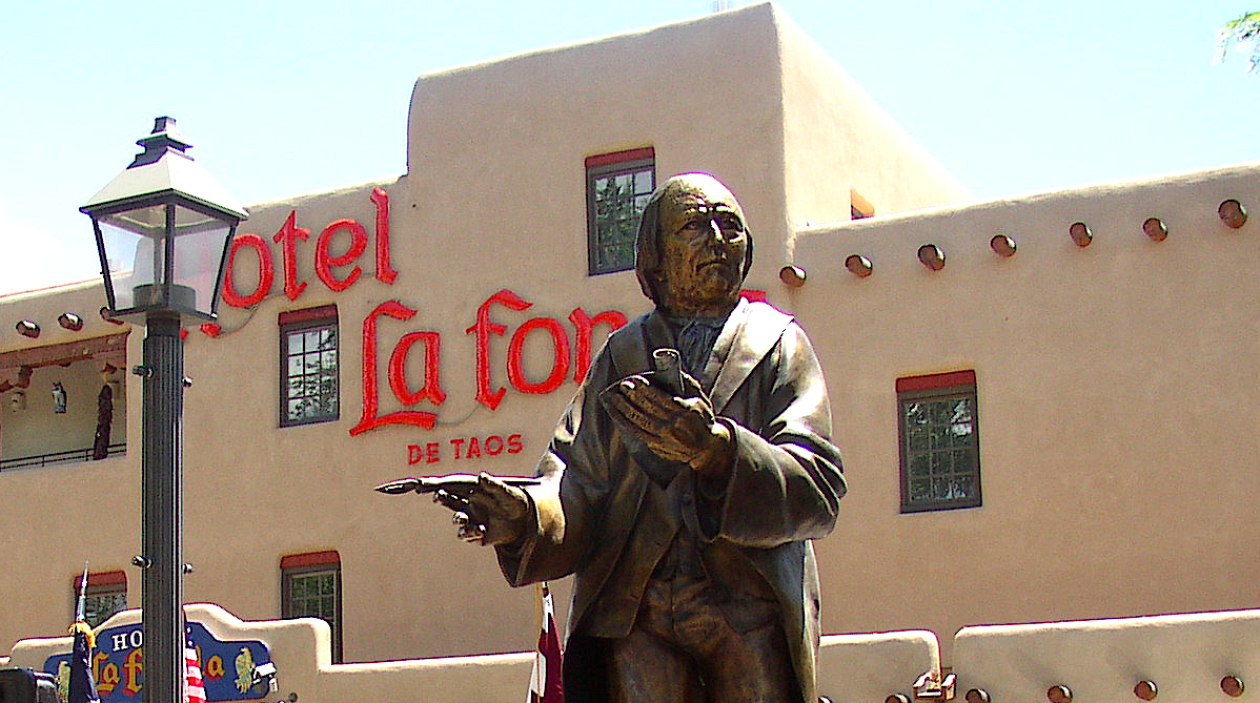
 The Story of a Chicano Jesuit Priest


The Story of a Chicano Jesuit Priest

MEMORIAS/AUTOBIOGRAPHY

MULTIPLE CONVERSIONS

by

Rev. Edmundo Rodriguez, SJ

Introduction – by Fr. Juan Romero – July 31, 2025

  On the feast of St. Ignatius Loyola, founder of the Society of Jesus, better known as the Jesuits, I slightly edited this Story of a Chicano Priest, autobiography of Fr. Edmundo Rodriguez, S.J.

Jesuit priest Fr. Tom Steele taught me much about the history of all-things New Mexican and was a great partner in my study and writings about the life and legacy of Padre Antonio José Martínez, Cura de Taos as featured in this blog The Taos Connection. However, the much greater Jesuit influence in my life has been Fr. Edmundo Rodriguez lovingly called Mundo. He was a major mentor for me in the early ‘70s when I was executive director of the PADRES organization—the national association of Chicano priests based in San Antonio. Father Rodriguez, SJ was one of the founders of the group and was well accomplished in many other fields. He finished his earthly course on October 28, 2017. May he remain active in heaven as intercessor for us to continue carrying out his vision for the Church and the world. I regret that his home photos of the autobiography did not translate to this rendition.

Foreword

This autobiographic sketch is intended mainly for the members of my own family. I call it “Multiple Conversions” because at every stage of my life, I have experienced large and small metanoias, namely changes of perspective and paradigm shifts in my thinking and understanding.  Such “conversions” have usually come through interaction with people, and I am and have been blessed to have interacted with significant people all my life, beginning with my parents, brothers, and sisters.  Then, of course, there are the Jesuits and other religious figures who have touched me and influenced me.  But the strongest impact on my mental, emotional, and spiritual formation has come from the many memorable people whom I have met along the way: from great intellectuals to trabajadores analfabetos, to those whose courage and wisdom have challenged me to try to be a better person.

I am most grateful to God, our Creator and Lord, for directing my life and putting all those wonderful, challenging, instructive, and caring people in it. I am grateful to everyone who has occasioned a metanoia in me.  I only pray that these pages may reflect that sense of gratitude.

Chapter One: Chicano Boy

I, Edmundo Rodriguez, Jr., a Jesuit priest, a member of the Society of Jesus, write these memoirs at the age of 73, an age when I can more readily remember events from 60 years ago than from yesterday.  I call myself a Chicano because the word was accepted without opprobrium or political implication in the barrio in El Paso where I was born and grew up.  Later, of course, the word “Chicano” became politicized, and it seemed to be a good way of expressing the acquired awareness of the situation of the Mexican American poor in the United States, so I accept it in that fashion as well.

I was born at home at a small two-room apartment: 109 ABC Alley in El Paso, TX.  The alley was between El Paso Street and Santa Fe Street, and between Overland Street and Paisano Drive.  My father, Sergio Edmundo, was born in Torreon, Coahuila Mexico.  His father’s name was Isaac Olivan Rodriguez, and he died when my father was only a year old.  His mother was Rebeca Campos, an elementary school teacher.  As far as I can tell, my [paternal] grandparents were Protestants, and my father was baptized into the Episcopal Church.  My grandmother Rebeca later remarried a Mr. Navarro, so we knew her as Rebecca Campos Navarro.  Mr. Navarro had several children who became my father’s half-brothers and sisters:  Estela, Raquel, Isidoro, and Carmen. Mr. Navarro died some years before I was born.   The family moved first to Juarez and then eventually to El Paso.  My grandmother Rebeca became a devout Baptist and a formidable anti-Catholic.

My uncle Isidoro Navarro better known as Lolo, served in WWII as a medical orderly for the Army Air Corps, picking up dead and wounded soldiers in the European theater of war.  The experience left him with deep PTSD (post traumatic stress disorder), although the condition was not yet named.  For the rest of his life, he suffered from depression.  He was a very talented athlete, could have been a pro quarterback.  In fact, it was sports–particularly basketball–that helped him survive.  His marriages didn’t.  Before he went off to war, he had married a Catholic at a Midnight Mass on Christmas Day at Sacred Heart Church in El Paso.  This kind of wedding will probably never happen again—ever! 

I have fond memories of my uncle Lolo because both before he went into the Armed Forces and after he returned, he always gave time to the little kids of the barrio: to teach them how to catch a football, and dribble and shoot a basketball.  I’ll never forget his first day back from the war.  We all went into the alley, and he threw us a few passes.  Then he dropkicked the football high over the electrical wires.  We kids– I was eleven years old–just stood there in awe.  Then we all started to yell, “Do it again!  Do it again!”   And he did it twice more.  The first dropkick had not been a fluke.

My first conversion was what I learned from Uncle Lolo:  be good to the kids in the neighborhood.  In fact, I used to dream of building a gym in the middle of the barrio so that all the kids could play somewhere besides the alley where we had to be on constant watch for cars.  First conversion:  from thinking mainly about myself and my own needs, to caring about the other children in our neighborhood.  It was a small but significant conversion that stayed with me for the rest of my life.

My father, Edmundo, Sr., as a boy, always

felt like an outsider in his own family.  From what he told me, his stepfather had little use for him, and so he spent a lot of time on the street, often helping the garrero, that is, the man who brought his horse and wagon into the neighborhood to pick up discarded clothing, rags, and anything else that might have a little value.  The old barrio was a place where venders came walking through every day selling their wares, sharpening knives, and scissors–offering to do repairs of stoves, watches, sewing machines and the like.  It was not unusual for a kid to run on ahead of the vender to announce his coming.  My father did that, so from very early on, he developed a good way of dealing with the public.  As an adult he made myriads of friends and became quite a good performer with both Mariachi and dance orchestras.  I never found out how he learned to play the guitar or how he learned to make orchestra arrangements, but he did, and became quite good at it all.  He was intelligent, well-read, hard working, and somewhat high strung.   That’s probably why he used alcohol to calm down, especially when he had worked at a clothing factory all day and then went off to play gigs at night.

(My mom, Naná. and my sister Elisa.)

My mother, Ignacia Escajeda, was born in San Elizario, TX, an old Spanish town that dates to the 1600’s. Her life was a hard-scrabble farm life.  She told me at one time that she resented the fact that her father, Jose, was not able to pull the family out of poverty.  She never explained why she felt that way.  Her mother was Romana Moreno.  As I remember her, grandma Romanita was a great cook, especially when it came to making a green chili and cheese concoction. She and I used to sit and enjoy with tears streaming down our cheeks because the chili was so hot.

I spent the summers between 1944 and 1949 with my Escajeda grandparents who lived in an adobe house about a mile from the center of San Elizario.  The house was surrounded by fields of cotton and alfalfa.  As it happened, I was able to do farm work during those years:  I hoed weeds, picked cotton, bailed alfalfa, and at two in the morning helped to open the compuertas (gates) to irrigate the cotton fields.  This was necessary because the water district assigned times for irrigation that had to be observed or the opportunity would be lost.  The Escajeda house had no electricity or running water.  Kerosene lamps supplied light; a pump in the kitchen supplied water.  But the pump in the kitchen supplied water with a slightly salty taste, so we had to take buckets and bring drinking water from another pump some 100 yards away that had sweet water.  It also happened that the sweet water pump was close to an acequia (ditch) that had a small snake pit.  My cousin Tavo (Gustavo Baltierra), who had been orphaned as a baby and whom my grandparents were raising as their own child, and I often brought our B-B guns over to shoot at the snakes.  Whether we ever killed any of them, I do not recall.

So, without radio or television, what could we do for entertainment at night?  It was not a problem.  Don Jose, my grandfather, would take us out into the star-lit skies and have us lie down on a blanket.  The stars were so bright they almost seem to be ready to fall upon us.  Then he would begin telling us stories.  The stories fired up our imaginations, so who needed the cool medium of TV while storytelling was so wonderfully exciting?  I have collected a couple of these stories from memory and attached them as an appendix to this piece.

During the regular school year back in El Paso, rumors of war were rife.  We heard that the Russians had an atomic bomb and that they were ready to launch it against the United States.  El Paso was supposed to be one of the top ten targets because of the presence of Fort Bliss.  At school we had atomic bomb drills, and this meant getting under our desks and protecting our heads with our arms.  We also learned that if an attack came while we were at home, we should cover ourselves with white sheets to ward off the radiation.  All of that seems preposterous now, but it caused us children to live in perpetual fear of annihilation.  I determined to hold off such a catastrophe by prayer.  So, every night I said three Hail Marys to beg Our Lady to fend off an atomic war.  I suppose I was not the only one making such prayers in the post WWII days.

During the summers, while I was out in the rancho with my grandparents, I had recurring dreams of El Paso being blown to bits by an atom bomb and my parents and siblings all getting killed.  In the morning, I had to get reassurance from my abuela that nothing like that had in reality happened.   This memory makes me think that those of my generation were victims of an atomic war, even though the hot war did not happen then. 

I was probably seven years old when I experienced my most profound experience of God.  I was by myself, just sitting and thinking, when this euphoric sense of peace and consolation came over me.  Later, I might have described it as an out-of-body experience, but at that time it was just what St. Ignatius Loyola called “consolation without previous cause.”  I didn’t have the words to describe the experience at that time, but I do remember feeling that somehow God was possessing me, and I had no doubt that it was God.  Even now, in my seventies, I remember the experience vividly and do not doubt that it was God who was present to me.  The experience only lasted a minute or so, although it seemed much longer.  I never told anyone about it, and there seemed no reason to do so.  I was not scared, nor did I feel that I was facing some mystery.  The experience seemed perfectly natural at the time.  Although the experience was never repeated quite the same way, there have been critical times in my life when the memory of it has come back and given me strength and perspective.

An experience that influenced my perspective later was my mother taking me to a migrant worker camp when I was about ten years old.  She accompanied another lady, and the two of them were bringing some food and clothing for the migrants.  I’ll never forget that getting into the migrant camp was like getting into a prison.  The camp was fenced in.  To get in, my mother and the lady, whose name I cannot recall, had to say to the guard at the entrance to the camp that they were related to someone in the camp.  I noticed then that there was a little store in the middle of the camp. 

The migrant camp experience was simply data stored away in my memory, until later in the ’50’s, when, at a social science class at Bowie High School in El Paso, we studied the closed system of Pullman, PA.  It seems that workers for the Pullman Company were pretty much trapped because their salaries were low and the prices at the company store were high, so most of the workers were in debt to the company, and therefore could not leave for other work in other places.

Just a couple of other items may be of interest from my childhood and adolescence.  I used to love to put on “plays” in the house and in the neighborhood.  In the neighborhood we usually strung a clothesline from one post to another in the area by the apartments at the corner of Santa Fe and Second Street, draped a sheet or blanket over it and that was our “theatrical curtain”.  Then we would make up a story to enact.  I used to go to the variedades (live skits at the movie theatres, usually before a movie) with my grandmother Rebeca, so it filled my head with visions of acting and directing and fame. 

I was probably nine years old when I decided we would have a play inside the apartment on Santa Fe Street.  Unfortunately, I tied a string to the chest of drawers on one side of the room and to the knob of my father’s guitar amplifier on the other.  Once everything was set, I pulled the curtain. The amplifier came crashing down on the floor, breaking several of the tubes in it.  (Nothing was transistorized in those days.)  My mother heard the crash and, in a panic, rushed in. As it happened, my father had a gig that very evening and would need the amplifier.  She grabbed me by the hand and took me right over to El Paso Street where all the shops were.  We went from shop to shop, any place that might have replacement tubes.  We found a few, but not all.  So, the amplifier was caput!  It was almost time for my dad to come home from work, and then I panicked.  I knew he could be really upset and would take his belt to me, so I ran outside to the telephone pole and climbed up on the roof of the apartments.   I just sat and waited.  Soon, my dad, my mother, my siblings, and sundry neighbors gathered below me urging me to come down before it got dark. They thought I might fall and hurt myself, but the more they urged, the more scared I became, and the more I refused to come down.  Finally, I said I would come down if they went and got my grandma Rebeca to come.  Someone went and got her, and so I came down under her protection.  I remember that whole incident as though it were yesterday.

Making real bombs: “Don’t try this at home.”

Some of my contemporaries from the old barrio will recognize the “toys” we played with as kids.  First, there were the stilts that one made with two tall slats of wood and with small blocks nailed to them.  You became seven feet tall.  Then there was the skate box, which was made by nailing two old skates on a board and then nailing a wooden box on top. Wheee! Off we went.

 Since we were close to Juarez, bullfighting was one of our favorite games.  One kid would be the bull with a piece of wood for horns, and the other the bullfighter with a towel for a cape.  We sometimes went out on the street and tried bullfighting the passing cars!  We terrified the drivers, who stopped and cursed us while we ran away.  Then there were the more dangerous toys:  the toy guns made from clothespins and rubber bands, which could shoot stick matches that lit the match as it was propelled toward the victim. Sometimes we ignited somebody’s shirt—never fatal, however.  As there no computer games, we had to play outside.  One of our games was to dig a small hole in a vacant lot, get some dry grass, build a smoldering fire, put a few sticks on top to cover the hole, take off our shoes, hide them, and wait for a kid with shoes to come stomp out the “fire”.  He, of course, would stomp right into the hole.  It was a miracle nobody ever broke a leg.

 But the most sensational toy of all was a kind of Molotov cocktail that I will now describe.  Do not try this at home. The movie theatres used a very volatile type of film in those days.  When the film broke, the operator would cut off a piece and splice the remainder together.  The pieces would end up in the trash can.  We, kids, would rummage in the theatre’s trashcans and rescue those pieces of film.  Then we would get a Coke bottle.  Now, on Overland Street, close to Santa Fe Street, there was a burned-out building that had had a basement.  It was perfect for bomb throwing.  We would stuff the film into the Coke bottle, light it with a match, and cap the bottle all in one motion, then drop it into the burnt-out basement.  The bottle would explode on the way down with a big bang.  How did we escape being injured?  We lay on our bellies on the pavement as we dropped the bottles so that we would be protected from the flying glass.  We also made sure no adults were in evidence so that we wouldn’t get punished.  Again, don’t try this at home!

Chapter Two: Becoming a Jesuit

As I entered my Senior Year at Bowie High

School, I began to plan my future.  My immediate plans were to get into the co-op program at New Mexico State University and study biochemistry.  The U.S. Government had scholarship funds for those who were willing to engage in the sciences.  I dreamed of earning a college degree, getting a good job, and marrying my sweetheart, to whom I was very attached. 

But it seems that God had other plans.   I began to think that I should be a priest.  Such thoughts had never crossed my mind before, so I figured this was a mistake and I tried to put such thoughts aside as temptations that should be rejected immediately.  But the thoughts would not go away.  I remember going to St. Ignatius Church one evening and pleading with God to take these thoughts away from me.  But God did not hear my prayer.  So, I gave in, and told my parish priest, Father Morales, that I was thinking about the priesthood.  He quickly took me to Bishop Sidney Metzger who told me, after a brief interview, that he would send me to the diocesan seminary in Santa Fe in the fall.  So, how did I end up with the Jesuits?

One Sunday afternoon, I emerged from the Plaza Movie Theater and bumped into Father Harold Rahm, S. J., with whom I was already well acquainted.  He said to me, “How would you like to meet our Father Provincial?”  “Who is that?” I asked.  “He’s our boss,” Rahm said.  “Why not?” I replied.  So that evening I appeared at the door of Sacred Heart Rectory.  “I have an appointment with Father Pro…something,” I told Father Bob Gafford, S. J. who answered the door.  He ushered me into Father Provincial’s room.  “I’m Father William Crandall,” he said, “Why do you want to become a Jesuit?”   “What is a Jesuit?” I asked.  What ensued was a long conversation, and a promise by Father Provincial that if I applied, I would be accepted into the Jesuit Novitiate. 

Now I was in a crisis.  I was accepted by the both the Bishop as well as by the Jesuit Provincial, and was not at all ready to give up my dream of getting a college education and marrying a girl whom I loved very much.  Accepting either invitation would mean the shattering of that dream.  So, I decided to apply to the Jesuits because by that time I had heard that the Jesuits had high standards for admitting candidates to the Novitiate.  I figured that if the Jesuits rejected my application, I could say to God, “Look, Lord, I did my best to become a priest, but I was not accepted.”  The Jesuits did not cooperate with my plan.  They sent a letter of acceptance and asked me to go to three interviews with Jesuits in El Paso.  I went to the interviews and shortly after I received a letter telling me when to come and what to bring to the Novitiate. 

Now I was in real trouble.  First, I had to tell my girl and she would not be at all happy.  Then I had to tell my father, Edmundo, Sr. He was not Catholic, but I had no idea how anti-clerical he was until I told him that I was going away to become a priest.  At first, he tried to convince me that I would be much happier married and earning money than trying to live the lonely, unproductive life of a priest.  During this time, he showed me unflattering photos of bishops and priests.  “You don’t want to be like them,” he told me.  Then he reminded me that I was his eldest son and that he expected me to provide an heir to the Rodriguez name.  This was especially important to him because he had been an only child himself.  I persisted in my plans to enter the Novitiate, so he simply stopped talking to me.  Only the very day that I was to board the train to Louisiana, when I went to say good-bye to him at his work, did he talk to me.  He came to say good-bye at the train station, but I knew he was not reconciled to my going.

On August 12th, 1953, after my graduation from High School, I took a train to New Orleans.  Father Harold Rahm, S. J., the young priest who had chosen to work with gangs in South El Paso, told me to visit Jesuit High School in New Orleans.  The Jesuits at the JHS had no idea who I was since Father Rahm had forgotten to call ahead.  Nevertheless, the Jesuits at JHS believed me when I told them I was on my way to Grand Coteau to enter as a Novice.  To keep me occupied, the Minister of the House gave me some streetcar tokens and suggested I take the Canal Street trolley and take in the downtown sights. 

My trip to downtown New Orleans was a real shocker.  The Canal Street trolleys had two places to mount them:  one at the front, where the conductor sat, and one in the back, where there was a place to put in a token or coins.  I chose to enter through the back.  I put my token in and sat down.  The streetcar went half a block and then came to a screeching stop right in the middle of the block.  The conductor screamed out, “What do you think you’re doing?”  I had no idea he was screaming at me, so I just continued to sit there quietly.  So, the conductor raised his voice even more, “What do you think you’re doing!?”  I still sat quietly.  So now the conductor came right to the back of the trolley and leaned into my face: “What are you doing here?”  “I’m going downtown,” I said, confused by his vehemence.  “This is the colored section.  You gotta move,” he said to me.  By now, the other passengers were very quiet and just watching to see what would happen.  I got up and moved to the front, and everyone breathed a sigh of relief.   I had just experienced racism at its rawest, and it would not be the last time during my years of sojourn through the Southern United States.

The Jesuit Novitiate was pretty much as it had been for some generations.  Romanita Escajeda, my maternal grandmother, died while I was making the Long Retreat based on the Spiritual Exercises of St. Ignatius Loyola.  The fact had a profound impact on me because she had been like a second mother to me.  In those days we could not go home for such happenings.  I simply wrote a poem in her honor and wrote about her in my spiritual journal.  The Spiritual Exercises experience helped me get close to Jesus in his life, passion, and death.  Because of my grandpa Don Jose’s Manita Zorra and Manito Coyote stories under the stars, my imagination quickly became engaged in contemplations based on the Gospels.  The imaginative contemplations on the life of Jesus are the most powerful, most impact-producing forms of prayer of the Exercises.  In retrospect, it seems to me that experience gave me the confidence to pronounce my First Vows of Poverty, Chastity, and Obedience on August 15, 1955.

Before we go to August 16, 1955, I should say something about the men I encountered in the Novitiate.  Some men came all the way from Tampa, FL., just as I had come from El Paso, TX.  There were men from Dallas, from New Orleans, from Mobile, AL., and from Macon, GA.  Most were 17 or 18 years old, but we did have some veterans who were a bit older.  Frank Renfroe from Dallas had already been drafted into the Navy, so he had to leave the Novitiate to fulfill his term of duty.  He returned to the Novitiate two years later and eventually got ordained as a Jesuit priest, did work as a missionary in Paraguay and as of this writing, is working in El Paso as a jail chaplain. 

Most of the new novices were good students and some were outstanding athletes.  As time went on, about half of the original group of 32, decided to go back to “civilian” life.

Chapter Three: The Jesuit Scholastic

After vows, we became Jesuit Scholastics, which meant that we moved across the center of the house from the East Wing to the West Wing.  But that short journey was like one of a thousand miles.  In the Juniorate, as the West Wing was called, we received a fabulous liberal arts education in English and World Literature, in Mathematics, and in Spanish, Latin, and Greek.  Our professors were outstanding, especially C. J. McNaspy, S.J., who was a recognized author and lecturer.  Those two years prepared me well for both the study of philosophy and for graduate school.

In August 1957, our class moved to study at the Philosophate of Spring Hill College at Mobile, AL.  This was the first time in four years that we found ourselves on a co-ed college campus.  It took an adjustment to go from an all-male environment to a mixed one.  Several of us had to work through emotional crises, including myself, for the old dream– earning a college degree, finding a good job, and having a family– had not died altogether.  Nevertheless, I adjusted and was able to do well in both the study of philosophy and the other subjects.  At Spring Hill College, I earned a Batchelor of Arts and a Master of Arts degree.  My master’s thesis was on a difficult but fascinating philosopher-theologian named Bernard Lonergan, S. J.   He was newly come upon the philosophical scene with a book called Insight: A Study of Human Understanding.  Reading that book, studying it, and writing about it were some of the most intellectually fulfilling experiences of my life.  I have continued to use his ideas and methods throughout my ministry; I (and others) have developed leadership courses based on Insight.

Most of us had some sort of ministry outside the academic walls.  I chose to team up with two of my classmates and help at a recreation center in the African American section of Mobile.  We organized games and tournaments, coached the kids, and went around to various high schools begging footballs, baseballs, bats, helmets, and whatever else we could get.  Of course, what we got were hand-me-downs, but to us that equipment was precious. 

There is one poignant moment that sticks out in my memory from that time.  One of the young men, a senior in High School, dropped out of High School in February with only three months to go before graduation.  “Why?” I asked him, “What is so hard about finishing?  You’re doing well. Why not graduate?”  James replied with a question: “Do you know my father?”  “Yes,” I said.  “What does he do?” James asked.  “He’s a custodian at the College,” I said.  “Do you know he went to two years of college?” James said, “and if he can only be a custodian after finishing high school and having two years of college, what’s going to be different for me if I finish high school?”  I was stunned.  In 1959, I had no answer to his question.  James felt overwhelmed by the specter of racism in the South and saw no way beyond the limitations it imposed on him and on young men like him.  Talk about conversion, there is no more eye-opening experience than to see reality through the eyes of those who experience racism in its most raw form.

Later that year, we had a lecture by John Howard Griffin who wrote the book Black Like Me.  He was a white man who changed his skin pigmentation to look like an African American and then went to New Orleans to live as an African American.  He spoke how former friends just could not see him because whenever they encountered him, they would simply look past him as though he weren’t even there.  In the book, he describes how he was treated by Whites: always as an inferior, always looked down upon.  Reading his book and listening to him had a profound influence on me and on my Jesuit classmates.  We started listening to the sermons of Martin Luther King, Jr., by short-wave radio on Sundays.  I believe that our superiors, who were men who had grown up in the segregated South, became a bit frightened of the new attitudes we Scholastics were acquiring.  After all, we were going to have to work in a South that would still be segregated.

Chapter Four: Teaching as A Scholastic

These events prepared me well for what I was going to be asked to do during my years of Regency, the term that Jesuits use for the formation period during which Scholastics teach in one of our high schools.  In 1960, I was assigned to teach at Jesuit High School in Tampa, FL.  It was a very comfortable assignment.  The student body was made up of Anglos and Cuban Hispanics.  They all got along relatively well.  There seemed to be no racial or ethnic issues at the school.  The school had a par-three golf course immediately adjacent to it, and I got to hone my short game twice or thrice a week.  As an extracurricular, I was assigned to the drama club.  That meant preparing the boys to perform plays in public.  I had done a bit of drama while at Spring Hill College, but now I had to learn a lot more about doing sophisticated drama, like Twelve Angry Men.  The Juniors and Seniors performed that play very well, but it ran for only two nights. I also had Freshmen and Sophomores in the Club, so for them I wrote a short play, a comedy based on the story of The Littlest Angel.  With costumes made from sheets and pillowcases, the play was such a success that we were invited to perform it at other schools.  It was so good because there were a couple of impish boys who delivered their lines with great timing and expression.   I ended the school year on a high, expecting to return to Tampa to continue along the same lines.  But it was not to be.

During the summers, it was the custom to have Regents (teaching Scholastics) go to Spring Hill College to continue studying.  So, I took the train from Tampa to Mobile and arrived at Spring Hill College and began to settle in.  But the superior came over and said to me: “Don’t unpack, you have another assignment.  I’ll be back in an hour and tell you what you are to do.”  So, I repacked my clothing and waited.  He came back in an hour and said, “Here’s a train ticket.  You are assigned to teach summer school in New Orleans, and you need to get there tonight because you start teaching in the morning.”  “Teaching what?” I asked.  “I don’t know.  They’ll tell you when you get there,” he replied.  That was typical of the way Jesuits were supposed to be ready to teach anything at all on short notice.  Happily, this viewpoint and practice has changed considerably since those days.

It turned out not to be too bad.  I was asked to teach Spanish to boys who had failed it during the year at Jesuit High School in New Orleans.  Since I’d taught Spanish in Tampa, it was not a problem.  So, the summer passed, and I spend my free time choosing and blocking a couple of plays for when I got back to Tampa.  Finally, the end of summer came, and I went to the Treasurer of the School and asked for money to purchase a train ticket to return to Tampa.  “Oh,” he said, “you’re not going back to Tampa.  You’re staying here.  You’d better talk to the principal.”  So, I went in search of the principal, a much-respected Jesuit, who had a reputation of getting only the Scholastics he wanted for his School and no others. I asked him what I was supposed to do in the school year about to begin.  “You will teach English, Spanish, Speech, and Latin to one of the Sophomore classes,” he said.  “By the way,” he continued, “They are the slowest class but have the best athletes.”  “What about extra-curriculars?” I asked, “Will I be in charge of the drama club?”  “No,” he said, “you’ll be coaching football and basketball to the Eighth Graders and the Freshmen and running the intramural sports.”  I was stunned.  I had played football and basketball in high school but had little idea about coaching these sports, so I quickly went to the public library and started reading about coaching.  Boy, was I having to make some quick adjustments!

I started teaching and coaching, and thus I thought I was on my way.  But then the principal called me in and said, “We’re integrating next year.  We have four boys from St. Augustine High School who will be attending here next year.  Two will be in your class, and two will be in the class you now have that will be moving up a grade.  I want you to prepare them.  This is a big change for all of us.”  The whole purpose of my being at Jesuit High School in New Orleans suddenly took a new and challenging turn.  I immediately thought of my experiences in Mobile and realized that that was God’s way of preparing me for this task. 

So, my double task with my class, made up of White boys who had inferiority complexes since they were placed in the “slowest” class, was to build up their sense of self on the one hand, and on the other to break down the prejudices which those same boys bring from their family and social environment.  To build up their self-image, I insisted that they read as many books as the top class.  There were howls of protest that they were not equipped to read that much.  But in their heart of hearts, they knew they would be proud to say, “We read the same number of books as the top class.”  And so it happened.  Another tactic of mine was to have the boys dress up in suits and go together to see college productions of plays.  Antigone was one of those plays.  Nobody else in the whole school had gone to see Antigone, but these boys not only saw it on stage but could “talk about it intelligently (since we had studied it both before and after the stage play).  I could see their self-confidence growing.

Dealing with the prejudices that came from family traditions in New Orleans was a much more difficult task.  I decided to take an academic approach.  So, I looked up everything I could on race relations and made copies of certain essays that we read together and discussed during English Class.  The discussions were good, but I just couldn’t see whether their attitudes were changing or not.  That would not show up until the next year when there would be two African American students in their junior class. 

The following year, I had a new sophomore class with two African American boys in it.  The year started normally.  As far as I could see, the African American boys were simply accepted as fellow students.  No big deal.  I could see that the African American boys were a bit nervous, but nothing said to me that they were being harassed in any way.  Then it happened.  Items began to disappear from their lockers in the gym.  Notes were passed to them that were insulting and degrading.  It became obvious to me that someone was trying to make life miserable enough for them that they would decide to leave the school.  But who was doing all this?  I did not want to guess and accuse anyone falsely, but I kept close watch.  Finally, one of the White boys quietly told me who the culprit was.  Why did he tell me?  Because he knew we had started the year well, but now it was becoming ugly.  One day, in fact, at lunch hour, I saw one of the African American boys dialing on the public phone.  Because he seemed agitated and angry, I came up to him and asked what he was doing.  “I’m calling my friends from St. Aug,” he said, “they’ll come over and we’ll give these White boys what for!”  I could picture us having a race riot on campus.  “Don’t,” I said, “I can assure you this harassment will end shortly.”  He put the phone down, and I sighed a sigh of relief.

So, I was faced with a dilemma.  How could I deal with the culprit without direct evidence?  I talked to the school president and asked him if I could threaten the culprit with expulsion.  “No, you may not,” he told me.  But I was afraid that the harassment would not stop if I did nothing.  So, I decided to take the bull by the horns and use the threat anyway.  I pulled the culprit aside and said to him, “I know you are the one causing all this trouble.  If it continues, you will be expelled from this school.”  I held my breath.  The harassment stopped.  Things got back to normal.

Later, I found out that the culprit was being egged on by people on the White Citizens Council, an organization that vehemently opposed any kind of integration.  While the harassment stopped, I started getting some very ugly phone calls at night.  But that was a small price to pay for relative peace and successful integration at the school.

One other interesting thing that happened to me during my stay in New Orleans was that I was invited to sit at night with Ambassador Raymond Telles’ daughter.  Raymond Telles had been mayor of El Paso before President John F. Kennedy made him ambassador to Costa Rica.  Sadly, his daughter, who only ten years old in 1961, caught encephalitis-a sleeping sickness-and she was brought to Ochsner Medical Center for treatment.  The girl’s mother stayed with her most of the time, but I relieved her for a couple of hours at night.  Every night a big limousine from the United Fruit Company would pull up to the school and would take me to the hospital where I would sit with Cynthia for two hours while her mother rested.  Cynthia and I became good friends but when she left New Orleans, I never saw her again.  Many years later, I learned that Cynthia Telles had become a physician, a pediatrician.  I thought it was a marvelous thing to learn.

Chapter Five: The Jesuit in Theology

After my Regency and some summers at Texas Western College and the University of Texas in Austin, I was sent to St. Mary’s, Kansas to study theology.  That was 1963 just as the Second Vatican Council was beginning.  The first few months were very hard.  St. Mary’s, KS, was a small town in 1963, population less than two thousand people: a public and a Catholic elementary school and a public high school.  We were out in the country and all that activity of the Regency years suddenly came to a halt.  It was difficult to sleep at night because of the noise of the crickets singing their song.  Then of course it meant going back to class, doing papers, and reading assigned books.  Sounds kinda’ boring, ¿no?  It was.

But boring didn’t last too long.  There were some rural parishes that “employed” some of us to go teach in their CCD classes.  I chose to teach second graders.  From them, I learned something very important about teaching.  I would explain something about God—Father Creator, Son Redeemer, Holy Spirit Sanctifier at one class.  Then the next class I would say, “Children, can anyone tell me about what we learned about God last week?”  Several hands shot up.  “Kerry, tell me.”  “My cat had kittens last night,” Kerry said.  All the kids wanted to know how many, what colors, and had he named them yet?  What I learned was that I first needed to listen to the children’s experiences before they were ready to listen to me.

A few years later, I would remember that lesson when my sister Elisa, a Loretto nun, sent me some mimeographed pages of Paulo Freire’s educational methodology.  Freire’s method of alfabetizacion always began with listening to the stories of the campesinos.   Then Freire used those stories and concerns as the basis to teach reading, spelling, and the use the written word.  I later taught the method to some students at the University of Texas in Austin who went out and worked among migrant farm workers.  The students came back very excited about the success of the methodology. 

Theology, of course, is a serious academic endeavor.  It means attending many classes, reading many books, writing many papers, and attending a fair number of seminars.  There is no doubt that learning about the nature of Christ, the Church, and God from top-ranked world theologians is an exciting enterprise.   I loved the study of theology.  Besides the catechetical classes, I also tutored students at the local Catholic grade school.  I, along with others, also formed the public high school students into a choir that performed for their parents and other townspeople.

We Jesuits organized a musical performing group among ourselves.  We had a fellow who played the piano and the bass, and two others played guitar.  Another mainly sang because he had a trained voice, and I played the banjo and did comic songs.  We sang at various school assemblies, at restaurants, at BYOB lounges, and at conventions.  We were creative enough to be able to write comic songs to fit a particular group.  We were good, and our audiences enjoyed our performances.

Another activity in which we engaged was preparing the performing plays, such as Christopher Fry’s Thor with Angels and The Fantastics.  I helped with props in Thor but had an unexpectedly good role as “the dying Indian” in The Fantastics.  We performed it several times in different places and got good reviews even from newspaper critics in Kansas City.  The main reason for our success was the ingenious direction of Joseph Vanderholt, S. J.  He was in the class two years behind mine.  The photo here shows my partner, the late Father Don Driscoll, S. J., in his role as the washed-out Shakespearean actor.

Another activity, in which others and I participated, was a campaign to protest the Kansas housing laws.  In other words, Kansas was quite segregated by housing patterns, and many of us Jesuits and other activists pushed to have the laws changed so that those neighborhoods that had excluded African Americans and other minorities could be integrated.  It was during this activity that I learned about “red lining” of neighborhoods by banks and the use of fear tactics by realtors, which caused Whites to abandon houses, and then they sold at low prices to the realtors.  Then the realtors would turn a big profit by selling the same houses to African Americans and other minorities as they moved into that neighborhood. 

Chapter Six:  The Year in El Paso

(I bless Naná, the matriarch of the Rodriguez family.)

My first assignment as a Jesuit priest in 1967 was at Our Lady’s Youth Center that was under the direction of Father Richard Thomas, S. J.  I had no idea what an adventure that was going to turn into.  The old Knights of Columbus building, which had been taken over by Father Harold Rahm, S.J., a few years earlier, still had a lot of trash that had to be cleaned up.  One of my tasks was to throw out the trash.  I was taking out trash late one evening when a well-dressed young man came up to me. He said, “Father, you’ve got to help me.  I’m a heroin addict.”  This was 1967 and El Paso did not have a methadone program.  “Call the police,” he said, “I’ll go to jail and do cold turkey.”  So, I called the police.  They came and said, “We can’t take him in.  He’s not in the act of committing a crime.”  The young man walked away very sad, and I felt helpless and discouraged.  I knew there would be many more such encounters in my priestly life.

But discouragement did not set in because I started working with the alumni from Bowie High School.  Father Thomas and I learned that several graduates wanted to attend college but did not know how to proceed or whether they could deal with college-level courses.  So, I put out the word to Jesuit Scholastics around the country and told them that I wanted to start a college prep program for these graduates to give them a taste of college classes before they decided to enroll in college.  The scholastics who came taught classes in English, math, and history.  These were 101 courses.  A couple of us worked as tutors.  Besides the classes, we arranged to visit the UTEP campus and introduced the students to the financial aid people at the University. 

Because we canvassed the neighborhood door to door, we were able to get 40 graduates, young men and women who had graduated from Bowie within the past 5 years.  Seventy percent of our students enrolled at UTEP for the fall semester.  Unfortunately, I was reassigned from El Paso to San Antonio for the following year, so I had no way to track those who enrolled to see whether they went beyond one year or one semester.  I often wish I could have expanded that program into two or three more years.

There were a couple of other programs that we developed for the Bowie students during my year in El Paso.  One was a Coffee House which allowed the students to come in and spend time visiting with each other, but also gave those who wished a chance to perform with poetry or song or humor. My brother Billy, pictured here, joined with two of the girls to perform folk songs as part of the entertainment.   The Coffee House became quite popular with the Bowie students.

A traveling choir of students was a by-product of the Coffee House. The traveling choir performed at nursing homes and hospitals and sang contemporary popular songs.  Because the songs were accompanied by humor and short personal visits to aging folks in nursing homes, we began to be invited to different places to perform. 

Another program was called The Insight Retreat.  Father Richard Thomas and I took 20 or so students on an overnight program of fun, prayer, and reflection at the Juan Diego Camp just outside of El Paso.  The program had a powerful impact on the students because it helped them reflect on their values and share their dreams.   It also had a powerful impact on me.  Especially the night that Rosie, a Senior at Bowie, who lived in “Chihuahuita,” the poorest neighborhood in El Paso, started crying in the middle of a discussion about God.  We all stopped and asked her, “Rosie, what is wrong?”  She said, “If God loves us so much, why are we so poor?”   I just swallowed hard and kept silent, and joined in her tears, as did the rest of the students.

Later that same night, when we returned to Our Lady’s Youth Center, I went to pitch some trash in the dumpster and heard some cries from within the dumpster.  I looked inside and found three street children from Juarez sleeping there.  Then, much to my sadness, I discovered that a number of those street children were sleeping on our two-story Sacred Heart rectory roof that was flat and could be easily climbed by pipes along the side of the building.   The next few days, I rounded up as many of these children as I could and took them over to an orphanage in Juarez, but they wouldn’t stay.  I allowed a few of them to sleep in my station wagon, but there seemed to be no solution.  Father Richard Thomas, S. J., who ran Our Lady’s Youth Center, announced to the children that they were welcome to come to the Center every afternoon at four o’clock, and that they would take showers and eat a meal of oatmeal and beans with something to drink.  We began with about a dozen children, but the number swelled to over eighty in just a couple of weeks.   It hurt me deeply that there was nothing more we could do for these street children, most of whom had been thrown out of their homes by their parents and told not to return unless they brought money.  Although these children became thieves by necessity, they never stole a single item from the Youth Center.

All during my time in El Paso, I walked the streets of the Second Ward and visited people in the tenements and said Masses there.  In the summer of 1968, I wrote an article called “Mexican Americans, the Invisible Minority” and sent it along with several graphic photographs of the poverty situation to the Ave Maria Magazine published out of Notre Dame University.  I never expected it to be published, much less to be the cover article in that national magazine.  I suppose I stepped on a few Catholic toes because I was summoned to the Chancery to explain why I had put the Catholic Church in a bad light in the article.  It appears that I gave too much credit to the work being done by the Protestant Churches in the Second Ward (a language School by the Lutherans, a health clinic by the Methodists, and food distribution by the Salvation Army).  When Father Bob Gafford, S. J., who was then pastor of Sacred Heart Church learned that I had been summoned to explain myself, he came as my defender.  At the Chancery Office, we were ushered into a boardroom.  Several of the priests sat behind tables while Bob and I sat in chairs facing them.  The Bishop (Sydney Metzger) was not present.  One of the priests said, “Don’t you think it was unfair of you to give so much credit to the Protestants and hardly mention what the Catholic Church is doing in the Second Ward?”  I replied that I thought I had pointed out the presence and work of Our Lady’s Youth Center and the work done by both Sacred Heart Church and St. Ignatius Church, which were the two Catholic Churches in that part of town.  At that point Father Gafford jumped in and questioned the questioners: “You promised to open a hospitality house five years ago.  Nothing yet, what happened?”  And he mentioned several other things promised and not fulfilled.  Then the presider said, “Let’s table this for discussion at a later time,” and we were dismissed.  But in those days, no reasons were given for decisions by bishops and superiors affecting us priests.  I was reassigned from El Paso to San Antonio.  Many years later, one of the diocesan priests told me that in fact I had been blackballed from the El Paso Diocese.

Chapter Seven: The San Antonio Years, March against Brutality

So, I arrived in San Antonio having had a shocking lesson on ecclesiastical politics and the dangers of taking the side of poor people even in the Church. 

Talk about ecclesiastical politics, my second day in San Antonio, Father Harry Martin, S. J., the pastor at Our Lady of Guadalupe Church, took me to a meeting of the San Antonio Priests’ Association.  There was only one item on the agenda: to call for Archbishop (Robert E.) Lucey’s resignation! (October 1968) This was a total surprise to me, but most of the priests present felt that the Archbishop had become dictatorial and arbitrary in dealing with the priests and should be asked to resign by the Pope.  A letter to the Pope was prepared and was signed by Father Martin and by many other priests present.  I refused to sign simply because I had not been present for the previous meetings at which all these things had been discussed.  But what a shocker, priests asking for the Archbishop’s resignation! In all my experience as a religious, I never expected to witness such a thing.  Eventually, the Holy Father did send a bishop from another diocese to investigate, and the outcome was the resignation of Archbishop Lucey.

Our Lady of Guadalupe Parish in San Antonio was in a state of utter collapse.  I was named minister-treasurer of the parish, and that meant that I was to pay the bills.  The parish was deep in debt both with the Archdiocese and even with the suppliers of the basics:  utilities, milk for the school children, paper, and other supplies. In the first few months, I spent more time dealing with bill collectors than with parishioners.  It took a lot of begging and negotiating over a four-year period before the parish got out of debt.

My first three funerals were vendetta murders.  People who lived next door to each other got into a fight and a young man was killed.  The next thing, one of the young men from the other family was killed as well.  Then back to the first family, another man was killed and another funeral.  The feud between those families finally stopped because one family managed to burn down the house of the other family.  For me it was depressing and discouraging.  There were days when it seemed like the problems were just too overwhelming and I wondered whether I was up to the task.  But the Lord wanted me to be there and gave me the grace to hold on during those first few months.  Much to my surprise, I was appointed administrator within a year, then pastor a year later.

This picture is a scene from a protest play enacted by a Chicano Drama company that I helped to sponsor. Some exciting things began to happen.  I got a call from Attorney Ruben Sandoval, who asked if some Hispanic leaders could have a meeting in our parish hall.  The issue to be talked about was that of police brutality.  I thought it was a good way of getting in the know about what was happening out in the community, so I agreed.  The meeting included attorneys, labor leaders, clergy, college students, Brown Berets, and many others.  The attorneys reported that in the past ten months, ten Mexican American young men had been shot, many in the back, by police, and that there was a pattern of beatings of several others.  The West and Southside communities were seething with anger, and there was a danger that without some safety valve, San Antonio could experience the kinds of riots that had plagued other major cities around the United States.   It was around that time that the Wall Street Journal had an article stating that San Antonio was ripe for a major upheaval. 

The result of that meeting was a very carefully planned “March Against Police Brutality” that was to start at Our Lady of the Lake University and end downtown at the Alamo.  The attorneys worked to get all the requisite permissions to have the march go on the most direct route from the University to the Alamo.  Meantime, some of us, including myself, went and visited with the police chief to identify for him the police officers that we asked to be taken off the street because of their tactics and reputations.   The police chief knew well what was happening, but he had to keep up the morale of the whole department. It was not easy for him to act without feeling pressure from the community, and he told us as much.  It was then that the chief gave me his private number so that I could call him at any time that I felt he should know what was happening in the community.

The March, started with some 1200 participants, who included college students, Catholic and Protestant clergy, community activists, and members of families of the victims of the “police brutality” as well as many other individuals and groups.  The March started off peacefully and orderly enough, but there was a moment when I thought we were about to witness a disaster.  Father James “Hooty” McCown, S. J., and I were toward the front of the March.  As it happened the most direct route for the March made it pass right on the side of the County Jail.  As we came in view of the jail, two officers were roughing up a young Mexican American in plain view of everyone.  As the marchers saw this, they surged toward the chain link fence and toward the police.  Almost without thinking, Father Hooty and I put our backs to the fence and started pushing the surging crowd forward and the momentum of the marchers carried them forward away from the fence.  We don’t know what might have happened if the marchers had torn down the fence and tried to attack the police.  After that very dangerous moment, the March continued in an orderly manner.

The March had its desired effect.  Several officers were taken off street duty and placed on desk duty.  Tensions in the community lessened and the activists went on to other issues.

Chapter Eight: The San Antonio Years, The Formation of P.A.D.R.E.S. and MACC

 Early in my time in San Antonio, Father Ralph Ruiz, a diocesan priest–in charge of the Archdiocesan Inner-City Apostolate located in a house within Guadalupe Parish–called to invite me to come to a meeting with a few other priests, all working in the poverty-stricken Westside of San Antonio.  All of us were quite alarmed at the tremendous poverty, unemployment, malnutrition, illness, and misery among Mexican Americans in that part of the City.  The focus was to ask ourselves: What could we as priests do about such a situation?   Is it enough simply to provide Mass and Sacraments to the people in such dire straits?  One of our predecessors, Father Carmelo Tranchese, S. J., who became pastor of Guadalupe Parish during the great Depression of the 1930’s, had single-handedly fought to bring government money to provide safe and sanitary housing where before there had been nothing but hovels.  But by the 1970’s, times had changed; one priest probably would be able to do very little to change conditions.  So, the group decided to form itself into a working group to discuss and plan how to expose what had long been hidden to the eyes of the wider public, namely, the miserable conditions of the people of the Westside. 

The group called itself P.A.D.R.E.S. (Padres Asociados para Derechos Religiosos Educationales y Sociales).  Somehow word got out that some priests in San Antonio had formed a group to fight for poor people’s rights, so that at our next meeting, priests from Denver and Houston attended. (1969) That expanded group decided that it might be worthwhile to call a national meeting of priests working in similar circumstances, those who were ministering to the Hispanic poor.  For the sake of organization, Father Ruiz was elected president, and I was elected vice president.   We, the PADRES, traveled to Washington, D. C., to pressure the American Catholic Bishops to provide at least one bishop from our Hispanic heritage for the Church.  The result was the appointment of Bishop Patricio Fernandez Flores. (He was ordained as Auxiliary Bishop of San Antonio on Cinco de Mayo 1970, and is pictured here.)

In the early days, one of my tasks was to travel to New Mexico to recruit priests to become members of P.A.D.R.E.S.  The priests in New Mexico were a tough bunch to recruit, since they did not, did not like to call themselves either Mexican American or Chicanos, but only Hispanic or Españoles. Interestingly, the New Mexican priests eventually became the most loyal and fiercest members of P.A.D.R.E.S.

I also went to Coachella Valley, California, to participate in the migrant workers’ strike against the grape growers.  That’s where I met Cesar Chavez, the great organizer who led a successful boycott that earned the migrant farm workers the right to organize and to bargain for better wages and working conditions.

Articles and books have been written on the whole history of P.A.D.R.E.S., so it is not my intention to develop this part of the story any further.  You will find a bit more about P.A.D.R.E.S. in Appendix Four.

MACC (The Mexican American Cultural Center). A member of PADRES, Father Virgilio Elizondo, pushed the idea of starting an institute to do research on Hispanic ministry, provide language skills for those who would be working among Hispanics or in Latin America, and to help grassroots people develop leadership skills.  It was my task to develop the leadership development program.  I became part of a mobile team that traveled around the country conducting workshops in various communities.  The workshops were successful in getting people politically involved in their towns, Hispanics, mostly Mexican Americans but also Puerto Ricans and Dominicans, who had never had any political power at all. 

Another time, wearing a coat and tie, I came into another small town and parked behind a small federal building that was across the street from the City Hall.  I walked through the federal building and out the front door and across the street to the City Hall.  I went to the receptionist and said, “Miss, I’m here to find out what the City has done with the federal HUD grant which it got last year.”  She immediately got up and went and got a lady who came out and asked me why I wanted to see the books.  Notice, I had not asked to see the books.  “I am making a study of how that money was spent,” I said.  So, the second lady went to the back and out came back with a gentleman carrying a ledger.  He opened the ledger and showed me where there was a single entry made out to the water company.  I said, “Wasn’t this grant supposed to be to provide housing for the poor?” I asked.  “Well, we felt that improving our water system would help the poor and everyone else,” he explained.  I didn’t say anything else.  I just closed the ledger and walked out and crossed the street back into the federal building.  As I went in, I looked back across the street and saw six or seven people looking at me out the windows of the City Hall.  My thought as I got into my car was, “I better be careful.  I could get shot.”

Chapter Nine: The San Antonio Years, Beginning of C.O.P.S.

(I pose here with Mayor Lila Cockrell and Councilman Henry Cisneros of San Antonio.)

C.O.P.S. (Communities Organized for Public Service).   Ernie Cortes was a brilliant young man who had graduated from Texas A. and M. and took a job with the Mexican American Unity Council (MAUC) as an economic development specialist.  In the early ‘70’s, Ernie saw the same poverty and miserable conditions in Westside San Antonio that I was seeing.  Ernie decided that economic development was going to take forever, so he decided to go up to Chicago to get training with the Industrial Areas Foundation (IAF) in community organizing.  The IAF assigned him to do organizing in East Chicago, IL, but Ernie wanted to organize in San Antonio.  So, one night I got a call from Ernie at Guadalupe.  He wanted to meet with me.   So, we met, and he explained the process of community organizing to me.  I’d heard several young activists explain their versions of organizing the community to me and this was the first time I felt that here was someone who really knew what he was talking about.  He asked me to take the role of Chairman of the Organizing Committee and I accepted. 

It became my task to put together an ecumenical committee of Church people and others who could help us get funding to hire an organizer full-time and set up an office for him.  So, I contacted my friends in the Episcopal Church, the Lutheran Church, and the Methodist Church.  Ernie already had a connection with the Church of Christ that was providing some funding for him.  Eventually, our committee managed to put $30,000 together by making sure that each bishop and judicatory leader understood that they were putting money along with other church leaders.  It also helped that the IAF had some successes in places like Chicago and Rochester, NY.  Eventually, we managed to get a nice grant from the Bishops’ Campaign for Human Development. 

It was said that one of the Churches had invested $100,000 into an organizing effort in San Antonio that went nowhere because the “organizers” had tried to work with men and women in bars.  Nothing ever came of that.  Our organization took a completely different approach.   We targeted citizens who owned property, had good jobs, and especially were concerned about their children.  Ernie interviewed about 1,000 people before we pulled together small meetings and then a large meeting where the agenda was put together from the issues that the people had brought up in their interviews.  At first, the group wanted to name itself The Committee for Mexican American Affairs, or something like that, but the idea of naming itself C.O.P.S., Communities Organized for Public Service, won out because the correlative of C.O.P.S. is ROBBERS, referring to the people who were milking the Westside dry.

C.O.P.S. has become one of the most successful community organizations in the nation.  Why did it succeed at the beginning?  The weather helped.  San Antonio gets torrential rains that caused flooding in the Southside, and the City Government was doing nothing about it.  Many houses on the Southside would have water coming into their homes, and carpeting or tiles would have to ripped out at the owner’s expense.  The City had passed more than one bond issue to relieve the flooding on the Southside, but nothing had ever been done.  Why?  Because the City Council, that had been taken over by developers, had loaned bond money to developers to provide the infrastructure for housing developments on the Northside—the much more    The arrangement was legal because the bond money was provided as “a loan” to be paid back at some unspecified future time.  C.O.P.S. brought this arrangement to light. When it became known through newspaper reports what was happening, the Southside residents became a hornet’s nest.  

The C.O.P.S. organizers who had been canvassing and interviewing homeowners in the West and South sides convinced many of them that they would not be able to do much individually.  However, together in a well-organized manner, they could bring around the City Council, the City manager, and the Mayor to do the right thing.  C.O.P.S. provided excellent training so that ordinary people who had no experience in public speaking could address officials with both cogent arguments and passion. 

Because of the excellent organizational skills of Ernie Cortes, the ecumenical support of the Churches, and the circumstances created by the weather and the neglect of the City Council, C.O.P.S. became a formidable organization from beginning.  I became one of the clergy leaders and eventually served on the Mayor’s Charter Revision Committee that changed the way the City Council was elected.  From elections at large that favored big money candidates like the developers, the City went to elections by districts, so that every part of the City–wealthy or poor–had a voice in making policy decisions.  It was a radical change for a city that had been governed for decades by a small group of powerful citizens. 

The effect on the people of the Westside and the Southside and the near Eastside was that they began to form a new image of themselves, an image of having a voice where before they had none, an image of being doers where before they felt helpless, an image of having power where before they felt powerless.  The most important achievement of C.O.P.S. was not getting the Mayor and City Council to address the flooding but giving the minorities and the neglected parts of the City a voice—thus empowering those who before were marginalized.  That’s why C.O.P.S. became such a model for other Cities to emulate.

Chapter Ten: The San Antonio Years, Don Pedro Arrupe Arrives

(Father General Pedro Arrupe is greeted in San Antonio by Father Ricardo Ramirez, president of MACC and later Bishop of Las Cruces.)

A historic first for our parish was the visit of Jesuit Superior General Pedro Arrupe.  Don Pedro, as we Jesuits called him, who has since his death in 1991 earned veneration as a modern-day saint, was making a tour of the New Orleans Jesuit Province and one of his stops was Guadalupe Parish.  I remember now that my first thoughts were:  why should such an exalted person visit our humble parish?  It was in the late 1970’s that he came.  By that time, he had a world-wide reputation as a promoter of faith doing justice and as a man who did not shun controversy.  He was known for defending Jesuits in Central and South America, India, Indonesia, Africa, and other places, Jesuits who were vigorously defending the poor against those who were exploiting them.  Don Pedro was not only getting heat from secular powers but from ecclesiastical powers as well.  But Don Pedro, a man ever loyal to the Church he loved and faithful to Jesus to whom he had committed his life, did not back down if he felt the controversial Jesuits were doing the right thing. 

Jesuits from Houston and El Paso came to San Antonio to meet with Don Pedro.  We crowded into the rectory dining room and listened to Don Pedro regale us with stories about his young days as a Jesuit in the United States.  Young Father Arrupe had made his Tertianship year in New York.  Part of his assignments was to visit the prisoners at the Riker’s Island [New York City’s largest prison in the Bronx].  That was something that he still remembered vividly. Then he said something that startled me.  He had been sent to San Antonio, TX, to Guadalupe Parish, in preparation for an excursion into Mexico as the Spanish Government had requested him to do.   He also mentioned that he had baptized some babies while at Guadalupe Parish.  Wow!  As soon as I could, I went to our Baptismal Register to see if his name was there.  Sure enough, his signature was there, the same as the signature of his letters to the members of the Society of Jesus.  I immediately called a few parishioners and the word got out through the networks that had been built up through C.O.P.S.   We had a Mass the next day which he celebrated, and it was clear that the parishioners where quite excited to be with this famous priest who had been, if only for a very short time, a member of the parish staff.

So, what was his trip into Mexico about?  That trip was dangerous because it was precisely at the time when the Mexican government was persecuting the Catholic Church and had expelled many priests, religious brothers, and women religious, and even killed a number.  It was the time of the Blessed martyr Father Miguel Pro, S. J., who when he was shot, yelled out, “Viva Cristo Rey!”  A Mexican government photographer took the famous photo of Father Pro with arms outstretched in the form of a cross and another right after he was shot, slumped to the ground. 

Don Pedro had been asked by the Spanish government to go check on the condition of Spanish orphans of the Spanish Civil War who had been sent to Mexico for their safety.  Don Pedro could not travel into Mexico as a priest.  He traveled as a layman, passing himself off as a student of a “leftist” Spanish professor.  Apparently, the Mexican government never discovered his real identity.  I wonder if anyone in Mexico ever discovered that the hospitality they offered to that “student” was in effect to a Jesuit priest who would be become almost as famed as the martyred Miguel Pro.

After the conversations with the Jesuits, Father Provincial of the New Orleans Province, Thomas J. Stahel, S. J., who had worked as an editor of America Magazine, asked if a couple of us could prep Father General for a press conference he would be having the next day.  What questions was he likely to be asked from San Antonio press, radio, and television reporters?  For an hour and a half, we posed questions about controversial Jesuits in Nicaragua, Brazil, the United States, and other places.  We also asked whether the documents of the 32nd General Congregation of the Society of Jesus were tinged with socialism.  He answered all questions directly and tactfully. 

The next afternoon, we took him to the Mexican American Cultural Center where Father Virgilio Elizondo, the founder of the Center, and Father Ricardo Ramirez, president, had arranged to have a special dinner for him, inviting prominent people from the City of San Antonio.  Interestingly, several Army and Air Force generals showed up for the event.  I was a bit puzzled and asked Virgilio the reason generals were invited to come.  “Oh,” Virgilio said, “the generals are here to honor the General of the Jesuits.  Generals honor a General.” 

Then we went to a conference room filled with microphones and reporters.  The press conference lasted about 45 minutes.  I was deeply disappointed because of all the preparation questions we had posed the night before, not one reporter asked anything even slightly controversial.  I think Don Pedro was disappointed also.  He did manage to give a plug both for the work of M.A.C.C. and the efforts of C.O.P.S.

Chapter Eleven: The San Antonio Years, This and That

In this section I want mostly to relate interesting tidbits that come to mind. 

I was driven to San Antonio from El Paso by Gene and Josephine Ross, accompanied by their children.  It was a noisy but fun trip.  When they saw where I was going, that is, the Church on El Paso Street, they said, “Are you sure you want to stay here?  This looks like a pretty tough neighborhood.”  And of course, it was a tough neighborhood as I was to discover soon enough.

After I’d been at Guadalupe Parish for a few months, one of the ladies who was a strong leader in the parish said to me, “Be aware that we call this parish COMEPARRACOS (devourer of pastors).”  I inquired why the people called it that, and she told me that several of my predecessors had either died early in their tenure or were so stressed that they had to be sent somewhere else.  The lady wondered aloud how long I would last!  Some years later, she asked me how come I was still sane with all the money and personnel worries.  I told her “What?  Me worry?  Never!”  She didn’t know what to do with that!

Summer programs.  Most summers at Guadalupe, we held programs for the children of the barrio.  Usually, at the end of the summer we had the children put on a stage presentation for their families and friends.  One presentation had to do with kids dressed up as trees and flowers and a rock who talked to a knight.  The 8-year-old who was supposed to be the knight was being put into his suit of cardboard armor when he suddenly said he had to go to the bathroom.  So, the counselors took off his armor and he ran to the bathroom.  Meanwhile the cameras from one of the TV channels appeared and started filming the audience and waiting for the curtain to open.  The boy came back and started being dressed again.  Then he had to go to the bathroom again.  So, he ran out.  Now the audience was getting restless, so one of the counselors went out and told the audience what was happening backstage.  They started laughing.  Meanwhile the boy came back and was costumed again.  Now it was time for him to get on stage, but he embraced a post and started crying.  Stage fright had a hold of him.  Just then his cousin, a 9-year-old, came over and said: “I know all his lines.  I’ll do it.”  So, the counselors started to remove the armor suit to put it on his cousin.  But the knight let go of the post and ran on stage, tears streaming down his face.  The curtains opened, the play, which lasted 7 minutes, was presented with the knight doing his lines between sobs, the audience in stitches and the TV cameras rolling.  It was a most memorable end to a summer program.

There is a coda to this story.  Twelve years later, I officiated at this young man’s wedding.  His cousin was the best man.  I asked his permission to tell the reluctant knight’s story, but he asked me to please not to do it.  So, I’ve saved this story until now.

Some of the counselors were high school students who came from the neighborhood and some who had known me in El Paso.  One who came from Arizona was my nephew Michael Marquez, a teenager filled with the desire for adventure.  He was of great help for the summer program, but he caused me a bit of worry.  I told him that we were in a very rough neighborhood and to please stay on the main streets when he went out.  I suppose I should not have said that, because one day he decided to go downtown and took a short cut through the housing projects.  Some neighborhood teenagers surrounded him because he was intruding into their territory.  Happily, one of them said: “Hey, man, this guy works over at the church.  Leave him be.”  We at the church had a good relationship with the toughs of the neighborhood, so we got Michael back a little scared but in one piece. 

 The Guadalupanas were a group of grand ladies.  They raised money in many ways.  Of course, they kept their own books and I had to come to them hat in hand to ask for money when I needed it.  But they were aging, and no new women had joined in a long time.  So, they asked me to try to recruit some younger women if possible.  So, I worked on it and got five younger women to join.  There was a nice induction ceremony, and everyone seemed happy.  Three months later, two of the new members came to see me and said, “We’re quitting the Guadalupanas.”  “Why,” I asked.  “Because every time we suggest something, they say, ‘We have our own way of doing things.  Just do what we tell you.’”  So, all my efforts at recruiting new members went down the drain.  I was so mad I went to the next Guadalupana meeting and torn into them.  Do you think they were contrite?  Not at all!

I want to tell another story, a lesson I learned about courage.   One night, the parish held a summer festival at a park in the middle the public housing complex.  A couple of the Oblate seminarians came to help us run a booth.  While we were there, a couple of tough guys came by and tried to create a confrontation with one of the seminarians.  The security officer noticed what was going on and made the tough guys move on.  But about an hour later someone yelled, “Look!  There’s a man coming at us holding a gun!”  Many of the children started to run right toward the man with the gun in his hand.  This of course was the worst thing that could happen.  One or more of these kids could be shot and killed. Several others and I ducked behind a brick wall in front of the social center, and then I ran into the center and called the police. 

Meantime, our church janitor, the father of nine children, ran straight at the gunman, got shot in the arm, but disarmed him.  Then the janitor simply sat on top of that tough, who was on drugs, until the police came and took him away.  His spontaneous, courageous action surely saved the lives of some children.

I have never forgotten that incident.  Why?  Because it taught me that I, who had no children, reacted in fear to preserve myself, while the janitor, who had nine children, reacted courageously, and saved lives.  His name was Manuel Hurón and I’ll never forget him.

When Pope John Paul II came to San Antonio, I was in New Orleans, but I was asked to go to San Antonio to present a painting done by prisoners of the Bexar County Jail.   The painting was of the churches of the Six-Parish Coalition that I had started when I was in San Antonio.  In the painting, an image of Our Lady of Guadalupe and of the Pope hovered above the churches as though to bless them and protect them.  So, I–along with other parishioners– made the presentation to His Holiness.  The Pope’s visit to Our Lady of Guadalupe was not in the church building, but at a plaza in front of the church.  The security was tight.  When the Holy Father finished his talk, the secret service agents led him out stage left, but a woman from Guatemala called to him and he wheeled around and went to her on the opposite side of the stage.  For a moment, the agents lost the Pope!  The woman told him the story of her coming to the United States by freight train and how she lost one of her legs jumping off the train.  A news camera was right there filming that little aside and I ended up translating for them.

(One of several despedidas from San Antonio.  Mariachis were part of my life there, and I learned to sing with them.)

My time in San Antonio was a rich, difficult, humanizing time.  While I was not sorry to be assigned elsewhere after 12 years, I would never have exchanged my days in San Antonio for time anywhere else.

                        Deacon Carlos

Sandoval pictured here with me and his wife Antonia in 1983.  He had just celebrated 25 years as a permanent deacon.

“Viva la Virgen de Guadalupe!  Viva!

Chapter Twelve:  The New Orleans Years, Pastoral Assistant to the Provincial

(A Mass with children in one of the Jesuit Parishes.)

After 12 years in San Antonio, I began to feel the need for a change.  I thought I was beginning to repeat myself and attracting no new people into the ministries of the Church.  I mentioned this to the then Pastoral Assistant to the Provincial, Father Marty Elsner.  It was a mistake.  He wanted very much to get out of his job as Pastoral Assistant and so he engineered to take my job in San Antonio and to get the Provincial to put me in his job.  So, in August of 1980, I loaded up my small pickup truck with my “chivas” (stuff) and drove to New Orleans.

I arrived in New Orleans on a Sunday afternoon.  There was no one in the Provincial House except Father Harry Martin, S. J., who had just returned from Brazil.  Father Martin had been pastor of Guadalupe in San Antonio immediately before me.  So, Harry let me in and then suggested that we go to the Walgreen’s a few blocks away to pick up some small items.   While we were in the drug store, some robbers held it up!  As the robbers ran out, the clerk that was held up started screaming, and a plain clothes policeman who was in the store drew his gun and started after the robber.  But robbers got away in a car waiting outside.  I said to myself, “Wow! I thought San Antonio was dangerous, but New Orleans….”

My job in New Orleans was to be Assistant to the Provincial Superior, Father Tom Stahel, S. J., for the International and Pastoral Apostolate.  Part of my job was to visit the Jesuits who work in parishes and retreat houses.  Another aspect was also to look after the men who were assigned to the International Apostolate (the foreign missions). 

So, I started traveling: first to different places around the Southern and Southwestern United States.  One of our men was stationed at that time in Tennessee.  I went to spend a couple of days with him, and he invited me to go with him to celebrate Mass for a small Irish community in the hills.  The little church could not have held more than 100 people.  I noticed that the walls of the church were made of cement and about 18 inches thick.  I asked one of the men walking out of the church to explain the massive walls to me.  “Are they so constructed for insulation?” I asked.  “No, father,” he said, “after the Ku Klux Klan burned us down twice trying to drive us out, we decided that the next time they would only damage the roof.  But they’ve never come back.”  I knew how the Klan reacted to African Americans and Jews, but this was the first time it really came home to me how much the Klan hated not only African Americans but Catholics as well. 

Several other interesting places that I visited were in New Mexico.  I stayed at our parish, Immaculate Conception Church in Albuquerque, but visited places like Wagon Mound where Father Joseph Malloy, S. J., was pastor.   I also visited a small church near Las Cruces where Father F. X. Donahue, S. J., was pastor.  That church had a perfect view of the Organ Mountains through a picture window behind the altar.  I remember thinking that if I ever got a chance to build a church, I would look for a site like this one and construct the building so that the beauty of nature could be revealed as part of the worship experience.  Another place I visited was Cuba, N. M.  Father Pierre Landry, S. J., was an associate pastor at ICC in Albuquerque.  He offered to drive me to Cuba to a trailer that the Jesuits used as a villa on their days off.  It was winter.  There was snow on the ground.   Father Landry took me up the mountain on a narrow lumbering road.  All I could do was keep my eyes on the steep drop on our left, and hope that no lumber truck would come barreling down upon us.  It was a harrowing experience.  I never told Pierre that, neither did he ever again invite me to come with him to the villa!

Chapter Thirteen:  The New Orleans Years, International Assistant to the Provincial

(See me against this gigantic tree in Brazil)

Then it was time to travel to South America to see how our missionaries were doing.  Our province has always been very careful to keep a close connection with those who represent us in mission territory.  My first trip was to Brazil.  I landed in Rio de Janiero, somewhat confused as to how to get to Sao Paolo, my ultimate destination.  I saw a plane about to leave for Sao Paolo, so I jumped on it.  When I arrived, no one in Sao Paolo to greet me. I went to the phone bank and discovered that one had to purchase “fichas” or tokens to make phone calls.  I noticed a place selling such fichas and I managed to buy a few.  I called the numbers I had but got nothing besides a message in Portuguese that I did not understand.  The kind lady who had sold me the fichas noticed my distress and came over.  I spoke Spanish slowly and she answered in Portuguese, and so she dialed the numbers I gave her.  Then my blood ran cold as she said: these numbers are discontinued.  However, she got new numbers and dialed one of those.  To my relief, someone answered.  It was the cook at the church in Osasco.  When I gave my name, she got very excited and started speaking so rapidly that I understood nothing.  I hung up.  I asked myself, now what do I do?  I thought of getting back on a plane to Rio and then to Miami.  What a mess!

Then I noticed a sign that said in English: “PAGING”.  I went there.  I did not know who might be expecting me, so I decided to page myself!  The man in the booth asked me, “Sir, do you want me to page both airports?”  I was at the wrong airport.  I had taken a domestic flight from Rio and landed at the domestic rather than the international airport in Sao Paolo.  After a time, I heard someone say to the man in the booth, “I too am looking for Edmundo Rodriguez.”  It was Father Jack Vessels, S. J.  “I’m here to pick you up,” he said.  I could have kissed him.

(A visit with Jesuits in Brazil and Paraguay.)

Little did I know that my first trip to mission country would portent many other adventures of a similar kind. 

Of course, my travel to Brazil was not for vacation but to see the work that our Jesuits were doing down there and to have the province office assist in any way we could. One of the Jesuits I visited with was Louie Diaz who belonged to the California Province.  His work was with the people of the favelas, the barrio with makeshift houses made from leftover lumber, cardboard, and other materials in an area that had no sewerage services and only an occasional spigot of water for the residents to use.  And what did Louie do in such dire circumstances to bring the Gospel to such desperately poor people?  He held house parties.  He would have someone bake cookies and someone else provide lemonade.  Then he would have neighbors come together and sing some popular songs and he would say a few words of comfort.  The people reacted very well since it was a positive way of getting together for a bit of enjoyment.  Then on Saturday or Sunday he would say Mass in a nearby chapel and many of the neighbors would attend.  I thought his idea of bringing the Gospel to people by partying was a marvelous idea, and it seemed to work.

Brothers Tony Coco and Bob Hollingsworth ran the Kennedy Center in Campinas.  The Center had been started by Father Harold Rahm, but the Brothers continued to train people in computer literacy, electricity, printing press usage, typing and other skills which help them find moderately paying jobs.  One thing that amazed me was that part of the Center building was used for schooling.  The children came in three shifts, early morning, till about noon, then from noon to 6:00 p.m. and then from 6:00 p.m. until 10:00 p.m.  The number of students is so large that schools must operate in this fashion otherwise they could not possibly accept all the students who come. 

The Brothers had developed good relations with the city leaders and so they received support from them.  Brother Hollingsworth was especially skilled in political negotiations.  I help a bit by bringing IBM Selectric heads from the United States and smuggling them into Brazil because the government forbad their entry from outside.  But the problem was that such items were enormously costly there in Brazil and often did not work very well.  I also brought thousands of dollars in greenbacks to help them fight inflation that was out of control in Brazil during the 80’s.  My coat pockets were lined with 100 and 20 dollar-bills as I boarded the airplane in Miami.  This was obviously long before the September 11, 2001 attacks in New York and Washington that saw a great tightening of security procedures. 

Another of the Jesuits doing great work in Brazil was Father Harold Rahm.  Father Rahm was very instrumental in my joining the Jesuits when he was in El Paso in the late 1940’s and early 50’s as I have already mentioned in Chapter 2.  Father Rahm decided to set up several “The Lord’s Ranches” in Brazil where he took in young men addicted to drugs and tried to rehabilitate them.  I was impressed that he used the old Jesuit novitiate Training Schedule as the model for this work.  The young men would be awakened by 5:00 a.m., gather for prayer at 5:30 a.m., then work in the vegetable fields until 8:00 a.m. and come in for breakfast.  Then from 9:30 until noon, they would participate in lectures, group therapy, and other such events.  Then there would be a period of siesta and more fieldwork or other work in the afternoon.  The evenings would be filled with some entertainment, more prayer, and a restful sleep.  The “novitiate” process seemed to work for many of the young addicts, and Father Rahm won national recognition for his work.  I enjoyed visiting the ranches with him.

One of the most amazing Jesuit works in all of Brazil is that of Father Edward Dougherty, S. J.  He has set up a television and radio network that broadcasts all over Brazil.  His intent is not only to evangelize the people of that country, but also to counteract the influence of Candomblé.  This is one of the Afro religions that combines both elements of the original slave religion with aspects of Christianity.  The programs that the Jesuit network sends out over the airwaves seem to be having a good effect.  Father Dougherty has gotten a lot of help from people in the United States for his work, even from Protestant sources.

Brazil is a beautiful country, and nothing is more spectacular than the Iguazu Falls.  Look:

Chapter Fourteen:  The New Orleans Years, Men to Paraguay

My role as Assistant for the International Apostolate also took me to Paraguay and Argentina.   In 1968, General [Alfredo Stroessner] ruled Paraguay, and the Church, including some Jesuits, began to protest some of the human rights abuses of his regime.  The upshot was that four European Jesuits were expelled from the country.  Then toward the end of the 1970’s, there were some problems in the diocesan seminary such that the bishops of the country asked the Jesuits to take over the teaching duties there.  So, the Jesuits left other apostolates that they were tending to respond to the request of the bishops. 

It was then that Pope John Paul II asked Father General Pedro Arrupe to send other Jesuits to fill those slots left vacant by the Jesuits of Paraguay.  Father Arrupe then asked our New Orleans Province to send men to Paraguay.  When I took over as Assistant for the International Apostolate, we sent four men, Don Bahlinger, Charlie Thibodeaux, Frank Renfroe, and C. J. McNaspy, to work in Paraguay.  I went to visit them just as they were settling into their new jobs.

Don, who had been working in El Salvador, immediately embarked in the dangerous work of organizing the peasant farmers into cooperatives.  The farmers had been going through brokers who kept a good deal of the profit, leaving very little for the farmers themselves.  By organizing a cooperative, the farmers would have a much larger share of the sales of their crops.  The enterprise was dangerous because there were many interested parties who like things the way they were, including people in the Paraguayan military. 

The military personnel in charge of San Ignacio, the town where Father Bahlinger was stationed, decided to harass him so he would quit.  They figured that it would be counterproductive to put in jail or expel an American, so instead they arrested a 70-year-old grandmother who was one of the catechism teachers in his parish for “holding a public meeting without proper permission.”  There was a law against holding public meetings without the permission of the local commandant.  What kind of meeting was this grandmother holding?  She was preparing 7-year-olds for their First Holy Communion.  She was held by the military for about three days, causing Father Bahlinger much grief.  That was, of course, the military’s purpose in the arrest.  But he continued his work courageously.

Father Frank Renfroe, S. J., another one of our missionaries, moved from Paraguay to Argentina.  He took over a church which was middle class but whose territory included a very poor rural community.  He found that there were many malnourished children there and that there was no potable water except a quarter mile away.  The residents of that place had to walk with their pails each day to bring drinking water every day.  

Father Renfroe responded to this situation by engaging volunteers from his parish.  They knew how to convert soybean flower into milk, hamburgers, and other nutritious foods, and they began a daily feeding program for the children.  I could see the improvement in the children during my second visit there.  He also tapped benefactors in the United States and had them send money to dig a well deep enough to find potable water right there in the middle of the village.  There was a big celebration when the water came gushing out of the single spigot from which the villagers could fill their buckets! 

It happened that my second visit to Frank Renfroe resulted in my becoming an “undocumented alien” in Argentina.  Frank and I met at Foz Iguazu, where the impressive Iguazu Waterfalls are located and where they required no visas to cross from Paraguay to Argentina.  If you have seen the movie “The Mission” with Robert De Niro, you’ve seen the Falls.   To travel into Argentina to be with Frank, I had to move to the interior to where visas were required.  I went to a ferry to cross the Parana River back to Paraguay and an Argentine naval officer told me I could not board because I had no visa to enter Argentina.  This was during the time of the Falklands/Malvinas conflict between Argentina and England in which the United States had taken the side of the British.  The officer was probably unhappy not only because I had no visa, but because I had an American passport.  He finally relented and allowed me to board the ferry. 

When I got to the Paraguayan side, the immigration official said to me: “You do not have an exit visa from Argentina, so you cannot enter Paraguay.”  I thought to myself?  What am I supposed to do?  Return to Argentina?  But I said, “Sir, how much would it cost me to get an exit visa from Argentina?”  Without hesitation, he said, “Veinte dolares.”  So I pulled out twenty dollars from my wallet and he put some sort of stamp on my passport and let me through.  As I continued, I thought to myself, “Thank God for a bit of corruption.”

My travels were sometimes a bit precarious.  I went in 1981 to Rome to visit Father Charlie O’Neil, S. J., who was director of the Jesuit Historical Institute.  It was an interesting visit, but the hair-raising part of the visit was our driving to the Rome airport.  As we went around a bend in the road, four armed men jumped out in front of us and pointed Uzis right at our heads.  They inquired who we might be and why we were on our way to the airport.  Charlie said, “Let’s not make any sudden moves.”  We didn’t and they let us through.  It so happened that on that very day, members of the German Red Brigade in Rome had released a certain Judge Giovanni D’Urso, whom they had kidnapped several months earlier.  The Red Brigade was a terrorist group who had killed Italian Prime Minister Aldo Moro in 1978.   Their demand in kidnapping Judge D’Urso, who was head of the Maximum-Security Prison in Italy, was to try to free some of their members from prison.  When we were stopped, the Brigade members were then trying to escape from Italy.   As far as I could determine, they were never caught.

Below is a photo of Father Bob McCown, S. J., on the terrace of the Pontifical University in Rio.  I got to the University on a Sunday and Bob was the only Jesuit who seemed to be around.  The doorbell rang, and we went to see who it was.  It was a man from a funeral home who said he had come to pick up the body of a Jesuit who had died during the night.  The priest was an aged Italian Jesuit who was retired there at the University.  Bob knew the man lived up on the fourth floor, so we went up there and sure enough, the man was laid out on his bed dressed in his cassock.  Now the task was to get this portly Jesuit down to the first floor so that the funeral home man could take him away.  The building had an elevator, but the box was so small that it was geared to carry only one person at a time.  So, we took the body to the elevator and stood him up.  Bob held him up and I went down the stairs to the first floor.  On the first floor, the three of us carried the man to the station wagon from the funeral home and off he was taken.  It was a kind of a bizarre experience.

Oh, Father Bob was teaching film making at the University. 


Chapter Fifteen: Provincial of the New Orleans Province, General Congregation 33

It was a most unexpected happening.  I assumed that I would only be in the provincial office for three years and then would be sent out to another apostolate.  It was to my surprise that my name was sent to Father Paolo Dezza.  When Father Arrupe suffered a stroke, Pope John Paul II named Father Dezza as delegate to the Society of Jesus to govern it in the Pope’s name.  It was Father Dezza who named me provincial superior of the New Orleans Province in 1983.  Most previous provincials had come out the academic world, that is, from the ranks of university professors and the like.  Having done parish work since my earliest years as a priest, I had no standing in the academic community at all.  Therefore, my being named as provincial was something of a shock to me.

Now it made sense why Father General Pedro Arrupe had asked me to come visit with him in Rome the year before.  Although the given reason was for me to give an account of our pastoral and international apostolates, the real reason seems to have been that he wanted to see if I would be up to the task of directing the province as superior.  Because I had met Father Arrupe during his earlier visits to the United States and knew of his stature as an advocate for faith and justice in the Church, I felt very honored to spend time in his presence in intimate conversation.  It was not long after that when he had a stroke that ended his tenure as our Father General.

Father Dezza, whom Pope John Paul II appointed as our leader following the disablement of Father Arrupe for complex reasons having to do with the fact that Jesuits were involved in the conflicts in Central America and with Liberation Theology in South America and other parts of the world, managed to convince the Pope that the Society of Jesus should call a General Congregation and return as quickly as possible to normalcy.  The General Congregation would receive Father Arrupe’s resignation and elect a new superior general.  The intervention by Pope John Paul II was a historic event that distressed many Jesuits and pleased some.

The intervention by the Pope was apparently based on his concern that some Jesuits were going overboard in their defense of the poor.  The Pope wanted to bring balance to our efforts on behalf of justice.  That he himself advocated justice for the poor is clear from his addresses when he visited Mexico.  Not withstanding the controversies, most Jesuits agreed with the spirit of the 32nd General Congregation that stressed the need for justice to be part and parcel of the expression of Catholic faith. 

This followed the declaration of the 1971 Synod of Roman Catholic Bishops who declared, “Actions on behalf of justice and participation in the transformation of the world fully appear to us as a constitutive dimension of the preaching of the Gospel, or, in other words, of the Church’s mission for the redemption of the human race and its liberation from every oppressive situation.”

One of my first duties as provincial was to attend the 33rrd General Congregation in Rome.  The General Congregation is made up of provincials and representatives of Jesuit provinces and vice-provinces throughout the world.  There were delegations from places like Japan, India, Africa, South and Central America, North America, Australia, and countries behind the Iron Curtain.  Those from behind the Iron Curtain, countries dominated by the Soviet Union, came to the Congregation with danger to themselves.  They had to do their apostolic work in secret and under threat of being arrested at any time.  Other Jesuits from Indonesia, India, Central America, and Cuba, for example, also worked under difficult, dangerous conditions.  I also met French worker-priests, that is, priests who worked in factories and related to ordinary workers, not as ritual priests but as fellow workers.

(Meeting Pope John Paul II at the General Congregation of the Jesuits in Rome.)

Only a couple of days after the General Congregation had started, I received word that my father had had a cerebral hemorrhage and died.  I immediately arranged to fly back to New York and thence to El Paso.  During the funeral I thought how providential it was that I had gone to visit mom and dad shortly before I left for Rome.  Because of the troubles in Europe, I had gone to visit them in case something might happen to me, not thinking something might happen to them.  I preached a homily but don’t remember much of what I said because tears were streaming from my eyes.  After the funeral, I returned to Rome and joined the other delegates in electing Father Peter Hans Kolvenhach as our new Superior General. 

As to the decrees of the Congregation, I had only a very small part in producing them.  One of the issues that came up was how we might state our belief that our Society, like the Church, should make “an option for the poor.”  This was a controversial issue for two reasons:  one was that some Jesuits from behind the Iron Curtain tended to read such language as “socialistic” in nature and it was precisely under socialistic regimes that they were suffering.  The other was that Jesuits engaged in high school and university education knew that most of their charges would come from middle class and well-to-do families and they did not want them to feel that Jesuits were now caring only for the poor.  There was in impasse.  I proposed a compromise: state the preferential option for the poor but also state that the work of the Society is not limited only to the poor.

 In some ways, the compromise was a dilution of what many in the Congregation would have preferred, but it was clear to me and to many others that no compromise would mean that a key statement supporting the work of General Congregation 32, which did put great emphasis on the work of social justice, would have been omitted.

One of the great Jesuits I met at the Congregation was Ignacio Ellacuria.  Ignacio was president of the University of Central America in El Salvador.  Ignacio was one of those movers and shakers passionate about bringing about a just peace in his war-torn country.  It was this kind of work which he was doing in 1989 when he and five other Jesuits were gunned down by members of the Salvadoran Army.  There were two laywomen employees of the Jesuit household who were killed as well, apparently to leave no witnesses behind.

Father Anthony De Mello, the great spiritual guru from India and author of several books on popular spirituality, was also a member of the Congregation.  He gave points for meditation every morning before breakfast.  I enjoyed his presentations, but little did I suspect that he would die of a heart attack just four years later in 1987.  It was my privilege during the 90’s to help Father Frank Stroudt, S. J., with De Mello retreats at Grand Coteau, LA.

At the end of the General Congregation there was a kind of talent show that was staged by the members.  I could not attend because I had become very sick and put in the infirmary of the Curia next to the room where Father Arrupe lived.  We were both under the care of a Spanish Jesuit Brother from Sevilla named Banderas.  Brother Banderas was very efficient and good humored, but I became seriously ill.  Brother Banderas had a doctor look in on me every day.  I experienced a high fever and even hallucinated.  One day Brother Banderas came in and said that if I did not get better soon, he would have to put me in a Roman hospital and that I wouldn’t like that.  By that time, I had begun to feel a little better, so I quickly arranged to fly back to the United States.  Back at home my doctor found an infection in my lung, so I had been suffering from some sort of pneumonia.

Some interesting things happened while I was in the infirmary.  Before I had become very sick, I went to visit Don Pedro [Arrupe] who understood several languages, but because of his stroke could speak only Spanish.  The Provincial of Japan, a native Japanese, came to visit him and spoke to Don Pedro in Japanese.  Then Don Pedro would answer in Spanish and I would translate to the Provincial into English, which he understood.  That went on for a while, until Don Pedro said to me in Spanish, “He wants me to go back to Japan with him, tell him he has to talk to my Superior!”  I explained to the Provincial that Don Pedro was tired and wanted to end the conversation. 

Later on I learned from some of my American compatriots that a group of Spaniards had presented a song at the “talent show” during which an enormous figure done with an open umbrella in a cassock, with a balloon as a head and a name tag with “RODRIGUEZ” appeared from the back of the group.  It was obviously an effort to draw some laughs at my expense, but none of the Spaniards would admit to it later.

Chapter Sixteen: Provincial of the New Orleans Province, The Trip to Sri Lanka

(Spring Hill College Jesuits with the Jesuit General Assistant for India, Parmananda Divarkar who came with me from Rome to the States.)

Back in the provincial office in New Orleans, I began the routine visitation of the various houses of the province.  This involved talking to individual Jesuits, often to encourage them, sometimes to admonish them, but always to be interested in their health, their work, and their spiritual state.  These visits with individuals were probably the most rewarding and edifying experiences for me during my time as provincial.  I got to know men of depth and goodness up close and personal.  Jesuits are often reluctant to broadcast their prayerful motivation for doing what they do.  What I found were men suffused with the love of God and who loved the people with whom they were working.  Every one of them, of us, I should say, have our shortcomings, but the overwhelming discovery for me was the genuine goodness that was under the surface.

The office of provincial involves more than what we in the Jesuits call “cura personalis,” that is, care of the individual.  It also involves the care of the apostolate.  My method to care for the latter, was to call together Jesuits who were working in a specific apostolate, for example, those working in retreat houses, or in parishes, or in schools, or in higher education, or in social ministry, so that they could know each other better and do some planning.  This may not seem like such an innovative idea, but the New Orleans Province is very spread out going from Florida, Georgia, and Tennessee in the East to New Mexico in the West.  That means that many men might not see each other for years, unless they were superiors.  Then the provincial would call them together for meetings twice a year.  But the other Jesuits who heard confessions, taught in the classroom, directed retreats, and worked with social justice groups, were rather isolated from the rest who were doing similar work. 

I’m a great believer in group-processes.  My philosophy is that if you bring good people together to get to know and trust each other and to plan together, there will be good results.  That had been my experience of the General Congregation; that had been my experience of the 1975 Call to Action Conference of the Catholic Bishops in Detroit where I was the writer of the preliminary paper on parish life and during which I chaired the section on Ethnicity and Race.  Then also my work with the Mexican American Cultural Center (MACC), in conducting leadership development workshops around the country, convinced me that Jesuits could profit from something similar.

Looking back, I can see that the idea of these “Jesuit Convocations” as we called them was a mixed bag.   In some instances, they worked well; in others, Jesuits, who can be very individualistic, attended but found group processes not to their taste.

Besides the ordinary work of cura personalis and cura apostolica, I also had to visit some of our men in distant lands.  One of those trips was to Sri Lanka.   I went to Sri Lanka in December of 1985.  First, I flew to Rome and from there to Colombo.  Father Ashley Samarasinghe, the provincial of the Sri Lanka Province of the Jesuits, met at the airport.  I later learned that Father Ashley had been working among the very poor of his country fighting to provide better housing and jobs for them.  He returned to that work after his term as provincial. 

I arrived in Sri Lanka (Ceylon) not long after the civil war had started.  This meant that the Eastern Province, where the fighting was fiercest, the place that gave birth to the Tamil Tigers, the revolutionary fighters hoping to establish an independent country, was closed to foreigners like me.  That was a problem.  Most of the men who had come to Sri Lanka from the New Orleans Province were in fact in the Eastern Province, and they were the ones I most wanted to see.   I did see them, and I’ll explain in a bit how I managed that.

The day after I arrived, I was driven to Kandy to visit with some of the men there.  The road was crowded with many different conveyances, buses, cars, trucks, mini-vans, bicycles, and oxcarts.  The driver was perfectly calm as he darted from one side of the road to the other going around the slower traffic.  On the other hand, I was on pins and needles the whole time.   The Jesuits have a retreat house in Kandy.  After visiting with the Jesuits stationed there, one of the Sri Lankan Jesuits took me to see the internationally famous botanical gardens.  We blended into the throng of tourists.  I heard English, Spanish, French, German, and several other languages that I could not identify.  The gardens were in bloom with a wide variety of flowers and plants. 

My guide also took me to the Topaz Hotel, high on a hill overlooking some of the most spectacular scenery in the country.  There were a multitude of hills dressed in coconut trees with mist floating between them.  I remember thinking how sad it was that such a beautiful country should be engaged in a civil war in which thousands of its citizens were dying, being killed by fellow citizens.  The country is divided into two predominant ethnic groups: the Tamils in the Northeast, and the Singhalese who control the government and the rest of the country. 

One of the Jesuits, a historian, gave me an insight into the present conflict.  At one time, the British ruled Sri Lanka, then known as Ceylon.  A strategy of the British to control the majority population of Singhalese was to recruit the minority Tamils, educate them, give them important posts in the government, and have them also as military allies.  Then, of course, the British pulled out and the Tamils were left on their own.  Then as the Singhalese majority rose to political and military power, the Tamils were edged out of important posts that they had held before.  The Singhalese dominated government also closed the religious schools which had been instrumental in educating the Tamil elite.  The reaction to these events by the Tamils was one of the causes of the civil war.

The history of Sri Lanka from the times of the Kings, the Dutch, Portuguese, and English colonization is a much more complex history than I have described in the previous paragraph.  It is but one view of the conflict.  I think it has some elements of truth.  Not being a historian myself, I will not try to enlarge on this theme.

Now, however, how did I, a foreigner, manage to go all the way to Batticaloa that was in a forbidden war zone?  Both the Jesuits of Colombo and I were determined that I would go to the Eastern Province to see both American and Sri Lankan Jesuits there.  Early in the morning of December 23rd, I was transported by minibus to Kurunegala, a town right on the edge of the forbidden zone.  Meanwhile two Singhalese Jesuit scholastics boarded the train going from Colombo to Batticaloa.  In preparation for the transition into the war zone, I had to be made to look like an already established missionary.  These could travel back and forth without problems.  Someone found a white alb, affixed a roman collar to it and put a black cincture (cloth belt) on it and gave me a prayer book to read.  When the train stopped at Kurunegala, several of us go on the train, purportedly to visit with the scholastics, then one of the scholastics got off with the “invaders” and I took his seat.  I immediately put my face into the prayer book.  But all was not well yet.  There was a soldier assigned to watch for just such intruders as myself and whenever he came into the railroad car, the scholastic would jump up and converse with him in Singhalese while the soldier eyed me suspiciously.  After a few miles into the war zone the soldier must have figured that he couldn’t put me off anyway and stopped coming to check.  I’ll always be grateful to that scholastic, now Father Gamini, for helping me while risking arrest himself.

In Batticaloa the Jesuits still live at the residence of the school that they ran until the government of the Prime Minister, Mrs. Bandaranaike, closed it along with all other private and religious schools.   The day I arrived we gathered in the evening for a meal in the large dining room of the residence.  After a while I heard popping noises outside and said, “My, I didn’t know you all celebrated Christmas with firecrackers.”  “No firecrackers, Edmundo,” one of my companions said, “There is a fire fight between the rebels and the soldiers not far from here.”  That was when I realized that I was really in a war zone.  The next day we went to visit a sick Jesuit in a nursing home.  On the way back, there was shooting on the street right close to where we were.  Later we learned that a motorcycle, following a truck full of soldiers, had backfired.  The soldiers thought someone was shooting at them and started shooting at random.  Someone said later that an innocent bystander was arrested to cover up the soldiers’ impulsive action.

Later we went to Father Godfrey Cook’s little church out in one of the nearby villages.  About a year earlier, the Muslims from another village had come to burn down the houses of Hindus and Christians who were in Father Cook’s parish.  Father Cook along with Fathers Fred Cooley and Harold Webber had repulsed the Muslims, but still many families were left homeless.  The church patio provided refuge for such families until other housing could be provided for them.  One of the moving stories about this event was that of a little Hindu girl who wandered into the church and saw the large crucifix.  She started crying as she looked on the image of Jesus nailed to the Cross.  “What did he do?” she kept asking, “What did he do?”  It was a teachable moment for Father Cook who could then talk about Jesus to his Hindu neighbors.

As it was Christmas Eve, Father Cook gathered a group of children to sing Christmas carols for me in Tamil.  I had a hard time keeping from laughing.  The children sang in their native tongue but with a thick German accent.  Father Cook, who was German, taught them and they simply imitated his accent in their Tamil renditions of the carols!

The time finally arrived when I had to return to Colombo.  The Jesuits took me to the train station early in the morning.  There was a large crowd of people milling around but everyone was silent.  This was very unusual.   Wherever I had seen crowds like that before there had always been a hubbub.  The reason for the silence soon appeared.  There on the columns of the station hung two young men with their intestines hanging from the slice in their belly.  They were both dead.  Then the silence was shattered because the police had brought the mother and sister of one of them to identify his body and their cries pierced the silence.   Again, I was shocked that such a beautiful country with such thoughtful and gentle people could show forth such savagery.

The train ride back to Colombo was long and slow because the soldiers had to walk ahead of the train to make sure that the tracks had not been mined.  It was a relief to finally get off the train in Colombo.  From there I flew back to Rome where another unexpected event occurred.  As we approached the Rome airport, the pilot announced that we would be delayed in landing because of traffic patterns at the airport.  When we landed, we discovered that a Palestinian commando had shot people waiting for an Israeli flight. Everyone in the airport was evacuated so that the caribanieri, the Italian police, could search for any other suspects.  I joined the people outside the airport.  Some were crying, and others were wondering what would happen next.  The television people were already there, interviewing the survivors. 

Once they let us back in, I went straight to the Iberia Airlines counter and bought a ticket for Madrid.  I managed to get the last seat on the plane.  Before we left, I was able to call the Jesuits in Madrid, and they said they would come for me at the airport.  I stepped out of the plane in Madrid, and the Jesuits were there.  Then I noticed the guardia civil spaced about twenty feet apart all through the airport with their Uzis at the ready.  Seeing my unspoken question, one of the Jesuits said that a note was found in the pocket of one of the Palestinians in Rome that said that the Madrid airport was also targeted.   I suppose that because the Spaniards took precautions, the raid never happened there.

After a few days in Spain, I flew home to New Orleans and reflected that all during my trip I never felt any sense of panic or even much fear.  I felt that I was simply doing my duty as provincial, and that God was calling me to visit our men and to experience these dangers.  I felt that if God wanted me to go home before my term was over, that would be fine with me. 

   Chapter Seventeen:  The Trip to El Salvador

(Picture taken of the Jesuit Martyrs of El Salvador.)

After my term as provincial expired in 1989, I went to Santa Barbara, CA, for some physical, spiritual, and theological retooling.  I did not imagine that my next trip abroad would be to the war-torn country of El Salvador.   On December 16, 1989, a unit of the Salvadoran army invaded the Central American University and killed six Jesuits and two women workers.  Apparently, the intended target was Father Ignacio Ellacuria, S.J. who had been working to bring about a truce between the government and the rebels.  His efforts infuriated the military and the right-wing politicos, and so he became targeted for assassination.  It seems that the others were killed to leave no witnesses behind.  The government could then claim that it was the rebels and not the army who had killed the Jesuits and their workers.  The Jesuits and their workers thus joined the list of Salvadoran martyrs along with Archbishop Oscar Romero, who was shot and killed while he was celebrating Mass on March 24, 1980, and Sisters Maura Clarke, Ita Ford, and Dorothy Kazel, along with lay volunteer Jean Donovan, who were murdered by a Salvadoran death squad trained by the United States’ School of the Americas on December 2, 1980.  Besides Father Ellacuria, other Jesuits killed were Ignacio Martin-Baro, Segundo Montes, Armando Lopez, Joaquin Lopez y Lopez, Juan Ramon Moreno.  There were also two lay women killed: Julia Elba Ramos, a cook, and her daughter 15-year-old Cecilia Ramos. 

It was that sad event which prompted the president of the Jesuit Conference in Washington, D. C., Father Pat Burns, S. J., to call me and ask if I would be willing to travel with Father General Peter Hans Kolvenbach, S. J., to San Salvador to be with the surviving Jesuits and to investigate the murder of those who were killed.  I admit that I had some trepidation about going back into another war zone, since the civil war was in full force in El Salvador, and the Jesuits were obviously targets of the Salvadoran military, or at least of death squads within the military.  But I thought this a privileged assignment I was being given, and I knew that Father Kolvenbach–whom I had gotten to know during my time at the General Congregation of 1983 in Rome–would be pleased to have me with him. 

Father Kolvenbach, Father Alvaro Restrepo, Father General’s Assistant for Northern Latin America, and I met at the airport in Miami.  While we were waiting for the flight that would take us to San Salvador, I struck up a conversation with a gentleman from El Salvador who was returning from Paris back to his own country.  He was the owner of a coffee plantation.  I asked him to tell me his view of the conflict in his country, and he did.  I was quite distressed at what he said.  The problem, he contended, are some of these immoral women who go around sleeping with just anybody and having children, and who then must be supported by people like himself.  In other words, it’s the poor people who are at fault.  If only they would act in a moral way, things would be fine.

I could not believe my ears.  A few years before, the American political cartoonist Jules Feiffer had drawn a woman on welfare saying something like this: “I’m the reason for corruption in Washington; I’m the reason for our involvement in the wars in Central America; I’m the reason for all that goes wrong in America!”  The cartoon was supposed to be satirical, but this man was serious in his analysis.  The poor are forever being blamed for their poverty, as if they set the policies that control minimum wages, the level of unemployment, and are the guilty ones of racism and discrimination.  Hearing that same drivel from a wealthy Salvadoran made me sick at heart as we waited to board the flight there at the Miami airport.

We arrived in San Salvador just prior to the toque de queda, the 6:00 p.m. curfew by which everyone not in the military’s uniform had to be out of the street or be shot on sight.  We went to the Jesuit house near the dormant volcano.  The mountainside was strafed by bombing runs by the military during the night.  I supposed there were guerilla bases on that mountain.   There was a certain amount of tension in the Jesuit community that included both young and older Jesuits, because it was not certain whether the killing of Jesuits had stopped or whether there would be death squads coming after the rest of them.  Back in 1977, a death squad threatened to kill all the Jesuits if they did not leave the country.  International pressure from the United States and other countries made the threat null and void.  But the same people who made that threat were still around in 1989, so the fear that they might carry out their threat was real.

The most important part of the trip was to go see the very spot on the U.C.A. (the University of Central America) where the six Jesuits and the two laywomen were tortured and killed.  There seemed to be no question that members of the Salvadoran army did the killing.  The University is in a militarily sensitive zone with an army post nearby.  The seat of government is just a stone’s throw away, and families of the military dependents live in the area just north of the University.  The time it took to do the killing was two and a half hours, and there were sharp shooters posted on nearby roofs to keep neighbors from coming out to their backyards to see what was happening at the University.  The killing happened with more than a hundred shots fired, and no response from the army troops in the area.  The scene was peaceful, but the thought of what happened was horrifying.

Father Kolvenbach met with both the President of El Salvador, Alfredo Cristiani, and with Archbishop Arturo Rivera Damas.  He urged President Cristiani to push the investigation of the murders and offered comfort and support to Archbishop Rivera Damas who had been quite outspoken against the abuses and injustices both by the regular army and the rebel FMLN. 

One of the most moving visits was to a small parish community where one of the slain Jesuits had been saying Mass on weekends.  Father General and I thought we were going there to console them, but it turned out that they were the ones who tried to console us.  It was a gathering of some fifty poor simple people.  They provided cookies and coffee, sang for us, and made us feel welcome.  For me, it was the most truly moving visit of the trip.

On the morning of December 29th, we made our way back to the airport to fly back to Miami.  On the way to the airport, in the morning light, I saw how beautiful El Salvador was, with its lush green hills.  The mists gave the panorama a wonderfully serene and peaceful look.  I prayed, as I looked on that scene, that the human panorama might one day become as serene and peaceful as the physical one I was surveying.

Chapter Eighteen:  On to Holy Trinity Seminary in Dallas

(Naná comes to visit at the Seminary and receives a warm welcome from the Hispanic Seminarians.)

I spent the first part of 1990 at the Jesuit Spirituality Center at Grand Coteau, LA, doing an internship in conducting personally directed retreats.  Then there came a request from Father Tom Cumisky, O.P., who had been provincial of the Southern Province of the Dominicans at the same time as my own term as provincial, and who was now rector of Holy Trinity Seminary in Irving, TX.  The Seminary was accepting a diversity of candidates who were Hispanic, African American, Haitian, Polish, Czech, Vietnamese, and Anglo Americans.  He said he needed someone to do work with the students to help weld them together into a sense of community.  I thought the task was daunting and challenging and wondered if I would be up to it, but I accepted to go. 

At the Seminary I was made faculty advisor, spiritual director, and academic dean.  I also taught in the Master’s in Ministry Program at the University of Dallas.  As faculty advisor, I was to guide the pre-theologians through their year or two of study and formation.  The pre-theologians were men who had already graduated from college but need to take philosophy courses at the University to prepare them to move on to theology.  I met with each one personally once every two weeks or as they requested.   The idea of “formation” beyond academic formation was a strange idea to some of them.  The formation was into a religious culture, and into a life with a basis in Catholic spirituality.

As spiritual director, I met with some of the underclassmen, especially those from Mexico and Europe who had trouble expressing themselves in English.  My task was to assess their interior life and to encourage them to learn to meditate and contemplate in the Ignatian manner, since that was my own basic spirituality.  There were, of course, moments of vocation crisis and other emotional problems.  Some left the seminary, and many moved on to the next level.

As academic dean, I was to keep track of how the men were doing in their studies.  After one of the grading periods, I asked that everyone who had received a grade a C or below should come see me.  I waited two days, and no one came.  Since I had seen the grades already, I set my alarm clock for two thirty in the morning, got up, dressed, and went and knocked very loudly at a couple of bedrooms.  The guys came out and looked at me perplexedly and I said, “Son, I asked that you come see me and you didn’t, so I came to see you.”  The next morning there was a line waiting to see me.

(Posing with Pre-Theologians.)

And what about my other task, namely, trying to weld the diverse groups into one community?  Part of the idea was to get them to understand the cultural differences, accept them, and realize that each culture brought gifts to the whole community.  But preconceived ideas about others are hard to break down.  So, I did some role-playing games, where the Hispanics were given the role of playing Vietnamese, the Vietnamese were to play at being African Americans, the Anglo Americans were to take the role of Hispanics, etc.  It was a real eye opener for them to realize how much they stereotyped each other.  The good thing was that once the prejudices were on the table, they could challenge each other and begin to be more accepting of each other.

At the University of Dallas, I taught the course on the Social Encyclicals of the Popes, beginning with Rerum Novarum of Pope Leo XIII and through the work of Pope John Paul II.  All went well until I got a note from the chair of the Theology Department telling me that I had to teach a document about Liberation Theology by Cardinal Razinger.  I went to the chairman and told him that I was not teaching Liberation Theology, but he insisted.  So, I told the class that they would not understand the Cardinal’s document unless they understood something about liberation theology, so I gave them a short course in it.

I only spent three years in the Seminary, but they were good years.  I made some life-long friends there, especially Tom Cumisky who became my friend and spiritual director, Larry LeNoir who was my golfing partner, Gail Tillman who is the most intelligent person I’ve ever had the privilege to know, and Luis Antonio Payan who became a Phi Beta Kappa as a college junior.  Since that time, Tom has passed away, Larry, Gail, and Luis Antonio have earned their Ph.D.’s and I alone remain unlettered to tell the tale!

Chapter Nineteen: Back to the House of Bread

St. Charles College in Grand Coteau, LA houses the Jesuit Novitiate, and is therefore known as the House of Bread.  I had spent four years there when I first joined the Jesuits, and another few months after I finished my stint as provincial.   In 1993, I was reassigned as director of the Jesuit Spirituality Center that is also housed at St. Charles College. 

I decided to arrive at the Spirituality Center two weeks ahead of time to sort out my papers and to spend time with Father Tom Madden, S.J., the current director; he was moving to Miami to become pastor of the Gesu Church.  However, my plan didn’t work.  The day I arrived, Father Madden asked if I could take some retreatants because Sister Connie Champaign’s brother had died in New Orleans, and he had to go to the funeral to be with the family.  So, forget the sorting.  I jumped into the work, and my notes were piled up in boxes in the old dining room.  There they remained until I was ready to move again.

I spent six years at Grand Coteau.  My main job was the direction of the Center, but I was able to conduct preached retreats for priests, deacons, and lay people in places from Florida to California and personally directed retreats of five to thirty days right there at the Spirituality Center. 

I put my meager computer skills to work right away because the database of fifteen thousand names had been corrupted.  That database was our lifeline because every year we had to send out our catalog so that our clients would know when the various retreats and special events were being held.  It was also how we raised extra money to make ends meet.  We could only get out about half the database, but that was not acceptable.  I made what copy I could and sent it to a company in California, but they still could not access the second half of the database.  So, I stayed up night after night until I figured out how to bypass the corrupted data and get to the second half of the database.  Then I had to translate the whole thing from Mac to IBM and that too took some doing.  Those of you, who are already computer whizzes, should remember that this was out in the countryside in 1993 before there were hundreds of geeks roaming around.

Although the New Orleans Province very generously supported the Spirituality Center, I nevertheless, felt that we should raise some extra money to fix up some of the rooms to make them more attractive to our retreatants.   So, I gathered a few friends from the area and started a golf tournament by which we raised some ten thousand dollars at its peak.  I also invited people in the area to name a room after a parent, priest, Sister, or anyone else they might want to honor, by contributing a fixed amount to paint, refurnish, and replace fixtures for one room.  We did several rooms this way.  Several more were done after I left Grand Coteau.

My proudest achievement at the Spirituality Center was to provide personally directed retreats in Spanish.  We attracted retreatants from Mexico, Central and South America.  I directed a 30-day retreat for a priest from Brazil.  He knew no English, little Spanish, and I had trouble understanding Portuguese.  Somehow with my Spanish and his Portuguese we managed.  Later, I thought we maybe should have tried using Latin, but he was a young priest and knew no Latin. 

Another very moving experience for me was directing a retreatant who was both blind and deaf.  He had not always been deaf, so he could speak.  We communicated with a Braille typewriter.  I typed in regular English, and he read my ideas in Braille.  The whole time I kept asking myself, would I just give up if I were unable to see or hear?  Yet this man kept on going, using his mind and his tactile sense to communicate and to keep on going.  He was a cheerful man.  His sister who set up the retreat told me that he cooked for himself at home, most days took the bus to the YMCA, went swimming, and–most amazingly–played the piano.  I asked what he got out of playing the piano.  “Vibrations and a remembrance of what notes sounded like when I was not yet deaf,” he told me.  I’ll forever be grateful for my senses.

During my time in Grand Coteau I also started working with a project of the National Catholic Council on Hispanic Ministry (NCCHM).  The project was a leadership development program targeted to young Hispanic Catholic leaders from dioceses around the country.  The Lilly Endowment Fund provided a substantial grant to provide not only travel and stipends for those doing the training, but also for participants who might have to travel to places like Chicago, Denver, Palo Alto, San Antonio, Las Cruces, and other places which had Catholic retreat centers.  My job was to help with the planning of the program and to review it, and to provide a day of recollection at the beginning so that the workshop could be in a markedly Catholic social justice context.  Adela Flores Gallegos, a graduate of the Harvard Kennedy School of Government, was the director.  She put together a great team of experts to teach the participants about strategic planning, fundraising, negotiating, and other skills necessary for exercising leadership in their communities.  The project went on for three years.  After the funding ran out, all the printed materials were turned over to dioceses that were interested in continuing the workshops.  Meeting and dealing with young Hispanics from New York City to Los Angeles was a real conversion experience for me as I was able to relate to the next generation of young leaders. 

One of the Jesuits whom I shall never forget was Father Henry Montecino, S. J.  He came to the Spirituality Center while I was there, a masterful retreat master and homilist.  But the thing I remember most about him was that while I was provincial, he volunteered to go to Uganda to teach philosophy.  Father Louis Lambert, S. J., had written to me asking if there was anyone who could go teach philosophy at a diocesan seminary in Uganda.  Henry was nearing his retirement after teaching for more than twenty years at Loyola University of New Orleans.  When he got my letter of inquiry, he said “yes.”  His generosity both surprised me and delighted me.  Uganda in the 1980s was involved in civil strife and was therefore very dangerous.  Henry told me later that the rebels would come to the seminary looking for members of certain tribes so they could kill them.  The faculty had to hide these seminarians until the rebels moved on.  They themselves were in danger, of course.  Eventually Henry came home for a visit to reassure his family that he was doing well, but then the government of Uganda did not let him back into the country.  That’s when he came to Grand Coteau.

Chapter Twenty:  A Visit to Spain

The New Orleans Province provided me with the opportunity to visit Spain for a month before reporting to my new assignment in Albuquerque, NM.  I had been in Spain for business twice before but never with much time to be a tourist.  Brother George Murphy, S. J., and I flew to Barcelona.  From that base, we traveled to the Basque country to visit the Ignatian places like Montserrat and Manresa.  Our visit to the Loyola castle was eventful. We went to the town of Loyola near San Sebastian where there are no Jesuits, instead of going to Azpeitia where the Castle of Loyola is located.  So, then we had to go back to San Sebastian to spend the night, and then continue by bus the next day to the Castle of Loyola in Azpeitia.  It was a real treat for both of us to be in the birthplace of St. Ignatius that was also the place where he experienced his total conversion from being a soldier caring only for honor and glory, a ladies’ man, and a lover of romantic novels, to becoming a man totally dedicated to the service of Christ and the Church. 

From there, we went to Bilbao where a curious thing happened.  We had a guide who was showing us around the center of town on a Sunday.  There were many families out walking around, enjoying the fresh air and the sunshine.  Our guide said to us, “You can see how peaceful it is here.  You see the families enjoying the place.  Why don’t more tourists come to visit us?”  Then we went into the Cathedral and prayed for a bit.  As we came out of the Cathedral and walked down the street, we passed a restaurant.  Our guide said to us, “This is the place where the Basque separatists killed our mayor with a bomb.”  How ironic, I thought, to talk about peace where things like that still happened.

To me the most moving and memorable part of that journey to Spain was the visit to the City of Granada where are located the tombs of the Catholic majesties of Ferdinand and Isabela, the monarchs who sent Columbus to the New World.  One of the Jesuits whom I had gotten to know at the General Congregation in 1983, a professor at the Jesuit University there, was our guide.

In Sevilla, I was interested in see the church were Dominican friar Bartolomé de las Casas had been baptized.  He had strongly opposed the enslavement of the natives of the New World, asserting that these were not half-human, but real humans with souls to be saved and not bodies to be enslaved.  In 1502, he went to Cuba as a soldier and was given an encomienda or small township for his military service.  But soon thereafter, he studied for and was ordained a priest.  Because of the Spanish conquerors’ desire to enslave the Indians, Bartolome wrote treatises objecting to this practice and made several trips to Spain asking the Crown to set up several towns in which Spaniards and Indians could live together as equals.  Later, he joined the Dominican Order and eventually became bishop of Chiapas in Guatemala.  In 1540, he returned to Spain and was the force behind the passage of laws prohibiting the enslavement of Indians and assuring rights of the Indians.  Back in America in 1544, he found great resistance to the new laws, and spent the rest of his life writing on behalf of and defending the Indians. 

Eventually Brother George and I returned to Barcelona and spent some time touring that interesting city.  We stayed at a Jesuit parish that had a great library, so I spent the “down time” reading Spanish history and watching classic bullfights on video.  As tourists, we spent a good amount of time admiring and visiting La Sagrada Familia church begun by Antoni Gaudi.  Gaudi also did several other buildings and a park. 

We also visited the Picasso Museum, especially the painful expression of war in a painting, called Guernica, inspired by the bombing of the Spanish town of the same name by German airplanes in 1937.  It is a painful thing to look at.  The painting is a testament to human brutality but has a flower at the end of a sword to give hope for peace in the mist of war. 

Chapter Twenty-One: The Years in Albuquerque, NM

My young friend, Luis Antonio Payan, now a professor of political science and an expert regarding border issues at the University of Texas in El Paso, flew to Lafayette, LA, and helped me drive a U-Haul truck to Albuquerque, NM.  We arrived there on January 2, 2000.  Many people thought that the world of computers and all that depend on them would end at the stroke of midnight of the year 2000, but it did not.

I took over as pastor from Father Frank Renfroe, S. J., a few days later.  I was happy to be in a parish with a school again.  Having a load of children around makes for a very lively parish.  Of course, it also makes for many headaches, but these are a small price to pay in return for the great joy that children bring to a faith community.

I soon discovered that the principal of the school was Sister Marianella Domenici, S. C., a blood sister of U.S. Senator Pete Domenici.  She was not only a competent administrator, but she also made sure that the Catholic character of our Immaculate Conception elementary school was evident to everyone.  I told her then that during my time as pastor, I would pray that she would outlast me at the school so that I would not have to try to find someone as well prepared and competent as she was . 

God granted me that prayer.

The Jesuits already in the parish were very welcoming.  When Luis and I arrived, they immediately set to unload my boxes of notes and books and brought them to the basement where I could work on sorting things out later. 

Besides the School, the parish was responsible for an assisted living facility for aging persons, many of whom had little money except what the government gave them.  The facility had been the convent for the Sisters of Charity back when they staffed St. Mary’s School.  When most of the Sisters left, those who remained moved to apartments nearby and the convent was then converted into a place for those who could no longer be at home by themselves.  Mr. Patrick Newell had directed the facility for 17 years and had managed to keep it in the black even though so many residents were unable to pay the full amount required.  Mr. Newell begged and raised the extra money necessary every year.  Here again was someone who was dedicated and competent.

Then there was the Marie Amadea Shelter for Pregnant Teenage Girls.  At a time when some of the social agencies were encouraging young girls to abort their babies, the parish was providing special care both for the girls and their babies.  Dorothy Wickens, supported by her husband Dick, ran the Shelter.  She made sure the girls went to school during their pregnancy and were taught ways of caring for their babies if they wanted to keep them or put them up for adoption by worthy families.

I admit that having to look after four major institutions—namely, the Church, the School, the Rest Home, and the Shelter—made my head spin at first.  But then, I realized I had great people to depend on.  Still, it made for many meetings. 

One of the unique people whom I met and tried my best to support was Brother Tom Reis (Shown here presenting the Oil of the Sick).  Brother Tom has enormous political skills in dealing with doctors, merchants, and politicians, but his whole purpose is to gain food and housing for people who are in great need.  Brother Tom finds some of the homeless men who sleep under freeway bridges, throw stones at them to get their attention, then feeds them.  He has a deep devotion to the Mexican Jesuit martyr, Miguel Pro.  I am convinced that Miguel has done many favors for Brother Tom and for those whom Brother Tom commends to Miguel.

Outside of these responsibilities, I accepted to be a teacher in both Spanish and English classes for the deacon candidates.  For the Spanish group I taught ecclesiology and Church history.  For the English group, I taught the Social Teachings of the Church.  At the end of their four years of classes and study, Archbishop Sheehan ordained sixty-four deacons for the Archdiocese of Santa Fe and the Diocese of Gallup.  I also taught in the Escuela de Ministerios of the Archdiocese.  I enjoyed these opportunities to teach because my style is to be very interactive.  And my classes are never devoid of humor.

Appendix One–A

Bowie High School

Our family used to live on Santa Fe Street until 1947.  That street was in the Bowie High School district.  But in 1947 we moved to Sunset Heights that was in the El Paso High School District.  Technically, I was supposed to attend El Paso High School after I finished 8th grade.  My uncles, aunts, and cousins who had attended Bowie urged me to go to Bowie even though it would take two buses to get to it.  Before the move to Sunset Heights, we had moved to San Elizario for a year and I attended Junior High in Clint, TX.  As I remember, I did not quite finish the 8th grade but went and registered at Bowie.  That’s how I ended up becoming a mid-term graduate.

My dream was to join the band in high school.  But my uncles and cousins urged me to try out for football.  In 1949, Bowie and Jefferson High had not yet split, so Bowie must have had had close to 4,000 students.  That meant that the number of boys trying out for football would be enormous.  My thought was: “Go try out, get cut, then go see if you can get into the band.”   I could then tell my football-minded folks: “See, I tried but they didn’t want me.”  Why did I not get cut?  My view is that it happened this way:  the varsity, coached by Guy Davidson, asked the JV coach for some “dummies.”  The dummies were not supposed to do anything but stand in place while the varsity players ran their plays.  They were not supposed to hit us, only to tap us to show that they knew their assignments.  But apparently nobody told the varsity guys, so they creamed us.  After a while we, the dummies, started fighting back.  I guess when we went back to practice with the Junior Varsity, we had been seasoned a bit and I believe all the dummies made the team.  So instead of four years of band, I ended up with four years of football.

Another interesting thing that happened to me had to do with my joining a Joicst Cell.  Now this program was developed in France after WWII when the Communists formed small cells to propagate themselves and infiltrate society in small doses.  It was very effective.  So, a young Catholic priest named Joseph Cardijn, decided to create similar cells not motivated by Marxian materialism but by Catholic principles.  The idea was to win the working class to Christ and to counteract the Communist influence. In El Paso, a young priest invited me and five other Bowie students to form a Jocist Cell.  We did and we studied scripture and prayed and asked what we could do to win Bowie students to Christ.  We set up some talks by priests at the CYO and recruited students during school time to attend the talks.  We were quite successful.  The gathering of students was sizeable.

Then one day, the others and I were called to the principal’s office.  We were ushered into a conference room where we found the Bishop, the Superintendent of Public Schools, the principal, and a couple of other people.  We were told in no uncertain terms that our “proselytizing” violated the separation of church and state and that if we continued, we might be expelled.  But happily, a compromise was reached.  We, zealous apostles, could recruit the students before or after school but not on the school grounds.  That was my first lesson in ecclesiological/educational politics.

 Besides the subjects like history, sociology, physics, chemistry, and the rest, I got to run for school political office one year.  I won the post of vice president with Harry Drinis, a dear friend since grammar school days, as president.  The next year Harry and I were campaign managers of two of our classmates who also won.  I acted and sang in an operetta; made money by taking photographs, developing them at home, and selling them to the students for a slight profit.  I also joined a quartet that sang out in the street and made All-District two years in football.  One of my most hurtful experiences was being cut from the basketball varsity because I only had three years of basketball eligibility. 

In all this, I made many fast friends both from among my classmates and from among others in the school including faculty members. 

One more thing:  I was called back into the principal’s office with one month to go before graduation.  The principal told me that if I missed even one day of penance hall, since I owed more than a month’s worth, I would not graduate on stage with my class.  To this day I cannot tell you what I was guilty of that merited so many days of penance hall.

Appendix One–B

Cuentos del Abuelo

La Manita Zorra y el Manito Coyote y el Gran Queso

La Manita Zorra andaba por allí de noche buscando algún conejito para cenar.  Era una noche muy clara con una luna llena y el cielo lleno de estrellas.  De repente le brinca el Manito Coyote de atrás de una zarza y le dice, “Ahora sí, mi Manita Zorra, voy a festejar contigo, y tu vas a ser mi platillo!”   “Ay, Manito Coyote,” le dijo la Manita Zorra, “Mira que yo voy a comerme un gran queso deliciosos que me han ofrecido.  Si me dejas, yo lo comparto contigo.  ¿Qué dices?”   “Tu eres muy mentirosa y no te lo creo,” dijo el Manito Coyote.   Pero añadió, “¿donde esta ese queso tan delicioso?” le pregunto el Manito Coyote, “después que te coma, iré por él.”   “Pues, está muy cerca de aquí,” le dijo la Manita Zorra. “Mira, esta allí en aquel pozo.  Llévame para allá y lo veras.”

El Manito Coyote, como era muy tonto y tenía mucha hambre, arrastró a la pobre Manita Zorra hasta el pozo y de dijo, “A ver pues, ¿donde está el queso?”  “Mira adentro del pozo y lo verás,” le dijo la Manita Zorra.   Sin soltar a la Manita Zorra, el Manito Coyote se acercó al pozo y miró para adentro.  Abajo vió el reflejo de la luna al fondo del pozo y  su boca comenzó a salivarse al verlo.  “¿Y cómo, malvada Manita Zorra, vamos a sacar ese queso?” le preguntó el Manito Coyote.  “Si tu me pones en el balde y me baja hasta el queso, yo te lo traigo y juntos nos lo comemo.  ¿Qué dices?”  “Ni pensarlo,” le dijo el Manito Coyote, “Tú te lo comes y me dejas aquí con hambre,” replicó el Manito Coyote, “eso sí que no.”  “Entonces súbete tu la balde y déjame bajarte, y tú sacas el queso y entre los dos nos lo comemos.”  El Manito Coyote pensó un momento.  “Creo que así funciona mejor,” dijo.  Y pensó que el podría disfrutar tanto del queso como de la Manita Zorra. 

Sí subió al balde, y la Manita Zorra lo bajó poco a poco hasta echarlo al agua.  Luego ató la soga contra uno de los suportes del techito y se marchó.   Desde adentro del pozo, Manito Coyote comenzó a gritar: “Manita Zorra, alguien se ha robado el queso.  Sácame de aquí.”  Pero nadie le contestaba porque Manita Zorra se había ido.  Con el tiempo, vinieron unas mujeres y sacaron el balde con el Manito Coyote casi muerto de hambre.  Las mujeres le pegaron con sus jarros, y el pobre apenas se escapó de ellas.

La Manita Zorra y el Manito Coyote y La Boda

Después de mucho tiempo, la Manita Zorra estaba descansando bajo un árbol cuando de repente el Manito Coyote se apareció y la tomó del cuello.  “Ahora sí, no te me escapas,” le dijo. “Ahora sí que vas a deleitar mi paladar!”  “Espera, espera,” contestó,” la Manita Zorra, “mira que en unos momentos llegan los de la boda.  Ellos traen mucha comida, carne, guisado, tamales, todo lo que a tí te gusta.”  “¿Cuál boda?  ¿De qué estás hablando?” le dijo el Manito Coyote.  “Pues, la boda de los conejos.  Yo estoy invitada, y si quieres, te llevo como huésped mío,” le mintió la Manita Zorra.  “Pero si yo no soy de los invitados, ¿cómo me van a dejar entrar?”  “No te apures,” le dijo Manita Zorra, “mira que aquí traigo un pañuelito, y con esto te puedo disfrazar.  Pero tengo que vendarte los ojos para que no te reconozca nadie.”  “Ay, pues,  para una cosa tan elegante, estoy dispuesto a todo,” dijo el Manito Coyote.  

La Manita Zorra le vendó los ojos y los llevo de la mano a un cañaveral y le dijo que allí se esperara porque pronto vendrían los novios. Luego la Manita Zorra comenzó a echar lumbre al cañaveral por todos lados.  Cuando el Manito Coyote oyó lo que para él eran cuetes, comenzó a gritar, “Manita Zorra, ya se acercan los novios, ya vamos a comer como reyes!”  Y brincaba de alegría y se daba vueltas en el aire.  Pero al ratito, le llegó la lumbre y saltó corriendo entre el cañaveral ardiente, se quemó seriamente pero logró escaparse.  “Ay, Manita Zorra, ya nunca volveré a creerme de tí.”  Pero ya nunca después buscó a la Manita Zorra, y cuando la veía de lejos, corría por otro lado.  Y así se acabaron los cuentos del Manito Coyote y la Manita Zorra.

             La pícara Manita Zorra                     El pobre Manito Coyote

Appendix Two

2003Homily on the Occasion of the 50th Anniversary

of the 1953 Bowie Graduation

Dear Fellow Graduates of the Year 1953:

Not long ago I had an opportunity to listen to some high school students. These students were much as we were back in the 1950s.   One of the things which most impressed and disturbed me was that some said that they were suffering from low self-esteem.  This happened because they compared themselves to other students, and because in some cases they were not encouraged to acknowledge their gifts by those around them.

During our years at Bowie High School, we discovered something wonderful about ourselves.  We discovered that we had talents.  We have discovered that we were intelligent.  We discovered that we have a heart to love with.  We discovered skills and abilities that enabled us to do for ourselves and to serve the community.   We discovered that there were people, parents, teachers, friends, and classmates, who cared about us and wanted us to do well in life.

What we discovered are God’s gifts in us, God’s gifts to us, God’s gifts for us.

Now the question becomes: what have we done with these gifts?  Jesus asks us to be good stewards of the gifts entrusted to us.  Stewardship means that the gifts we are given are to be used as God wishes us to use them, and not to be abused or used for evil purposes.  Have we learned something?  Then we have the duty to share that knowledge with others.  Have we received care and nurture from others?  Then we have a duty to care and nurture others.  Have we learned to read and to do mathematics?  Then we have the duty to use those skills for the good of the community.  

God’s gifts are given not just for our own selves, but for the good of our families and communities.  We are called to be persons for others.  Too many people fall into what I call the “me first, me only, and me always” way of thinking.  Another word for it is selfishness.  What is called for in this world is generosity.  We need to be generous with our time, generous in our judgments about others, and generous with whatever we are given.  I hope we all learned the virtue of generosity.  It will serve us well wherever we go and in whatever we do.

True, sincere, constant generosity is only possible if we have a deep gratitude to God for the gifts that God constantly showers upon us.  To develop gratitude, we need to be attentive to the gifts we are given. To be attentive, we need to be reflective.  Don’t let the distractions of the world in which we live so overwhelm you that you do not take time to pray and to be reflective.

Let me finish with this, then: Be reflective, be attentive, be grateful, and above all else, continue to be generous.

Appendix Three

A Presentation to Young Hispanics from the

NCCHM Leadership Development Program

Based on the Ideas of Bernard J. F. Lonergan, S. J.

by

Edmundo Rodríguez, S. J.

Theological Reflection, Part I: A Rationale and a Method

The Presupposition

There is an eros of the body, by which the body is filled with longing and desire to be physically united with another person.  But there is also an eros of the spirit that fills the human spirit with desires and longings for what is beautiful, for what makes sense, for what is true, for what has value, and for what has ultimate value.  The energies of the desire of our person, our body-spirit, are at the heart of what it means to be human.

What is the method?

It is not something we learn which is alien to us, but rather that which is ourselves in our search for what is good and true as we engage in every facet of life.

Experience

We attend—pay attention–to real experience because we will want to understand and evaluate the quality of our experiences: Does this experience fit into my life?  Do I want it to?  Is this experience worthwhile?

What is experience?   It is everything we receive through our senses, sight, touch, hearing, and taste:  it is the things we read, the people we meet, the situations we encounter, the events which happen to us, our own feelings, the artifacts we use, and the natural things around us.

Most of the time, the experiences we want to attend to especially are those that appear to us or to others to be significant.  

We often attend to significant experiences through our memory.  We can also gain experience by reading about the problems that afflict other people, and by being attentive to those who so suffer.  For example, understanding those experiences can give us a better understanding of ourselves and of others, and can help us become sensitive and respectful of them.

Exercise 1:  Try to remember a special day in your life like a graduation, the birth of a child, a serious illness you may have experienced, or a celebration.  What do you see?  What do you hear?  Do you feel or taste anything?  Now make some notes about this.

Share your notes with one other person.  This will help you understand the process of experiencing.

Understanding

The root of understanding is a spontaneous drive that we all possess, and that make sense of what we experience: what we read, what we see, what we are told, and what we feel.  We should include what we read or are told, because we cannot possibly experience everything that is important to attend to directly. 

Understanding is not something we can manufacture.  It comes spontaneously when we attend closely to experience.  Until we understand something, we haven’t understood it.  We can deceive ourselves, or others and pretend that we do understand, but we don’t.  We must therefore study the data of experience, turn it round and round in our heads, see what others have understood about it, until BINGO!  I SEE!  It is the Eureka experience.

Exercise 2:  Look again at the experience you annotated in the previous exercise.  What do you understand about that experience now that you did not understand before?  Is there a meaning about these events that you had missed before?

Share these findings with three other persons.

Judgment

Once we have understood our experience, we spontaneously move toward judgment, but judgment of what?  First, to judge whether (or not) our understanding is adequate.  Did we examine the data sufficiently?  Were we content with the first bright idea that came to us, and perhaps missed something more important?  Did we try to verify the data?  If I judge that my understanding is faulty, then I must return to examining the experience (data), more carefully observing and verifying the reality.

Secondly, we need to judge whether what we have understood involves values.  Is this something good?  Is this something bad?  This is where theological reflection begins.  Why?  It is because we need scriptural and theological criteria as norms for judging. 

While we must ultimately learn to trust our own judgment, we must be careful not allow our judgments to be biased.  There are four types of biases.

BIASES

The four biases to which we humans are susceptible are:

1) The neurotic bias comes from the tension between what is immediately satisfying what is more ultimately good.  Taking a few more drinks may be immediately satisfying, but it may lead to drunk driving or to saying things that are better left unsaid.  Doing the hard work of studying mathematics may not be pleasant now butpays off when one receives an engineering degree.

2) The egoistic bias comes when we pursue what is immediately satisfying to us and neglect what is valuable to others.  We may like to linger over a delicious meal, but we should not do it when we have promised someone that we would pick that person up at the airport.  This does not mean that we should not pursue what is both valuable and satisfying, only that we should not do it at the expense of others.

3) The group bias comes when needs and wants of the group I belong to, the folks I’m comfortable with, my friends and family, for example, become the main criteria for judging something to be good or bad.  When the board of directors of a large corporation decides to close a plant, putting thousands of people out of work, because it will make the company more profitable, they are defining the company as those who benefit from such an action, namely the stockholders like themselves, and are excluding the welfare of the workers.  Group bias is very insidious and very common, and it is probably one of the biases that the Gospels assail most vehemently.

4) The bias of common sense is the tendency of all of us to seek short term and immediate solutions even to complex problems.  If there is a difficulty, solve it now with the means at hand.  Common sense does not ask further questions:  Will solving things this way cause more problems down the road?   Think of the ways in which Western countries have supplied arms to small third world nations so that they might defend themselves. Then, instead of just defending themselves, those countries go to war!

Exercise 3.  After the Civil War, southern states passed laws segregating the races.  These laws were based on a judgment about the races.  What were these judgments and what kinds of biases were at work?

Share your findings with four other people.

Criteria for Judging

As believers, we know that no one knows our nature so well as our Creator, the one who made our nature as human beings.  In scripture our Creator reveals his own nature as a loving, caring, solicitous being and gives us guidelines for how we are to be.  Take the Commandments for example.  We sometimes say:  “They’re just don’t do this and don’t do that.  And who wants to live by don’ts?”  Yes, but when we attend to the don’ts, we discover that doing the opposite destroys trust, love, unity, cooperation and companionship among us, the very things which make life worth living.  When we lie and steal and cheat and hurt each other in other ways, we destroy our relationships with each other.  When we use each other whether for convenience or pleasure without regard to the dignity of the person, we create barriers that are hard to overcome.  Besides, scripture not only reveals to us what we should not be doing, but more especially what we should be doing to live full, satisfying human lives in union with other human beings.

What we call theology is really an elaboration of the seeds we uncover in the sacred writings, whether they may be the Judeo-Christian scriptures or the writings of other religious traditions.  For example, we speak of incarnational theology.  This means that we attend to the fact that God became human like us, thus affirming the goodness of our humanity, and thus identifies Himself completely with us.  We are no longer alien to God, nor God alien to us.  Our own mission as Christians, we believe, is to do likewise, to share each other’s joys and sorrows, not to stand aloof and distant from each other but to become part of each other as members of one body.  St. Paul’s image of the body of Christ is an example of incarnational theology.

Decision

We attend to experience to understand.  We understand to judge.  We judge to decide.  Decide what?  To decide whether (or not) something merits our embracing it, making it our own, taking action in its regard, avoiding it, or expressing it in some way. 

When we decide, we exercise our freedom.  We have within us a drive to be authentic.  We want to do what we judge to be right and good, but the decision to do that is not automatic.  Even when everything is clear, we can decide to pass up an opportunity. 

V. The Conversions

Intellectual conversion is the recognition and affirmation that the dynamic structure of our own knowing and choosing consists of the compound set of operations–experiencing, understanding, judging, and deciding.  It is called a conversion because it breaks with the notion that knowing is simply “looking.”  That idea in philosophy is called Empiricism, the theory that the only things that exist are those that can be seen and measured in some way.  Therefore, trust and love and care do not exist because they cannot be measured.

Moral Conversion occurs when we recognize and acknowledge the drive within us to transcend the self, to go beyond our own interests and needs to attend to the interests and needs of others, to strive for the common good.  This conversion, this drive for self-transcendence is affective at its very core.  Our feelings–joys, sorrows, fears, and desires–give our intentional consciousness its drive and power.  We therefore must constantly discern our feelings with our values.  Sometimes we must overcome disagreeable feelings in order to do something good. 

Religious Conversion occurs when we come to understand both from our own experience and the testimony of Scripture, how it is that God loves:  unconditionally.  Unconditionally does not mean uncaringly, or indifferently, rather it means that God pours out God’s love to us whether we respond or not, whether we choose to love God back or not.  Jesus speaks of God making the rain to fall and the sun to shine on the just and the unjust, on those who are faithful and those who are faithless.  God does not withhold God’s love because we withhold ours.  Religious conversion occurs when we decide that our own efforts at love must also be unconditional, as difficult as that may be.  The litmus test that Jesus puts before us is the willingness to forgive seventy times seven times.  Religious conversion then is a radical conversion involving intelligence, judgment, and will, and therefore a difficult one to achieve. 

Exercise 4.  What does it mean for humans to love each other unconditionally?  Can you think of situations in which persons might find it very difficult to desire good to each other?  What would unconditional love mean in such situations?

Share your findings with three other persons.

   VI. Communication

The basis of all community is “common meaning” within a common field of experience, and community is the basis of all society.  All humans, and certainly all Christians, are responsible for community and common meaning.  We are individually responsible for what we make of ourselves, but collectively, we are responsible for the world in which we live.

Thus, if we have understood something important, something we have judged to be good, making us more human, more loving, more trustworthy, more caring, more reasonable, more responsible, then we need to communicate with others so that together we may achieve a common meaning.  This involves dialogue:  both speaking and listening, agreeing and debating, affirming and challenging, sticking to our values and being willing to change our views. 

In the end, theological reflection is about communication so that as a community of believers we may define and redefine ourselves.  That will be our next session.

Notes:

Bernard Lonergan, Insight: A Study of Human Understanding, (San Francisco, Harper and Row, 1978).

Bernard Lonergan, Method in Theology (New York: Seabury, 1979).

Vernon Gregson, The Desires of the Human Heart, (New York: Paulist Press, 1988).

Vernon Gregson, Lonergan, Spirituality and the Meeting of Religions, (Lanham, MD: University Press of America, 1985).

Theological Reflection–7

Theological Reflection Part II Reflection as Self-definition

As a personal but also as a community task, theological reflection is one of self-definition or self-redefinition.  What is self-definition all about?

Self-definition

Self-definition is not only to know who we are, but what flows from who we are, that is, the appropriate norms, relationships and actions that are congruent with who we understand ourselves to be.  In the musical Oliver, Fagin and the Artful Dodger sing about being pick-pockets and how pickpockets see rich people as potential targets, how artfully a wallet should be lifted, and what a glorious thing it is to lift someone’s wallet or pilfer someone’s purse without being caught.  Their self-definition as pickpockets is what makes their criminal acts flow smoothly and without guilt.  They have a moment of doubt when they think about going straight like other folks, but they put that aside like an ugly temptation.

Fagin and the Artful Dodger have accepted the self-definition, and that is what they are already as their permanent self-definition.  A Christian cannot do that, and that is why Christians, and the Christian community, must engage in theological reflection.

Sciences and Self-definition

Self-definition for believers comes not only from scripture, but also comes from the reality of the present, the understanding that we have of ourselves through the sciences (like neurology, psychology, and sociology).  The principles gathered from scripture and tradition are to be applied to the present reality.  The task of theological reflection is to integrate that which comes to us from the sacred sources and the understanding we have of ourselves now.  It is an on-going task because both the knowledge of ourselves through the sciences and what we understand of our traditions and scripture are continually growing.

The Starting Point

Self-definition begins with understanding of who one is at present.  That involves looking at our values, our relationships, our goals, what we actually do and where our resources (money and energy and time) are invested.  This also includes looking at our religious and cultural conditioning, our family of origin issues, the results of earlier choices and our desires.  It also means looking at how all this plays out in our relationships and our decisions, actions, and behavior.

The Summoning Self

A second moment of self-definition is to look within at the summoning self.  This is the self that is being called forth by new values, new understanding, and new challenges from different circumstances.  The summoning self will emerge as we look within, as we examine our values, as we study the reality around us, as we develop a deeper understanding of scriptures and the meaning of our traditions.  This summoning self challenges us to change, to grow, to leave behind comfortable paradigms and ways of thinking about and viewing the world around us.  This moment is a crucial one because we can reject the summoning self and be satisfied with the present self or we can begin to move toward the summoning self, breaking through the fear of change and the pain of letting go.

Beyond our own horizon

The summoning self causes us to project our horizon beyond that which our present self can see.  That which was beyond begins to appear if we give ourselves permission to see it.  For example, many people see those who are in prison as bad people who have forfeited their human dignity and who deserve whatever happens to them there.  But if we allow ourselves to think of those “bad people” as real human beings, as brothers and sisters, cousins, aunts and uncles, fathers and mothers, as persons with feelings, who cry, who experience humiliation, loneliness, and fear, then we may begin to expand our horizon to include them in the circle of our concern.

The Self – a (re)shaping moment

The third moment is that of self-(re)shaping, of determining to change from the present self to the summoning self.  This will require a deliberate decision because the old self will resist dying, the old self will object, the old self will not want to risk giving up its gains to venture into unexplored territory.  Let’s take the example of a worker in a factory who becomes convinced that the only way for her and her fellow workers to gain better working conditions and fairer wages is to join a union.  But immediately rising within her mind is the specter of losing her job or being treated harshly by employers or being viewed with suspicion by fellow employees.  These fears are real. These things can really happen.  So, to move from being a passive victim to being an agent of her own future, she must decide to overcome all those fears and take those risks.  Only then can she make the transition from her old-self to a new-self to which she feels called, but which gives no guarantees.  The self-shaping decision must be deliberate.  There must be a calculation of the cost involved.  There must be a weighing of the pros and cons, but finally the only way to move from the old self to the new is to decide, there is no other way.

Exercise: the whole group should do this exercise.  Examine what has happened to the Roman Catholic Church since the Second Vatican Council.  How is it different?  How have official attitudes within the Church changed?  Is there a new self-understanding within the Church?  How does this new self-understanding manifest itself?  Apply the ideas on conversion to this analysis.

A Case in Point (to be used only if the previous exercise is not done.)

Let’s take an example.  This happened to some parishes, not all, of course, since many are still exploring and struggling with the summoning self.  Consider a parish as it came out of the pre-Vatican II era, the summoning self which was triggered by the ideas and the spirit of Vatican II, and the self-shaping that took place as a result.  In 1960, the present self-definition of our example parish could have been like this:  a geographic entity without de facto boundaries; a service station for religious rites, a center for socializing, a special dwelling of God; the relationships between clergy and people were of professionals to clients, the clergy were outsiders to the community and the parishioners were strangers to each other, like people waiting in line to enter a theater; the authority lines were hierarchical and the style was non-reflective, no questions asked.  If there was any sense of community in such a parish, it was primarily through membership in small elite groups.  The activities included Masses, sacraments, schools, sports, dinners, and festivals. 

The summoning-self that was called forth by the spirit of Vatican II was that the parish be not a place but a people, a community which is called to be priestly, pastoral, and prophetic.  Collegiality became more important than hierarchy, authority as servant-leadership more important than authority as protective overseeing, communal decisions and communal action became more important than a Moses leading the Hebrews to the Promised Land. 

The parish which did the hard work of self-shaping according to the spirit of Vatican II, where both clergy and people decided to risk changes, began to look very different from its 1960 form.  The parish experienced conflict between those who were impatient for change and those who wanted to hold on to the traditions that were familiar to them.  The conflict was very emotional because religious views provide psychological stability to a person and cohesion to a community.  They are more difficult to change than political views, for example, although religious and political views are often intertwined.

The parish which made the step toward a new self-definition saw itself not so much as a gathering place but as a searching, pilgrim people who were called to created bridges among peoples at enmity with each other (race relations, immigration issues, ecumenical efforts) because it understood priestliness as an imperative to bring about reconciliation; a people called to serve the needs of others, to feed the hungry, to console the sorrowing, to defend the defenseless because it understood its pastoral nature from the model of the Good Shepherd; a people called to be the voice of the voiceless, to denounce injustices, and to bring hope to those who have been left at the margins of society.  These people are to be a prophetic people.

The relationships of such a parish are those of equals, of brothers and sisters, of collaborators.  Clergy are to be part of the community, not as standing above, but standing with the other members of the community.  The members are to know each other as persons and not as people waiting in a line.  The giftedness of all is called forth in ministries and projects that reflect the priestly, pastoral, and prophetic aspects of the community.  The communication is to be dialogic and the communal attitude reflective and prayerful.

The process of self-redefinition is long and painful and must occur through communal theological reflection, whether it is a small value-laden organization or the universal church.  There will necessarily be resistance, but the rewards can be tremendous:  a deeper humanity, a more joyful community, and a greater assimilation to what God calls us to be.

Notes:

Ben F. Meyer, The Early Christians: Their World Mission and Self-Discovery, (Wilmington DE: Michael Glazier Inc., 1986).

Theological Reflection, Part III: Leadership Values

Introductory:

Leadership skills are neutral.  Hitler, for example, knew how to gain an audience’s attention, motivate his hearers, and gain their loyalty.  Yet we remember Hitler as a monster who tore up the face of Europe and left a wake of death and destruction behind.  Leadership skills become weighted with the values of those who possess such skills.  In Hitler’s case, his values were that of promoting a master race, of forcibly taking the territory of other nations for Germany, and of eliminating the Jewish people from all the lands he conquered.  His values were racism, domination, and ruthless elimination of any who might oppose his designs.

Mahatma Gandhi was also a master organizer.   He knew how to mobilize people.  He knew how to get the world press to publicize his efforts.   He too gained the love and loyalty of millions.  His goal however was to free the people of India from the colonial domination of their English conquerors so that India might become a sovereign nation.  His values were the dignity of a people, the value of even the least important persons, placing the needs of people before material needs, promotion of a non-violent struggle against oppression, and a desire for people to live together in a just and peaceful society.  He did not hesitate to use his considerable skills to promote his causes for which he was willing to die and did.

The work of Gandhi, of Martin Luther King, Jr., of Franklin Delano Roosevelt, and of Cesar Chavez could not have happened without their having become skilled in leadership skills. For example, Saul Alinsky trained Cesar as an organizer before he ever started the Farm Workers Organizing Committee.  Knowing how to raise money, how to use the press, how to plan, how to run meetings, how to utilize the special gifts of others, were not natural gifts of any of these leaders.  They had to learn, whether in training or by apprenticeships.  They were great-souled people, but we may never have heard about them without skills, because they would probably not have accomplished much.

You have been learning some very valuable leadership skills at the hands of masters.  You have learned about collaborative leadership, about the usefulness of understanding personality types, you have been exposed to important items about the structure of the Church, you have learned about the importance of obtaining and using power, you have been taken through exercises in strategic planning, in developing projects, in developing human and financial resources, and in this session, you have learned the importance of nurturing the leadership.  There are more skills to come, more things yet to be learned.  When you look back, you must admit that this program has equipped you to do some significant work back in your communities.

But one question is always present behind all these things you are learning:  what will you do with these skills and why?  Part of your training has also included theological reflection and presentations on the theological foundations of lay ministry and the idea of public discipleship.  These are intended to help you sort out your own values, to ask yourself what you really care about, and whether you will use these skills for self-promotion, for exclusion of others, or more crassly, for material gain; or will you use these skills to help transform an unjust, violent world into what the Gospel calls it to become.

Now I want you to do some value reflection fun exercises with me.

Exercise 1: THE RAFT (Done for fun and to reflect on values.)

There is an imaginary raft (from the Titanic) that can only hold three people.  But there are presently six people on it.  Each of the persons takes on an important imaginary role (doctor, president of the United States, mother of 10 children, etc.) that can be defended as needing to survive for the good of others.  These are written down.  No one is permitted to sacrifice him/herself but must defend the reason for continuing to exist.  The SIX persons then stand together closely and argue about who should survive.  Each must argue for self but may also argue for others.  At the end of 10 minutes, a negative vote is taken.  Those who are voted off the boat will be lost and the rest will survive.  If more than three people are left at the end of 15 minutes, all die.

Discussion:  What were the values that the participants discussed?  How were decisions reached?

Theological Reflection IV  (After Strategic Planning Session)

Those who think of themselves as victims tend to be passive and do very little planning and looking ahead.  Those who think of themselves as victims (something which often happens in the Hispanic community) don’t look ahead, don’t plan ahead, don’t ask the important questions.  We cannot afford to think from the viewpoint of a VICTIM, but that we must rather see ourselves as AGENTS who are challenged by the situation in which we find ourselves and are determined to respond to it.  The most successful leaders of business and industry learn to think like agents.  They don’t throw up their hands when massive problems confront them:  when they are deeply in debt, when the workforce goes on strike, when markets begin to shift, when war destroys mills and factories.   No, they say:  we’ll think our way through the problems and take decisive action.  We don’t always like the actions they take, like closing down steel mills or moving factories to other countries, but we have to admit that they do not act as VICTIMS.

Our challenge is to be AGENTS, but agents whose decisions are based on Christian values rather than purely utilitarian ones.  In other words, we cannot simply sacrifice people to solve our problems.  The towns in the Old West often solved their violence problems by killing anyone who caused trouble.  Their formula was simple:  if you have a problem, get rid of the problem by killing the people causing it.  We do the same now when we move factories leaving workers stranded, destroy public housing units leaving families homeless, and combine schools leaving some children far to walk to them. We need instead to work toward more humane solutions that usually require more thought, effort, and funding. 

Believers in God never think of God as a passive being.  They know God is creator, doer, agent, imaginative, inventive, and that God has a plan for human beings.  Is there really a plan?  Or is the created human universe just a chaotic mishmash of wars, confusion, some shining moments, and lots of fits and starts?  

As believers, we accept that there is a plan.  What is that plan?  What are its objectives?  What is its strategy?  It is through the Jewish and Christian scriptures that we uncover the plan.  What is the ultimate objective?  To unite the human creature with the Creator, so that the human may be “divinized” and enjoy the bliss which an only come from union with the Creator.  That objective will also result in communion among the humans themselves, no longer with the dark shadows of evil lurking in their relationships but enveloped in the energy of love.

And how is this ultimate objective to be achieved?  Certainly not by destroying the Creator’s most precious gifts to humans: namely, their intelligence, their free will, and their ability to grow and change.  We humans sometimes wish that the free will of some of our fellows would be taken away, thereby making them less problematic and dehumanizing them.  No, God’s strategy seems to be to use the very elements that are so destructive to become redemptive.  Thus suffering, which is not willed by God but is the result of human choices, can become the source of unity among humans, for often it is only in the common bond of suffering that isolation is bridged, that barriers fall, and that people unite in a common effort to bring about a better world for themselves and for each other.  It is instructive that Jesus tells his disciples that if he is to be lifted up (on the Cross), he will draw all people to himself, and, of course, to each other.   Another element is that instead of using force to transform society, humans will be taught to use the “weakness” of love and non-violence to transform society at a deeper level.  

Exercise 1:  Can you give more details about God’s plan for human beings?  Can you refer to biblical passages that point to God’s purposes? 

Share your findings with three other persons.

Exercise 2: God is agent and has made us humans to be agents as well.  The first task of any AGENT, a word that means a DOER, is to look closely at the situation, to analyze it, to judge it, and then to determine a course of action.  What we want to do now is to examine your situation in your part of the country from five different aspects:  The economic, the political, the religious, the educational, and the cultural/familial.

Write a brief answer to each of the following questions.  Afterward you will share the answers with five different people.  Do this quickly but remember that it should be done with those who live and work in proximity to each other. 

Start with the ECONOMIC situation:

     1) Name some of the ways in which your community depends on economic structures in this area:  who are the principal employers?  How has the community benefitted from these jobs?

     2) What is happening to jobs, wages, and benefits in the area now?  Is the workforce expanding?   Are there jobs for the young people?  What kinds of things are happening?

     3) If there are dislocations, why are they happening?  What is causing the problems in the ECONOMIC sector?

The POLITICAL situation:

     1) What kind of political representation and involvement does your community have?   What are its benefits to the community?

     2) Where is lack of representation felt and how?  What are the consequences of not being properly represented?

     3) What is at the source of the lack of political representation?   Why is the community not more aggressive in seeking representation?

The EDUCATION situation:

     1) What benefits does your community derive from the schools in your area?  What are some of the success stories?

     2) What problems are schools experiencing?  What problems does the community experience in relationship to the schools?  What are the consequences of these problems?

     3) Why are such problems being experienced?  What is the role of the school board and administrators?   What is the role of the community people in bringing solutions to these problems?

The RELIGIOUS situation:

     1) In what way have the churches benefited your community?   What are some of the ways in which the churches have been involved for the good of the community?

     2) What are the areas of problems experienced between the community and the churches?

     3) What is the source of these problems on the side of church administrators?  What is the source of these problems on the side of the people?

The CULTURAL/FAMILIAL situation:

     1) What are the positive aspects of the cultural patterns of the community as you experience them?

     2) What are the strong points of family life in your community?

     3) What are some of the problems experienced in families?

     4) What are some of the cultural patterns that cause problems in the community?

     5) What causes the negative family and cultural patterns to continue?

Take each question in the group in turn and prepare a report at the end of the session.

The Second Part of this exercise is to JUDGE.

Consider how the patterns you have uncovered fit or not into the plan of God for human destiny?  What values are at play, both positive and negative, in each of the situations you have described above.  What criteria should you use to judge what should be embraced and promoted and what should be confronted and challenged?  After outlining these items, what conclusions do you, as a group, reach?

This has been an exercise in Theological Reflection, for through it you will find that you (your group) will be redefining yourselves as agents of change rather than simply as observers.  But to move to the next level, you need to clarify the identity and decide to act on it.

Theological Reflection  (After Conflict Management session)

The book of Genesis offers two examples of conflict and reconciliation.  The first is that of Jacob and Esau, where the person who was the cause of the conflict is also the one who makes a move to reconcile. The second is that of Joseph and his brothers, wherein the person wronged decides that reconciliation is more important than taking revenge.  In the first case, the motivation is fear.  In the second, the motivation is love of family, but in either case, it is apparent that seeking reconciliation is a difficult and risky process.

Esau and Jacob

First, let’s look at the conflict between Esau and Jacob.  Jacob steals both his brother Esau’s birthright and his brother’s blessing from their father Isaac.  This means that Jacob is given authority not only over all the goods that Isaac leaves behind, but over his brother as well.  By right of being the firstborn, Esau should have had that authority.  “Esau bore Jacob a grudge because of the blessing his father had given him.  He said to himself, “…I will kill my brother Jacob.”  His mother Rebekah saved her son Jacob by whisking him off to live with his uncle Laban.

Many years later, it was Jacob, the guilty one, who sought to reconcile with his brother Esau.  Because he was very much frightened that his brother would finally have his revenge, he sent emissaries to Esau while Esau was still far away to say,

“I have been staying with Laban and have been detained there until now.  I own cattle, asses, and sheep, as well as male and female servants.  I am sending my lord this information in the hope of gaining your favor.”

(Gen. 32:5-6)

Jacob not only makes an offering of his possessions to his brother, who is coming against him accompanied by four hundred men but puts the women and children of his family ahead of him so that his brother’s heart my be softened by the sight of them.  It works.  Esau forgives Jacob and does him no harm.

Exercise 1.  What are some reasons for conflicts between persons who need to work together that you can identify from your own experience?  How do feelings contribute to making reconciliation difficult?  What happens when conflicts remain unresolved for a very long time?

Share your findings with others in the group.

Joseph and His Brothers

The second story from Genesis involving conflict and reconciliation is that of Joseph and his brothers.   It is interesting that the conflict now arises in the family of Jacob, so it appears to be a family trait.  Joseph is the youngest of eleven sons.  He is a dreamer and is also imprudent.  He dreams that he will have authority over his brothers and even over his parents and tells them so.  His father Jacob compounds the resentment of Joseph’s brothers by both expecting Joseph to report on the conduct of his brothers when they are out in the field, and by giving him gifts that he does not give to the others. 

The result is that many of his brothers finally decide to get rid of Joseph and eventually sell him into slavery.  As a slave, Joseph is taken to Egypt and eventually rises to be the manager of all the pharaoh’s crops.  He therefore becomes the second most powerful man in Egypt after the pharaoh himself.  Then a drought and famine hit the area and Joseph’s brothers are forced to journey to Egypt from Israel to beg for food to survive.  Without knowing it, they end up in front of their brother Joseph.

Joseph recognizes them immediately, but they have no idea that the person from whom they are begging food is their wronged brother.   At first, Joseph is tempted to punish his brothers:  “You are spies.  You have come to see the nakedness of the land…unless your youngest brother comes here, I swear to you by the life of the pharaoh that you shall not leave here.” (Gen. 42:14-15) The brothers are now helpful before him. 

Finally, after many comings and goings, Joseph breaks down:

Joseph could no longer control himself in the presence of all his attendants, so he cried out, “Have everyone withdraw from me!”  Thus no one else was about when he made himself known to his brothers…. “I am Joseph,” he said to his brothers, “Is my father in good health?”  But his brothers could give him no answer, so dumbfounded were they at him.”                                                                                           (Gen. 45:1-3)

Joseph’s form of reconciliation becomes a model of Judeo-Christian reconciliation, for not only does he not demand any restitution from his brothers but offers them the opportunity to move their families to Egypt where they prosper under his protection. 

Exercise 2.  What is the temptation that Joseph must overcome in dealing with his brothers?  Does it make sense to you that Joseph has been called a “Christ figure”?  Why?  Why is Joseph’s form of reconciliation more fruitful than that of Jacob (of the previous story)?

Share your findings with the group.

Appendix Four

Questions and Answers about P.A.D.R.E.S

(A Sampling)

(These are e-mails exchanged between Richard Edward Martinez, a doctoral candidate and Father Edmundo Rodriguez, S. J. regarding the organization P.A.D.R.E.S.)

Date:   22.11.2000 22:25:35 Mountain Standard Time

From:  chicanoselfreliance@yahoo.com (Richard Edward Martinez)

To:      SJEDROD@aol.com

Dear Edmundo:

Hi.  Because I might not have been clear enough in my last emails, about the questions–I’m after the things that “radicalized” you guys.  I’m also looking for the things that created the right “window of opportunity” for PADRES to happen.  Hope this makes things a bit simpler.

 Different members were “radicalized” by different situations.  By the time I came to San Antonio, I was already well aware of racism, poverty, and discrimination both in the African American and Chicano communities.  Certainly Ralph Ruiz, who was working in the poorest section in San Antonio, was very aware of the dilapidated housing, the high unemployment and under-employment, the hunger, and the malnutrition rampant in San Antonio.  In fact, Ralph was featured in a CBS documentary called “Hunger in America.”  The Chicano movement was flourishing in South Texas about this time, led by people like Jose Angel Gutierrez and Willie Velasquez.  The Chicano priests who spearheaded the formation of PADRES were in touch with the Raza Unida Party as well as with lawyers, like Ruben Sandoval, who were fighting police brutality in South Texas.  We were also in touch with Latin American liberation theologians like Edgar Beltran, a Medellin peritus from Columbia, and Paolo Freire, the Brazilian Educator, who shared their analysis of what was happening to the poor in Latin American and helped us to make an analysis of what was happening to the Hispanic poor in the U.S.    Our main contact with the Latino-americanos was Father Virgilio Elizondo who was then in process of organizing the Mexican American Cultural Center, which was modeled on the Pastoral Institute of the Philippines.

Our “radicalization” was both rooted in the experience of the poor in our barrios and in the intellectual analysis of the unjust structures that produced the poverty and misery we were experiencing.

=====

Richard Edward Martinez

Doctoral Candidate

Department of Urban Planning

University of California at Los Angeles

Date:   22.11.2000 13:35:39 Mountain Standard Time

From:  chicanoselfreliance@yahoo.com (Richard Edward Martinez)

To:      SJEDROD@aol.com

Dear Father Edmundo:

Dissertation on Formation of PADRES

Richard Martinez, UCLA, 2000

I am analyzing the formation of PADRES, honing in on the context of the times and the factors that may have influenced its emergence.  My underlying assumption is that context matters, and there are specific things that are possible in one context and not others.  I will try to investigate the role of several factors, and if found to be significant, I shall use them as data to test my theoretical model.  My model is called the insurgent consciousness model, which is based on the thesis: how and under what conditions can oppressive institutions be changed from within to benefit the oppressed.

The model has 4 key elements and corresponding

questions:

ELEMENT 1: Competing framework that allows for the recognition that the grief is structurally caused; cause identifiable; grief unjust.

QUESTION 1: While it seems clear that PADRES members acknowledged the discrimination and injustice in the Church, I’m wondering what helped them see this?  Was it coming together as a group and sharing stories? During the 60s, did you think the Church should be a tool for social liberation?  If so, where did this thinking come from? 

Your question presumes that the discrimination in the Catholic Church was deliberate and that conscious injustices were committed against minorities.  There certainly is a more sophisticated way to view this.  The Catholic Church in the United States is basically an immigrant Church.  Most of the Catholics who came during the 19th and 20th centuries were rejected minorities, Irish, Italian, German, Polish, etc.  The majority Anglo-Protestants, considering themselves the founders of the country, considered the rejected minorities as inferior.  Most of the Catholics who came early fought their way up the political and economic ladder.  They brought their own priests and religious who established parishes, schools, and hospitals.  Each ethnic group formed a kind of ghetto (for example, in New Orleans there were some five churches within sight of each other, but each catering to a different ethnic group).  The U. S. Catholic Church, therefore, was, until the mid-1950’s, a largely composed of self-absorbed ethnic enclaves who struggled against the dominant majority and negotiated power among themselves. 

In the Southwestern U. S., the Catholic Church was predominantly Spanish and Mexican.  Up until the middle of the 19th century, when Mexico lost the Southwest to the United States, the hierarchy in Mexico governed churches in what became U. S. territory.  Unfortunately, when the U. S. took over places like California, New Mexico, and Arizona, the Mexican connection was severed, and the priests and people were basically abandoned.  Then Rome then sent people like French Archbishop Lamy to New Mexico who preferred French and Italian clergy to Spanish and Mexican clergy.  That was the first phase of the lack of Hispanic clergy for the Hispanic Catholics of the Southwest. 

The second phase was the heavy immigration from Mexico in the 1920’s and beyond.  Because of the persecution of the Catholic Church by the Mexican Government after the Mexican Revolution of 1910, most of the new immigrants came without benefit of their own clergy.  That meant that it was up to the U. S. ethnic Catholic clergy to provide services for an ethnic group with was culturally foreign to them.  I believe they did the best they could under the circumstances.

It is important to note that northern European Catholicism developed in an atmosphere of conflict and polemics with the Protestants and that southern Europe Catholicism developed without such conflicts but rather in tension with both the Islamic and Jewish religions in Spain and then with the native religions of the peoples’ colonized in the New World.  Obviously, the difference in practices and style were vastly different between the two traditions and they clashed in the Southwest as Catholic peoples from Mexico and Catholic clergy from the northern European traditions attempted to continue to foster Catholicism in the United States.  It is out of this clash that many mistakenly label what was happening in the Southwestern Church as “discrimination and injustice.” 

It was not until the 1940’s and 1950’s that several Chicano young men began to join the ranks of the priesthood, primarily though religious orders like the Franciscans, the Claretians and the Jesuits, but also through the various dioceses.  That phenomenon planted the seeds for what would later become PADRES, since it was these priests who came out of the cultural conditioning of the southern European/ Spanish/ Mexican tradition of Catholicism.  Most understood that they needed to approach their communities in a different way than had the priests of the northern European tradition who had been serving those communities.  They also saw the poverty which afflicted the community and were motivated, often encouraged by the priests who had been serving these communities, to engage in the struggle to help the communities develop leadership to fight poverty and injustice.  For example, Father Harold Rahm, S. J., who worked among El Paso’s poor, encouraged several young Chicanos to join the Jesuits or the Diocesan clergy; Father Carmelo Tranchese, S. J., who hailed from Naples, Italy, fought tooth and nail to bring better housing and jobs to the Mexican immigrant community of San Antonio, TX.  These men saw the need for the Hispanic/ Mexican/ Chicano communities to have priests chosen from among them and encouraged “native” vocations.  Most members of PADRES could say that they owed their vocation to one of these “Anglo” priests.

ELEMENT 2: Sentiment that unless organized action is taken, the grief will continue; emotional involvement in form of anger over injustice; hope that things could get better with struggle.

QUESTION 2: Was there hope, and what gave you hope?  (Vatican II?)  Was there anger over injustice?  Did you feel that unless you do something this stuff would continue?  

Although the PADRES members felt the need to have Hispanics (Mexicans/ Chicanos/ Puerto Ricans/ Central Americans, etc.) represented in the hierarchy of the Church in the U. S., nevertheless their focus was on “secular” affairs.  The analysis they did made it clear that there were important economic interests that were intent on exploiting the minority and immigrant population.  They joined the efforts of Cesar Chavez to organize the migrant farm workers in California and South Texas and similar efforts to organize in the Midwest.  They joined with other Catholics (like Msgr. Jack Egan of Chicago and Gino Baroni of Washington DC) in pressuring the U. S. bishops to set up the Campaign for Human Development so that church money could be made available to support organizing efforts to overcome situations of injustice.  PADRES early formed alliances and coalitions with other groups fighting for justice such as the Protestant group headed by Dr. Jorge Lara-Braud in Texas and the National Federation of Priests Councils (NFPC) which was a national organization of priests from all over the United States who wanted to promote the ideas of Vatican II.  There were also conversations and mutual support of Chicano organizations like The Brown Berets, the Raza Unida Party, the Southwest Voter Registration Project (SVRP), the Mexican American Unity Council (MAUC), the Mexican American Legal Defense and Education Fund (MALDEF), and Catolicos por la Raza of Los Angeles.  The idea was to join together the efforts being made by young Chicanos in civil society with the efforts being made from within the Church clergy ranks to challenge and promote a change of economic and political structures.   Most of the PADRES members (priests and brothers) were personal friends with Chicano activists.

(Richard eventually obtained his Ph.D. and published his dissertation.)

* * * * * * * *

GRAND COTEAU ~ Father Edmundo Rodriguez, SJ, died Oct. 28, in Opelousas, La. He was 82 years old (1953-2017), a Jesuit for 64 years and a priest for 51 years.

A man of compassion and action, his Jesuit brothers will celebrate his life in a Mass of Christian Burial at 11:00 a.m. on Tuesday, Oct. 31 in the St. Charles College Chapel in Grand Coteau, La. A visitation will be held immediately beforehand at 10:00 a.m. on Oct. 31 in the same chapel. Burial will be in the Jesuit Cemetery at St. Charles College, following the funeral Mass. 

He was born in El Paso, Texas, on Feb. 18, 1953, to Edmundo Rodriguez and Ignacia Escajeda Rodriguez, who predeceased him. He is survived by his sisters, Sr. Elisa Rodriguez, Susana Marquez, Aurora Powell, Rebecca Ballon and Gloria Rodriguez and his brothers, Guillermo Rodriguez and Jaime Rodriguez.

After graduating from Bowie High School in El Paso, he entered the Society of Jesus on Aug. 14, 1953, at St. Charles College in Grand Coteau. He was ordained to the priesthood on June 7, 1966, at Holy Name of Jesus Church in New Orleans and pronounced final vows in El Paso on New Year’s Day 1978.

After his ordination n 1966, served at Our Lady’s Youth Center in El Paso in its ministry with the poor. He helped start a program to support local high school graduates enrolled in college. Finding that street children from Juarez were sleeping in the dumpster behind the Center and on the roof of the parish rectory, he began working with other religious leaders to find ways to get food and shelter for them. Daily, he walked the streets, visited people in the tenements and said Masses there. 

When he was re-assigned to Our Lady of Guadalupe Parish in San Antonio in 1968, this early experience influenced his approach to ministry: attentiveness to local needs, direct contact with people, and action to help meet those needs. He served at Our Lady of Guadalupe for 12 years (1968-80) as pastoral associate, administrator, pastor, and Jesuit superior. He helped to establish PADRES (Padres Asociados para Derechos Religiosos, Educationales, y Sociales), the Mexican American Cultural Center (MACC), and C.O.P.S. (Communities Organized for Public Service).

In 1980, he moved to New Orleans as pastoral assistant to the provincial. In this role, he was instrumental in bringing men from the New Orleans Province to work in the Province of Paraguay. 
He became provincial of the New Orleans Province in 1983. As provincial, he participated in the Society of Jesus’ General Congregation 33, which elected Peter-Hans Kolvenbach as superior general. Later, following his term as provincial, he was asked to accompany Fr. General Kolvenbach to El Salvador when the General traveled there following the murders of six Jesuits, their housekeeper, and her daughter.

He served for three years as academic dean at Holy Trinity Seminary in Irving, Texas, before becoming superior and director of the Jesuit Spirituality Center in Grand Coteau (1993-1999). While there, he also began working with the National Catholic Council on Hispanic Ministry, a leadership program for young Hispanic Catholic leaders from dioceses around the USA.

After a year at St. Rita Parish in Dallas, he was named pastor and Jesuit superior at Immaculate Conception Parish in Albuquerque, N.M. (2000-2008). 

He then served as a retreat and spiritual director at Montserrat Retreat House in Lake Dallas, Texas (2009-2015). He provided direction in Spanish and, with his pastoral experience, provided understanding support to the local clergy.
He was missioned to the St. Alphonsus Rodriguez Pavilion in Grand Coteau in 2015. He continued helping with retreats and other endeavors until this past summer when a fall required him to move to a rehabilitation center.

In all he did, he was much beloved for his warmth, kindness, keen intelligence, and sense of humor. He always had a joke, often corny, and frequently enlivened meetings with his guitar and humorous songs. 

He earned a B.A. in education and master’s degree in philosophy from Spring Hill College in Mobile, Ala. He did graduate studies in Romance Languages at the University of Texas at Austin. He studied theology at St. Mary’s College in St. Marys, Kansas, earning the S.T.L. (1967). Prior to his ordination, he taught for one year at Jesuit High in Tampa, FL (1960-61) and two years at Jesuit High in New Orleans. 

Memorial gifts may be made to the USA Central and Southern Province of the Society of Jesus at 4511 West Pine Blvd., St. Louis, MO 63108 or online at http://jesuitscentralsouthern.org.

St. Charles College 
313 E Martin Luther King Dr. 
Grand Coteau, Louisiana 70541 

SERVICES

Mass

Tuesday, October 31, 2017 
11:00 AM

INTERVIEW WITH VICENTE MARTINEZ

ON

PADRE ANTONIO JOSE MARTINEZ, CURA de TAOS

by

Sylvia Rodriguez

Recorded for Radio by Robin Collier – 2006

Edited (Redaction and Notes) by Fr. Juan Romero – 2025

SYLVIA 

  Welcome to our show: PEOPLE, CULTURE, AND PLACE. We bring you conversations with community-based people as well as university scholars who are doing interesting and important work related to culture and the human condition. Cultural Energy produces this program in Taos, New Mexico. Robin Collier is recording today’s program at the Alfonso Ortiz Center for Intercultural Studies of the University of New Mexico. I am your host, Sylvia Rodriguez.

  Our distinguished guest today is Vicente Martinez, an old friend and fellow Taoseño, a photographer and a community scholar of northern New Mexico history, especially that of El Cura de Taos, the famous, controversial, and enigmatic Padre Antonio José Martínez. He was the first pastor of the Nuestra Señora de Guadalupe Church in Taos, the oldest parish in the USA dedicated to Our Lady of Guadalupe.

  Padre Martínez is a major figure in 19th-century New Mexico, perhaps best known through the villainous and defamatory portrait that Willa Cather created in her novel Death Comes for the Archbishop. Historians, especially revisionist historians, acknowledge that Cather’s portrayal of Padre Martínez is biased and inaccurate. However, there can be no doubt that the priest was a complex and seemingly contradictory character who wielded considerable power in his day.

  There have been several works about the Padre, a modernizing figure in many ways. A definitive scholarly biography that fully addresses the many questions about his role in politics, religion, and New Mexico’s social history has yet to be written. Perhaps the most uniquely positioned Martínez scholar is Vicente, who happens to be a great-great-grandson of the Padre. Vicente grew up in the Padre’s house, now a national and state historical property. He first began to hear about the Padre as part of family lore. Vicente, I ask you, who was Padre Martínez, and why is he important?

VICENTE

BEGINNINGS

  Padre Martínez was the Cura of Taos from 1826 to about 1856, a period of about forty years.[1]

His parish extended from San Luis, Colorado, all the way down to Picacho Peak [?] and east to Mora County. The area included all of Taos proper, an extensive and dangerous area that he covered on horseback. His role as a religious leader began four years after the death of his wife in 1813. Four years later, in 1817, he entered the Tridentine Seminary in Durango, Mexico. He excelled in his studies for the priesthood, was ordained in 1822, and returned to New Mexico as one of a handful of native-born Catholic clergy.

POLITICAL LEADER

  Martínez’s career as a political leader was also impressive. Under the Mexican government, he was elected to the New Mexico Departmental Assembly and served in the assembly in 1830, 1831, 1836, 1837, 1845, and 1846. In 1848, he presided over the Convention to Organize and Establish New Mexico as a U.S. Territory. He was, of course, a leader in both the Upper and Lower Houses. On his death on July 27, 1867, the New Mexico Territorial Legislative Council issued a proclamation recognizing Padre Martínez as “el Honor de su País”, the Honor of his Homeland. This tribute was etched on his tombstone at the Campo Santo at the eastern edge of Kit Carson Park. Reprising that tribute is the larger-than-life-sized bronze memorial, recently dedicated in 2006, and standing in the middle of Taos Plaza.

EDITOR, PUBLISHER, AND EDUCATOR

  As an educator and publisher, Padre Martínez established the first coeducational primary school in Taos in 1826. He established a college preparatory Latin school for prospective native New Mexican seminarians in 1833. After the American occupation in 1846, he changed his seminary to the first law school in New Mexico. I think he realized that the American invasion of New Mexico was imminent and prepared his students by expanding his curriculum to include courses in civil law. The Padre’s students went on to become some of the most important New Mexico Hispanic leaders of the second half of the 19th century. His alumni included the first Hispano federal judge in New Mexico, leading legal scholars, numerous territorial legislators, and even U.S. congressional delegates. In 1835, Padre Martínez obtained the first printing press in New Mexico. He printed a spelling and grammar booklet for children, and later printed other books for his school on topics such as mathematics and law. He also printed circulars on issues of popular discourse and resumed publishing the regional newspaper, El Crepúsculo De La Libertad. His leadership in the field of education was most appropriately recognized when the Taos Municipal School Board of Education and Advisory Board to UNM Taos voted to name a building in his honor on the Klauer Campus.

SYLVIA

  Oh, wow! When did that happen?

VICENTE

  In 1998.

SYLVIA

  Oh, I didn’t know that. So, he does have local recognition.

VICENTE

  Finally, yes. And that makes me very happy. So that’s why he’s such a significant figure of that period.

SYLVIA

  So, here is this extraordinary figure, but we don’t know what he was really like. He was a controversial figure after the Americans came, and after Lamy became the archbishop. Let’s talk a little bit about that phase of his career when he undergoes a difficult time at odds with the powers that be. But let’s start with how you happened to get into the Padre since you have a unique avenue into his story, a very personal connection. You live in his house; you occupy his home. Talk a little bit about how you, Vicente, came to know the Padre, and what he means to you.

VICENTE

ROOTS AND REPERCUSSION

  I came to know the Padre through my family’s oral history and was raised to believe that we were his direct descendants. I knew enough about him even when I was in grade school to brag about being a descendant until some of the Anglo students started calling me a “bastard”. It kind of hurt, and I didn’t know how to take it, so I stayed away from the topic for a while. However, family lore was always much stronger than any insults could have been. Living in that house was, of course… well, his spirit was always present. I feel that it is, and I grew up with that.

SYLVIA

  Where is his house located?  

VICENTE

  The house is located on Padre Martinez Lane in the center of town, about two blocks west of the Taos Plaza. It’s a short block south-southwest from the current church and a half-block southwest from where the old Guadalupe Church was located until it burned in 1961. The new church was rebuilt to the north and across the road. He lived very close to his church and was its first pastor. The house was probably built in the early 1820s and occupied by the Padre since 1826. It has undergone some changes over the years, but it is essentially the same home.

SYLVIA

  What were some of the things that your family had to say about the Padre?

VICENTE

EDUCATION AND POLITICS

  They always recognized his leadership in education and politics. I mean, we always knew that he had a co-educational school, apparently unusual for that period. However, there were likely other schools.[2] As we explore history, we begin to uncover parallel universes, so to speak. Maybe the Padre Martinez school wasn’t the only one. The same is true with the newspaper. Gabriel Melendez, in his book, discovered the existence of a printing press in California around the same time as the one in Santa Fe. Santiago Abreu, a magistrate in Santa Fe, initially purchased the printing press that showed up in 1834. Antonio Barreiro, an attorney, bought it in Santa Fe and hired Jose María Baca to operate it. Padre Martinez used it to print a children’s spelling and grammar book. By 1835, Padre Martínez purchased the press and brought it together with Sr. Baca to Taos.

SYLVIA

  And the press? I’ve read that it was used to print the Kearny Code.

VICENTE

  When [Stephen Watts] Kearny took over Santa Fe in 1846, Padre Martinez brought the press from Taos back to Santa Fe. He loaned it to General Kearny to print his new Code.[3]

SYLVIA.

  Do we know where the remnants of that press are?

VICENTE

  No, we don’t, but there were some interesting articles in the New Mexican a while back about that. I think it was called a Ramage press, but they’re not sure where it ended up. Some thought it might have ended up in a gully somewhere around Cimarron, but we don’t know for sure.

SYLVIA

  So, why is the Padre so controversial?

VICENTE

CONTROVERSIAL

  The Padre passed through some tough times. I’m sure there was some friction between the Church and the Mexican government during the period of secularization” lasting from the 1820s to the 1830s.[4] In early 19th-century New Mexico, there was no “wall of separation” between Church and State. In 1826, during the period of secularization, Padre Martinez was appointed administrator of the Taos parish of San Geronimo. The parish included Nuestra Señora de Guadalupe, built near the Taos Plaza about 1804, as a mission extension of the Pueblo parish.

  In another area: I don’t think it was unusual in the 19th century, especially in Latin America, for priests to be involved in politics. So again, there would be friction there too.

POLITICAL CAREER

  His political career started in the 1830s. At the time, in November 1831, he wrote an incredible Expocisión, a detailed explanation, or setting forth of facts or Catholic social theory, that he addressed to the Mexican National Congress. In that document, he deplores the condition of New Mexicans. It’s a rather incredible document about New Mexican life. The biggest issue at the time was fending off attacks from nomadic tribes. And it was constant. He also speaks about the poverty, lack of education, and lack of services in New Mexico. Most importantly, Padre Martinez addressed the lack of sound government. Of course, New Mexico was a territory of Mexico during that period, so government services were never forthcoming.

SYLVIA

  Now, he was at odds with the church over the issue of tithing, correct?

VICENTE

TITHING

  He didn’t believe in tithing and carried his opposition to it throughout his life. People paid[5] for marriages, debts, with whatever they could. Remember, during that time it was a barter economy for the most part, so cash was not available. He also made an appeal to the Mexican government about tariffs. So, it wasn’t just tithing; it was also tariffs, and he requested that goods not be taxed when they came to New Mexico.

  By the 1850s, a USA-style Catholic Church entered New Mexico. I call that “confrontation with an ancestor”– the old church encountering the new American church. I think that’s where a lot of the friction for him began. One of Bishop Lamy’s concerns was that parishes were not generating sufficient money to operate. Like any institution after a conquest, there’s going to be friction.

SYLVIA

  Another area that seems unclear is Padre Martinez’s relationship to the Hermandad, or what today we call the Penitentes.

VICENTE

PENITENTES

  That’s something that I’m not an expert but I think it’s being explored. I’m working on a book with Father Tom Steele and Father Juan Romero, that will address many of those issues. Father Steele has a better take on that than I do, and I think Rowena Rivera wrote a book on Penitente self-government. We do know that Padre Martinez was very involved with the brotherhood of the Penitentes in New Mexico. In some earlier letters from 1831, Los Hermanos (Penitentes) still identify themselves as the Third Order of St. Francis, considered a lay organization. The First Order would have been the priests, the Second Order would have been the brothers and the nuns, and the Third Order would be the laity.

  So how it transitioned from the Third Order to the Hermandad as we know it today is something that’s being explored. Padre Martinez certainly played a role in that transition. His Excellency José Antonio Laureano de Zubiría y Escalante came to New Mexico in 1833 as the new bishop of Durango. At the time, he expressed grave concerns about the practices that he thought were too extreme.

SYLVIA

  And didn’t Padre Martínez call Bishop Zubiría’s attention to the existence of this organization?

VICENTE:

  He did. The Taos Padre also angled for the Durango Bishop to appoint him as the spiritual leader of the Penitentes.

SYLVIA:

  Right. The Morada in Taos was recently signed over to Guadalupe Parish. The property is east of the Mabel Dodge Lujan estate, a property that may once have belonged to the Padre. It is at least near where the Padre had property. As the son of Severino Martinez, he was a substantial landowner. Say a little bit about the Padre as a landowner within the context of his powerful and mercantilely involved family.

VICENTE

ABIQUIU BIRTH AND MOVE TO TAOS

  All right. In 1804, when Antonio was eleven, the family moved to what is now known as the Martinez Hacienda here in Taos. Don Severino was a trader and was much involved in the Chihuahua Trail. They may have moved here to better participate in the business of the Santa Fe Trail, which was beginning. Padre Martinez grew up in the Ranchitos area but maintained connections to Abiquiú. The family was involved in livestock– sheep, cattle, and so forth, so they needed and acquired lands. I believe the Padre’s father, Severino, was the recipient of the land grant in San Cristobal.

  The Martinez family acquired holdings in the Taos area and was an economic power. I’m sure they were involved in commerce with Anglos who began coming into the area [in the early 1800s] and the French-Canadian fur trappers about the same time. There was also some friction among them.

 I am trying to understand how Padre Martinez acquired so much land through family inheritance. The land he had is presently located at Kit Carson Park, its cemetery, and in the entire area. I suspect he also had land where the Morada was. However, it’s stated that the land belonged to Taos Pueblo, and it may well have been the case. I don’t dispute that.         

SYLVIA

  Yes, it’s said to be the only Morada that sits on Indian land.

VICENTE 

  But as we know, the relationship between the Pueblo and the family of Padre Martinez is unclear at this point. Severino Martinez was also the Alcalde of Taos.

SYLVIA

  He was the Alcalde of Taos, so they were most definitely both a political and economic force in Taos. Right?

TAOS UPRISING OF 1847

  Another unclear area is Padre Martinez’s role in the 1847 Taos Revolt, when some people of Taos and the Pueblo conspired to kill the first territorial governor, Charles Bent. Some of the rebels[6] moved out to Turley’s Mill [at Arroyo Hondo] and wiped out some folks there.

  And we hear different stories about Padre Martinez, on the one hand, being in alliance with the rebels. And then we also hear about him giving shelter to Americans and others who were caught up in the revolt. This is another area where he has an almost contradictory image. Was he involved? He saw the coming of the Americans and, as you say, was trying to prepare his students for that change. He was in many ways a modernizing figure. So, how do you see the transition, or what do we, in fact, know about what happened?

VICENTE

CHIMAYO REVOLT OF 1837

  Well, I think it goes back further than that. You first need to look at the uprising of 1837 and the War of the Chimayoses, or La Guerra de Los Ganaderos or Chimayoses to understand that he was blamed for that. Everybody seems to blame Padre Martinez for anything that went wrong.

IMPACT OF MEXICAN INDEPENDENCE

 Padre Martinez was in Mexico during the time of Mexico’s liberation from Spain [after 821]. He was influenced by the likes of Padre Guadalupe Hidalgo and was exposed to the constitutional form of government, which much influenced him. He spoke about these ideals when he was a priest in Taos, but was not laying the groundwork for rebellion or insurrection. He was merely expounding on the ideas of a constitutional form of government that he felt would be a much better form of government. The ideas he brought and how people interpreted and acted on them may have been quite different. However, in 1837, a rebellion occurred over a minor court case between people from Santa Cruz and Taos. It resulted in the killing of Governor Albino Perez [who had been sent by General Santa Ana to quell the uprising]. José Ángel González, a native Indian of the Taos Pueblo, succeeded Albino Perez as the new governor of New Mexico. Native New Mexican Armijo arrived at Chimayó and Santa Fe to try to quell the uprising, and Padre Martinez sided with him. However, Armijo was blamed for many things and fled. Some say he fled cowardly.

  Ten years later, by 1847, the Padre was also blamed for fomenting the insurrection against Governor Bent. Most telling is the biography on Padre Martinez that my great-grandfather, Santiago Valdez, wrote in 1877. He records a dialogue between Padre Martinez and the people who instituted the insurrection. According to Valdez, Padre Martinez admonished the insurrectionists, and I offer this paraphrase of the wisdom of my great-grandfather, “You know you’re not going to win this battle. It would be best to put down your arms. This government is much bigger than you are.”

 William Lee, one of the persons who escaped the massacre of [Governor Charles] Bent and his family, came to Padre Martinez for refuge, and Padre took him in. A delegation of neighbors and Pueblo Indians came to visit Padre Martinez to ask him about that support. They wanted to know why he was siding with the Americanos. In my opinion, it was because he opposed the violence.

SYLVIA

  Is it true that the trial was held in his house?

VICENTE

  The trial was held in his house, and he was there. He sent two letters asking that the trials be stopped. One letter was sent to the Mexican Consulate Manuel Alvarez in Santa Fe, and the other to Colonel [Sterling] Price. Padre Martinez sent the letters because Narciso Beaubien was killed during the massacre. Narciso was the son of Carlos Beaubien, judge at the trial that Padre Martinez characterized as nothing but revenge.

SYLVIA

  Yes, according to historical records, forty to sixty people were in jail. I have no idea where the jail was located or how big it was, but that was a lot of people, and the leaders of the revolt were Mexican.

VICENTE

  Yes, they were, and there were also Indians, a very mixed group. The Padre wrote letters on behalf of all, and he asked [the prosecutors] to please quit the trials.

SYLVIA

  There are two more things I want to touch on about the Padre. One is about his household and children, offspring, adoptive children, and how it is that you would be the great, great-grandson of a priest. The other is his schism with Bishop Lamy. Even after the Bishop excommunicated him, Padre Martinez continued to have a significant following.

VICENTE

CHILDREN OF THE PRIEST

  To the first question: My great-grandfather, Santiago Valdez, was born in 1830. Padre Martinez, in his last will, acknowledges him as a son and says to Santiago, his factual heir, “I’m the only father that you have ever known, and I’ve educated you and looked after you.” Santiago was placed to live with the Valdez family, and I’m still researching that whole relationship. As far as [the mother of] Santiago Valdez is concerned, the jury’s still out. We’re doing DNA testing, and I’m waiting to hear the results.

  About a year after Santiago was born, another child, George Antonio Romero,[7] was born to the Padre’s housekeeper, Maria Teodora Romero. Other children were born between 1831 and 1844. I believe there were five altogether. Furthermore, based on my research, I have determined that the Padre revealed himself in the Baptism Register as the father of the first three Romero children. Listing paternity, he wrote his name “Antonio Martinez” without a title, and he listed his parents as the children’s grandparents. I think that proves the three children were his. He does not claim paternity so clearly for the other two children purported to be his. However, marginal notes in the Baptism Register have the notification “father unknown” and/or “mother widow”.

SYLVIA

  And then, finally, what becomes of Padre Martinez after Bishop Lamy arrives? What about their conflict and his last years?

VICENTE

BISHOP LAMY AND SANCTIONS

  Lamy’s conflict with Padre Martínez? I see it the other way around–the Bishop’s conflict with Padre Martínez. In my opinion, the conflict primarily concerned the lack of fees generated–the tithing issue. It also had to do with the Padre’s age and health. In 1856, Padre Martinez sent Bishop Lamy a letter saying [paraphrase], “Look, I’m getting old and tired, and am thinking about retirement. I have a young priest in mind, a former student of mine, with whom I can work if you send him to Taos.”

  However, Bishop Lamy took the Padre’s letter as his intention to retire, or more likely as a definitive statement. Instead of sending the priest Padre Martinez had requested, the Bishop sent to Taos, a Basque priest, Father Damaso Taladrid, whom he had met in Rome. The new priest arrived and basically took over the parish. The two priests clashed from the start, and their relationship deteriorated over time.

  Father Taladrid barred Padre Martinez from celebrating Mass in the church. Padre Martinez’s response was to build a chapel[8] next to his house and he dedicated it to La Purísima, the Immaculate Conception.[9]

  After the wedding in 1856, Bishop Lamy censured Padre Martinez[10] “suspending him from divine things”, i.e., forbidding him to celebrate Mass, preach, hear Confessions or give absolution.

  Two years later, in April 1858, for an article he had published in La Gaceta de Santa Fe, Bishop Lamy excommunicated Padre Martinez. The priest’s article excoriated the prelate for his newly promulgated legislation that revived the policy of tithing.[11] Excommunication was a much more severe ecclesiastical censure than suspension.

  Until his death, Padre Martinez continued his quite extensive ministry. The youngest of his putative sons from Teodora, Jose (Vicente) Ferrer Romero, saw himself continuing the Padre’s ministry as a Presbyterian layman.

SYLVIA

  Has he been reinstated into the good graces of the Church? He was originally buried at his chapel by his house, but later reburied at the Kit Carson cemetery in what used to be his property. Could you say a little bit about that?

VICENTE

DEATH AND BURIAL

  In his Will, Padre Martínez requested to be buried in his oratory, and in fact was buried there when he died in 1867. However, twenty-four years later in 1891, his remains were taken from the oratory and placed where they are today.[12] I am not sure what was behind that.

SYLVIA

  And wasn’t the Hermandad very prominently in attendance in either or both of his burials?

VICENTE

  Very much so, in both of them. I think they always recognized him as their leader.

SYLVIA

 No doubt your research will continue.

VICENTE

  There is new scholarship in the works, and you’re part of that.

SYLVIA

  I suppose there are still many unanswered questions.

VICENTE

RECOGNITION

  There are. Hopefully, a book to be published will answer a lot of these questions. The naming of a building at the UNM campus may have been the first modern recognition of the Cura de Taos. He has not been sufficiently acknowledged for his huge role in New Mexican history. Perhaps that’s beginning to change since 2006 when the heroic bronze memorial of the Padre was erected in the middle of the Plaza.

SYLVIA

  Well, thanks a lot, Vicente. I could go on as we always do for hours about this, but this will at least tantalize people to look more deeply into this incredible figure of Taos history. Thank you very much!

VICENTE

  Thank you, Sylvia.

SYLVIA

  You have been listening to an interview with Vicente Martinez, photographer, and community scholar of northern New Mexico history. He is a specialist on El Cura de Taos, the famous, controversial, and enigmatic Padre Antonio Jose Martinez, the first pastor of the Nuestra Señora de Guadalupe Church in Taos. Our show is “People, Culture, and Place: Conversations from the Ortiz Center”, produced by Cultural Energy in Taos, New Mexico. You can hear this show and others in the series online. This is Sylvia Rodriguez at the Alfonso Ortiz Center for Intercultural Studies at the University of New Mexico.


[1] Antonio José Martinez was born on January 17, 1793—the feastday of St. Anthony Abbot, patron of Western Monasticism. He was baptized at the church of Santo Tomás in Abiquiú. When he was eleven years old, he moved to Taos with his parents and siblings. As a young man, he returned to Abiquiú, where he had grown up, got married, and then became the father of a daughter whose mother died in childbirth. Over a year later, the young Antonio José decided to study for the priesthood. He embarked on a thousand-mile journey to the seminary in Durango, where Antonio José Martínez excelled in his five years of seminary studies. In 1822, a year after Mexican Independence was achieved, he was ordained a priest at Durango. During his last year of studies, he became sickly, likely from asthma, so he returned early to Taos to recuperate at home with his parents. He studied privately for a couple of years to complete what he had missed during the last part of seminary formation.

   After a couple of years of recuperation at home, during which he engaged in further study and some ministry, the young Padre was appointed to serve for another couple of years at parishes at Tomé and Abiquiú. By 1826, Padre Martínez was appointed as priest-in-charge of the church of Nuestra Señora de Guadalupe in Taos, his home church where he had grown up. He was appointed administrator of the Church of Our Lady of Guadalupe, built in 1804, which would remain a mission of San Geronimo parish but not become an independent parish until l842. In any case, in 1822, Padre Martinez was going home, would become administrator of Guadalupe Church in Taos by 1826, and by 1842, eventually and officially became pastor, Cura de Taos, as he is best remembered.              

[2] As a young boy growing up in Abiquiu, Antonio José attended the parish school of Santo Tomás established by the Franciscan Friars.

[3] The Kearny Code was New Mexican law revised for the territory under the US.

[4] Padre Martinez was a “secular” or diocesan priest under the authority of the bishop. This contrasts with a religious-order priest, such as a Franciscan, who would be directly responsible to his religious superior. The Mexican government was removing and replacing Franciscan priests from parishes.

[5] For a priest to charge for a sacrament (Baptism, Marriage, Eucharist, Penance, etc.) would be to traffic in sacred goods by which he would commit simony, a sin of sacrilege named for Simon Magus in the Acts of the Apostles (8:9-24). It is legitimate for a priest to receive an “offering” on a religious occasion, but this is not to be considered “payment”.

[6] The Indians and New Mexicans certainly would not have considered themselves as ”rebels” insofar as their lands were wrongly invaded and occupied by a foreign force from the United States.

[7] Some opine that the second son was given his name in English in homage to George Washington, the first president of the United States.

[8] The Padre’s favorite niece wanted to get married in 1856 at Guadalupe Church. It would have been most normal for her uncle to be the presiding priest, but Father Taldrid refused the request. As a result, Padre Martinez arranged to use his house chapel for the occasion, but that merited the ecclesiastical sanction of “suspension” Bishop Lamy imposed. Padre Martinez, on canonical grounds, challenged the sanction’s validity.

[9] Vicente Martinez showed me an heirloom he revered: an image of La Inmaculada Concepción de María owned by the Padre and painted on tin.

[10] Suspensio a divinis — Padre Martinez, an expert in Canon Law, contended that the suspension was invalid because it lacked the necessary three canonical warnings.

[11] Under Spain and Mexico, Church and State in New Mexico used to collaborate for the collection of taxes, aranceles (tariffs) for military and clergy expenditures, and diezmos (tithes) such as the offering of an animal or fruits given to the priest upon a service performed, e.g., a wedding, funeral, baptism, or marriage. Padre Martinez looked after people who couldn’t afford a monetary donation for these services, and he opposed taxes that he deemed an excessive burden on the poor. He strongly opposed such taxes imposed by the government through the church. As a young priest and legislator, he opposed these taxes, and through his efforts, they were eventually eliminated by law. However, after New Mexico became part of the United States, Church and State were no longer united, and Bishop Lamy revised taxation policy, still an excessive burden on the impoverished.

[12] Padre Martinez is buried at the northeast edge of Kit Carson Park in Taos that serves as a campo santo, a burial ground or cemetery. This land used to belong to Padre Martinez, and he willed (some of) it, including the cemetery portion, to Theodora Romero, by whom he had children. After the Uprising of 1847, many of the deceased Americans were buried at this campo santo. When Kit Carson died in 1868, a year after the Padre, he was buried a short distance to the north of the Padre.

THE DURAN CHAPEL

by

Fr. Juan Romero

(Revised May 5, 2024)

  A dust-heap since the mid-1960s, the Duran Chapel in the village of Talpa near Taos, NM was built in 1838. Its adobe rubble may be in for a remake because of Doreen Duran, resident of Albuquerque, who has been working with family members and others towards its restoration. A short distance east of the famous church of St. Francis in Ranchos de Taos, it was originally dedicated in honor of Nuestra Señora del Rosario de Talpa in Jalisco, Mexico for which the northern New Mexican village was named. A decade before the Duran Chapel was built, a sister chapel was built in 1828. This first one, built in honor of San Juan de Los Lagos, remains in good condition and in active use as a chapel of ease for the famous church of St. Francis.  The presence of these two chapels named for Marian images from Jalisco so close together in northern New Mexico is a testament to commerce among traders along El Camino Real de Tierra Adentro connecting Mexico City to Santa Fe

The Chapel in honor of Our Lady of the Rosary of Talpa (AKA The Duran Chapel), built in 1838 and re-roofed in 1851, was dedicated and given for the use of Padre Antonio José Martinez, Cura de Taos.

Portrait of a solemn man in 19th-century attire.

  The chapel’s intriguing history is the subject of a compelling book published in 1979, The Chapel of Our Lady of Talpa by William Wroth. The Taylor Museum of Fine Arts Center at Colorado Springs, Colorado published the booklet of one-hundred-plus pages and digitized it in 2008. The museum houses a first-rate collection of the original altar screen and accompanying santos by classic nineteenth century santeros, wood carvers of holy images. The publication offers an arquitectural blueprint of the chapel and other interesting data provided by the Works Project Administration (WPA) that President Roosevelt created to provide employment for artists, writers, and others during the Great Depression of the 1930s to early ’40s. Modern rebuilders of the chapel will certainly use the floor plan in its reconstruction.

  My interest in the chapel is personal and historical. My father’s mother is a descendant of Nicolas Sandoval who built the chapel. One of Sandoval’s daughters, Juana María, married a Duran from whom the chapel later took its name. One of Juana’s daughters, Margarita Vigil, married my grandfather Juan B. Romero for whom I am named.  Secondly, I am interested in the life and legacy of Padre Antonio José Martínez whose brothers in 1804 pioneered Arroyo Hondo twelve miles north of Taos and to whom my mother is related.  In 1973, I published Reluctant Dawn, a biography about the Padre, and I maintain a blog about him, <thetaosconnecton.com>.  More specifically, when the chapel was re-roofed in the summer of 1851, it was dedicated “a disposeción (sic) del presbítero Don Antonio José Martínes (sic)â€.

Esta Adorasion [sic] de/ Mi Señora de Talpa/ Fue consedido y fabri/cado su oratorio A/disposecion [sic] del/ Presbitero Dn Ant/ José Martines/ el dia de hoy/

2 de Julio/ de 1851- José de Gracia [Gonsales]

This her prayer-chapel in veneration of my Lady of Talpa was today granted and refashioned for the disposition of the presbyter Don Antonio José Martínes

July 2, 1851 – José de Gracia [Gonzales]

  Expert santero Jose de Gracia, at the direction of Sandoval, inscribed this dedication on latillas (planks) in between the vigas (beams) on the ceiling. The date of the inscription was significant because it precisely marked the time that Bishop Juan B. Lamy was arriving in Santa Fe as the new Vicar Apostolic of New Mexico, now for three years part of the United States. Within the westward expansion of the United States, S.W. Kearny occupied Santa Fe in 1846. The US-Mexican War ended with the treaty of Guadalupe Hidalgo in February 1848, and New Mexico then became a territory of the United States. Civic-political adjustments took place rather quickly, but adjustments within the ecclesiastical sphere dragged on. The American Bishops met at Baltimore in 1850 and petitioned Pope Pius XI to transfer jurisdiction of ecclesiastical affairs from the see of Durango in the Mexican Republic to Santa Fe, New Mexico. The Holy Father named French missionary Jean Baptiste Lamy as Vicar Apostolic to the new Vicariate Apostolic of New Mexico, a temporary missionary status dependent on the Archdiocese of St. Louis, Missouri. Father Lamy was ordained a bishop in 1850 but did not take charge until he was fully credentialed a year later.

  Ecclesiastical bureaucratic confusion occasioned a delay in the official transition of jurisdiction. Rome had mistakenly advised the neighboring Bishop of Sonra in Mexico   instead of the proper Bishop of the far-flung Diocese of Durango. Consequently, New Mexican clergy did not at first accept the change since Bishop Zubiria, their own ordinary or bishop-in-charge, had not formally been advised of the transfer of church jurisdiction. However, within a few months, and after a cordial meeting at Durango between Bishops Zubiria and Lamy, the confusion was resolved, and Bishop Lamy arrived in New Mexico by July 1851 to commence his new ministry. On July 1, a day before the Talpa Chapel was dedicated for the use of Padre Martinez, Bishop Lamy wrote a letter advising the clergy of New Mexico of arrival, and shortly afterwards he arrived into Santa Fe.

PENITENTE LAND

  Many of the images within the Chapel were related to the Penitente Brotherhood for whom the Cura de Taos was chaplain. As laymen, members of the Penitente Brotherhood could not celebrate Mass nor administer the sacraments, but they served as the as “the spiritual back bone†of isolated Catholic communities where priests were scarce. The brotherhood had a deep devotion to the suffering Christ inherited from its roots in medieval Spanish Catholicism which took the form of voluntary self-flagellation, the carrying of heavy crosses (maderos), and other forms of self-mortification. Although some of their past penitential expressions may have been exaggerated, Los Hermanos de Nuestro Padre Jesús Nazareno modified those expressions in accord with the exhortations of Bishop José Laureano Zubiria of Durango. His Excellency in 1831 made his first episcopal visitation to the northern outpost of his far-flung diocese. During the Bishop’s visit, Padre Martinez finessed the occasion to be appointed as chaplain of the Hermandad. He thereby somewhat assuaged the Bishop’s concerns and exhorted the Hermanos toward moderate means of self-mortification. Bishop Zubiria followed up his visit with further correspondence in 1833. (Cf. Weigle, Brothers of Light, Brothers of Blood, 1976:195-6)

  Penitente leaders held an organizational meeting in 1835 that some leaders consider to be the formal beginning of the Brotherhood. Three years later, Nicolás Sandoval– an active and influential Penitente — established the private chapel of Our Lady of Talpa. Sandoval and Padre Martinez had mutual roots in Santa Cruz east of Española, near the Pueblo of Ohkay Owingeh/San Juan Caballeros at the junction of the Chama and Rio Grande rivers, the original site of the Spanish colonization of New Mexico in 1598.

THE PRIEST OF TAOS

  Antonio José Martínez was born 1793 in front of the Santa Rosa chapel in Abiquiú (still standing but in ruins) along the Chama River. At the age of 19, he married a distant cousin who died in childbirth. A couple of years later, the young widower decided to a become a priest. Leaving his daughter with her maternal grandparents, Martínez traveled one-way over a thousand miles from Taos south to the seminary in Durango. A bright student, he excelled in the study of Canon Law, and was ordained in 1822, a year after Mexico’s independence from Spain. He returned to Taos where he had grown up since the age of eleven, and where he lived with his parents after his ordination while recuperating from an asthmatic condition.

  After a few assignments outside of Taos, Padre Martínez in 1826 was appointed as priest-in-charge of his home church of Nuestra Señora de Guadalupe at the Taos Plaza, dependent on the San Geronimo parish established at the Pueblo in the early 17th century. In the mid 1830s or early 1840’s, Our Lady of Guadalupe church at the Taos Plaza became the seat or headquarters of the parish, and Padre Martínez officially became its pastor. The Cura de Taos would play a powerfully influential role in both church affairs and politics of New Mexico until his death in 1867.

  After a sabbatical in Durango during 1842, Padre Martinez returned to Taos. Within a short time, the church of Nuestra Señora de Guadalupe became a parish in its own right—no longer juridically dependent on the Pueblo Church of San Geronimo that had been the parish seat (headquarters) for over two centuries.  Padre Martinez was named pastor, cura proprio ofGuadalupe Church, no longer a mission of the Pueblo Church but now the parish headquarters. Soon thereafter, Governor Armijo certified Martínez as a civil lawyer, already recognized as an expert in Canon (Church) Law.

TRANSITION

  These years were the precursor to the “transcendental epoch†in between the US occupation of New Mexico in 1846. the arrival of J.B. Lamy as the new bishop of New Mexico in 1851, and New Mexican statehood in 1912. (Benjamin Read, Illustrated History of New Mexico, 1912) As a major expression of Manifest Destiny, the American Army occupied Santa Fe in mid-August 1846. Steven Watts Kearny invited Padre Martinez and his brothers to swear allegiance to the United States and they did. Martinez took his printing press to Santa Fe and lent it to Kearny who printed his historic Law Code on it. Within weeks, Padre Martínez returned home and turned his seminary into a law school because he believed that, from now on, the one who would “ride the burro†of influence and authority in New Mexico would no longer be the clergyman but the attorney. (Cf. Santiago Valdez, Biography of Padre Martinez, 1877)

  Padre Martínez adjusted relatively quickly and rather well to New Mexico’s new political reality under the United States. However, for all his talents and accomplishments as the Priest of Taos and politician of New Mexico, Martínez had difficulties adjusting to the new ecclesiastical reality.

FATHER TALADRID – FATHER ORTIZ

   In the early 1850s, Bishop Lamy traveled to France to recruit clergy for his new diocese and to Rome to take care of business. As travel companion and priest-secretary, he took with him Father Eulogio Ortiz, a former pupil of Padre Martinez at his home-preparatory seminary. He was also the nephew of Padre Juan Felipe Ortiz, former Vicarcio of Santa Fe on behalf of Bishop Zubiria of Durango.

  Padre Martinez in a letter to Bishop Lamy divulged his frail health with concomitant advancing age, but the Bishop took it as a desire to retire from the strains of parish ministry. While in Rome, Bishop Lamy met Basque priest Father Damaso Taladrid and recruited him to work at Our Lady of Guadalupe parish in Taos where Padre Martinez was in semi-retirement. Father Taladrid arrived in Taos in May 1856, and the Bishop appointed him to succeed Padre Martinez. However, the two priests would prove to have a rocky relationship.

  A significant pinch-point was the desire of Padre Martinez to preside at the wedding of a favorite niece at Guadalupe Church where the Padre had been in charge for three decades. Father Taladrid, however, did not permit Padre Martinez to preside at the marriage. As a result, the Padre arranged to have his niece’s wedding at his private oratory that he had just finished constructing at his own house nearby, a five-minute walk from the church. Since a Catholic wedding is supposed to take place in church, Bishop Lamy, in September 1856, penalized Padre Martinez with “suspension†for having presided at the wedding at his private house-chapel (oratory). The Bishop suspended the Padre’s “facutltiesâ€, i.e., his license, to preach, hear Confessions (give absolution), and publicly celebrate Mass.

  In another incident, Father Taladrid found that Padre Martinez was celebrating Mass in “private unlicensed chapels in various communitiesâ€, and complained to Bishop Lamy. Shortly afterwards, by 1857, Father Taladrid was removed from the parish, likely for causing too many problems not only for the retired pastor of Taos, but also for its people.

[Some people] came to ask me to go to celebrate a low Mass on the 15th of this month [of September, feast of Our Sorrowful Mother, a special devotion of Penitentes] in a chapel under the title of Our Lady of Talpa [my emphasis] …. Father Martinez had celebrated it every year …. this priest was not authorized by any law to celebrate Mass in any oratory or chapel without previous permission from his legitimate Bishop.

(AASF, L.D.  1856, N0.  24; Quoted in Wroth, Talpa Chapel)

FATHER EULOGIO ORTIZ 

   Padre Martinez suggested to Bishop Lamy that he appoint Padre Medina as Father Taladrid’s successor. Medina was a young native New Mexican priest whom Padre Martinez had taught in his preparatory seminary at his house. However, the Bishop chose Father Eulogio Ortiz to succeed Father Taladrid and become the new priest in charge of Guadalupe parish. Father Ortiz was also a former student at Padre Martinez’ preparatory seminary, also nephew of Vicario Ortiz and traveling companion of Bishop Lamy. The Padre’s initial joy was soon dashed.  One of the “last straws†in the struggles between Padre Martinez and Bishop Lamy concerned the Duran Chapel and Father Ortiz.

  After his 1856 suspensio a divinis, “suspension from divine things†and 1858 excommunication, Padre Martinez was regularly using the Talpa Chapel that had become his base. His many relatives and partisans were regular attendees at the Chapel, and they supported their beloved, aging, and sickly priest who had served the community for three decades.

  The Duran Chapel was also a headquarters for the influential members of the Hermandad, Los Penitentes. As Holy Week approached in 1858, Father Ortiz arranged the removal of Penitente-related images and vestments from the chapel. Taking the santos and vestments at this sacred time was calculated to impede the Holy Week ceremonies scheduled to soon take place there. This outraged Padre Martinez who immediately communicated his anger and fully expected Bishop Lamy to severely reprimand the younger priest.  Martínez fumed to his Bishop:

Such abuses [of Father José Eulogio Ortiz] have reached such a point of monstrosity, Illustrious Sir…to commit the tumultuous and sacrilegious action with which he broke into the oratory of Nicolas Sandoval dedicated to the Virgin Mary, and–with his accomplices– carried off its santos with injurious violence that has motivated his shameful appearance before the court of Santa Fe. An action such as this man did is a double sacrilege [my emphasis] because it was performed inside a sacred place and to sacred objects, with smashing of the doors and threats with weapons.  The laws…describe excommunication for the authors of such violence, not to mention the penalties of the Civil law.  [my emphasis]

(Quoted in Talpa Chapel, p. 36; AASF, L.D. 1858, No. 17.)

  What is quite ironic about this outburst is the demand of Padre Martínez for the “excommunication†of Father Ortiz. It had the effect of triggering his own formal excommunication by April 1858, a few weeks after his letter to Bishop Lamy.

  Padre Martinez thereafter began to use as his base the chapel of Nuestra Señora del Rosario de Talpa, AKA the Duran Chapel. The United States Census of 1860 claimed over 300 congregants for the chapel. They included family members and parishioners whose allegiance remained with the Padre. Father Angelico Chavez, dean of New Mexican historians, in his book My Penitente Land claims that the rupture was “not a true schismâ€. Nevertheless, there definitely was a split. The Padre’s younger son Vicente Ferrer Romero—a preteen when his father was suspended in 1856 and excommunicated in 1858—became a lay leader and effective circuit rider for the Presbyterian Church. The Padre’s youngest brother became a Presbyterian as did, for a while, Pedro Sanchez who had married the Padre’s favorite niece in his house chapel and authored a biography of the Padre in 1904. Sanchez, and hundreds of other relatives and partisans of the Padre who had left the church during the tumultuous times, returned after the Missions that Italian Jesuit Father Donato M. Gasparri preached at Taos in1869.  Nevertheless,

[the whole affair] left a wound in the side of the Catholic Church in New Mexico, which was long to heal, and the scar can yet be felt. To the Spanish American minority, however, the wholesale removal of the native clergy has been a tragedy, for it deprived them of their natural leaders capable of cushioning the shock of conquest for which as a group the Hispanos have never recovered.

(E.K. Francis, “Padre Martinez-A New Mexican Myth,†New Mexico Historical Review, October 1956)

  “Never is a long time,†as my father used to say. The French clergy that Bishop Lamy recruited have disappeared, and native Hispanic vocations significantly increased by the 1970s. Robert F. Sanchez became Archbishop of Santa Fe on July 25, 1974 (died in 2012), the feast of Santiago – Patron Sant of Hispanic America. Until 1970, there was not one Mexican American or Latin American bishop native to the United States. That changed when Archbishop Patrick Flores was ordained Cinco de Mayo 1970. Since then (as of 2012) there have been many bishops appointed to serve in the United States: three Archbishops (San Antonio, Los Angeles, Philadelphia), ten Bishops, and thirteen Auxiliary Bishops. As important as hierarchy may be, the real cypher of missionary success is the growth of Latino Catholics well served. In 1970, the claim that “25% of the Catholic population in the United States is Latino/Hispanic†surprised many U.S. bishops. As a matter of fact, the Latino population has almost tripled since then, reaching over 60 million in the country, 18% of its total population. In some places such as the Archdioceses of New York and Los Angeles, Latinos make up more than half of the total Catholic population. Nevertheless, it remains a challenge to adequately serve that population. For various reasons, many have converted to other denominations. Lack of adequate service is one of those reasons.

  As Cura de Taos, the Padre occasionally opened his pulpit to a Protestant preacher. HIn his later years, he liked to use the Anglican Prayer Book, and seems to have flirted with becoming an Episcopalian. Anglican Bishop Talbot visited the Padre at his home, but the Anglican hierarch insisted that Martinez regularize his relationship with Teodora Romero, mother of his children. Despite being censured by his church, Padre Martinez, nevertheless, held on to his Roman Catholic identity.

  Willa Cather, according to her Pulitzer Prize winning novel Death Comes for the Archbishop, put Padre Martinez writhing in hell. Her fictionalized account of the life of Bishop Lamy, whom she calls Bishop “Latourâ€, makes an ogre of Padre Martínez whom she calls by his proper name while making him a foil to her heroic bishop.

  Msgr. Jerome Martinez, former rector of the Cathedral-Basilica of Santa Fe and a Canon Lawyer, has opined that the “excommunication of Padre Martinez was invalid because it lacked the formality of three canonical warnings.†Certainly, no saint, Padre Martinez died reconciled to God and His Church through the ministrations of Padre Lucero, a former student of the Padre and pastor of neighboring parish in Arroyo Hondo. Lucero confessed, absolved, and anointed the Padre upon his death bed. It is common Catholic teaching that anyone who consciously and conscientiously celebrates these sacraments, popularly known as “Last Rites†enters directly into heavenly glory.

  A measure of the esteem in which Padre Martinez was held by the people of the villages of Taos, particularly the Penitente Brothers, is the fact that “more than 300 members of La Fratenidad Piadosa de Condado de Taos marched in his funeral procession in 1867.† (Weigle, 1976:49) When the Padre died, the Assembly of New Mexico inscribed the phrase “La Honra de Su País†as part of his epitaph on the tall marble tombstone. When in 2006 the more than life-sized bronze memorial of the Padre was installed at the Taos Plaza, the NM State legislature reprised the phrase to name the memorial “The Honor of His Homelandâ€. In his book My Penitente Land, Fray Angelico Chavez—dean of New Mexican historians—called Padre Martínez “New Mexico’s greatest sonâ€.

  It is my fervent hope that the restoration of the Duran Chapel, la capilla de Nuestra Señora del Rosario de Talpa, will presage a healing of divided families, a peaceful reconciliation between historically divided countries, and an end to rancor among people with divergent views on politics or religion. Tolerance and full acceptance of one another despite differences within families and among nations remains a dream deferred. Yet the practice of these virtues is certainly God’s will for us: “Love one another!†Through the intercession of Our Lady of Talpa, may the restored Chapel advance fulfillment of that velleity.

[Fr. Juan Romero was born in Taos, ordained in 1964 for the Archdiocese of Los Angeles where he grew up since the age of four. He served in several California parishes from Santa Barbara to Orange County and was pastor of three. He twice served on the national level in special ministry: 1972-1976 as executive director of the Mexican American priests’ association PADRES based in San Antonio, and 1984-1985 as national coordinator of the Tercer Encuentro Nacional Hispano de Pastoral sponsored by the US Conference of Bishops andbased in Washington, DC. He is retired from administration, resides in Palm Springs where he serves as a “supply priest†for the Diocese of San Bernardino. He recently marked sixty years as a priest.]

PADRE MARTINEZ: PRINTER AND PUBLISHER

February 29, 2024

[Fr. Juan Romero was born in Taos, ordained for the Archdiocese of Los Angeles in 1964. In 1973, he authored RELUCTANT DAWN, a biography of Padre Martinez. A second edition was published in 2006 upon the installation of the memorial in honor of the Cura de Taos at the Taos Plaza. Romero maintains a blog about the Padre <thetaosconnection.com>, is retired from administration, and still helps at parishes in the Palm Springs area where he resides.]

THE TAOS NEWS

  In local folklore, Padre Martinez is considered the founder of the Taos News. Since boyhood, Padre Martínez had grown up in Taos. He was ordained a priest at Durango in 1822 and returned to Taos 1826 for a new assignment as priest in-charge of San Geronimo parish based at the Pueblo. The parish included several mission churches, among them Nuestra Señora de Guadalupe at the Plaza. One of the first things the Padre did as priest-in-charge was to establish a school for girls as well as for boys at his home near the church. Education was one of his major passions. He later established a seminary (1835) at his home and then a law school (1846).

El Crépusculo de La Libertad – Taos News Precursor

  Padre Martínez did not actually begin the Taos News. Robert McKinney founded the paper in 1959.  His daughter Robin McKenna Martin was its printer for several years and has been the paper’s owner since 1978. She continues in that latter role until today. In a November 2023 Taos News podcast hosted by her daughter Laura, Robin boasted that the newspaper, according to the National Newspaper Association, was “the best [small-town] weekly newspaper in the United States”. Ms. Martin, however, credited the Cura de Taos with having founded El Crepúsculo de La Libertad, a precursor of today’s Taos News. She related that there were many papers in Taos County during the 1800s “mostly during the Gold Rush…. Revista de Taos began in 1908”, she commented and then proceeded to share some of the paper’s history according to family lore.

The name El Crepúsculomeans ‘gloaming’ in English…the time of day or night when the sun is below the horizon. It’s not quite dark so it can either mean dawn or twilight–the dawn of liberty as his supporters understood it, or the twilight of liberty as his detractors have called it.

When Mexico, then including New Mexico, became independent from Spain in 1821, two Abreu brothers brought a press up on the Camino Real from Mexico City to Santa Fe. [They] printed [likely on a handheld press] a [broadside] paper critical of the [Mexican] government. As a result, civil enforcers hung the Abreu brothers by their thumbs in the Santa Fe Plaza and then flayed them alive. That was the end of the paper….

  Robin Martin continued relating the story to her daughter and podcast listeners:

During the depths of the depression [in the 1930s], your grandfather Robert was doing a lot of research into companies that were almost worthless…. He bought stock in them for pennies, and eventually they became very valuable because the land was recognized as being valuable. By 1949, he was married [to your grandmother] whose family had a ranch in eastern New Mexico. They bought the Santa Fe New Mexican, and the Taos News a decade later.

In 1959, your grandfather was at a party when he heard that the Taos News was for sale. He was sitting next to George O’Keefe at the pool at Lake Ranch. She mentioned to him that the newspaper in Taos had just shut down. He got up from the party and went back to Santa Fe, got a crew together and started the Taos News [under new management] with a publication on the streets by the following Thursday.

THE BEGINNING

  Antonio José Martínez, eldest of his siblings, was born in 1793 at Abiquiú, NM six years before President Washington died, the year the cornerstone of the White House was laid, and the Cotton Gin invented. The family moved to Taos when Antonio José was eleven. He was seventeen when Padre Hidalgo in 1810 gave his cry (grito) for Independence from Mother Spain. At age 19, Antonio José married a distant cousin, also from Abiquiú, but she died giving birth to their daughter. A couple of years later, the young widower traveled far south to the Durango seminary and four years later was ordained a priest in 1822, a year after Mexican Independence.

  A decade later in 1832, Padre Martinez preached a powerful panegyric exalting Padre Hidalgo from the pulpit of La Parroquia of Santa Fe, location of the future cathedral. A Mexican nationalist, Padre Martínez nevertheless was always well-disposed toward the ideals of the American government. He named one of his sons GEORGE (not Jorge) after George Washington, and was also partial to his contemporary Abraham Lincoln. Always favorable toward the ideals of the American government, Padre Martínez in later life was to become more so.

FIRST PRINTNG PRESS of NM

 The first printing press on the American continent was established at Mexico City in 1539, a century before any printing press arrived in the British Colony of Massachusetts or anyplace else in what is now the United States. The press that Padre Martinez eventually used was purportedly a Ramage press assembled in Philadelphia. According to the NM History Museum, Josiah Gregg (author of Commerce of the Prairies, 1844) is said to have brought the press on the Santa Fe Trail from St. Louis to Santa Fe in 1834. Gregg supposedly sold it to Ramón Abreu.

  However, another more circuitous narrative credits Don Abreu himself for being the key person in getting the press to New Mexico. This adventure likely took place at the instigation of Padre Martinez who served a few times on the Asamblea del Departamento de Nuevo Mexico, analogous to a state or territory of the Mexican Republic. Don Ramón Abreu was a native New Mexican who was serving in the Mexican legislature as secretary for the same Departamento. As politicians in northern New Mexico, both Don Abreu and Padre Martínez were well acquainted. It is not much of a stretch to think that Padre Martinez, planning for his educational endeavors, asked Don Abreu to obtain a printing press for New Mexico.  Abreu in 1832 contacted Don Antonio Barreriro, deputy from Mexico City, to arrange for the transfer of a printing press from Mexico City to Santa Fe. Abreu then contracted with Jesús María Baca of Durango, a printer by trade, to bring the press from Mexico City to Santa Fe. Padre Martínez may already have known José María from his four years in Durango when a decade earlier he studied there as a seminarian. Martinez and Baca may even have been schoolmates—a supposition.

SPELLER-GRAMMAR

  Two years after the encounter between Abreu and Barreriro, Jesús María Baca in 1834 transported the Abreu press from Mexico City to Santa Fe. Shortly thereafter Padre Martinez wrote the SPELLER-GRAMMAR dedicated to the “Children of the Martinez Family” published on the Abreu press that some have mistakenly deemed as New Mexico’s first book.

MANUALITO and EL CREPUSCULO

The NM State Archives, however, recognizes Manualito de Parrocos as the state’s FIRST BOOK published in 1839 on the Padre Martinez press. The Handbook for Priests, a bilingual ritual in Latin and Spanish, contained the rites of sacraments and some special blessings.

  The publication of the Speller five years before coincided rather closely with the first pastoral visit of Bishop José Laureano Zubiría of Durango. In the fall of 1834, he traveled a thousand miles to the northern extremity of his far-flung diocese. Bishop Zubiria had been a seminary professor of Padre Martínez and was familiar with the acumen and talents of the priest of Taos. The Padre asked permission from his former teacher to begin a preparatory seminary at his own house, and permission was granted.

  The Padre soon came to own the Abreu press, hired Jesus Maria Baca as his printer, and in late 1835 moved the press from Santa Fe to Taos. They used it for well over thirteen years to print religious pamphlets, educational materials, and political tracts. At some point during this period, the Padre published New Mexico’s first NEWSPAPER El Crepúsculo de la Libertad. After only six issues, however, Padre Martinez ceased publication to focus on his education priorities.

  Martínez began his preparatory seminary for the study of logic (introduction to philosophy), rhetoric, Latin and other topics for which he printed materials and was the primary professor. Graduating students traveled almost a thousand miles south to Durango to continue their seminary studies in philosophy and theology in preparation for priesthood. Sixteen such students were eventually ordained to the priesthood to serve the people of New Mexico. Other alumni eventually went into law, politics, or other stations in life.

BATTLES

  During the Chimayó Uprising of 1837, the Padre was conflicted since he was appointed chaplain for the New Mexican soldiers fighting on behalf of the Mexican Republic. At the same time, he felt closely related to his parishioners, fellow New Mexicans including Native American partisans from Taos and Chimayó. The “rebellion” needs to be seen within the wider context of war and the costs of war. General Santa Anna had been victorious against “Texians” who in the 1836 battle of the Alamo at San Antonio unsuccessfully tried to secede from the Mexican Republic. The following spring, however, General Sam Houston retaliated at San Jacino with his American soldiers and quickly defeated General Santa Anna’s troops. This victory gave Texas its independence from Mexico, assured expansion of Manifest Destiny westward, and ultimately led to the U.S. Mexican War a decade later.

 Santa Anna needed to recuperate funds for the great financial losses in Texas, so he sent Albino Perez as Governor to northern New Mexico to impose new taxes to recuperate monies. It proved to be an unpopular move and Perez proved to be an unpopular governor. Resistance turned harsh in the form of his decapitation. A couple of Native Americas succeeded as co-governors of New Mexico and they appropriately had their headquarters at the Palace of the Governors. Interestingly but tangentially, Don Ramón Abreu who had been a key player in the transfer of the printing press from Mexico City to Santa Fe three year prior, surfaced as a player in this Chimayó Uprising. H.H. Bancroft in his History of NM and Arizona mentions Abreu: “The alcalde was arrested at the governor’s orders (Albino Perez) by Ramon Abreu who is called prefect.” (The Revolution of 1837, #317)

AUTOBIOGRAPHY

  Padre Martínez wrote his AUTOBIOGRAPHY soon after the Chimayo War of 1837 and published it on his press the following year as Los Méritos del Presbítero Antonio José Martínez, Cura de Taos. In an 1840 revision of the autobiography, Martínez more truthfully and humbly refers to himself as “INTERIM CURATE” instead of as “Cura” that connotes the rank of pastor. He would not actually be named as the pastor of Taos until parish jurisdiction would be transferred from the church of San Geronimo at the Pueblo to the church of Nuestra Señora de Guadalupe at the Plaza. Both the change in jurisdiction and the promotion to CURA happened soon after the Padre’s return to Taos from Durango.

BECOMING THE CURA

  One of the signature items printed on the Martinez Press was the autobiography Padre Martínez wrote following the uprising in 1837 and published a year later. On the title page, he referred to himself as the “Cura de Taos”. Eleven years prior, he had been appointed priest-in-charge of the parish in Taos and its missions, but he had not yet been officially named as “pastor”. As a young man and quite busy priest, the intellectually gifted priest had missed canonical examinations that were a requisite before one could be named to a pastorate. A year’s sabbatical would make up for that.

  In preparation for a sabbatical in Durango where he had spent four years as a seminarian, Martínez in 1840 prepared a shorter version of the autobiography for his ecclesiastical superiors. In the revision, Martinez did not mention either his prematurely deceased wife or his legitimate daughter who died at the age of twelve. Less so did he mention other children that he fathered after taking Holy Orders. Two were of special note: Santiago Valdez wrote a Biography of the Padre in 1877; Vicente Romero converted to the Presbyterian Church, became an effective circuit rider as a layman, and effectively used the Padre’s press to print Protestant tracts.

PASTOR AND LAWYER

  Shortly after the Padre returned from his Durango sabbatical in 1842, the Pueblo church of San Geronimo, lost its status as a parish headquarters for the churches and chapels of Taos. The mission church of Nuestra Señora de Guadalupe at the Taos Plaza was elevated to the status of parish, and Padre Martínez was named PASTOR officially meriting the title Cura de Taos. At about the same time in 1842, Padre Martinez asked for and received a license from the Governor to practice civil law.Since seminary days, Martinez was already accomplished in canon (church) law, and now was also recognized as a civil lawyer. This strengthened his hand in politics.

POLITICAL CHANGE AND KEARNY CODE

  At the end of summer 1846, there was a serious change in the political weather. Stephen Watts Kearny brought the US-Mexican War to New Mexico when he occupied Santa Fe. Kearny invited Padre Martínez and his brothers to swear American citizenship, and all freely did so. Shortly afterwards, Martínez moved his printing press from Taos back to Santa Fe where he made it available to the soon-to- become GENERAL Kearny who in turn used it to print his LAW CODE as well as other government documents.

DEMISE OF PADRE AND PRESS

  Forty-two years after coming to Taos as the priest-in-charge, Padre Martinez died in 1867. Just as the Grandfather’s Clock stopped ticking “when the old man died”, so also did his printing press cease to function in the same year as the Padre’s demise. Located at the printing office of the Cimarron News fifty-five miles northeast of Taos, the press was destroyed at the beginning stages of the Colfax County War. The war derived from the turmoil between new owners and old settlers with different claims to the Beaubien-Maxwell land grant. According to the NM History Museum, “the printing office was broken into…. The press and printing type were thrown into the Cimarron River…[and] no further record of the press or its parts has surfaced.”

LEGACY CONTINUES

  Robin Martin, heir of the Padre Martinez Press legacy, concludes her reminisces:

The original offices of the Taos News were in Cabot Plaza but then were moved to a location with the long porch directly south of Guadalupe Church. The offices are now located down the street from the County buildings [north of the plaza] …. Some people have always been upset or angry at the paper but that’s fine. We talk about things that are uncomfortable. If we think something in the government’s not going right, we let people know…. Having local ownership is important because you know the history of a community, you know where the bodies are buried, and you know when something’s about to blow up. You can investigate it, and maybe keep it from blowing up…. It’s the community [that is important], saving democracy and saving the way the town feels, saving the honesty of the government. Absolutely!

PASTORAL LETTER

PASTORAL LETTER

José Antonio [Laureano de Zubiría], Bishop of Durango 

Priests of New Mexico

November 13, 1850

[This item is being posted a few days after January 17, the birthday of Padre Antonio José Martínez of Taos born in 1793. Bishop Zubiría had been a seminary professor of Padre Martínez in Durango where he studied.]

INTRODUCTION

by

Rev. Juan Romero

CONTEXT

  The historical interest and value of this Pastoral Letter lies in the window it offers into the time and space between the civil and ecclesiastical transfer of jurisdiction between the Republic of Mexico and the United States leading up to and for a few years after the US-Mexican War. Only a dozen years after the Republic of Mexico had become independent from “La Madre España”, Bishop Zubiría in 1833 made his first pastoral visit to New Mexico and Colorado, the northern extremity of his immense diocese of Durango. On this occasion, Bishop Zubiría—a former professor of seminarian Antonio José Martínez of Taos–gave Padre Martínez permission to begin a pre-seminary at his home for the formation of young men interested in becoming priests in New Mexico. They had to travel over a thousand miles to the south to continue their theological studies in Durango. 

  The U.S.-Mexican War from 1846 to 1848 marked a most “transcendent epoch” in American civil society, opined historian Benjamin Read in his Illustrated History of New Mexico published in 1912 at the time the territory was becoming a state of the Union. This liminal stage was reflected in the history of the Church which witnessed one of American history’s greatest transitions of episcopal jurisdiction, together with its concomitant drama and confusions.

  The large diocese of Durango in the Republic of Mexico was under the jurisdiction of Bishop José Laureano de Zubiría y Escalante from 1831 until his death in 1863. His diocese came to be cut almost in half on July 19, 1850. Pope Pius IX held the scalpel of ecclesiastical surgery, but the operation had begun four years prior with the march toward fulfillment of Manifest Destiny expressed in the U.S.- Mexican War. Stephen Watts Kearny led the Army of the West from Fort Leavenworth, Kansas to Santa Fe in mid-August 1846. The US-Mexican War ended a year and a half later with the Treaty of Guadalupe Hidalgo in early February 1848. Through spoils of war, the United States came to occupy and then own a large swath of territories north of Mexico that greatly diminished the size of the Bishop’s Mexican Diocese. These lands—not all part of his Diocese–included Texas, New Mexico, California, Utah, Arizona, and slivers of Wyoming and Oklahoma. 

  Civil institutions rather quickly adjusted to the new political reality, but Catholic ecclesiastical structures took more time. The American Bishops at their 1850 Council in Baltimore petitioned Pope Pius IX to transfer ecclesiastical jurisdiction from the northern part of the Diocese of Durango to become a new American Diocese of Santa Fe in New Mexico. In response, the Holy Father created the Apostolic Vicariate of New Mexico—a missionary stage of transition in the process of becoming a diocese in its own right. The new Vicariate Apostolic of (Santa Fe in) New Mexico was to be technically attached to the Archdiocese of St. Louis Missouri, font of the Santa Fe Trail ending in Taos. Father Jean Baptist Lamy, a French missionary serving in Ohio, was chosen to lead the fledgling local church. On November 24, 1850, Bishop Martin Spaulding of Louisville, Kentucky consecrated Lamy as bishop.

  A month before that consecration, in September 1850, Bishop Zubiria began his third and final pastoral visit of almost three months to the northern extremity of his extremely far-flung diocese of Durango that extended to Colorado. Upon returning to his base in Durango in the Mexican Republic, the Bishop wrote his Pastoral Letter to his northern clergy in New Mexico. The Letter was dated November 13, 1850—twelve days before Father Lamy was consecrated a bishop.  Bishop Zubiria was to formally remain as the prelate-in-charge of his whole Diocese of Durango for less than another two weeks—indeed a liminal time– until Jean Baptiste Lamy was ordained Bishop for the Apostolic Vicariate of New Mexico. 

 Almost nine months later but not yet after his face-to-face visit with Bishop Zubiría, Bishop Lamy arrived at his new post in July 1851. However, there still had not been enough time for an appropriate gestation of the new reality. When Bishop Lamy arrived at Santa Fe to begin his new ministry, Juan Felipe Ortiz of Santa Fe–the Episcopal Vicar for Bishop Zubiria, explained that the clergy of New Mexico could not yet accept him as their ordinary—the term for bishop-in-charge–since they had not yet received official notification from Bishop Zubíra about any change in episcopal leadership. 

  Bishop Lamy immediately arranged to make a pilgrimage of over 2,000 miles–over to Durango and back to Santa Fe– for a visit with Bishop Zubiría in order to proffer his Roman credentials as the proper Bishop of New Mexico. In November 1851, a year after his episcopal consecration and after much confusion and several clarifications, Bishop Lamy returned to Santa Fe to finally and fully take charge of his Vicariate Apostolic of New Mexico. By 1853, the Apostolic Vicariate of New Mexico had become a Diocese in its own right, and in 1875 it was elevated to the status of an Archdiocese. Archbishop Lamy died in 1888.

FUZZY TRANSITION

  Bishop Zubiria had been aware of the 1848 Treaty of Guadalupe-Hidalgo that ended the U.S.-Mexican War ceding half of the territory of his Diocese to the United States. He also must have been aware of the 1850 Council of Baltimore promoting the transfer of ecclesiastical jurisdiction of the great swath of territory north from Mexico to episcopal jurisdiction in the United States. However, the date for the transfer of jurisdiction was not clear to Bishop Zubiria because of a bureaucratic mistake made by the Vatican. By oversight, the notification of transfer of jurisdiction was sent to the Bishop of Sonora, Mexico whose diocese was adjacent to Arizona but still part of the Mexican Republic. Bishop Zubiria “did not get the memo” of the transfer of jurisdiction, but the Bishop of Sonora did. The latter must have thought it was a pro-forma notification, a copy meant only for his information. 

  Part of the lack of good communication between Rome and Durango, moreover, was nomenclature–the protracted and unwieldy name of Durango’s Bishop, José Laureano de Zubiría y Escalante, quite confusing to Vatican bureaucrats. The Vatican clerical staff sometimes did not recognize the name or signature of the Durango Bishop who, in correspondence with the Vatican, often signed his name simply as “Laureano”, the surname of his father. Mexican usage highlights a mother’s maiden name (de Zubiría) that, to a non-Mexican, might seem to appear as a paternal surname. In 19th-century Mexican usage, a mother’s maiden name was customarily appended to one’s paternal surname. The somewhat cynical thinking behind that usage is the fact that one can be sure of one’s mother, but not necessarily always of one’s father. Escalante was the name of Bishop Zubiria’s maternal grandmother. All of this was quite confusing to bureaucrats at the Vatican. Bishop Zubiria, i.e. José Laureano, after not having been advised about the transfer of the northern portion of his Diocese, sent a doleful letter of complaint to the Holy Father: “I have always been a loyal son to Your Holiness, yet I was not notified.…” [Paraphrase of a Letter from Bishop Zubiria to Pope Pius IX which, during a sabbatical in the Jubilee Year 2000, I read at the Secret Archives Secunda Secundae of the Vatican Secretariate of State.] 

FOCUS OF THIRD VISIT 

  Bishop José Lauraeano de Zubiría y Escalante, convinced that the territory of New Mexico was still under his jurisdiction, made his third and final visit there in the fall of 1850. Upon returning home to Durango by mid-November, he wrote his Circular Letter to the Clergy of New Mexico on November 13, 1850. Its focus was to ratify disciplinary actions he wished to implement after his visit. No doubt he was also interested in “cleaning house” before a new administration came into town. His Pastoral Letter was an invitation to Catholics living in concubinage to get their marriages blessed, i.e., con-validated in the Church.

Bishop Zubiría, properly fulfilling his ministry of protecting the faithful from clerics without jurisdiction, decreed that Catholics in that situation need to get their marriages blessed soon and without charge. His Letter was also a call to those who had been invalidly married by a priest without jurisdiction to have their unions canonically con-validated. The letter denounced by name a couple of priests who without proper episcopal jurisdiction were invalidly presiding at so-called con-validations of marriages. Bishop Zubiría correctly stressed that to be validly married, a Catholic couple needed to express their free consent before two witnesses and a priest who had faculties (license from the proper bishop) to minister in his diocese. Bishop Zubiría, in this Pastoral Letter, called out by name two wandering clerics (clerici vagi), Padres Cárdenas and Valencia, who were invalidly presiding at marriages since they did not have faculties from him. They traveled around Rio Abajo (Socorro, Belen, Tomé, y La Isleta) pretending to preside at marriages without having proper delegation (jurisdiction/faculties/license). In the eyes of the Church, such marriages were considered invalid, and such couples who had their unions “blessed” by either of these clerics needed to have their unions properly witnessed by priests with proper jurisdiction and with two witnesses according to prescriptions of the 16th century Council of Trent. 

  Bishop Zubiría decreed invalid marriages needed to be con-validated soon and without charge. Couples failing to do so would be deprived of Holy Communion. In addition, they also could serve as godparents or sponsors for baptism, confirmation, or marriage until their marriage was blessed in church. After con-validation of the marriage, they could once again be restored to the status of good standing within the Church.

  Bishop Zubiria sent the letter to the young Padre José Miguel Gallegos from Abiquiú, the talented pastor of the prestigious parish of San Felipe Parish in Albuquerque. Bishop then charged the priest with the task of making copies of the Pastoral Letter and distributing them to the clergy of New Mexico. However, the Bishop did not clearly realize that his Diocese of Durango was on the brink of immanent momentous change. The priest from Abiquiú had a promising ecclesiastical career. However, because of the vagaries of time and chance, the promise of that career was not to be fulfilled. 

  An English translation of the Letter from Bishop Zubiria follows:

TEXT

Translated by Rev. Thomas Steele, S.J., Vicente Martínez, Elena Nápoles-Goldfeder, and 

Rev. Juan Romero

(Revised – December 2022)

November 13, 1850

To the priests, gentlemen, addressed in this decree: grace and health in Our Lord Jesus Christ.

  Since coming to this Territory, I have made repeated announcements from its pulpits to the faithful regarding the weddings officiated by the woeful priests, Fray Benigno Cárdenas and Don Nicolás Valencia. My much-beloved sons and brothers, all of you know, as well as I, of their disobedience against their Bishop. With great sadness of my spirit, it caused their suspension on February 25, 1848, and that has been made public in the parish of Belén.

  My Vicar General gently invited those involved in invalid marriages performed by those two priests [Cárdenas and Valencia] to have them con-validated before their own [parish] priests in good standing. Furthermore, these priests should do so free of charge, taking into account the spiritual good of souls. Although many have come forward to have their invalid marriages blessed by the church, there is, nevertheless, no lack of others who persist in their irregular marriages. 

  After three months of waiting and at the time of my leaving the Territory, they still do not pay attention to the pastoral voice of their seventh Diocesan Prelate, but dismiss and disdain that voice, [I declare that] those couples who persevere united in the abyss of such deceitful ties are truly nothing more than–to put it more clearly—in public cohabitation. It is even more criminal when they attempt to cover themselves over with the respectable name of the holy sacrament of matrimony by pretending to appear pure. Because what they call “matrimony” is totally otherwise; they commit an outrageous sacrilege. There cannot be any kind of excuse for this after what they have heard but have not wanted to believe. With impertinence, they are disobeying the voice of their shepherd-bishop. May God clarify this for them, for their guidance and direction in spiritual matters.

  Since this is a very grave evil and one of the most pernicious scandals to souls, may it be held in little regard for its notorious mocking of our sacred Catholic religion that we profess because we are blessed [in our faith]. For these powerful reasons, the blessing of our religion should not be, nor can it be, something pretended. Those who try to pass themselves off as good Catholics cannot be hidden without (medicinal) punishment occasioned by their contumacious behavior. Such punishment is meted out for the purpose of their correction and amendment and for the purpose of reducing disorders as well as for healing the fallout of scandal and evils that such inconsiderate and ungrateful children are causing.

  I commend to you, priests of Socorro, Belén, Tomé, La Isleta and Alburquerque [sic], that upon receipt of this decree, you pass it on to the hands of everyone so that each might investigate the marriages officiated by Fathers Valencia and Cárdenas that may have taken place in your parishes. May you find out which couples are living together without proper con-validation of their impure relationships, and which [of those] couples may be interested in regularizing their marriage. Advise them of the necessity of having their marriages blessed before you, or before the priests to whom you will give delegation. Place clearly before them the importance of [either] having their marriages blessed in the church within a time frame that should not exceed eight to ten days, or of necessarily separating forever. That is sufficient opportunity for those couples living separately to prepare their consciences, cleansing them from impurity, to make a good confession to validate their marriages in a Christian manner.

  I hereby impose on contumacious persons a major penalty of being barred from receiving Holy Communion. This applies to those involved in marriages that have already been identified as invalid. The couple has been notified and openly called upon for the validation of their marriages, but– by disgrace –allow time to pass. Should they dare to continue in their matrimonial situations without having their marriages blessed, that punishment shall last while they persist in their obstinacies. 

  All of you [clergy] shall make this penalty effective by explicitly naming those persons as disbarred from Communion by writing their names on a paper and posting it on the doors of the church. It shall be written in the following manner: NN. was married to N. in an invalid ceremony officiated by Father N. This censure is being imposed because, after being notified of the invalidity of their bond, they have persistently refused to make the decision to marry properly. Having been openly called to con-validate their marriage, they shall be excommunicated by sentence of the Bishop until such time that they shall subject themselves to due obedience. In such a case, they shall be absolved, and the faithful shall be notified of their dutiful consent. The respective priest shall then immediately set a date for the con-validation of the marriage and fix his signature to it.

  So that the validations can be facilitated for the good of souls, I promise that it should be done free of charge, as has been done up until now. The marriage will be regularized without any more expense on the part of the interested parties other than the dowry, and that should be taken care of by the best man and maid of honor. So that they can proceed with their con-validation, I will supply the usual stipend for the Mass. 

  You shall prepare a brief report, even if it is verbal, for the purpose of certifying that there was no diriment impediment whatsoever. Moreover, to whoever suspects that such an impediment may exist, I now declare by this present decree that I have dispensed it —so long as licit pairing does not exceed the second degree of consanguinity or affinity–or even if there be an illicit paring, but that it does not reach the first degree of consanguinity or affinity.

  Finally, so that this decree shall have its necessary execution, I command that a copy of this order be circulated in a flyer, and that another copy be made for the record book [parish marriage register]. Each of the dowries should be used to make another copy of this decree in pamphlet form, and then, with the priest’s signature, hung on the church door. 

  Together with receipt and execution of copies [of this Pastoral Letter] aforementioned, I remit these pages to the pastor of Albuquerque in deference to his position. With his endorsement, and bringing an end to this matter, I now send it to the Vicar to be placed in the archives of Santa Fe.

  Given at the Plaza of San Antonio, with the awareness of the parish of San Miguel del Socorro, November 13, 1850. 

José Antonio [Laureano de Zubiría], Bishop of Durango

By order of Don Luis Rubio, Secretary of Visit,

[Reviewed and endorsed by] 

José Manuel Gallegos, [Pastor of San Felipe in Albuquerque]

CHARLES de FOUCAULD – AN UNLIKELY PATRON SAINT for DIOCESAN PRIESTS

EARLY HISTORY OF THE JESUS CARITAS FRATERNTIES IN THE U.S.: 1963-1973

Canonized May 15, 2022

by

Fr. Juan Romero, Archdiocese of Los Angeles

  Charles de Foucauld, an ascetic monk known as a Little Brother of Jesus, is an unlikely patron saint for diocesan priests.  He inspired the International Fraternity of Jesus Caritas thus becoming one of the few patron saints for diocesan priests.  At the beginning of December 1916 and at the relatively young age of 58, Charles Eugene de Foucauld was killed in Tamanrasset, Algeria. His feast day is celebrated on December 1, near the anniversary of his death. Pope Benedict XVI beatified him as a martyr for the faith on November 13, 2005, and Pope Francis canonized him on May15, 2022. Although the only group he ever directly founded was a lay fraternity of the Little Brothers of Jesus, Blessed Charles has inspired a multitude of other groups and is counted as the co-founder of the Little Sisters of Jesus. His life and legacy were an inspiration for Jesus Caritas fraternities of diocesan priests throughout the world. Here are some highlights of his life and ministry based on a talk recorded on YouTube, sponsored by the McGrath Institute given in 2018 by Professor Gabriel Reynolds of the University of Notre Dame.

  Charles was born into wealth in 1858 at Strasbourg along the borderland between France and Germany. He was, like St. Augustine of Hippo, a cradle Catholic, but not enthusiastic about nor faithful to the practice of his religion until he had a conversion experience in later life. De Foucald was intellectually gifted and had a good education, but his grades were poor until he encountered something that truly interested him. Geography and the desert peoples of northern Africa intrigued him, but his attraction to “wine women and song” as well as Cuban cigars trumped academic interests of this young military officer in the French cavalry. In a change of assignment, he paid the passage to send ahead his mistress Mimi, a Parisian actress, posing as his spouse to be with him at an assignment in southern Algeria where he bravely served in combat.

  A restless man, he left military life and moved to Morocco where—although there were few Christians in the area– the influence of a French priest helped stabilize his life. The area was ruled by a Muslim Emirate, and a strong Jewish colony had been present there since the middle-ages. Charles was intrigued by his surroundings, and an Irish librarian encouraged him to pose as a rabbi to gain easy entry to the people and territory. This allowed him to literally take measurement of the land, and Charles won a gold medal from the Sorbonne University for his geographical study.

  Deeply impressed by and strongly attracted to the simplicity, dogma, and morality of the Jews and Muslims of Morocco, Charles admired their fidelity to faith and its expressions in prayer and fasting. Through the prayerful intercession of his cousin Marie–and after a grace-filled

encounter in the sacrament of Penance at the Paris church of St. Augustine—Charles in 1886 returned to returned to France and to his Catholic faith. He decided to live for God alone and joined a Trappist Monastery for a cloistered life. In 1890, he moved to another more severe and remote Trappist monastery in Syria. Five years later, during the time of the Armenian Genocide, de Foucald the military man resurfaced to organize a successful defense of the monastery against marauders. While in Syria, he wrote a Rule for the Little Brothers of Jesus, but the order was never truly organized during his lifetime.

 His Trappist brothers recognized the leadership qualities and spiritual capabilities of Brother Charles. He was seen as “exceptional, stubborn, humble”, and they sent him to study in Rome towards a possible future leadership role in the monastic order. However, he chose instead to move to Nazareth where he lived for a few years in a hut provided by Poor Clare Sisters. Brother Charles worked as their gardener and subsisted on a diet of bread and water. When the Poor Clare Sisters gave him dates, figs and almonds to augment his diet, he would—unbeknown to them—give away the food to people in the village. In Nazareth, he grew in appreciation of the Hidden Life of Jesus and was given mystical experiences: “a union that had no earthly name”. Brother Charles de Foucald received greater clarity and transparency of the person Jesus Caritas and began to focus on his true vocation.

  The Sisters suggested he go to Jerusalem to meet with their Mother Superior who urged him to be ordained a priest. “You have to be a priest to begin a religious order,” Mother Superior counseled. The Patriarch of Jerusalem demurred ordaining him since he had no real roots there, so he went to Viviers, France where he was ordained in 1901.  Father Charles then left for Western Algeria where he committed himself to be a “brother” with and for the POOR. He planned to establish a community of Little Brothers but was unsuccessful.

  By 1904, as a French patriot residing in the French colony of southern Algeria, Brother Charles without followers was a “community” of one. He attempted to redeem slaves and felt called to proclaim the Gospel to Berbers. At the same time, he recognized the spiritual needs of the soldiers in the French garrison. The tension was resolved when his vocation finally focused through his call to live in solitary isolation, contemplation, and service to the poor–a ministry of hospitable presence to Muslims and dedication to work in the Algerian Sahara. He lived among the Tuareg people, translated the Gospel into their language and produced a Tuareg-French dictionary. He made no conversions and baptized only two persons: a Black African slave whom he had raised and an old lady. Otherwise, he thought of himself as merely a “useless servant” (Lk. 17:7-10).

  Nevertheless, he built a small hermitage in southern Algeria where he dedicated himself to an ascetic “ministry of presence”. By 1908, his health was declining, but he lived for another eight years. He was eventually killed before the Great War between Germany and France, its initial antagonists. Militarized Muslim Turks and Black Africans were aligned with Germany. At the end of 1916, there was a plan to kidnap but not kill Brother Charles suspected of being a French agent and captured him. Little Brother Charles in a kneeling posture, hands and feet bound

behind his back when Algerians arrived to rescue him. However, a teenage militant panicked and shot Charles through the head.

  His cousin Maria for years had prayed for his conversion. Among his last writings, he counseled her, “Never be afraid of danger…God will not forget.” Pope Francis at the beginning of his encyclical Fratelli Tutti (All are Brothers) echoes the message of his chosen namesake St. Francis of Assisi that the heart of the Christian message is “a fraternal openness that allows us to acknowledge, appreciate, and love each person, regardless of physical proximity, regardless of where he or she was born or lives”.

  This holy man of God has influenced the lives of many throughout the world and continues to do so. Although he did not begin Jesus Caritas fraternities for diocesan priests, he nevertheless inspired them with his love of the Eucharist as sacrifice and sacrament and by his commitment to live Gospel simplicity, by his devotion to the Hidden Life of Jesus of Nazareth and by his attraction to “the Desert”. For over half a century, I belonged to a Jesus Caritas Fraternity that faithfully met monthly. The brotherhood profoundly influenced my own life as a diocesan priest, and I am forever grateful to the brothers of my fraternity and to St. Charles de Foucald.

JESUS CARITAS FRATERNIES IN THE U.S.: 1963-1973

Introduction

  At a national retreat for members of the Jesus Caritas Fraternity of priests held at St. John’s Seminary in Camarillo, California in July 2010, Father Jerry Devore of Bridgeport, Connecticut asked me in the name of the National Council to write an early history of Jesus Caritas in the United States.  About fifty priests from all over the country gathered for a week while a smaller number of priests were already there participating for the full Month of Nazareth. This chronicle is based on conversations with and testimonies of some of those present.

  As a young priest studying at Catholic University in Washington, D.C. during the mid-sixties, Father Thomas McCormick, a former National Responsible of the Fraternities, encountered the Little Sisters of Jesus.  He noticed that one of their menial jobs was to clean toilets at the University.  Father Tom was curious about this humble self-effacing group that was so faithful to their spirituality inspired by Brother Charles de Foucauld.  These Little Sisters of Jesus lived his simple spirituality and radiated it as they were becoming fully catholic in their vision and mission.  They dedicated themselves totally to humbly living the Gospel as practiced by Charles de Foucauld, the French hermit of North Africa.  From very early on, the Little Sisters of Jesus served as a powerful underground promoting the spirit of Brother Charles in a very simple, yet immeasurable manner.

  Father Tom McCormick in 1974 succeeded Father Dan Danielson as the National Responsible for Jesus Caritas Fraternities in the United States. Originally of the Midwest and later of Denver, Tom McCormick served in that position until 1979.  Father Danielson was the first National Responsible, and until recently Father Joseph Greeley of the Archdiocese of Los Angeles served as the Responsible of the Jesus Caritas Fraternities in the United States. Father John Jacquel of Erie PA, as of 2022, is the new National Responsible.

  The Fraternities were established for diocesan priests since religious order priests supposedly already had “fraternity” built within their structures.  Nevertheless, several religious order priests over the years have joined Jesus Caritas fraternities in partnership with their diocesan brothers. The sense of priestly fraternity grew during the decade of the ‘70s as Jesus Caritas Fraternities spread on both coasts as well as throughout the United States. 

  This brief history is intended to complement two seminal Jesus Caritas works for the USA: A New Tree Grows in Brooklyn by Msgr. Bryan Karvelis (RIP) of Brooklyn, New York and the booklet American Experience of Jesus Caritas Fraternities by Father Dan Danielson of Oakland, California.  This essay proposes to record the beginnings of the Jesus Caritas Fraternities in the USA over its first decade of existence from 1963 to 1973.  It purports to be an “Acts of the Apostles” of some of the prophets and apostles of the Jesus Caritas Fraternity in the USA, a collective living memory of this little-known dynamic dimension of the Church in the United States.  It is not an evaluation of the Fraternity, much less a road map for its future growth and development.  Its immediate purpose is to be a simple report of some of the main facets of the early history of Jesus Caritas in the USA, an “Observe,” if you will, of our beginnings and common roots in this country.  Any consequent “Judge” or “Act” is outside the purview of this paper but may be used as an organizing tool for potential growth of the Fraternity.

  The influence of Brother Charles of Jesus was first felt during the late Nineteenth Century in Africa where he labored as a quasi-hermit, and then in the early Twentieth Century at his homeland, France.  In the early 1960’s, Peter Heinermann brought the story of Brother Charles and the Jesus Caritas Fraternities to places outside of Europe.  Canadian priest Jacques Le Clerc was the coordinator of the Jesus Caritas Fraternities in Canada as well as their national “responsible.”  He brought the fraternities of Brother Charles to the American continent by way of Montreal.  With its strong French connection, Montreal was fertile soil for the development of Jesus Caritas Fraternities. Other fraternities were already established in many places throughout the world.  However, they had not yet come into the United States.  By 1963, the beginnings of the Jesus Caritas Fraternities in the United States coincided with the opening of the Second Vatican Council.

JESUS CARITAS IN THE U.S.

  Branches of Jesus Caritas Fraternities began to bud in New York and California, and various other places throughout the United States.  Msgr. Bryan Karvelis of the Brooklyn Diocese in New York and Father Dan Danielson of the Oakland Diocese in California were pioneer founders—the Peter and Paul–of the Jesus Caritas Fraternities in the United States. 

Msgr. Bryan Karvelis 

  Ordained in the late 1950s, Msgr. Bryan Karvelis died in October 2005, after half a century of priestly ministry and just a couple of months before the beatification of Brother Charles of Jesus.  Bryan had grown up in St. Boniface Parish in Brooklyn, and he served for almost fifty years as pastor of Transfiguration Parish in the same city.  Former New York socialite Dorothy Day, turned apostle-to-the-poor, greatly influenced Msgr. Karavelis.  He housed homeless people – mostly immigrants from Latin America – in the rectory, the basement of the convent, and in a shelter across the street from the church.  He helped them find more permanent housing, and he turned the former convent into a refuge for AIDS patients.

  In addition to Dorothy Day, Charles de Foucauld also powerfully influenced the life Msgr. Karvelis remembered as an “urban contemplative.”  (National Catholic Reporter, March 10, 2000) In 1966, Msgr. Karvelis began “mini churches” at Transfiguration Parish in Williamsburg, Brooklyn, as a way for parishioners to develop a deeper relationship with Jesus and his message.  “Each ‘fraternity’ consisted of fifteen to twenty members who meet in the church basement for study prayer and reflection,” wrote the National Catholic Reporter in the early spring of Jubilee Year 2000.  Within his parish, he organized Jesus Caritas-type fraternities akin to the Comunidades de Base of Latin America.  They became the organizational basis for the whole parish – a community of small communities; his parish council functioned practically as a Jesus Caritas Fraternity.  Karvelis lit a holy fire in Brooklyn that inspired a new zeal a group of highly enthusiastic social-action-type priests.  The priests of his parish and others of surrounding parishes came to recognize that they needed more prayerful reflection to balance their priestly lives.  They were going about doing good, and—like Mary, Martha’s sister—they were busy about many things, but perhaps not giving sufficient attention to the “one thing necessary”. (Lk 10:38-42)

  Msgr. Karvelis was convinced that the way for priests to hold on to priesthood was to cling to Jesus Christ Himself in the manner exemplified by Charles de Foucauld.  Karvelis emphasized the central importance of love for Jesus and fidelity to the Gospel mandate of serving the poor.  This was the great example Jesus gave to diocesan priests and to all, and it was well exemplified by Brother Charles.

  The basics of Jesus Caritas fraternities were catching on throughout the country. Priestly fraternities were on their own meeting monthly in commitment to a daily holy hour before the Blessed Sacrament, meditation on the scriptures with a predilection for the Gospels, simplicity of life, living in solidarity with the impoverished, and a monthly (or at least occasional) individual and prayerful “Day in the Desert” in preparation for one’s Review of Life to be shared within the monthly small-group meeting of a particular Fraternity. 

  The recommended (metaphorical) “Day” is to afford sustained quiet prayer time alone and away from one’s usual workspace. It may be at a mountain location, beach or anywhere, but without any props or distractions—even spiritual reading. The monthly meeting of the fraternity attempts to incorporate all of these elements: Gospel (or other scripture) reflection (not to be a time for homily prep), a meal together, Holy Hour before the Blessed Sacrament, and the Review of Life — the heart of the monthly meeting. An annual overnight at a retreat house is highly recommended for spiritually deepening the fraternity.

Prudence and the Review of Life

  Father Tony Leuer (RIP), a founding member of a Fraternity in Los Angeles, contributed an insight into the Review-of-Life process. Through his high school participation in the Young Christian Students (YCS), one of the “Specialized Movements” of Catholic Action that blossomed for about forty years from the ‘30s through the ‘70s, he had long been familiar with its Observe-Judge-Act technique. With its emphasis on concrete facts from members’ lives, the method is somewhat akin to the method used in Liberation Theology and in broad-based Community Organizing. Some Jesus Caritas priests such as Father Dan Finn of Boston have successfully used this methodology as a pastoral tool. 

  This approach to life is firmly based on the Virtue of Prudence as expounded by St. Thomas Aquinas in Quaestio 42 of his Summa Theologica.  The virtue is directed toward action based on prior reflection.  The virtue is not so much a habit to offer a warning of possible dangers in doing something, nor an exhortation to stop from doing something. On the contrary, rightly understood, prudence is the virtue (good habit of acting) ordinated to ACTION.

  This virtue echoes the well-known formula OBSERVE-JUDGE-ACT developed in the early 20th century by Father Joseph Cardijn of Belgium. In 1912, he began to use this method of discernment-action with young women working in factories. He taught them to evaluate their “action” since that evaluation provides the deepest learning in life. The young men and women this technique developed into the Jenuesse Ouvriere Chrétienne (JOC = YCW, i.e., Young Christian Workers) that eventually spread throughout Europe, Latin America, and the whole world.

  Pope Pius XII in 1965 named Joseph Cardijn a Cardinal who became a consultant at the Second Vatican Council. His process of prudence-in-action is the theological basis for the Review of Life that is at the heart of one’s sharing at a fraternity’s monthly meeting. The elements are as follows: 1) Observe concrete facts of a situation in life, 2) Judge (discern) them in the light of Christian principles, especially as reflected in the Gospel, 3) and then decide to Act concretely. Such action–on one’s own behalf or in concert with others for change—has as its purpose to move an unwholesome reality to conform more closely to values of Jesus Christ as espoused in the Gospels. This leads toward living a more human/Christian ideal in one’s own life and ultimately in society, thus preparing for the full coming of the Lord’s Kingdom.

  In his article A New Tree Grows in Brooklyn— a homage to the 1951 Broadway Musical of that title (Novel 1943, Movie 1945, and Movie adapted for TV 1974) — Msgr. Bryan Karvelis wrote about the Eastern USA experiences of Fraternity. His option to serve the poor eventually cost him dearly in later years when he suffered from hostile non-Catholic elements that literally beat him various times.  He also suffered from a kidney transplant but nevertheless continued to be enthusiastic about the development of Jesus Caritas Fraternities.

  Only a few years after his ordination toward the end of the sixties, Father Howard Calkins of New York experienced the turmoil of the times through very unpleasant changes in assignment. That unhappy experience – it turns out was a “happy fault” – provided the catalyst for beginning a new fraternity.  By 1970, Father Calkins, together with three or four others, made an “engagement” (pronounced the French way)—a commitment to live the charism of Brother Charles through a Jesus Caritas Fraternity.  He followed this up in 1971 with a “consecration” at Tabor, New York.  This commitment/engagement was somewhat analogous to a religious profession, but such a public affirmation is no longer customary in today’s Jesus Caritas fraternities.

SIGNS OF THE TIMES

  The first years of growth for the Fraternities in the United States took place at a tumultuous time.  The spirit of the sixties— good and bad dimensions– affected all of society including the Church. The spirit of hope marking the beginning of the decade moved toward dissent in the middle of the decade, and then to conflict and turmoil towards its end.  The March on Washington in August 1963 ushered in a hope in the possibility that we as a country indeed might be able to overcome the divisions of race.  Furthermore, the October opening of the Second Vatican Council gave rise to a great hope that God’s Spirit would breathe new life into the Catholic Church as well as in other institutions throughout the world.  Many of those hopes were quashed by the decade’s stormy end: the assassinations of Rev. Martin Luther King and Robert Kennedy in 1968, the convention of the Democratic Party in Chicago that summer, the drug-infested gathering of the nation’s youth at Woodstock, and widespread urban civil unrest. Discord within the Church followed the publication of Pope Paul VI’s encyclical on the regulation of births.

  At the same time, the Church was becoming more socially conscious. Many Catholic clergy, women religious and lay people were following the non-violent leadership of Rev. Martin Luther King.  Cesar Chavez–the unapologetically Catholic charismatic leader and founder of the United Farm Workers Union– challenged Catholic priests and bishops to support La Causa with more than words. He pleaded churchmen boldly assert the right of farm workers to organize their own union.  In the spring of 1969, Mexican American clergy, led by Chicano priests in Texas, organized themselves into a national organization of PADRES, an acronym that translates into Priests Associated for Religious, Educational and Social Rights.  The PADRES were claiming that the Church as an institution in this country was not adequately responding to pastoral needs of its Spanish speaking.  A significant “sign of the times” was that over 25% of Catholics in the U.S. were in this demographic.  Church leadership at the time was slow to believe the percentage claimed, but the immanent explosion of the Latino population within the country eventually validated the claim in spades.

  Turmoil and conflict within the United States and throughout the world certainly had its impact upon Catholic clergy.  Their worlds had been rocked.  As a result, many were deciding to leave active ministry, and some married.  Father Dan Danielson was concerned about the growing fallout among American clergy. He was convinced that Jesus Caritas Fraternities could help the priests hold on to their priesthood through emotional and psychological support of one another within the fraternities.  He thought that elements of “sensitivity sessions”, popularized on the West Coast by American Psychologist Carl Rogers, might be a tool that could be adapted to the fraternities while at the same time holding as sacred the general structure and emphasis of Jesus Caritas small gatherings.

Father Dan Danielson

  Father Dan Danielson spread the word of the Jesus Caritas Fraternities along the West coast and in other parts of the country.  He had been ordained from St. Patrick’s seminary for the Diocese of Oakland in 1963.  In 2005, on the feast of the Assumption, a few months before the beatification of Blessed Charles, Danielson wrote about his own association with the Fraternities and shared his reflections on the history of Jesus Caritas in the USA.

  Sometime around 1962, while studying theology at St. Patrick’s seminary in Menlo Park, a suburb of San Francisco, seminarian Danielson came upon a publication called Apostolic Perspectives, a small magazine published on the Ave Maria Press by Holy Cross Father Louis J. Putz. An article about a movement among diocesan clergy for fraternity and spiritual growth intrigued Danielson but it did not mention either Charles de Foucauld or Jesus Caritas Fraternities. This movement was on its way toward becoming a Secular Institute, a canonical status recognized by the Church only since 1947. Danielson requested further information from a given address in Brooklyn. In due time, he received from a certain Father Bryan Karvelis a copy of the article A New Tree Grows in Brooklyn. Surprisingly no bill was enclosed!  Danielson sent away for more copies of the article on Jesus Caritas Fraternities to distribute among fellow seminarians.  However, the rector reprimanded him for distributing material not previously approved by him and instructed him to cease proselytizing.  After that, Dan Danielson distributed copies sporadically, but only upon the explicit request of a fellow seminarian.

  Sulpician priest Father Frank Norris, a seminary professor with a viewpoint different from that of the rector, attended a meeting in Montreal, and brought back some information on Jesus Caritas Fraternities.  After Father Dan Danielson’s ordination in 1963, he began a Jesus Caritas Fraternity within his Diocese of Oakland.  Members of his group soon attempted to start other groups, but quickly realized that was a mistake.  They returned to their original group that became Dan’s core priest-support group, and it remained so for the next forty-plus years.

  A custom of post-Christmas Retreats for fraternities of northern California began in 1964, and the same kind of retreats soon spread from the Bay Area to southern California where new Jesus Caritas groups were springing up. The gatherings powerfully nourished the groups spiritually.

  Within a relatively short time, branches of the Jesus Caritas Fraternities spread through the eastern corridor of the country, then to the Midwest and into the south.  Msgr. Bryan Karvalis passed the baton, i.e., a sprig of the new Jesus Caritas tree, to Father Fred Voorhees of the Diocese of Buffalo.  Father Fred transplanted the twig onto the good ground of New York and then Detroit where it bore savory fruit for the East Coast and Midwest.  The powerful charism of Blessed Charles of Jesus independently touched Father Winus Roeten of New Orleans who planted a seed of Jesus Caritas in his diocese.  Father Roeten, in turn, influenced Father Doug Brougher, also of New Orleans, and they facilitated the development of other Fraternities throughout Louisiana.

  Father Jacques LeClerc was the national “Responsible,” i.e., coordinator, of the Jesus Caritas fraternities in Canada.  In the mid ‘60s, he introduced the Month of Nazareth to the United States at Holy Cross Seminary in Cromwell, Connecticut.  Among the attendees at that first Month of Nazareth in the United States were Fathers Dan Danielson of Oakland and Father Bryan Karvelis of Brooklyn. This was the first time the two pioneer co-founders of the U.S. Fraternities met face-to-face.

  This Month of Nazareth served as an encounter among several future evangelists, apostles, and prophets of the Jesus Caritas Fraternities.  Present at this Connecticut encounter were Fathers Ed Farrell of Detroit–author of books on priestly spirituality– Winus Roeten of New Orleans, and Fred Voorhees of the Diocese of Buffalo.  Each was also a pioneer in the spread of the Fraternities within their respective areas throughout the country.  These “four evangelists” saw the need for some structure within the U.S, independent of Canada, and they selected Dan Danielson as the first National Responsible for the still-fledgling Jesus Caritas national priests’ association in the United States.  The Fraternities grew in the U.S., but in a quintessentially American style.

International Connection

  Father Danielson during the 1970s had two bully pulpits for the propagation of Jesus Caritas Fraternities: he was an officer in the National Federation of Priests Councils and was a popular retreat master for priests throughout the country. After the Month of Nazareth at Connecticut in 1970, Father Danielson attended a Jesus Caritas International Assembly in Valmont, France—near Lourdes.  He went with one question in mind: Were we in the U.S. “schismatics” among the Jesus Caritas Fraternities of the world?  He asked himself the question because most priests in many of the Jesus Caritas groups with which he was familiar were negligent about paying dues. Furthermore, they seemed to lack explicit long-term commitment (“covenant”) to the ideals of the international fraternity.  He discovered to his happy surprise that the representatives of the international Jesus Caritas not only welcomed their brother priests of the United States as members, but they also gave them “the right hand of fellowship” (Galatians 2:9) and fully embraced them as fellow diocesan priests serious about living the Gospel.  The international gathering of brothers saw their American counterparts committed to spiritual growth, especially in their love for Jesus, regular prayer, and devotion to the Blessed Eucharist.  At that meeting in France, Peter Hienermann was elected as the International Responsible. A “responsible” is the convoker or coordinator of a particular J.C. group who has the task of scheduling a place to meet and reminding the brothers of their next meeting.  In addition, leaders of fraternities from every corner of the nation meet a least annually for better communication and coordination within the country, and this also happens on the international level.

  During the ‘70s, Father Danielson promoted two Months of Nazareth at the Franciscan Seminary in Santa Barbara. He soon realized that he needed to develop a presentation about the Jesus-Caritas Fraternities for the priests of the United States.  He determined that it had to be “realistic, and true to the experience of the existing groups in the United States.”  About twenty priests helped him produced a twenty-paged mimeograph publication called The Jesus Caritas Fraternity of Priests: The American Experience.  Eventually, it was printed in booklet form, extensively revised twice, and continues as the main booklet used to communicate the Fraternity to priests in the United States. Father Danielson gives own witness:

There is no question in my mind that the Jesus-Caritas Fraternity has been the single most important structural part of my priesthood in terms of what it means to be a priest. Most of the critical decisions in my priestly ministry of forty-two years, would not have been well made without the support and discernment provided by my Fraternity.  I find myself continually challenged by the life and charism of Brother Charles, a challenge that is filled with encouragement most of the time, with only occasional feelings of “I’ll never get it.”

BRANCHES SPREAD

California

  San Francisco was an important focal point for the propagation of Jesus Caritas in the West Coast and in the entire nation.  The seminary at Menlo Park was a true “seminary” for seedlings of new fraternities.  Father Jim Flynn of the San Francisco Archdiocese tended the garden of new vines thus influencing Bay area priests to become members of Jesus Caritas Fraternities.  They included Fathers Harmon Skilin, John Armisted of Stockton, and Tony McGuire of San Francisco.  Father Flynn strongly influenced and sent many young priests, such as Jack McCarthy, for higher studies at Catholic University in Washington, D.C. These men, in turn, became multipliers of Jesus Caritas Fraternities.

  Father Dan Danielson was the original inspiration to Father Larry Clark of St. Cecilia’s parish in Los Angeles, and Father Clark became one of the earliest members of the Jesus Caritas Fraternity in Southern California.  In the years 1968-69, he hosted various groups of priests, but lessened his connection with Danielson.  Tony Leuer and Peter Beaman picked up the Danielson connection, and then spread it to others by promoting other Fraternities within the Archdiocese. 

  During the mid-sixties in Southern California, through the inspiration of Msgr. John Coffield, Father Frank Colborn began a support group he tentatively called “Young Christian Priests” based on the Jocist Movement. This group quickly morphed into a Jesus Caritas Fraternity, one of the earliest and longest lasting in the Los Angeles Archdiocese. Among other early pioneers of Jesus Caritas in Southern California were Msgr. Willam Barry, Father Peter Nugent and future Bishop Joseph Sartoris.  Jesus Caritas member Msgr. Wilbur Davis, originally from the Archdiocese of Los Angeles but now of the Diocese of Orange, is credited with building a House of Prayer for Priests in the Diocese of Orange. It became a favorite meeting place for J.C. Fraternities.

Texas

  In 1972, Father Juan Romero began a Jesus Caritas group in San Antonio. Having been in a Los Angeles Fraternity for about six years, he was released from the Archdiocese to work out of San Antonio, Texas for a few years with the PADRES national organization of priests involved in Hispanic ministry. Father David Garcia, a former national board member of Jesus Caritas, credits Romero with being “the godfather” of Jesus Caritas fraternities in the San Antonio Archdiocese.  From there, fraternities spread to other parts of Texas.

AFTERWORD

Colorado and Beyond

 In the Jubilee Year 2000, almost forty years after the beginnings of JC Fraternities in the USA, the “Rocky Mountain Roundup” held near Denver, Colorado inaugurated the Third Christian Millennium for the Jesus Caritas priest fraternities in the country.  At the International Assembly held in Cairo in 2001, Father Greg gave a report on the state of the Jesus Caritas Priest Fraternities in the United Sates.  He reported that the American character of individualism tends to be eclectic, and it resists what some priests may perceive as an imposition of outside rules.  “Some fraternities are vibrant, some just social, and some suffer from rigor mortis,” he candidly observed.  The Review of Life is “a central practice in the life of the fraternity… a means of accountability…a kind of litmus test for living the fraternity and priesthood in our lives,” he continued.  Hospitality, love of Scripture, devotion to the Blessed Sacrament, simplicity of life and a love for the poor are some of the charisms that marked the life of Brother Charles, and that are attractive to many American diocesan priests.  However, other practices that Charles inspired or advocated, such as a monthly Day in the Desert and giving an account of the use of one’s economic resources (a form of evangelical poverty) are observed “with more difficulty” or in the breech. 

  He reported that there were about four hundred Fraternities in the United States, totaling over fourteen hundred members.  The structure consisted of a National Responsible that is considered “Regional” within the organization of the International Jesus Caritas.  The Responsible has six district Council Members to be “co-responsibles” with him, each representing various regions of the expansive country.  Father Greg further reported that some bishops encouraged their priests to join Jesus Caritas Fraternities, and that Fraternities were being introduced into seminaries. Although there was constant growth of Jesus Caritas priest Fraternities during the nineties, their number did not double in that decade prior to the closing of the millennium.

  The life and death of Charles de Foucauld has had great impact throughout the world during the twentieth century and into the twenty-first.  His impact upon clergy throughout the world has been immense, and his influence has reached the lay faithful as well.  The International Assembly of the Secular Fraternity of Charles de Foucauld met at Araruama, Bazil in 2000. Representatives from twenty-four countries came together and took as their theme “To Live Nazareth.”  Participants were called to live simply and encouraged to counter all the negative effects of globalization: “pursue solidarity with all those excluded, individually and collectively”.  Speakers encouraged listeners to adopt definite positions on issues to join with those groups—such as Amnesty International and other Justice and Peace networks–that advocate for human dignity. 

  At a time that many Westerners see every Arab as a militant Islamic fundamentalist, the life of Brother Charles of Jesus is a counter-cultural witness to a secular society polarized by multicultural and inter-religious conflicts.  His words—echoing Jesus—exhort us to. “Be patient…loving as God…[to] reject harshness, condescension, the militant spirit that sees those who differ as enemies… [and to] see in every human being a beloved brother/sister, friend.” That’s quite a different attitude in our time, but one that is the attitude of Jesus Christ and His Gospel. Little Brother, Blessed Charles of Jesus, pray for us!

Lay Fraternities Worldwide

  The charism of Blessed Charles de Foucauld has deeply touched many lay people throughout the word, and the disciples of Brother Charles of Jesus have an impact outside of the household of our Catholic faith.  A Methodist Pastor in 1979 spoke of his great admiration for Little Sister Francesca who worked as a model of discipleship and love in Roxbury, one of the poorest sections of Boston. The charism of Little Brother of Jesus Charles de Foucauld has touched secular institutes as well as lay fraternities.  Lennie Tigh of Boston is in contact with about 200 persons associated with lay fraternities of Jesus Caritas in Transfiguration, NY.  Yvonne Keith is also a promoter of lay fraternities among women in Colorado and beyond. 

  In Cleveland during the mid 1970s, Joe Conrad and others formed Lay Groups, six to eight to a group.  Three “concentric” groups, with as many as forty members each, quickly developed.  However, the number settled down to sixteen committed members comprising two Review-of-Life groups that live in a Core Community house whose focal point is Eucharist.  Their Thursday evening Mass is open to other people, and over a period of decades, this has led to the formation of other Jesus Caritas communities bonded by monthly adoration and Review of Life, as well as by an Annual Retreat together.

  Lay persons attracted to the way of life of Brother Charles de Foucauld were simply invited to gatherings for three consecutive months.  They were expected to participate in the Gospel Sharing and Review of Life, and eventually invited to make a commitment.  Within a year and a half to two years, they were furthermore invited to formally commit to the group for a year.  The commitment is to live a simple life of prayer in the spirit of Brother Charles. The “Act of Commitment,” analogous to a public vow before God and the community, is renewed annually for ten years, and then for life.

  Some years ago, the Cleveland Fraternities held a “Community Day” to examine their history and make an intention to deepen connection with Brother Charles. Organizers of the Day made available books and writings about Brother Charles that have inspired many to live more closely in accord to his example.  Among these are materials by Father Voillaume and Little Sister Magdeline.

International Lay Groups

  In 1991, the original Jesus Caritas Fraternity split into two groups.  One became a secular institute recognized by Rome.  The larger group took the name of Fraternity of Charles de Foucauld and drew up statues to be recognized as an Association of the Faithful.  Rome granted this recognition on December 1, 1998, the seventy-second anniversary of Brother Charles’ death.  In mid-August of the new millennium, laywomen of Jesus Caritas Groups held their own International General Assembly at Essen, Germany.  Thirty-three of them represented twenty-one countries.  For the first time, three members of Groups from Rwanda represented their forty-one members.  Main themes discussed were 1) Identity as single laywomen following the spirit of Charles de Foucauld, 2) Co-responsibility and 3) Celibacy.

  They took care of business in six main language groups connected to an International Team that has a non-hierarchical structure.  The leadership consists of a General Responsible (Italian), a Deputy (another Italian), Secretary (German), and Treasurer (French). Completing the leadership team is a Representative and Deputy Representative for Latin America, and a Representative from Africa.  The plan for Assembly 2004 was to choose a representative from Africa as Responsible for the continent.  Each member of a Fraternity is connected to a base community whose members pledge to live important values and practices: unity within the Fraternity and beyond it, listening and mutual respect; daily Eucharist and Morning Prayer.

  Besides his macro impact upon the world, Charles de Foucauld continues to have micro impact on the very local level in the many places where there is located a Fraternity inspired by him.  French speaking African priests from Cameroon belong to a Fraternity.  In Umtata, South Africa, a pair of Jesus Caritas sisters live together as “sisters” neither by blood nor by religious vocation, but by common commitment. Both work in ministry for two years in the States, and then return to South Africa to help without salary in clinics and hospital. They are of European origin and belong to a Group (not called a fraternity nor a sorority) that numbers seven members.  Each has taken a vow of celibacy and they “accompany African peoples in their struggles and hopes.”  One observes, “There are no miracles in Umtata…We simply walked with the people…accompanying in their struggles and dreams.” (Sounds very Focauldian!)

  Prior Marc of the Little Brothers of Jesus, in preparation for their Chapter in 2002, noted, “brother and fraternity…define our mission, the task that we have received from the Lord….” The message became inclusive by adding, “Jesus was son of man and of his mother, the Virgin, Mary of Nazareth.”  Jesus was not only the son of Mary, but also the son of the women and men that He met who do the will of the Father.  “Here are my mother and my brothers; whoever does the will of my Father who is in heaven is my brother, my sister, my mother.”  (Mt 28: 8-ff)

Conclusion and Testimony

  The fact that Charles de Foucald– soldier of fortune turned ascetic monk–became a Catholic saint proves that he was much more than a “useless servant”. In God’s way that became his own way, St. Charles served the Church and the world and powerfully influenced many lives including my own.

  For half a century I was closely associated with my Jesus Caritas fraternity of diocesan priests. Deaths and distance have ended it. Our support group numbered six or seven at a time during its existence and usually included members of Irish, Latino, and Asian heritages. Within the fraternity, there were triads, various groups of three. Three belonged to the fraternity for fifty years while others came and went. The fraternity included three classmates, and three—with some overlap– were or had been professors at our seminary. Three were extremely bright, but I was not in that trio.

  We came to profoundly know each other as much as one could. During the Review of Life, each of us would try to share one significant “fact” or event of the past month that we observed in our own lives, and for which we were seeking clarity to make a change that would make our lives more pleasing to the Lord. We tried to avoid complaining. However, in younger years we sometimes talked about our pastors. In later years, we talked about our associates. The purpose of the sharing was not to provide or encourage a complaint session, but to collectively discern, i.e., judge the Will of God manifested through the brothers’ comments on each other’s sharing. In the process of Review of life, we gained insight to decide what action the Lord was asking of us to put into effect action(s) for an improved reality in our lives. Support, challenge, insight, accountability (to give an account), and love: these were watchwords of the mutual sharing in the Review of Life.

  The life of Charles de Foucald was a wonderful inspiration to each of us and a great influence on the church and the world. He is a serious spiritual guide for anyone who wishes to closely follow the path of Jesus. St. Charles, pray for us!

          Saint Charles de Foucald (1858 – 1916) 

                         PRAYER OF ABANDONMENT

Father, I abandon myself into your hands.  Do with me what you will.

Whatever you may do, I thank you.  I am ready for all; I accept all.

Let only your will be done in me and in all your creatures.

I wish no more than this, O Lord.  Into your hands, I commend my soul.

I offer it to you with all the love of my heart, 

for I love you, Lord, and so need to give myself,

to surrender myself into your hands without reserve, 

and with boundless confidence, for you are my Father.

PADRE MARTÍNEZ AND TITHING

by

Juan Romero

As a young priest, Padre Antonio José Martínez, Cura de Taos, objected to the system of tithing that he perceived to be a severe burden on the poor. He formally voiced his opposition since 1829, only three years after he arrived back in Taos as the priest in charge of his boyhood church of Nuestra Señora de Guadalupe, an extension of the parish church of San Geronimo headquartered at the Taos Pueblo since about 1620.  As a civil legislator for the Departamento de Nuevo Mexico in the still new Republic of Mexico, independent from Spain since 1821, Padre Martínez advocated abolishing tithing.  In a union of church and state, the government was in charge of collecting tithes as income to pay expenses of government including military salaries as well as church expenses including the salary of clergy. Padre Martinez served various times as one of the legislators representing New Mexico within the Assembly of the Republic of Mexico, and also later as a Representative for the USA Territory of New Mexico. As a member of the Asamblea del Departamento de Nuevo Mexico, Padre Martínez campaigned to change the law so that tithing would no longer be mandatory. Without objection from the Bishop of the Diocese of Durango to which Taos and all of New Mexico and beyond then belonged—the northern frontier of the Kingdom of Spain—Padre Martínez successfully advocated for a change in the policy.  Tithes were abolished by the mid 1830s.

With its occupation by Colonel Steven Watts Kearney in August 1846, New Mexico became a part of the United States, but remained for a few years under the ecclesiastical jurisdiction of the Bishop of Durango, Mexico. However in July 1851, Jean Baptiste Lamy arrived at Santa Fe as the new Vicar Apostolic. He came from Ohio where he had served as a missionary from France. Padre Martínez joined other native New Mexican priests, as well as the Spanish Franciscan clergy and laypeople, in welcoming the new prelate who became the first bishop of New Mexico. The Vicariate Apostolic of New Mexico shifted from the jurisdiction of the Bishop of Durango, Mexico to the Bishop of St. Louis, Missouri until Santa Fe became a diocese in its own right in 1853. It became an Archdiocese in 1875. Padre Martinez made overtures to ingratiate himself with Bishop Lamy.  For his part, Lamy initially sought advice from the Padre known for expertise in canon law, and even borrowed money from him who came from a relatively wealthy family.

However, the relationship began to sour and more so with the 1854 promulgation of a Pastoral Letter of the Bishop that reinstituted the policy of tithing.  In his attempt to finance the operation of the new diocese, Bishop Lamy imposed the penalty of denying Christian burial to those who did not contribute to the church their tithe, one tenth of family income. Meanwhile, the public controversy over tithes and the Pastoral Letter of 1854 was heating up.  Bishop Lamy re-introduced tithing to meet new expenses, but also concomitantly imposed a harsh sanction of excluding from the rites of Christian burial those families that did not comply.  Through his writings in the secular newspaper La Gaceta of Santa Fe, Padre Martínez strenuously and publicly objected to this change in policy regarding tithes, and  denounced Bishop Lamy for “huckerism and simony”.

After serving in his beloved Taos for three decades as a busy parish priest, educator, printer, publisher and politician, Padre Martinez was tired and feeling sickly.  He thought it might be a time for a change in his own life, maybe even retirement. He shared his musings with Bishop Lamy who by then had been in charge of the church in New Mexico for five years.  In a letter dated January 28, 1856, Padre Martinez advised Bishop Lamy of his ill health: bladder infection and severe rheumatism that made walking difficult.  He requested help, preferably a native New Mexican priest as an assistant. Martínez specifically asked for Don Ramón Medina whom he had trained in preparatory seminary, and suggested that Padre Medina succeed him. However, Bishop Lamy chose to interpret the letter as a formal “resignation” and countered with the appointment of another priest he put in charge of the Taos parish, effective within three months, by May 1856: Don Dámaso Taladrid. 

Bishop Lamy had met the Basque priest during one of his trips to Rome, recruited him and appointed him to Taos. Father Taladrid had little regard for the ill health of Padre Martínez or for his many years of service at Our Lady of Guadalupe parish and its environs.  Within a short time, friction developed between the two priests. Taladrid made it difficult for Martínez to celebrate Mass in the church, so Martínez began to build a private oratory with its walled cemetery on his own property and at his own expense. Soon, in June, Taladrid reported to Bishop Lamy that Martínez was building the chapel. [AASF Reel 30, pages 529-530] Private chapels of devotion were common among some people of New Mexico, and the custom–less prevalently–continues to this day.

The visions/goals of parish ministry and distinct personalities of Padre Martínez and Father Taladrid clashed. In a letter of October 1, 1856 Padre Martínez advised Bishop Lamy that he was building a chapel next to his home since Father Taladrid did not allow him to use the parish church for weddings and funerals of family members and close friends. The Bishop learned that the wedding of the Padre’s favorite niece (Refugio Martínez to one of his former students Pedro Sanchez) would take place at the Padre’s chapel.

The Bishop’s response to Martínez’ letter was not a letter in kind, but rather a harsh action quickly meted out within a few weeks: suspension. Suspensio a divinis is the ecclesiastical censure by which a cleric, for a breach of discipline or for moral cause, is prohibited from exercising “the divine things” of priestly ministry.  By means of “suspension”, the bishop deprives the suspended priest from his faculties (license) to celebrate Mass, preach, or hear Confessions as well as to give Absolution except in danger of death.  In such a case, through the mercy of God, “ecclesia supplet”, i.e., the church supplies faculties and jurisdiction for a suspended or excommunicated priest to administer last rites of penance-absolution and Last Anointing with the Holy Oils, and to give Holy Communion (Viaticum) to a person in danger of death (in periculo mortis) or in the very process of dying (in articulo mortis).

For Padre Martínez, the much more severe ecclesiastical censure of excommunication was still a couple of years away—April 1858. Bishop Lamy in 1860 came to administer the sacrament of Confirmation at the Taos parish of Our Lady of Guadalupe.  While signing the Books of Parish Records (Baptisms, Confirmations, Marriages, Funerals) as customary upon coming for an official visit, he noted the excommunication of Padre Martinez in the respective sacramental registries of Confirmations and Funerals. The Bishop noted that the excommunication was because of the priest’s “scandalous writings”, not for any alleged immorality or concubinage.

Msgr. Jerome Martínez, Canon Lawyer and former rector of the St. Francis Cathedral-Basilica of Santa Fe, affirms that the excommunication was invalid in the first instance for lack of the canonically required three previous warnings. If that be so, then no formal process for “lifting an excommunication” would be required as may have been necessary for some excommunicated historical figures such as Galileo who was “strongly suspected” of heresy in 1633 or Joan of Arc who was burned at the stake in 1431 . Joan’s conviction was overturned a quarter of a century after she was condemned, and was ultimately canonized in 1920.

No such happy outcome awaits Padre Martínez. Nevertheless upon his death in 1867, his fellow legislators in the Territorial Assembly of New Mexico, inscribed upon his tombstone as part of an epitaph: “La Honra de Su País”. Shortly before Town of Taos on July 16, 2006 installed the more than life-sized bronze memorial of the Padre within the plaza grounds, the State Legislature of New Mexico unanimously ratified and made present that same encomium, “THE HONOR OF HIS HOMELAND”.

FRANCISCO XAVIER ROMERO – A “Hitherto Unknown Santero” of the 17th Century


FRANCISCO XAVIER ROMERO

A “Hitherto Unknown Santero” of the 17th Century

In Memory of my Uncle Tom, my Father José Tobias, and

Fr. Tom Steele, S.J.

by

Rev. Juan Romero

(Witten January 2008, Revised December 2018)

  While we were enjoying a delightful and fraternal dinner at a restaurant near his Immaculate Conception residence in Albuquerque, Fr. Tom Steele, S.J., eminent scholar of all things New Mexican, made a surprising announcement to me in mid-January 2008. We were at the time collaborating on primary source materials relating to Padre Martinez of Taos, but the announcement had nothing to do with the famed Cura de Taos. With a twinkle in his eye and nascent smile, Fr. Tom said, “I have discovered a hitherto unknown santero”. Father Steele (RIP) is a recognized authority on the history of NM and in its various expressions of culture including santos and santeros who fashion them. I was, of course, curious about who this new santero might be. In New Mexican parlance, santos refer to saints’ images carved in wood (bulto) or painted on a wooden slab (santo) or on another medium perhaps such as ox hide.

I was greatly surprised and intrigued when Father Steele revealed that this new santero was Francisco Xavier Romero whose name I recognized as a distant ancestor! Father Steele discovered him in 1993 while studying paintings made from rock minerals and vegetable dyes on ox hides. In the Jubilee Year 2000, Father Steele–author of several books–wrote an essay on Francisco Xavier with the view of future publication. He gave it to Mr. Tom Chavez, an expert on such paintings and former employee of the Palace of the Governors in Santa Fe. He is also an historian as well as nephew of Fray Angelico Chavez, the famed New Mexico historian, poet, and prolific author.

In his essay, Father Steele made the case that Romero is to be identified with “Franciscan B” as listed in some New Mexican art catalogues. Among a collection of these painted ox hides housed at the New Mexico History Museum within the Place of the Governors. <http://www.nmhistorymuseum.org/hides/>. The Segesser Hides are the most famous works within the collection made up of two categories: Segesser I depicts skirmishes between rival Pueblo Indians and Apache Plains Indians between 1693 and 1719. Segesser II depicts a rout of Spanish soldiers and allies in 1720 in the area of present-day Nebraska.

There is a Jesuit connection to this collection that may have triggered the special attention Fr. Steele S.J. paid to the ox-hyde paintings. Fellow Jesuit priest Philip von Segesser von Brunegg of Switzerland obtained painted ox hides in 1732 from the prominent Anza family of Sonora. One of their illustrious members, Juan Bautista De Anza, in 1774 set out to search for an overland route from Tubac, Sonora to Monterrey, the capital of Alta California. His an expedition included 20 soldiers, 11 servants and 3 padres that returned from their successful expedition in 1777. As a reward,  the Spanish Viceroy of New Spain appointed de Anza as the Governor of La (Custodia de) Nuevo Mexico which at the time also included the present-day states of Arizona, Utah, Colorado and parts of Wyoming. <https://en.wikipedia.org/wiki/Juan_Bautista_de_Anza> One of De Anza’s signature exploits as Governor of La Nuevo Mexico was his 1779 defense of Taos in the mountains of northern New Mexico. Together with Utes and Apache Indians as allies, Govenor De Anza defeated marauding Comanches under the leadership of Cuerno Verde. He remained as Governor of New Mexico for eight more years, and then returned to his home-base of Sonora. He was put in charge of the Presidio of Tucson in 1788, but died within the year before taking up the new office.

The family name of Padre Felipe von Segesser, S.J. exudes wealth and class now poured out in service to vocation and mission. Padre Felipe followed in the footsteps of fellow Jesuit missionary Padre Eusebio Francisco Kino, the great pioneer-evangelizer (as well as geographer, explorer, cartographer and astronomer) who served in Sonora and Arizona for 24 years until his death in 1711. Both priests were from wealthy families of the old Hapsburg region of Trent in the liminal territories of northern Italy, southeast of Switzerland and southwest of Austria. In 1758, Padre Felipe serving in Sonora sent the paintings to his family in Switzerland. The Palace of the Governors in New Mexico borrowed the hides for an exhibition in the mid 20th Century, and purchased them in 1988.

Francisco Xavier Romero, the “hitherto unknown santero”, is presumed to have been one of those who painted on these hides in the late 17th and early 18th centuries. He was one of the founders of the village of Santa Cruz that Spanish settlers established north of Santa Fe in 1693, after returning from their thirteen-year exile following the major 1680 uprising of Pueblo Tribes. Santa Cruz is near the junction of two rivers Chama and Rio Grande. The Okay Oingue Pueblo had been located there since the fourteenth century. When Spanish colonizers arrived in 1598, they called the pueblo San Juan Caballero. Adjacent but across the Rio Grande to the east, they established their own colony and named it in honor of San Gabriel.

Francisco Xavier Romero had collected vellum documents and kept his own manuscripts written on sheep skin and handed down to heirs through the eldest son of succeeding generations. From his own father Miguel Romero, my grandfather and namesake Juan B. Romero (Grandpa Jon as we called him) came into possession of the manuscripts, a family heirloom, sewn together in a book. In turn, Grandpa Jon handed them down to my father, José Tobias Romero, the eldest of his siblings.

However, my Uncle Tom, my father’s younger brother by seven years, having earned a Master’s Degree in Spanish literature, had a greater interest in them. Without objection, Uncle Tom took possession of the vellum tome, researched its contents well, and eventually translated the Francisco Xavier Romero documents. The fruit of Uncle Tom’s scholarly labor can be found at the State Archives of New Mexico in Santa Fe. Father Tom Steele, S.J. quotes from Uncle Tom’s work on Francisco Xavier Romero.

Uncle Tom, together with his brother–my father–had been a boyhood sheepherder. After a stint with the Civilian Conservation Corps when he was a young man, Uncle Tom joined the Army Air Corps–predecessor to the U.S. Air Force–and became a turret-ball gunner. He flew twenty-five successful Missions from England over Germany and was decorated with the Distinguished Flying Cross. On the G.I. Bill, Uncle Tom earned a Master’s degree in Spanish at NM State University in Las Cruces. With his family, he later moved to California where he taught Spanish on every level until his retirement. His grown children challenged him to finally translate that water-stained sheaf of vellum documents of Francisco Xavier Romero.

At their urgings, Uncle Tom, after his retirement as a professor of Spanish, finally completed the difficult task of translating the FXR documents, a series of letters testifying to his surgical skills and good reputation. However, he was even more strongly motivated for the task by a prior negative injunction by dean of New Mexico historians Fray Angelico Chavez while a guest speaker at the University where Uncle Tom was earning his degree. Tom asked Fray Angelico about Francisco Xavier Romero, and the priest –to hear Uncle Tom tell it– curtly replied, “You best forget about him!”  The response upset and angered Uncle Tom who was aware of the vellum parchments as documents precious to family lore.

Upon seriously studying the documents, Uncle Tom became aware that allegations cast a shadow over the reputation of our ancestor: one of theft of an ox and another of molestation of a young man.  Subsequent trials and exonerations, however, concluded that, in the first case, the animal was said to be “dead and wolf-eaten.” Nevertheless, the ox hides certainly came in handy to the santero who either painted on them or fashioned them into moccasins.  In the second case of alleged molestation, a judge found FXR–in the words of Fr. Steele’s abbreviated version of the events–“Innocent, but don’t do it again.”

Francisco Xavier was quite expert in the use of a SCALPEL, a skill that “cut across” or perhaps through his many endeavors, talents and occupations. That he may have been a scoundrel and perhaps a sinner is more than suggested in the correspondence that nevertheless attests to a good reputation. Francisco Xavier was foremost a surgeon and barber who knew blood-letting/phlebotomy, a therapy used at the time. FXR was also a shoemaker–cutting hides for teguas, i.e., moccasins. He was a sacristan at San Felipe Church, formerly known as San Francisco Xavier Church, at the corner of Romero and Church Streets in Old Town Albuquerque. Finally, FXR was a santero–cutting hides by the vara (about 3” less than a yard) upon which holy pictures or other images might be painted.

Francisco Xavier Romero was certainly well-regarded by the parishioners of San Felipe de Neri church when it was still known as San Xavier Church. He had served as sacristan and as the parishioners’ surgeon and shoemaker. When the governor was about to sentence him for his alleged indiscretions, the people of the parish prevailed upon the governor to pardon the sentence so that FXR could continue to serve there.  Francisco Xavier donated many religious artifacts both to the church of San Felipe and to the church of Santa Cruz de La Cañada located between modern-day Española and the santuario of Cimayó.

Thank heaven Uncle Tom disregarded Fray Angelico’s exhortation to “Best forget about him”. Or perhaps better still, thank God that the exhortation to forget instead provoked the reaction to REMEMBER the ancestor, and vow to attempt his rehabilitation for family honor. God alone is judge as to what extent Francisco Xavier was a scoundrel-sinner or pious man, even an un-canonized saints in heaven.  I’m confident that FXR, the “hitherto unknown santero” had within him–as do we all– some of each of those categories. May the merciful Lord grant us all pardon and peace!


Blog about Padre Antonio José Martínez, Cura de Taos. When he died, his peers in the USA Territorial Assembly for NM wrote on his epitaph, "La Honra de Su País" – The Honor of His Homeland. The last decade of his life–in the years following the American occupation– was clouded by controversy with his new bishop. Fray Angelioc Chavez in My Penitente Land called him "New Mexico's greatest son." This blog is dedicated to the life and legacy of this priest, educator, printer-publisher, lawyer-politician, rancher, patriot.