Category Archives: Padre Martinez

PADRE MARTINEZ: PRINTER AND PUBLISHER

February 29, 2024

[Fr. Juan Romero was born in Taos, ordained for the Archdiocese of Los Angeles in 1964. In 1973, he authored RELUCTANT DAWN, a biography of Padre Martinez. A second edition was published in 2006 upon the installation of the memorial in honor of the Cura de Taos at the Taos Plaza. Romero maintains a blog about the Padre <thetaosconnection.com>, is retired from administration, and still helps at parishes in the Palm Springs area where he resides.]

THE TAOS NEWS

  In local folklore, Padre Martinez is considered the founder of the Taos News. Since boyhood, Padre Martínez had grown up in Taos. He was ordained a priest at Durango in 1822 and returned to Taos 1826 for a new assignment as priest in-charge of San Geronimo parish based at the Pueblo. The parish included several mission churches, among them Nuestra Señora de Guadalupe at the Plaza. One of the first things the Padre did as priest-in-charge was to establish a school for girls as well as for boys at his home near the church. Education was one of his major passions. He later established a seminary (1835) at his home and then a law school (1846).

El Crépusculo de La Libertad – Taos News Precursor

  Padre Martínez did not actually begin the Taos News. Robert McKinney founded the paper in 1959.  His daughter Robin McKenna Martin was its printer for several years and has been the paper’s owner since 1978. She continues in that latter role until today. In a November 2023 Taos News podcast hosted by her daughter Laura, Robin boasted that the newspaper, according to the National Newspaper Association, was “the best [small-town] weekly newspaper in the United States”. Ms. Martin, however, credited the Cura de Taos with having founded El Crepúsculo de La Libertad, a precursor of today’s Taos News. She related that there were many papers in Taos County during the 1800s “mostly during the Gold Rush…. Revista de Taos began in 1908”, she commented and then proceeded to share some of the paper’s history according to family lore.

The name El Crepúsculomeans ‘gloaming’ in English…the time of day or night when the sun is below the horizon. It’s not quite dark so it can either mean dawn or twilight–the dawn of liberty as his supporters understood it, or the twilight of liberty as his detractors have called it.

When Mexico, then including New Mexico, became independent from Spain in 1821, two Abreu brothers brought a press up on the Camino Real from Mexico City to Santa Fe. [They] printed [likely on a handheld press] a [broadside] paper critical of the [Mexican] government. As a result, civil enforcers hung the Abreu brothers by their thumbs in the Santa Fe Plaza and then flayed them alive. That was the end of the paper….

  Robin Martin continued relating the story to her daughter and podcast listeners:

During the depths of the depression [in the 1930s], your grandfather Robert was doing a lot of research into companies that were almost worthless…. He bought stock in them for pennies, and eventually they became very valuable because the land was recognized as being valuable. By 1949, he was married [to your grandmother] whose family had a ranch in eastern New Mexico. They bought the Santa Fe New Mexican, and the Taos News a decade later.

In 1959, your grandfather was at a party when he heard that the Taos News was for sale. He was sitting next to George O’Keefe at the pool at Lake Ranch. She mentioned to him that the newspaper in Taos had just shut down. He got up from the party and went back to Santa Fe, got a crew together and started the Taos News [under new management] with a publication on the streets by the following Thursday.

THE BEGINNING

  Antonio José Martínez, eldest of his siblings, was born in 1793 at Abiquiú, NM six years before President Washington died, the year the cornerstone of the White House was laid, and the Cotton Gin invented. The family moved to Taos when Antonio José was eleven. He was seventeen when Padre Hidalgo in 1810 gave his cry (grito) for Independence from Mother Spain. At age 19, Antonio José married a distant cousin, also from Abiquiú, but she died giving birth to their daughter. A couple of years later, the young widower traveled far south to the Durango seminary and four years later was ordained a priest in 1822, a year after Mexican Independence.

  A decade later in 1832, Padre Martinez preached a powerful panegyric exalting Padre Hidalgo from the pulpit of La Parroquia of Santa Fe, location of the future cathedral. A Mexican nationalist, Padre Martínez nevertheless was always well-disposed toward the ideals of the American government. He named one of his sons GEORGE (not Jorge) after George Washington, and was also partial to his contemporary Abraham Lincoln. Always favorable toward the ideals of the American government, Padre Martínez in later life was to become more so.

FIRST PRINTNG PRESS of NM

 The first printing press on the American continent was established at Mexico City in 1539, a century before any printing press arrived in the British Colony of Massachusetts or anyplace else in what is now the United States. The press that Padre Martinez eventually used was purportedly a Ramage press assembled in Philadelphia. According to the NM History Museum, Josiah Gregg (author of Commerce of the Prairies, 1844) is said to have brought the press on the Santa Fe Trail from St. Louis to Santa Fe in 1834. Gregg supposedly sold it to Ramón Abreu.

  However, another more circuitous narrative credits Don Abreu himself for being the key person in getting the press to New Mexico. This adventure likely took place at the instigation of Padre Martinez who served a few times on the Asamblea del Departamento de Nuevo Mexico, analogous to a state or territory of the Mexican Republic. Don Ramón Abreu was a native New Mexican who was serving in the Mexican legislature as secretary for the same Departamento. As politicians in northern New Mexico, both Don Abreu and Padre Martínez were well acquainted. It is not much of a stretch to think that Padre Martinez, planning for his educational endeavors, asked Don Abreu to obtain a printing press for New Mexico.  Abreu in 1832 contacted Don Antonio Barreriro, deputy from Mexico City, to arrange for the transfer of a printing press from Mexico City to Santa Fe. Abreu then contracted with Jesús María Baca of Durango, a printer by trade, to bring the press from Mexico City to Santa Fe. Padre Martínez may already have known José María from his four years in Durango when a decade earlier he studied there as a seminarian. Martinez and Baca may even have been schoolmates—a supposition.

SPELLER-GRAMMAR

  Two years after the encounter between Abreu and Barreriro, Jesús María Baca in 1834 transported the Abreu press from Mexico City to Santa Fe. Shortly thereafter Padre Martinez wrote the SPELLER-GRAMMAR dedicated to the “Children of the Martinez Family” published on the Abreu press that some have mistakenly deemed as New Mexico’s first book.

MANUALITO and EL CREPUSCULO

The NM State Archives, however, recognizes Manualito de Parrocos as the state’s FIRST BOOK published in 1839 on the Padre Martinez press. The Handbook for Priests, a bilingual ritual in Latin and Spanish, contained the rites of sacraments and some special blessings.

  The publication of the Speller five years before coincided rather closely with the first pastoral visit of Bishop José Laureano Zubiría of Durango. In the fall of 1834, he traveled a thousand miles to the northern extremity of his far-flung diocese. Bishop Zubiria had been a seminary professor of Padre Martínez and was familiar with the acumen and talents of the priest of Taos. The Padre asked permission from his former teacher to begin a preparatory seminary at his own house, and permission was granted.

  The Padre soon came to own the Abreu press, hired Jesus Maria Baca as his printer, and in late 1835 moved the press from Santa Fe to Taos. They used it for well over thirteen years to print religious pamphlets, educational materials, and political tracts. At some point during this period, the Padre published New Mexico’s first NEWSPAPER El Crepúsculo de la Libertad. After only six issues, however, Padre Martinez ceased publication to focus on his education priorities.

  Martínez began his preparatory seminary for the study of logic (introduction to philosophy), rhetoric, Latin and other topics for which he printed materials and was the primary professor. Graduating students traveled almost a thousand miles south to Durango to continue their seminary studies in philosophy and theology in preparation for priesthood. Sixteen such students were eventually ordained to the priesthood to serve the people of New Mexico. Other alumni eventually went into law, politics, or other stations in life.

BATTLES

  During the Chimayó Uprising of 1837, the Padre was conflicted since he was appointed chaplain for the New Mexican soldiers fighting on behalf of the Mexican Republic. At the same time, he felt closely related to his parishioners, fellow New Mexicans including Native American partisans from Taos and Chimayó. The “rebellion” needs to be seen within the wider context of war and the costs of war. General Santa Anna had been victorious against “Texians” who in the 1836 battle of the Alamo at San Antonio unsuccessfully tried to secede from the Mexican Republic. The following spring, however, General Sam Houston retaliated at San Jacino with his American soldiers and quickly defeated General Santa Anna’s troops. This victory gave Texas its independence from Mexico, assured expansion of Manifest Destiny westward, and ultimately led to the U.S. Mexican War a decade later.

 Santa Anna needed to recuperate funds for the great financial losses in Texas, so he sent Albino Perez as Governor to northern New Mexico to impose new taxes to recuperate monies. It proved to be an unpopular move and Perez proved to be an unpopular governor. Resistance turned harsh in the form of his decapitation. A couple of Native Americas succeeded as co-governors of New Mexico and they appropriately had their headquarters at the Palace of the Governors. Interestingly but tangentially, Don Ramón Abreu who had been a key player in the transfer of the printing press from Mexico City to Santa Fe three year prior, surfaced as a player in this Chimayó Uprising. H.H. Bancroft in his History of NM and Arizona mentions Abreu: “The alcalde was arrested at the governor’s orders (Albino Perez) by Ramon Abreu who is called prefect.” (The Revolution of 1837, #317)

AUTOBIOGRAPHY

  Padre Martínez wrote his AUTOBIOGRAPHY soon after the Chimayo War of 1837 and published it on his press the following year as Los Méritos del Presbítero Antonio José Martínez, Cura de Taos. In an 1840 revision of the autobiography, Martínez more truthfully and humbly refers to himself as “INTERIM CURATE” instead of as “Cura” that connotes the rank of pastor. He would not actually be named as the pastor of Taos until parish jurisdiction would be transferred from the church of San Geronimo at the Pueblo to the church of Nuestra Señora de Guadalupe at the Plaza. Both the change in jurisdiction and the promotion to CURA happened soon after the Padre’s return to Taos from Durango.

BECOMING THE CURA

  One of the signature items printed on the Martinez Press was the autobiography Padre Martínez wrote following the uprising in 1837 and published a year later. On the title page, he referred to himself as the “Cura de Taos”. Eleven years prior, he had been appointed priest-in-charge of the parish in Taos and its missions, but he had not yet been officially named as “pastor”. As a young man and quite busy priest, the intellectually gifted priest had missed canonical examinations that were a requisite before one could be named to a pastorate. A year’s sabbatical would make up for that.

  In preparation for a sabbatical in Durango where he had spent four years as a seminarian, Martínez in 1840 prepared a shorter version of the autobiography for his ecclesiastical superiors. In the revision, Martinez did not mention either his prematurely deceased wife or his legitimate daughter who died at the age of twelve. Less so did he mention other children that he fathered after taking Holy Orders. Two were of special note: Santiago Valdez wrote a Biography of the Padre in 1877; Vicente Romero converted to the Presbyterian Church, became an effective circuit rider as a layman, and effectively used the Padre’s press to print Protestant tracts.

PASTOR AND LAWYER

  Shortly after the Padre returned from his Durango sabbatical in 1842, the Pueblo church of San Geronimo, lost its status as a parish headquarters for the churches and chapels of Taos. The mission church of Nuestra Señora de Guadalupe at the Taos Plaza was elevated to the status of parish, and Padre Martínez was named PASTOR officially meriting the title Cura de Taos. At about the same time in 1842, Padre Martinez asked for and received a license from the Governor to practice civil law.Since seminary days, Martinez was already accomplished in canon (church) law, and now was also recognized as a civil lawyer. This strengthened his hand in politics.

POLITICAL CHANGE AND KEARNY CODE

  At the end of summer 1846, there was a serious change in the political weather. Stephen Watts Kearny brought the US-Mexican War to New Mexico when he occupied Santa Fe. Kearny invited Padre Martínez and his brothers to swear American citizenship, and all freely did so. Shortly afterwards, Martínez moved his printing press from Taos back to Santa Fe where he made it available to the soon-to- become GENERAL Kearny who in turn used it to print his LAW CODE as well as other government documents.

DEMISE OF PADRE AND PRESS

  Forty-two years after coming to Taos as the priest-in-charge, Padre Martinez died in 1867. Just as the Grandfather’s Clock stopped ticking “when the old man died”, so also did his printing press cease to function in the same year as the Padre’s demise. Located at the printing office of the Cimarron News fifty-five miles northeast of Taos, the press was destroyed at the beginning stages of the Colfax County War. The war derived from the turmoil between new owners and old settlers with different claims to the Beaubien-Maxwell land grant. According to the NM History Museum, “the printing office was broken into…. The press and printing type were thrown into the Cimarron River…[and] no further record of the press or its parts has surfaced.”

LEGACY CONTINUES

  Robin Martin, heir of the Padre Martinez Press legacy, concludes her reminisces:

The original offices of the Taos News were in Cabot Plaza but then were moved to a location with the long porch directly south of Guadalupe Church. The offices are now located down the street from the County buildings [north of the plaza] …. Some people have always been upset or angry at the paper but that’s fine. We talk about things that are uncomfortable. If we think something in the government’s not going right, we let people know…. Having local ownership is important because you know the history of a community, you know where the bodies are buried, and you know when something’s about to blow up. You can investigate it, and maybe keep it from blowing up…. It’s the community [that is important], saving democracy and saving the way the town feels, saving the honesty of the government. Absolutely!

PADRE MARTÍNEZ AND TITHING

by

Juan Romero

As a young priest, Padre Antonio José Martínez, Cura de Taos, objected to the system of tithing that he perceived to be a severe burden on the poor. He formally voiced his opposition since 1829, only three years after he arrived back in Taos as the priest in charge of his boyhood church of Nuestra Señora de Guadalupe, an extension of the parish church of San Geronimo headquartered at the Taos Pueblo since about 1620.  As a civil legislator for the Departamento de Nuevo Mexico in the still new Republic of Mexico, independent from Spain since 1821, Padre Martínez advocated abolishing tithing.  In a union of church and state, the government was in charge of collecting tithes as income to pay expenses of government including military salaries as well as church expenses including the salary of clergy. Padre Martinez served various times as one of the legislators representing New Mexico within the Assembly of the Republic of Mexico, and also later as a Representative for the USA Territory of New Mexico. As a member of the Asamblea del Departamento de Nuevo Mexico, Padre Martínez campaigned to change the law so that tithing would no longer be mandatory. Without objection from the Bishop of the Diocese of Durango to which Taos and all of New Mexico and beyond then belonged—the northern frontier of the Kingdom of Spain—Padre Martínez successfully advocated for a change in the policy.  Tithes were abolished by the mid 1830s.

With its occupation by Colonel Steven Watts Kearney in August 1846, New Mexico became a part of the United States, but remained for a few years under the ecclesiastical jurisdiction of the Bishop of Durango, Mexico. However in July 1851, Jean Baptiste Lamy arrived at Santa Fe as the new Vicar Apostolic. He came from Ohio where he had served as a missionary from France. Padre Martínez joined other native New Mexican priests, as well as the Spanish Franciscan clergy and laypeople, in welcoming the new prelate who became the first bishop of New Mexico. The Vicariate Apostolic of New Mexico shifted from the jurisdiction of the Bishop of Durango, Mexico to the Bishop of St. Louis, Missouri until Santa Fe became a diocese in its own right in 1853. It became an Archdiocese in 1875. Padre Martinez made overtures to ingratiate himself with Bishop Lamy.  For his part, Lamy initially sought advice from the Padre known for expertise in canon law, and even borrowed money from him who came from a relatively wealthy family.

However, the relationship began to sour and more so with the 1854 promulgation of a Pastoral Letter of the Bishop that reinstituted the policy of tithing.  In his attempt to finance the operation of the new diocese, Bishop Lamy imposed the penalty of denying Christian burial to those who did not contribute to the church their tithe, one tenth of family income. Meanwhile, the public controversy over tithes and the Pastoral Letter of 1854 was heating up.  Bishop Lamy re-introduced tithing to meet new expenses, but also concomitantly imposed a harsh sanction of excluding from the rites of Christian burial those families that did not comply.  Through his writings in the secular newspaper La Gaceta of Santa Fe, Padre Martínez strenuously and publicly objected to this change in policy regarding tithes, and  denounced Bishop Lamy for “huckerism and simony”.

After serving in his beloved Taos for three decades as a busy parish priest, educator, printer, publisher and politician, Padre Martinez was tired and feeling sickly.  He thought it might be a time for a change in his own life, maybe even retirement. He shared his musings with Bishop Lamy who by then had been in charge of the church in New Mexico for five years.  In a letter dated January 28, 1856, Padre Martinez advised Bishop Lamy of his ill health: bladder infection and severe rheumatism that made walking difficult.  He requested help, preferably a native New Mexican priest as an assistant. Martínez specifically asked for Don Ramón Medina whom he had trained in preparatory seminary, and suggested that Padre Medina succeed him. However, Bishop Lamy chose to interpret the letter as a formal “resignation” and countered with the appointment of another priest he put in charge of the Taos parish, effective within three months, by May 1856: Don Dámaso Taladrid. 

Bishop Lamy had met the Basque priest during one of his trips to Rome, recruited him and appointed him to Taos. Father Taladrid had little regard for the ill health of Padre Martínez or for his many years of service at Our Lady of Guadalupe parish and its environs.  Within a short time, friction developed between the two priests. Taladrid made it difficult for Martínez to celebrate Mass in the church, so Martínez began to build a private oratory with its walled cemetery on his own property and at his own expense. Soon, in June, Taladrid reported to Bishop Lamy that Martínez was building the chapel. [AASF Reel 30, pages 529-530] Private chapels of devotion were common among some people of New Mexico, and the custom–less prevalently–continues to this day.

The visions/goals of parish ministry and distinct personalities of Padre Martínez and Father Taladrid clashed. In a letter of October 1, 1856 Padre Martínez advised Bishop Lamy that he was building a chapel next to his home since Father Taladrid did not allow him to use the parish church for weddings and funerals of family members and close friends. The Bishop learned that the wedding of the Padre’s favorite niece (Refugio Martínez to one of his former students Pedro Sanchez) would take place at the Padre’s chapel.

The Bishop’s response to Martínez’ letter was not a letter in kind, but rather a harsh action quickly meted out within a few weeks: suspension. Suspensio a divinis is the ecclesiastical censure by which a cleric, for a breach of discipline or for moral cause, is prohibited from exercising “the divine things” of priestly ministry.  By means of “suspension”, the bishop deprives the suspended priest from his faculties (license) to celebrate Mass, preach, or hear Confessions as well as to give Absolution except in danger of death.  In such a case, through the mercy of God, “ecclesia supplet”, i.e., the church supplies faculties and jurisdiction for a suspended or excommunicated priest to administer last rites of penance-absolution and Last Anointing with the Holy Oils, and to give Holy Communion (Viaticum) to a person in danger of death (in periculo mortis) or in the very process of dying (in articulo mortis).

For Padre Martínez, the much more severe ecclesiastical censure of excommunication was still a couple of years away—April 1858. Bishop Lamy in 1860 came to administer the sacrament of Confirmation at the Taos parish of Our Lady of Guadalupe.  While signing the Books of Parish Records (Baptisms, Confirmations, Marriages, Funerals) as customary upon coming for an official visit, he noted the excommunication of Padre Martinez in the respective sacramental registries of Confirmations and Funerals. The Bishop noted that the excommunication was because of the priest’s “scandalous writings”, not for any alleged immorality or concubinage.

Msgr. Jerome Martínez, Canon Lawyer and former rector of the St. Francis Cathedral-Basilica of Santa Fe, affirms that the excommunication was invalid in the first instance for lack of the canonically required three previous warnings. If that be so, then no formal process for “lifting an excommunication” would be required as may have been necessary for some excommunicated historical figures such as Galileo who was “strongly suspected” of heresy in 1633 or Joan of Arc who was burned at the stake in 1431 . Joan’s conviction was overturned a quarter of a century after she was condemned, and was ultimately canonized in 1920.

No such happy outcome awaits Padre Martínez. Nevertheless upon his death in 1867, his fellow legislators in the Territorial Assembly of New Mexico, inscribed upon his tombstone as part of an epitaph: “La Honra de Su País”. Shortly before Town of Taos on July 16, 2006 installed the more than life-sized bronze memorial of the Padre within the plaza grounds, the State Legislature of New Mexico unanimously ratified and made present that same encomium, “THE HONOR OF HIS HOMELAND”.

SANTIAGO VALDEZ – Author of 1877 Biography of Padre Martínez

Santiago Valdez, Benjamin M. Read, and his brother Larkin Gregory Read were business partners, friends and colleagues. They were also linked by marriage. Larkin was married to Teodora Martinez, the daughter of Santiago Valdez. If we are to believe that Santiago Valdez was indeed a son of Padre Martinez, as family oral history strongly asserts, then Larkin’s wife Teodora would have been the Padre’s granddaughter.  The brothers Read and Santiago Valdez much later became a team of translators for the Laws of New Mexico: Compiled in 1884.

Santiago Valdez, putative son of Padre Antonio José Martinez of Taos, was the main author of the Padre’s 1877 biography, Biografía del Presbítero Antonio José Martínez, Cura de Taos, complied a decade after the death of the priest. The original Spanish manuscript–literally hand-written and partially translated into English–is included in the Ritch Collection at the Huntington Library in Sierra Made adjacent to Los Angeles. In 1993, I did a contemporary English version of the work available from the NM State Archives and UNM library. Mr. Peter Blodgett, Huntington Library manuscript curator at the time, encouraged me to have my version published. In the hopes of having a scholarly edition published, I lent my copy of the manuscript to Fr. Thomas Steele, S.J. accomplished author regarding people and things  New Mexican. Together with Vicente Martínez of Taos—a close relative of Valdez– and Mr. Robert Torrez—former NM State Historian and protégé of Fr. Steele—we hoped to publish a scholarly annotated  edition of the biography, perhaps bilingual, together with two other key documents relating to cunabula of the Priest of Taos: his 1840 Autobiography written in Durango, and his 1867 Last Will and Testament.
In his Last Will and Testament, Padre Martínez named Santiago Valdez as executor and heir of his books and papers. In December of 1868, a year and a half after the Padre’s death, Valdez first began writing in Spanish the biography of the Padre.
Benjamin Maurice Read, friend and business partner of Santiago Valdez, did a preliminary translation of the manuscript after Samuel Elliot—related to the earliest efforts of the NM Historical Society—began translating the first twelve pages of the manuscript. On a separate page attached to the Spanish-English manuscript, Larkin Gregory Read– younger brother of Benjamin M. Read noted in his own hand that he had “faithfully copied” the original (Spanish) manuscript in good handwriting, and that his elder brother Benjamin Maurice Read was to further “annotate and amplify” it.  Larkin, having married into the Martínez clan through the Padre’s granddaughter, was a good resource for the work of his brother. Valdez completed the work in mid January1877 near the Padre’s birthday, the tenth anniversary of the Padre’s death, and a year after the nation’s first Centennial,.

[For further information on Santiago Valdez, author of the 1877 Biography of Padre Antonio José Martinez, see the lineage and other documentation of (Last Will and Testament of Padre Martinez) researched and compiled by Vicente M. Martinez at .]


Opposition to Tithing and Ecclesiastical Censures

As a young priest, Padre Martinez objected to tithing that he perceived as a severe burden on the poor.  Since 1829–only three years after he arrived back in Taos as the priest in charge–he publicly voiced his opinion.  As a civil legislator for the Departamento de Nuevo Mexico in the still new Republic of Mexico, independent from Spain since 1821, Padre Martinez advocated abolishing the system of tithing.  In a union of church and state–for centuries, the norm  in Europe and by extension in early Hispanic America–the government was in charge of collecting tithes as income to pay government expenses as well as church expenses including the salary of clergy.  As early as 1829, without objection from his Bishop José Laureano Zubiría of the Diocese of Durango, Padre Martínez successfully advocated for a change in the policy. Durango Diocese extended to Taos, to the whole northern frontier of the Kingdom of Spain that included all of  New Mexico and beyond.  Tithes were fully abolished by the mid 1830s, but by 1853, Bishop Jean Baptiste Lamy, the first Bishop of New Mexico after it became part of the United States,revived the policy of tithing.

  Wtit the the American occupation of Santa Fe, New Mexico became a Territory of the United States in 1846.  It new ecclesiastical jurisdiction under the diocese of St. Louis began in July 1851 when the new Vicar Apostolic Bishop Lamy arrived at Santa Fe from Ohio where he had been a missionary priest. Padre Martinez joined the other native New Mexican clergy, Spanish Franciscans and laypeople in welcoming Lamy destined to soon become the first bishop of Santa Fe.  Padre Martinez made overtures to ingratiate himself with the new prelate.  For his part, Bishop Lamy initially sought advice from the Padre known for expertise in canon law, and even borrowed money from Padre Martínez who had come from a relatively wealthy family.

 In his attempt to finance the operation of the still-new diocese, Bishop Lamy promulgated a new policy  about tithing in a Pastoral Letter of the early 1850s .  He imposed the penalty of denying Christian burial to families that did not comply with contributing tithes .

  After serving in his beloved Taos for three decades as a busy parish priest, politician, printer and publisher, Padre Martinez was getting elderly, tired and sickly.  He was thinking of possible retirement, and shared his musings with the Bishop.  As a young man in Durango about to be ordained a priest, Martínez suffered from a breathing condition (asthma?) that impeded his health, but he recovered upon returning to Taos.  As a mature man in later years, he suffered other maladies.  In a letter written at the beginning of January 1856 , Padre Martinez advised Bishop Lamy of his ill health that included  bladder infection and severe rheumatism that made walking difficult.  Martínez requested help, preferably a native New Mexican priest as an assistant, and specifically asked for Don Ramón Medina whom he had trained in his preparatory seminary. Padre Martinez suggested that Padre Medina could ultimately replace him as pastor.  Bishop Lamy chose to interpret the letter as a “resignation,” and  accepted it as such.  The Bishop appointed a new priest to succeed Padre Martínez as pastor of Taos, and the change became effective  within three months by May 1856.

  Bishop Lamy had met Don Dámaso Taladrid, a Basque priest and ex-military chaplain,  during one of his trips to Rome, and invited him to the diocese of Santa Fe, and appointed him to succeed Padre Martínez in Taos. Father Taladrid had little regard for the health situation of Padre Martinez or for his thirty years at the parish of Our Lady of Guadalupe.  Furthermore, Father Taladrid made it difficult for Padre Martinez to celebrate Mass at the parish, and even refused him permission to preside at the wedding of a favorite niece that was about to take place.  The two priests clashed.

  Father Taladrid newly in charge of Guadalupe Parish in Taos was being disrespectful to Padre Martínez as pastor emeritus. Taladrid made derogatory comments against Martínez, and made it difficult for Martínez to say Mass in the parish church.   To avoid these difficulties Padre Martínez since the summer of 1856 had been building a private oratory with its walled cemetery on his property and at his own expense.  By the fall,in a letter to Bishop Lamy –dated October 1 — PadreMartínez complained about Father Taladrid’s untoward behavior.  At the same time,Martínez formally informed the Bishop of his new private chapel.  However since June, Father Taladrid had already  reported to Bishop Lamy that Martínez was building a private oratory on his own property.

  During this time, the public controversy over Bishop Lamy’s Pastoral Letter that mandated tithes was heating up.  When Bishop Lamy re-introduced the policy of tithing in order to meet new expenses, he imposed exclusion from the rites of Christian burial for the deceased of those families who could not comply.  Padre Martínez, through his public writings in the newspaper La Gaceta of Santa Fe,  strenuously and publicly objected to this change in policy.   

  For his “scandalous writings,” Bishop Lamy suspended Padre Martinez in October 1856.  Suspensio a divinis is the ecclesiastical censure by which a cleric, for a breach of discipline or for moral turupitude, is prohibited from exercising “the divine things” of priestly ministry.  The bishop deprived the suspended priest from his faculties (license) to celebrate Mass, preach, or hear Confessions with Absolution except in danger of death.  In such cases, through the mercy of God, “ecclesia supplet,” the church supplies faculties and jurisdiction for a suspended or excommunicated priest to administer to a dying person the last rites of penance-absolution and anointing with the Holy Oils, and to give Holy Communion, called Viaticum when a Catholic is in either danger of death or already at the point of death . 

  The ultimate ecclesiastical censure of excommunication took place two years later shortly after Easter in the spring 1858.  It is worth noting that church censures imposed on Padre Martinez were not  for moral failings, but specifically for his “scandalous writings” as noted in church records of the Taos parish.  It remains my hope that such penalties be posthumously overturned as was done for Galileo, Joan of Arc, and John Hus.

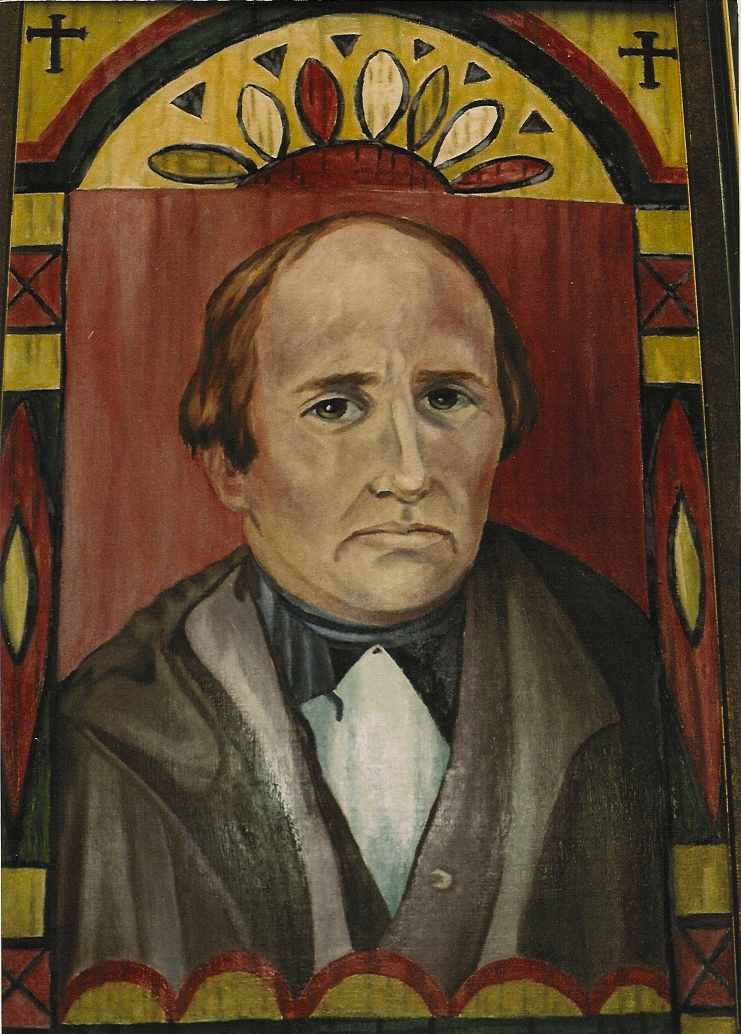
Portrait of Padre Martínez


AJM-Bissel.Portrait_Text

Portrait of a solemn man in 19th-century attire.Portrait of a solemn man in 19th-century attire.  Cynthia Bissell, a Taos artist, painted this portrait of Padre Antonio José Martínez, Cura de Taos in 1974. We met on Ledoux Street in Taos between the Harwood Foundation and the studio of R. C. Gorman where Cynthia was on a short roster of artists exhibiting work there since 1969. My grandfather’s house was across the Harwood Library where I was doing research for my monograph Reluctant Dawn,

The portrait of Padre Martínez, Cynthia explained to me, was done on plywood in the style of the retablos at the historic adobe church of San José de Las Trampas in northern New Mexico, one of her favorite places. She sent me the portrait as a gift when I was in San Antonio working with the PADRES organization. Cynthia moved to Arizona, and is now deceased.

Vicente M. Martínez, a close relative of the Padre, took a color photo of the portrait. When the Mexican American Cultural Center published Reluctant Dawn in 1976, the photo was reproduced in black-and-white. However, the portrait was published in color for the second edition of Reluctant Dawn published by The Taos Connection in 2006 on occasion of the instatllation and unveiling of the Padre Martínez Memorial in The Taos Plaza, La Honra de Su País/The Honor of His Homeland.

For almost three years, while I was Executive Director of PADRES, the national organization of Hispanic priests, the portrait hung on the wall of the PADRES headquarters on Ashby Street across from MACC. After I left, my successor lend it to Archbishop Sanchez of Santa Fe who kept it in his residence until he retired in 1993. Father Albert Gallegos of Belen, NM took possesion of it, but the portrait was lost after Father Albert’s death.

On the occasion of my Golden Jublilee as a priest in the spring of 2014, while giving a presentation on the Cura de Taos at the parish church of Our Lady of Guadalupe, the portrait resurfaced. The Archdiocese had it in storage, and returned it to “its proper home” at the church in care of its current pastor Rev. Clement Nigel. Padre Martínez had served as pastor of the parish from from 1826 until 1858. As rightful owner of the portrait, I took possession of it, and then immediately inscribed my name and date on the back in testimony of my gifting the portrait to the parish for posterity.

PADRE MARTINEZ AND PARTISAN POLITICS


PADRE MARTINEZ AND PARTISAN POLITICS

by

 Fr. Juan Romero 

January 17, 2014


[Antonio José Martínez was born in Abiquiú, NM on January 17, 1793–the feast day
of San Antonio Abad, father of Western Monasticism and Antonio’s namesake for whom he was baptized a few days later.  I wrote this article several years ago, but publish it on my blog today in honor of the birthday boy born 221 years ago.]

   “Now is the time for all good men (people) to come to the aid of their party!” My paternal grandfather, Juan Bautista Romero, for whom I am named was a man of many talents: teacher, carpenter, poet, and
erstwhile politician.  Grandpa John (as we called him–with a LONG “o”) ran for office both as a Democrat and as a Republican, but never won elective office. Padre Martínez, on the other hand–priest, educator, rancher, printer-publisher, lawyer, and politician–won several elections.  Born in the norther etremity of the Kingdom of Spain in the New World, he served at different times in the legislatures of New Mexico under the flags of both the Republic of Mexico and later that of the United States of America. 

  What was the political party of this priest-politician of New Mexico in the mold of his ideological mentors Padres Hidalgo and Morelos of New Spain on its way to becoming the Republic of Mexico? Santiago Valdez, the biographer of Padre Martinez writing in 1877, a decade after the Padre’s death, claimed the Padre belonged to the “Democratic Party.”[1] However, it was not the Democratic Party we know today.

  The Democratic Party looks to Thomas Jefferson
as its founding spirit, and the Republican Party to Alexander Hamilton
whose Federalist ideals are among their guiding principles.  Both Founding Fathers Jefferson and Hamilton are giants of American democracy in our republic we call the United States of America.  

  During an “era of good feeling” with its political rivals, the Federalist Party was disappearing, and the Whig Party replaced it by 1815. The so-called Democratic, or anti-slavery party of 1846-1851, was not synonymous with today’s Democratic Party, but existed in opposition to
the Whigs.  It began in opposition to the Federalists who held fast to the principle of states’ rights, a key plank in their platform. However, in its early years, at the beginning of the nineteenth century, the Democratic Party confusingly became known by the hyphenated  name Democratic-Republican Party.    

  This political party favored France in the wars between Britain and France, but its hyphenated name indicates that the core concepts defining the identity of political parties were fluctuating. Nevertheless,the Democratic-Republican Party was clear about one thing: they were against the Whigs. These successors to the Federalists advocated a strong central government, a more relaxed interpretation of the Constitution, and a republic run by a more professional and educated class.

    Antonio José Martínez was born in 1793 as a citizen of Spain in an America that that was still part of the Kingdom of Spain until 1821. In the 1820s, the Democratic-Republican Party began to morph into
what would eventually become two distinct political parties–the Democratic and Republican parties that we know today. The Federalist Party as such no longer existed in the mid-nineteenth century when New Mexico became a Territory of the United States and native New Mexican settlers became U.S. citizens.

  During his seminary days and young manhood, Antonio
José Martínez imbibed the principles of the Enlightenment. As a seminary student, Martínez excelled in canon (church) law, and had a an interest in politics as practiced by Padres Hidalgo and Morelos, architects of the Mexican Republic. He lived through and embraced Mexican Independence, and became a fervent Mexican nationalist promoting principles of freedom and democracy.

 By the mid 1830s, a priest for more than a decade, Padre Martínez had several times already been elected to political office in order to represent the Departamento de Nuevo Mexico (analogous to a state) in the legislature of the Republic of Mexico. By 1842, he requested and received from Governor Armijo permission to practice law as a civil lawyer in order to help the poor.  He appreciated the political system of the United States as enunciated ithe country’s founding documents, and admired Presidents George Washington and Abraham Lincoln. At the brink of the nineteenth century in 1799, the former was breathing his last breath when  the boy Martínez was six years old. The latter, a contemporary of the Padre, was untimely assassinated a couple of years before the Padre’s own death in 1867.

 After 1830, the Democratic Party in the United States had become a coalition of farmers, city dwelling laborers, and Irish Catholics. The Cura de Taos might have been attracted to such a political party that welcomed Irish Catholics. He most likely would have been in deep sympathy with the Democratic Party’s opposition to anti-immigrant nativists who held strongly negative views about all foreigners, or native-born Catholics, Jews and Negroes.

  However, Padre Martínez most likely would have initially opposed the Democrats’ embrace of the War with Mexico, the expulsion of eastern American Indians, and the acquisition of vast amounts of new land in the West. He also most likely would not have favored unlawful expansion of settlers squatting on land owned by him or anyone else among his broadly extended family or other New Mexican long-time settlers.

  Padre Martínez explicitly and vociferously opposed the process of Manifest Destiny, but after a process of mature deliberation, his political thinking shifted. He decided that New Mexico would be better off under the flag of the United States rather than that of the Mexican Republic.  Soon after occupying New Mexico in the name of the United States Government, General Stephen Watts Kearney invited the Padre to Santa Fe in August 1846.  His biographer Santiago Valdez in 1877, a
decade after the Padre’s death, described the meeting:

General Kearny invited all the prominent men of the Territory to visit him at the
capital, and Padre Martinez was tendered a special invitation…Padre Martinez, accompanied by his brothers [all escorted by Captain Charles Bent and his men]…left for Santa Fe, [and] during this visit, all three were sworn in as American citizens.[2]

  Almost immediately after his return from Santa Fe, in September 1846, Padre Martinez transformed into a law school the preparatory seminary that, with the full permission and encouragement of his Bishop
Zubiría of Durango, he had begun at his home in Taos more than a decade prior. Sixteen young men who had begun their preparatory education for the priesthood with Padre Martínez were eventually ordained to serve as clergymen throughout New Mexico. Padre Martínez, however, was now convinced that henceforth, instead of the clergyman,the attorney would be the one to “ride the burro”.[3]  The young men who studied at his law school went on to become attorneys and politicians to influence the development of New Mexico for years to come.

  General Kearny appointed Governor Donaciano Vigil in early 1847 to succeed the assassinated Governor Charles Bent, and Vigil selected Padre Martinez to preside over a Convention held in Santa Fe in
October 1847. One of the principal tasks of this convention was to facilitate transition from a military government to one purely civil in character. The Treaty of Guadalupe Hidalgo in 1848 formally concluded the U.S.-Mexican War.  As a consequence, the whole swath of land
north of Mexico that we call the American Southwest—including the vast territory of New Mexico that at the time also included Arizona and sections of Utah, Wyoming and Texas—transitioned from territory belonging to the Republic of Mexico to territory under the government of the United States of America.

  Having as a legislator in the Assembly of the
Departamento de Nuevo Mexico (analogous to a “state”) of the Mexican
Republic, Padre Martinez was elected “Senator of the First Senatorial District of Taos and Rio Arriba” and “embraced the Democratic or anti-slavery party”.[4]  In Santa Fe on October 12, 1850, Padre
Martinez presided over the second General Convention of the New Mexico as a Territory of the United States.  That assembly
requested the U.S. Congress abolish military rule and establish Civil
Government in New Mexico.

  By 1851, there was a third Convention of New Mexico, a Territory of the United States no longer under Military Rule. In preparation for elections, New Mexicans were choosing the political party to
which they wanted to belong as citizens of the United States.  However, the choices were still largely limited to either the Democratic-Republican Party or the Whigs Party.  Although the national Democratic Party and
the Republican Party were each in their infancy, neither party was quite formed in its present state nor yet very well known.  The question remained: what was the political affiliation of Padre Martínez during the American period?

 Marta Weigle in Brothers of Light, Brothers of Blood, her classic treatment of the Penitentes (the New Mexican-southern Colorado folk society whose members were known for their great devotion to the Passion of Christ), hints that he may have been a Republican insofar as many of the moradas (gathering centers for Penitentes) seem to have also been strongholds for the Republican Party. The Democratic National Committee (DNC) came into existence in 1848, the year of the Treaty of Guadalupe Hidalgo that ratified the results of the U.S.-Mexican War.
 By the 1860s, especially after the Civil War, the Whigs would also fade away completely. The Republican Party, conceived in 1850, took some years for party identity and loyalty to develop.  Within a decade, it became the “anti-slavery” party in which Abraham Lincoln ran and won as its first presidential candidate.

  The so-called “Democratic Party,” to which Santiago Valdez, the biographer of Padre Martinez, claimed the Padre belonged, was more accurately the Democratic-Republican Party that identified itself in opposition to the Whigs. The issue of slavery helped bring political identity into focus. Democrats and Whigs were divided on the issue of slavery. Democrats in Congress, especially those of the so-called “solid south,” passed the hugely controversial pro-slavery Compromise of 1850, while the Territorial Government of New Mexico was taking shape.

  Under the leadership of Padre Martinez, New Mexico—in opposition to the Democratic “solid South”—insisted New Mexico be admitted into the Union as a Free State.  In state after state, the Democrats gained
small but permanent advantages over the Whig Party that finally collapsed in 1852.  Division over slavery and its nativist leanings against immigrants and “foreigners,” especially those of Jewish or Catholic heritage, had fatally weakened Democratic-Republican Party. Democratic
leader Stephen A. Douglas of Illinois–the future debate-rival of Abraham
Lincoln—pushed through the pro-slavery Kansas-Nebraska Act in 1854 that repealed the Missouri Compromise of 1820. According to the principle of “popular sovereignty,” the Act opened the Midwest territories to slavery. In reaction to this, anti-slavery activists and individuals conceived the Republican Party in the early 1850’s, and the first official Republican meeting took place in 1854. The name “Republican” was chosen because it alluded to equality, and reminded individuals of Thomas Jefferson’s Democratic-Republican Party. They believed that government should grant western lands to settlers free of charge. In 1856, the Republicans became a national party when John C. Fremont was nominated for President, and Abraham Lincoln four years later became the first to win the White House as a member of the Republican Party.

  Padre Martínez admired his contemporary Abraham Lincoln, considered the founder of the modern Republican Party.  By the time Lincoln was elected President of the Country, Padre Martínez was in decline on many levels–in ill health with only a few years left until his own death in 1867. Furthermore, against the backdrop of the slavery issue, new issues, new parties, and new rules were forcing a major re-alignment of political parties among voters and politicians. While the Democrats survived the challenges, many northern Democrats joined the newly established Republican Party. Was Padre Martinez among them?


[1] Santiago Valdez, Biografía del Presbítero Antonio José
Martínez, Cura de Taos
, 1877 unpublished manuscript in Ritch Collection at
Huntington Library (near Los Angeles). Fr. Juan Romero provided a contemporary English
version in 1993 that is yet unpublished, but available through NM State Archives,
Archives of Archdiocese of Santa Fe, and University of NM.

[2]
Ibid., p. 111.

[3]Ibid.

[4] Ibid.

EXCOMMUNICATION OF PADRE MARTINEZ

THE INVALIDITY OF THE ECCLESIASTICAL CENSURE AGAINST PADRE ANTONIO JOSE MARTINEZ

 A Presentation for the New Mexico Historical Society

On the Occasion of the 300th Anniversary of the

Founding of Albuquerque

 April 22, 2006

 by

 Rev. Juan Romero

 Happy birthday Albuquerque!  In the early1940s, at the dawn of my consciousness, our family lived here for a while.  We came from Taos to this city’s lower elevation for mom’s health, but then we moved to Los Angeles in 1943 for dad’s job with Lockheed Aircraft.  From family members and from a large glass-encased poster at the edge of the Taos Plaza, I first learned about Padre Antonio José Martinez, Cura de Taos.  In mid July of this year, ten days before the anniversary of his death in 1867, Padre Martinez will be commemorated with a life-sized bronze likeness to be placed in the center    of the Taos Plaza.  It will reprise what his peers in the New Mexico Territorial Legislature wrote on his tombstone: “La Honra de Su Paíz-The Honor of His Homeland.”[1] 

Tradition preserved in the personal papers of his youngest brother Pascual Martinez[2] claims that Padre Martinez died repeating the Our Father.  The operative words in this context would be “forgive us our trespasses, as we forgive those who trespass against us,” and the mutuality of forgiveness prayed for would be Padre Martinez and Bishop Lamy. 

The 1877 Valdez biography[3] records the early life of Padre Martinez with several letters and documents, but says very little about his life after the arrival of Bishop Lamy.  The Pascual Martinez papers record that Padre José Lucero, his former student, good friend and pastor of the neighboring Arroyo Hondo parish attended Martinez upon his deathbed.  It is the common teaching of theologians that a person with good dispositions of love of God and sorrow for sin, and who receives the Church’s Last Rites–consisting of the sacraments of Penance, Anointing of the Sick and Holy Communion– upon death, goes directly to heavenly glory.  A month before he died, Padre Martinez revised his Last Will and Testament[4] that gives us an insight into his dispositions.

I declare that during the forty-two years
of my spiritual administration in several parts of this Territory of New Mexico, and particularly in this County of Taos, I have complied with my ecclesiastical ministry with fidelity and good faith to the best of my knowledge that I could….My body shall descend tranquil to the silent grave, and my soul shall appear and go up to the Divine Tribunal with plain satisfaction that I have done all that I could to illuminate the minds of my fellow citizens causing them their temporal good, and above all, their spiritual benefit….My conscience is quiet and happy, and God knows this to be true.  If anyone of my fellow citizens and neighbors complains that I have injured them, it may have been through a mental error, but not with the intention of my heart, as human creatures are weak…  Nevertheless, I have never had any intention of injuring anyone, and by nature, I have been inclined to do good, so help me God. 

Bishop Zubiría of Durango attested to the high moral character of Padre Martinez. He visited Taos three times in his tenure of the far-flung diocese of Durango that included New Mexico as it was then constituted: Colorado, Arizona, Utah and parts of Texas and Wyoming.  When the bishop visited in 1833, he acceded to Padre Martinez request to begin a pre-seminary to prepare young men for further study in Durango.  Padre Martinez had begun an elementary school in 1826, and his seminary would morph into a law school after the American occupation in 1846. 

In 1840, Padre Martinez had spent a year on sabbatical in Durango, the see of the Archdiocese at the time (and for eleven more years to come).  He caught up with course work since, because of illness, he had left seminary after ordination in 1822 but before he finished some theology courses.  This became an impediment for promotion to a “permanent” pastorate, although since 1826 he had been “interim” pastor of the Taos Church (San Geronimo at the Pueblo and its main chapel Nuestra Señora de Guadalupe at the Plaza). After his year, he was formally appointed CURA DE TAOS, the title for which he has been known in history.

When the Bishop Zubiría visited again, for the third time, in 1845, he ratified Martinez’ appointment as an permanent pastor.[5]   “He not only approved the records of Padre Martinez, but even thanked him for his skill and energy in performing his duties as minister.  As a matter of recognition, he granted Padre Martinez additional privileges for his well deserved merits.”[6]  Appointing him as “Vicar and Ecclesiastical  Judge” of Our Lady of Guadalupe parish “and its districts”[7] of the northern region, Bishop Zubiría  also gave Padre Martinez the “special faculty and power to absolve…heretics and also to rehabilitate or to suspend, as he may deem proper and according to his conscience, any priest who may deserve to be rehabilitated or suspended.”[8] These special faculties were valid for a period of five years ending September 18, 1850.[9] 

Although he had more than his share of political enemies, Charles Bent chief among them because of disagreements about land use and ownership, Padre Martinez was nevertheless  held in very high regard by the majority of the people of Taos and all of New Mexico.  By contrast, Willa Cather, in her Pulitzer Prize winning novel[10]–“the best novel ever about New Mexico”[11]—spoke for many of the Padre’s enemies[12] when she described the Padre as an ogre writhing in hell.  She may have been inspired to imagine Martinez there because of the inimical relation between Padre Martinez and the hero of the novel, a fictional and glorified version of Bishop Jean Baptiste Lamy.  

In the fall of 1856, almost a decade before Martinez died, Lamy censured the Padre with Suspension whose vality Padre Martínez—ever the Canonist—legally challenged.  The following year, in the spring of 185, Bishop Lamy excommunicated Padre Martínez “with all of the required formalities…servatis servandi.”[13]  Here is how one author described the dramatic scene of the excommunication:

Machebeuf appeared in the Taos church [of
Our Lady of Guadalupe] to celebrate High Mass and to pronounce the excommunication.  Tension was almost tangible.  The church was filled, and the people stood outside to hear the ceremony and to watch each other, and to see
who had guns.  When time came for the
sermon, Mauchebuf explained the meaning of excommunication of which most people had no understanding except that it was the Church’s ultimate discipline; and then he read the instrument itself to a hushed congregation and finished the Mass…There was no disturbance, though everyone felt the precarious atmosphere…[14]

The “instrument” of excommunication, part of “all the required formalities,” was likely from the Roman Pontifical containing ceremonies used by a Bishop in the nineteenth century:

Since I, [Name of Bishop], having legitimately warned [him] for the first, second, third and fourth times of the malice for which he is being convicted for whatever he has done or not done,  and since he has shown contempt for fulfilling my command to renounce his contumacy,[15]  and since he is remaining stubborn [exigente] in his rebelliousness, I therefore excommunicate him with these written words:  By the authority of the omnipotent God Father, and the Son and Holy Spirit, and by the authority of the holy Apostles Peter and Paul and all the Saints, I denounce him.  He is to be avoided [vitandus] for as long a time as it may take until he will have fulfilled what is mandated, in order that his spirit may be saved on the day of judgment.[16]

Joseph P. Mauchebeuf, Vicar General for Bishop Lamy and later first bishop of Denver, is the one who pronounced the excommunication, according to Howlett, author of Mauchebeuf’s biography. A couple of years later on July 1, 1860, Bishop Lamy himself came to Our Lady of Guadalupe parish to administer the sacrament of Confirmation to over 500
adults and children of the Jurisdiction of Taos.   He put this note in the book of Baptism records of the parish:

Since our last visit [to the parish of Our Lady of Guadalupe] in August of 1855 until the present date, various pastors have succeeded in this Jurisdiction whom we had to move for grave and critical circumstances….It is our painful obligation to observe here that at the beginning of the year 1857, we had to punish with suspension Sñr. Cura Martinez for his grave and scandalous faults and for his publications against order and the discipline of the church. Regretfully, however, he did not pay attention to the censures, and before long, he began to say Mass, administer the sacraments, and to publish things even more scandalous.  We then saw ourselves obliged to excommunicate him, servatis servandis, with all of the required formalities.  Since that time, this unfaithful [infeliz] priest has done all in his power, and in a most diabolical manner, to provoke a schism in public as well as in private, pretending to say Mass, administer the sacraments, and thus
loosing a great number of souls. However,  in spite of this schism, the major part of the faithful remain on the side of order and of legitimate authority, as this book of entries proves…Thus it is that while some lose faith, because they have forsaken good works, others are strengthened in
procuring the good of souls and the glory of God.[17] 

Only God is judge of ultimate destiny. However, the passage of time and critical history helps to evaluate a person’s rightful place in the earthly hall of merits and accomplishments. Antonio José Martinez was a liminal man of both the church and of the nation.  His life was at the threshold of three distinct eras that spanned the history of New Mexico, under Spain (two and a quarter centuries), under Mexico (twenty-five years), and under the United States since 1846.  As an actor and positive contributor to each distinct epoch, he was on the threshold of each, and helped his people of New Mexico segue one to another, sometimes with pain and/or struggle.  He was a churchman, rancher, educator, journalist, printer, publisher, lawyer and politician who lived in a time of great transition.  He was a man of the people, and one of the great figures of New Mexican history.  Although there were shadows in his life, the light emanating from him far outshone any darkness.  Indeed, he was a luminary of this time, a renaissance man only now coming to be better and more widely appreciated. 

His ecclesiastical superiors held Antonio José Martinez in very high regard as a seminarian in Durango.  He excelled in his studies, especially in philosophy and canon law. Bishop Castañiza who ordained Martinez favored him, and even considered appointing him as a first assignment to La Parroquia, the principal parish in Santa Fe, precursor to the Cathedral.  Bishop Zubiría who succeeded Bishop Castañiza also recognized the talents of the priest of Taos and showed his appreciation of him on all three of his visits to Taos: in 1833, in 1845, and in 1850 on the eve of the great transition. 

On his third and last visit in 1850, barely a year before Bishop Lamy arrived in Santa Fe, Bishop Zubiría gave Padre Martinez special faculties that again showed his complete confidence in the Priest of Taos.  Among the faculties, ironically, was to absolve penitents from suspension and excommunication.

The mid 1840s encompassed the “transcendent epoch” that brought tumultuous changes to New Mexico.  The engine was Manifest Destiny, the U.S.-MEXICAN WAR was the powerful train that came into New Mexico in 1846.  Its caboose was the 1848 Treaty of Guadalupe Hidalgo, and its railroad tracks continue to lead forward defining and shaping our own place and time.  Territories that had belonged to Spain since 1598, and then to Mexico since1821, now became territories of the United States of America. The political change affected church organizational structure.  By 1850, New Mexico was taken from the ecclesiastical jurisdiction of Durango in Mexico and became an Apostolic Prefecture under the Archdiocese of St. Louis, Missouri in the United States until Santa Fe became its own Diocese and later Archdiocese.

The historic tension between France and Spain was a backdrop for the cultural clash that was to distance the new Vicar Apostolic Jean Baptiste Lamy from New Mexico’s native clergy that Padre Martinez helped so much to develop. The 1850 Council of Baltimore decided to bring the new US territory under American ecclesiastical sway.  They nominated French missionary J. B.  Lamy as first Vicar Apostolic of Santa Fe who was a French-born missionary serving as a parish priest in the diocese of Cincinnati, Ohio.  Arriving in New Mexico in July of 1851, he was destined to become the bishop of the new Santa Fe diocese.  His territory of New Mexico included what is now the state of New Mexico in addition to all of Arizona and Colorado and parts of Texas, Nevada, Wyoming, and Utah. 

The initial encounters between Bishop Lamy and Padre Martinez were cordial, even warm and gracious.  Lamy seemed to genuinely appreciate the canonical acumen of Padre Martinez.  However, the pride and stubbornness of each soon began to show.  The conflict between them was, at its core, a conflict of culture more than of theology or morality.  The tension was expressed around issues concerning transition of power and authority.

One of the principal points of conflict between Padre Martinez and Bishop Lamy was Lamy’s reinstitution of the practice of tithing.  In the European model of Church-State union, the government was responsible for maintaining the churches and paying salary to the clergy.  As early as 1829, eight years into the Mexican period, Padre Martinez already was objecting to the practice.  He stated it was a burden too heavy for poor people, and advocated for a change in policy.  By 1833, he was a member of the New Mexican legislature and—with the approbation of Bishop Zubiría—successfully advocated  for a change in the law that ultimately eliminated government-sponsored tithing.  Martinez promoted free will offerings in church.  

Bishop Lamy’s Pastoral Letter that initiated the renewed policy on tithing was written in December 1852, but it was not printed nor promulgated until early 1853.  When Bishop Lamy re-instituted tithing under pain of denial of Christian burial, [18] it seemed excessively harsh to Padre Martinez who publicly denounced it in the press, the Santa Fe Gaceta,  as “hucksterism” and “simony.”[19] The Pastoral ran counter to serious objections by several of the local clergy, and did not begin to be fully implemented until 1854.  The text of the Pastoral was a brief document of three pages with seven points dealing with routine liturgical and catechetical concerns.  The fifth and sixth seriously offending points tried to launch a fund raising campaign redounding to the economic hardship of clergy and faithful. Those faithful who did not comply were deprived from church burial.[20] In addition, the renewed  system of tithing reduced the income of the priests by about a third. 

Bishop Lamy in 1856 suspended Padre Martinez from celebrating Mass, preaching,  and hearing Confessions because of his public scandalous writings that attacked him in the public press. The Padre responded with a legalistic letter outlining why the suspension was invalid, because it lacked three canonical warnings.[21]  Padre Martinez was convinced of the invalidity of the suspension from his study of Canon Law,  in which he was a recognized expert, and from the church law books available to him.  However, Bishop Lamy, admittedly not all well versed in Canon Law,  may have been operating out of an understanding of church law based on different text.  There was a canon that permitted the legitimate suspension of a priest “on the basis of an informed awareness”  Jesuit canonist Ladislas Orsay brought this [ex consciencia informata] to the attention of Fr. Tom Steele, S.J. as a possible way Bishop Lamy wanted to deal with Padre Martinez in order to avoid even greater public scandal since the Padre was so widely respected by the people, it is supposed.  This was intended to give a bishop maximum latitude in censuring a priest whose circumstances of suspension the bishop might not want to make public for whatever reason.[22]

Almost a thousand people, including several Washington politicians, signed a letter complaining against Bishop Lamy and his Vicar Machebeuf.  Padre José Miguel Gallegos—after a serious tiff with Vicar J. P. Machebeuf, left active ministry and became a politician, the first Hispanic Congressman in the U.S.—drafted the letter and sent it to the Holy Father.  Although Gallegos orchestrated the letter of complaint to Pope Pius IX against Bishop Lamy and Vicar Machebeuf, these hierarchs may have held Padre Martinez responsible for having formed and influenced the former priest and pesky Congressman Gallegos.  I believe the embarrassment of Bishop Lamy and Vicar Machebeuf before the Holy See was one of the main events that triggered Martinez’ extreme disfavor with Bishop Lamy. 

Since 1852, people complained to Bishop that Vicar General Macebeuf was breaking the seal of Confession.  The Bishop told the people that he would take care of it, but did nothing. They again complained, this time with the suggestion they would go to higher authority. After being effectively dismissed, Señor Tomás Baca—with at least the passive consent of Padre Gallegos–helped to garner over 900 signatures of people complaining about Machebeuf’s behavior. 

Meanwhile, Bishop Lamy suggested to his Vicar General Joseph Prospectus Macebeuf that he consult with Padre Martinez about the canonical dimensions of the allegation of direct violation of the seal of Confession.  Martinez was at first disposed to believe that Machebeuf was guilty,  but may have been pleased to be consulted in the affair.  After hearing Machebeuf’s version of what happened, Padre Martinez wrote to Bishop Lamy that he “was satisfied”[23] with Machebeuf’s explanation.  Martinez asserted in his letter to Lamy that Machebeuf was most likely carried away with overzealous preaching, but was not actually guilty of “direct violation” of the Seal of Confession.  Ironically, this letter would be used get Machebeuf off the proverbially papal hook when the matter once again surfaced before Roman authorities in the summer of 1856. 

[Another Topic: Padre Gallegos]

binding.  (My emphasis)  What’s to re-examine?  It was an invalid act of excommunication.  There’s no such thing as rescinding an invalid act.  It is per se invalid …You can’t rescind an invalid act. …There is no evidence of any trial by peers, as was required by the Canon Law at the time, and there was no evidence of allowing Martinez to defend himself….He [Lamy] could very well not have been [aware of the procedure].  I think it would be very important [to publicly declare the excommunication invalid]….I’d think that it’s really important to rehabilitate him.…The much good that he did do should be honored….The importance of the rehabilitation of Padre Martinez is not for the person per se, but for what he symbolized.

Both baptism and funeral books of Our Lady of Guadalupe parish in Taos mention the excommunication.  Servite priest Father Albert Gallegos, New
Mexico native and PADRES pioneer, authored a chapter on the canonical dimensions of the excommunication in Ray John Aragon’s book Lamy and Martinez.  In his book But Time and Chance [Sunstone Press], Fray Angelico Chavez challenges the notion that there was any real excommunication of Padre Martinez, much less schism.  Anyone
excommunicated as a vitandus, i.e., one to be avoided or shunned, is supposed to have his name published in the Roman publication the Acta Apostolica Sedis.  Before the publication of that journal, the names of vitandi—those TO BE AVOIDED—would have been inscribed at the Vatican in the Second Section of the tomes in the library of the Secretariat of State.  I did a thorough search of all Martinez names in the 19th
century, and found several.  However, during my research  at the beginning of the Jubilee Year 2000, I found no mention of any excommunication of Padre A.J. Martinez of Taos in any of the three Vatican Archives: 1)  the archives of the Secretariat of State,  2) Secretariat of State-Segunda Seccione (a confidential section reserved for records of  high profile or political cases), and 3)  the Archives of the Propagation of the Faith, now called the Congregation for the Evangelization of Peoples, that had jurisdiction over the United States during its missionary phase after Independence from England until the end of the nineteenth century. 

Notification of a formal excommunication  should have certainly been recorded in Rome, and most certainly in the archives of the Archdiocese of Santa Fe.  However, there is no record in either place, and this means that if there were any kind of an excommunication,  it had to have been a purely local affair that was kept private for pastoral reasons, and not promulgated. 

In an unprecedented moment on March 12, 2000, the First Sunday of Lent of the Jubilee Year 2000, Pope John Paul II knelt in St. Peter’s Basilica, and said, “We humbly ask forgiveness.” The Holy Father’s words and gestures were “the most sweeping papal apology ever, repenting for the errors of his church over the last 2,000 years.”     In the name of the Church, he was asking forgiveness from God for key lapses which she has committed over the past two millennia.  While the Holy Father was leading the Catholic world in a communal examination of our collective historical conscience, he acknowledged that church followers had “violated the rights of ethnic groups and peoples, and shown contempt for their cultures and religious traditions.”   (My emphasis) 

John Paul II continued, “The church of today and of always feels obligated to purify the memory of those sad episodes of every sentiment of rancor or rivalry.  (My emphasis) The jubilee becomes in this way for every occasion an opportunity for a profound conversion to the Gospel.  From the acceptance of divine forgiveness is born the duty to forgive one’s brothers and seek reciprocal reconciliation.”

Vatican theologians explained the Pope’s apology for past sins of the church by saying that although the responsibility for sin does not pass from one generation of people to the next, “the wounds created by sin do often linger and may require judgment and repentance back through history.” (My emhphasis)

Since he announced the Jubilee Year in his 1994 apostolic letter written to the Catholic world On Reconciliation, John Paul followed up that
important act of reconciliation with even more dramatic gestures, e.g., the posthumous nullification of the sixteenth century excommunication of the scientist Gallileo.  More recently, there was a statement of reconciliation with pioneer Protestant John Hus. 

In sympathetic ceremonies held in cathedrals throughout the Catholic world, bishops made similar acts of repentance on March 12, 2000 and specified them according to their own local histories.  In Santa Fe, Archbishop Michael Shean asked forgiveness for sins against the American Indian, women, and black peoples.  However, there was no
specific apology for the systematic reduction of the native clergy soon after the American occupation in the mid nineteenth century.  Several were suspended from functioning in their ministry.  Padre Martinez, who in spite of his brilliance and long legacy of priestly service to his people, ended his life alienated from his bishop and excommunicated from the church.  The church is holy, but is stained by the
sins of its children, and requires “consant purification.”  The “new evangelization” for which the Pope has been calling in this third millennium can take place only after there be a church-wide “purification of memory.” 
“One of the characteristic elements of the great jubilee is purification of memory,” [Emphasis mine] stated Pope John Paul II.  “…in this year of mercy, the church, strengthened by the holiness that she receives from her Lord, kneels before God and begs for forgiveness for past and present sins of her sons….We forgive and we ask forgiveness!….”

Lynn Bridgers wrote in DEATH’S DECEIVER, The Life of Joseph P. Machebeuf [1997 University of New Mexico Press – Albuquerque, pp. 268] wrote the following about the historical relationship between the French and Spanish that I believe is accurate and interesting background for the relationship between Martinez and Lamy:

A legacy of mutual distrust between the Spanish and the French served as the rocky river bed over which many Anglo and Hispanic conflicts flowed.  With the arrival of Lamy and Machebeuf, the French seemed to have accomplished ecclesiastically what they were unable to do militarily, moving their sphere of influence from the French lands of the Louisiana Purchase into traditionally Spanish-dominated New Mexico….Machebeuf’s personal views of Hispanic culture reflect a long complex process of maturation.  His early work was sometimes darkened by ignorance and misconceptions about New Mexico’s Hispanic Catholicism, but by the end of his life he had grown far beyond mere tolerance, to a deep love and respect for the Spanish-speaking people of the American Southwest. 

On February 3, 1869, a year and a half after the death of Padre Martinez,  Bishop Lamy reported on progress of vocations to his mentor Archbishop Purcell of Cincinnati. Lamy mentions a “schism” in Taos, but makes no mention of  any excommunication that is supposed to have taken place the Sunday after Easter  in 1858 or at any other time.  In an obiter dictum, Lamy mentions “a Schism” that Padre Martinez “made” (sicin 1860.  Lamy tells Purcell of the “Mission Jesuit
priest Father Gaspari was giving in Taos where “the unfortunate Martinez made a Schism that Lasted seven years [1860-1867] until the death of this said poor priest…. Most of the people, except some of his nearest relatives are coming back to obedience, and the mission which is producing a great change which leaves very few…”  
However, Lamy does not refer to any excommunication.  

Was an excommunication actually  made?  Was the prior suspension “secret,” i.e., ex consciencia informata, as some opine? Father Tom Steele, S.J. refers to Jesuit canonist Ladislaus Orsay in reference to the ecclesiastical penalty of “suspension from divine things” (celebrating Mass, preaching, hearing confessions).   Under certain circumstances, a bishop—without making it public—could invoke suspension of official license or faculties (permission) for a priest to act publicly in his diocese.  There would have to be good reason for a bishop to not make a suspension public, and it would need to be “from an informed conscience”  and for some greater good.  Nevertheless, it remains curious that Bishop Lamy did not ever publicly mention an excommunication of Padre Martinez  to episcopal peers or to family, to whom he often wrote about those pesky native  New Mexican priests.  Lamy does not mention the phrase about excommunication that he twice wrote in the parish books (Funerals and Baptism) of  the Taos church:  “…excommunication [of the unfortunate (infelíz) priest]…with all the required formalities…servatis servandis.

[12] Padre

Martinez made enemies with Charles Bent and his partners when he tangled with
them about land grant issues.

[13]Marginal
Note in Baptismal Register of Our Lady of Guadalupe Parish in Taos for July 1,
1860, p. 143.  My translation.

[14] Paul
Horgan, Lamy of Santa Fe, Faraar, Strauss, Giroux, NT, c. 1975, pp.
243-44.  Original source, Howlett
(through Father Ussell),  Life of Bishop J.P. Macebeuf, First Bishop
of Denver
.  The dramatic scene of excommunication
was first described in Memories, the
journal of Father Gabriel Ussel who was the third successor of Padre Martinez
as pastor of Our Lady of Guadalupe parish in Taos, and a purported eyewitness
of the event.  Howlett  quoted Ussel as one of his sources for the
Machebuf biography, and others have followed suit: Twitchell,  Leading
Facts of New Mexico
History;
Romero, Reluctant Dawn, p. 1; Father
Tom Steele, S.J. in “View from the Rectory” in New Perspectives From Taos published by Millicent Rogers Museum, p.
99 n.3; Lynn Bridgers (embellished the account of the excommunication in her
biography of Bishop Machebeuf) in her first footnote Death’s Deceiver, 1997 University of New Mexico Press, refers to
Father Gabriel Ussel’s journal Memories.  He was the French priest who was the third
the succeed Padre Martinez at Guadalupe Church in Taos within three years.

[15] Contumacy is
defined as flagrant disobedience or rebelliousness, or persistent refusal to
obey without good reason.

[16]From the Roman
Pontifical used in the 19th Century, Ordo Excommunicandi et Absolvendi, The Rite of Excommunicating and
Absolving, edited by order of Benedict XIV and Leo XIII.  It was made available to me through the
courtesy of Pat Lyons, Librarian, St. John’s Seminary, Camarillo, California.

[17] My translation
of marginal note in Baptismal Register
of Our Lady of Guadalupe Parish in Taos for July 1, “Fifth Sunday After
Pentecost,” 1860, p. 143. Father Gabriel Ussel was the pastor of Taos when
Bishop Lamy came to celebrate the sung Pontifical Mass for the
Confirmands.  He had not visited the
parish since 1855, five years prior when Padre Martnez was still in
charge.  On this visit, the bishop
confirmed over 500 adults and children who were part of the jurisdiction of
Taos.  Spanish text is in appendix.

[18] Christmas
Letter of 1852-53.

[19] Letter of
Padre Martinez to Bishop Lamy, printed in the Gaceta of Santa Fe.

[20] The two most offensive provisions of the 1852 Christmas
Pastoral that Padre Martinez cited:

1) “The
faithful of this territory… will know that we have taken away from the priests
every faculty to administer the sacraments and give church burial to the heads
of families that refuse to faithfully hand over the tithes that are their
due.” 

2) “From
February 1, 1854, triple the parish assessment will be charged for the
administration of the sacraments of baptism, matrimony and of church burial
from those faithful who belong to families that do not fulfill the fifth
Precept of the Church [to contribute to the support of the Church].”

[21] Archives of
the Archdiocese of Santa Fe, Letter of Padre Martinez writing from Taos to
Bishop Lamy in Santa Fe, Ocober 24, 1857. This letter succeeds Padre Martinez’
prior missive sent to the bishop the previous year, November 12 1856.  It again outlines the principal grievances,
and asserts Padre Martinez as “cura
proprio
,” i.e. as an irremovable pastor” who is “free of suspension.”  The various grievances or “excesses of the
bishop” are presented.  They include the
following:

1)    the
1851-1854 Pastoral Letter;

2)    the
suspension and take-over of Padre Gallegos’ Albuquerque house;

3)    the
suspension of ex-vicar Padre Juan Felipe Ortiz of Santa Fe whose house and
property was divided (although ultimately reimbursed); and

4)    the
Bishop’s alleged sale of church property—the Castrense or military chapel at
the edge of the Santa Fe chapel. 

Padre Martinez, with some delusion, also made other
un-winnable “demands”:

1) revocation of the Pastoral
Letter of January 14, 1854, because it is against the spiritual health of the
people;

2) the admission that he,
Padre Martinez, is not really suspended for lack of the three warnings; and

3) the recognition that Padre
Martinez is still the priest in charge of Our Lady of Guadalupe parish, i.e.
the cura proprio, since he is an “irremovable
pastor;”

4) that the Bishop remove
Father Damaso Taladrid, and send another assistant priest.  When these demands are met, Padre Martinez
says he will consider retiring.  

[22] Father Tom Steele, S.J., academic and premier New Mexico
historian, makes a case for suspensio ex
consciencia informata
. Respected Jesuit theologian and canon lawyer ,
Ladislas Orsy, brought that to the attention of Father Steele as a
possibility.  This would be a bishop’s
suspension of a priest that would prevent him from exercising his priestly
ministries.  This woud not be done
because of anything in the external forum, but because of the bishop’s
“informed and aware consciousness” that the priest is involved in some
nefarious dealings that the bishop might not want to make the public in order
to “avoid scandal” in the church or for some other proportionate reason.  According to this line of thought, Bishop
Lamy’s suspension might indeed have been valid.
However, it is difficult to uphold or deal with that in the external
forum of law.  The (schismatic) Council
of Pistoia and the Counter-Reformation Council of Trent treated the notion of suspensio ex consciencia informata, but
it was not commonly used nor even recognized.
It may have been in some moral theology or canon law books, but not
those of Padre Martinez.  The universal
body of canon laws binding the Catholic Church in the west was not,
surprisingly, formally codified until 1917, in the 20th
century.   It should not be such a great
surprise, then, that Padre Martinez and Bishop Lamy may  have been dependent upon differing law texts.
Twenty years after the Second Vatican Council, in 1985, there was a major
revision of the Code of Canon Law that leaves no trace of ecclesistical censure
ex conscincia informata.

[23] Horgan, p. __.

[24] Gallegos used
his position as Democratic Congressman in Washington to orchestrate for Pope
Pius IX a letter of complaints against Bishop Lamy and Vicar Machebuf.  In January of 1856, thirty-seven Legislators
of Territory of New Mexico signed the letter of complaints. In April 1856, they
sent it to the Holy Father from Washington, D.C. with a cover letter signed by
Congressman Gallegos.

[25] “This pastoral
seems to have provoked all this opposition…started by some priests of bad
fame…and who easily find followers among the ignorant and vicious people.  The main author of these claims is a certain
Gallegos, parish priest at Albuquerque who was scandalously living with a woman
of bad reputation.  Since he proved to be
incorrigible, he was interdicted by Mons. Lamy himself, and now is a parliament
member at Washington for the State of New Mexico.  The same [incorrigiblity] is declared, more
or less, about the other priests who signed the claim against Mons. Lamy.”

[26] My emphasis,
but the phrase belongs to the secretary-archivist accurately paraphrasing
Machebeuf’s negative value-judgment.

[27] Ibid.
The auditors of the Propagation of the Faith presented Father Machebeuf
with the documentation of allegations the Holy Father had received from
ex-Padre-turned-Congressman Gallegos writing from Washington, D.C.  The cover letter and documentation was
accompanied by signatures of over nine hundred Catholic faithful (!) including
thirty-four legislators of New Mexico. 

[28] Vatican
secretary-archivist’s summary of Father J. P. Machebeuf’s defense in Rome,
Letter #12 for year 1856-57 in Letters
and Documents of the Archives of the Archdiocese of Santa Fe
.

[29] Horgan, Lamy of Santa Fe, p. ___.

[30] Horgan, p.
229.  The author of Lamy of Santa Fe continues, “and he has never failed in a show of personal respect [my emphasis] towards
the bishop…[but]…we are sure public opinion is against him.”  The “public opinion” to which
Machebeuf referred referred to that of new comers who became enemies of the
controversial Padre.  Padre Martinez was
Bishop Lamy’s most “formidable” adversary because he was the
“most intelligent and even least corrupt.”  (Horgan, p. 219)  Nevertheless, Padre Martinez continued to
remain greatly loved and exceedingly popular among the greatest number of native
peoples.

[31] Ibid.p. 219.

[32] Ibid.

[33] He was the
father of his legitimate daughter María de La Luz born c. 1819, and whose
mother died in childbirth.  After Antonio
José went to the seminary in Durango, the young girl was given to the care of
her maternal grandparents.  She herself
died at the tender age of 12.  Two other
children merit special mention: Santiago Valdez (AKA Marquez/Martinez), author
of the 1877 biography of the priest, and Vicente Ferrer Romero who became a
pioneer Presbyterian evangelist.

[34] E. K. Francis,
“Padre Martinez: A New Mexican Myth,” New
Mexico Historical Review
(Vol. XXXI, No. 4 – October 1956, p 289.

[35] He was also
the author of a biography of the Padre Sanchez, Memorias del Presbítero Antonio José Martinez, Cura de Taos, printed
in 1904.

[36] Interview with Max Cordova de Truchas, AMIGOS, Volumen XII,
Nivel III, #2 © 2001 Semos Unlimited, Inc., Santa Fe NM 87505. My translation
form Spanish.

[37] I Cor.
1:11-13.

[38] Cf. Newspaper ____ in Taos Research
Center, Nita Murphy.  Archbishop Sanchez
asked canon lawyer Lucien Hendren to begin investigation of procedure.  It seems that “Angelico Chavez advised the
Archbishop against that course of action, I do not know why.”  (Msgr. Jerome Martinez in conversation with
Fr. Juan Romero, c. 2004.)  In January
1993, on the occasion of the funeral of Father Mike O’Brien in Mora, Archbishop
Sanchez told me he was once again prepared to take up the cause.  However, he was soon thereafter retired.

[39] Msgr. Jerome
Martinez made the statement on October 1, 2001 in Santa Fe without
qualifications to filmmaker Paul Espinosa of Espinosa Productions.  Interview transcribed by Marisa Espinosa.
[jerome.doc] Monsignor Martinez stated that an ideal time to have done this
would have been during the Jubilee Year 2000.  He also mentioned that Fray Angelico Chavez
advised Archbishop Sanchez against making a public statement as to the
invalidity of the excommunication. 

[40] Ibid.

[41]Sate
Historical Archives, made available from Al Pulido.

[42] Ibid., p. 58

[43]In a
picture taken in 1903, Vicente F. Romero (Lic.), is seen as one of sixteen  “Native Mexican Workers,” clergy and/or lay
evangelists for the Presbyterian Faith.
Others identified include Tomas Atencio (#9 – student of Chimayo/Dixon),
Rev. Gabino Rendón (#13 of Santa Fe), and Rev. José Yñes Perea (#15 of
Pajarito).  Cf. Our Mexicans by the Rev. Robert M. Craig, NY, Board of Home
Missions of the Presbyterian Church, 1904, p. 102.]

[44]
Document of the Presbyterian Church, from Al Pulido.    
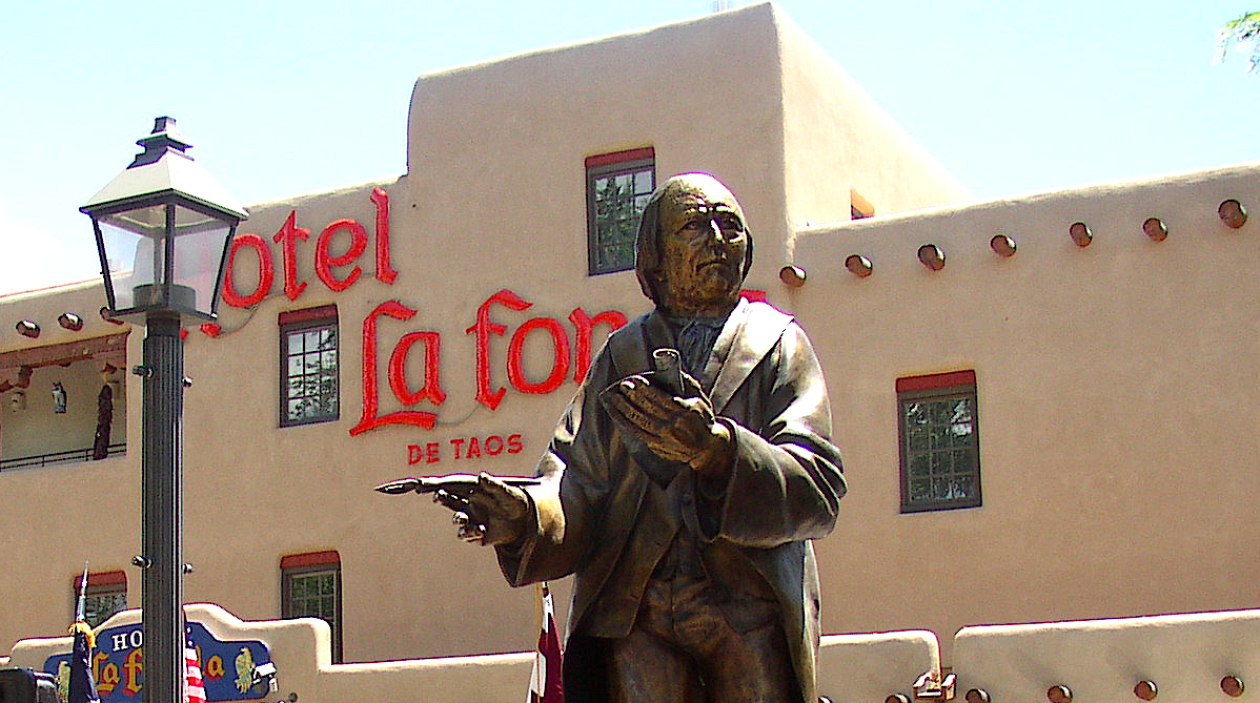
PADRE ANTONIO JOSE MARTINEZ, CURA DE TAOS Y HONRA DE SU PAIS

This website is dedicated to the person and legacy of Padre Antonio Jose Martínez (1793-1867) who during his life was known as the Curade Taos (Priest of Taos).  Upon his death in 1867, the NM Territorial Legislature called him La Honra de Su País (The Honor of His Homeland). He was orginally buried in his private chapel by his home in the center of Taos, and twenty-four years later his remains were removed to the “American Cemetery” on land that the Padre had donated for the burial of the Americans killed in the 1847 Uprising, located in what is now called Kit Carson Park.  The encomium LA HONRA DE SU PAIS/THE HONOR OF HIS HOMELAND was inscribed on his upright gravestone as part of the epitaph.  The NM State Legislature in 2004, under the leadership of Senator Carlos Cisneros, reprised that phrase in a unanimously passed resolution that provided funding for a public arts project.  Two years later, that phrase became the title for the larger than life-sized bronze memorial of Padre Martinez sculpted by San Luis artist Huberto Maestas and erected in the Taos Plaza.


Antonio José was born along the Chama River in Abiquiu, avillage established in 1739 west of Santa Cruz (next to Española) along the RioGrande. When he was eleven, in 1804, he moved to Taos together with his parentsand younger siblings.  At nineteen,Antonio José married Maria de La Luz Martinez, a distant cousin.  Within a year, his young wife died as shewas giving birth to their daughter who was named for her mother. 


The widower decided to study for the priesthood, left hisdaughter with her maternal grandparents, and made his way to the seminary inDurango where he excelled in his studies, especially canon (church) law andphilosophy. A major influence in his life was Padre Miguel Hidalgo, father ofthe Mexican nation.  From his parish ofOur Lady of Sorrows and under the banner of Our Lady of Guadalupe, in 1810,Padre Hidalgo shouted for independence from Spain.  Eleven years later, in 1821, a year before Antonio José wasordained a priest, Hidalgo’s shout for independence bore fruit.  La Nueva España, including New Mexicoand all of what is today called the “southwest,” became La Republica deMéxico.


Shortly after his ordination, Padre Martinez returned to hisnative home in Taos.  He was supposed tohave stayed for another year in Durango to obtain some pastoral experience andcontinue his theological studies.  However,he was sickly—asthma (?)—so he returned to live for awhile at his parents’ homewhere some of his younger siblings were still living. The young Padre Martinezhelped the aging Franciscan priest who was the pastor of San Geronimo (St.Jerome) parish, the main church of Taos founded at the Indian Pueblo at thedawn of the seventeenth century.  PadreMartinez also helped with baptisms, funerals, and wedding preparation at thechurch of Our Lady of Guadalupe at the Taos Plaza, about three miles to thesouth.  Guadalupe was not yet its ownparish, but was still a mission dependent on the main church of San Geronimo.


After he recuperated from his illness, Padre Martinez wasassigned to a couple of parishes where he had the opportunity to show hisspecial love for the poor—at Tomé located south of Alburquerque and at theparish of Santo Tomás in Abiquiu where he had been baptized as an infant, andwhere his wife was buried and his daughter was living with hergrandparents.  By 1825, the young Maríade La Luz also tragically died at the very young age of twelve, and within ayear, Padre Martinez was reassigned to be the priest in charge at Taos.  This was his fondest hope, now realized.


This blog will explore in some detail—through biography,correspondence and other documentation– the forty-two years that PadreMartinez spent in Taos from 1826 until his death in 1867.  I warmly invite you to MARK THIS BLOG AS ONEOF YOUR FAVORITES.  Beinteractive, and share what especially intrigues you with others who may beinterested.  Please help get the wordout.  Invite others to track this blog.


Padre Martinez distinguished himself as a religious leader,educator, journalist, author, printer, publisher, rancher, lawyer andstatesman. The last decade of his life was clouded by serious controversy withhis new bishop, the Most Rev. Jean Baptiste Lamy.  Martínez was a “liminal man” straddling the threshold of variouseras of New Mexican history–the Spanish period that lasted until 1821, theMexican period that lasted until 1846, and the American period that BenjaminRead called that most “transcendant epoch.” [Illustrated History of NewMexico, 1912]