HISTORICAL SKETCH OF THE CATHOLIC CHURCH IN NEW MEXICO
by
The Very Rev. James H. Defouri, SJ
Pastor of the Church of Our Lady of Guadalupe, Santa Fe
First Published in 1887 by McCormick Bros. – San Francisco, CA. No copyright restrictions.
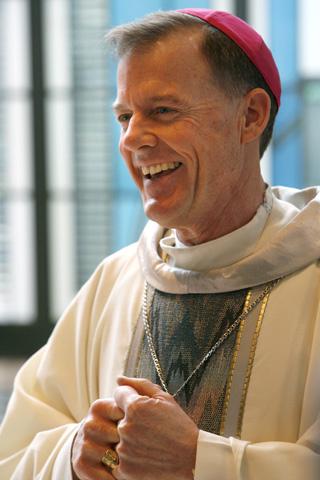
Redacted 2024 © by Rev. Juan Romero – The Taos Connection
In memory of two Jesuit mentors Fathers Tom Steele and Edmundo Rodriguez
CHAPTER I
First Attempt to Found a Mission
It is customary for a certain class of men to always assert that this continent is indebted entirely to the Saxon or Anglo-Saxon race for its population, its civilization, and its progress. These men, doubtless, forget that this is an injustice of the gravest nature. Many others who do not think for themselves follow them, ascribing to the Anglo-Saxon people the honor of winning for civilization and the glorious destiny being worked out here, a continent
[Santafeians place the population of America at 57,000,000 souls; native whites 38,601,676; native Negroes 6,566,776; native Indians 64,587; Germans 1,966,742; Irish 1,854, 5r2; British 917,598; Canadians 275,000; Scandinavians 449,262; French 106,971; Chinese 104,468, making a total of 50,907,652. I call ” natives” the sons of any of these nationalities, who are born in the United States. The other 7,000,000 are of scattered nationalities, such as Italians, Mexicans of old Mexico, Spaniards, etc. How many Anglo-Saxons are there?]
that is the inspiration and spur of both. The world forgets too often that it was a child of the Latin race, a stanch Catholic, a pious hero, who conceived the idea of the Western continent, and it was a Spanish Sovereign, a stout Catholic, Isabella surnamed ” the Catholic,” who placed at his disposal the means necessary to pursue his researches in the pathless and unknown Western Ocean. Later, the Spanish people won through the gallantry of Cortez the Mexico of today, and the splendid Territory of New Mexico is but the hopeful progeny of the civilization he planted there. If we consult the best historians of those times, we find the hero Cortez, after burning his vessels, for he must conquer or die — marching at the head of his five hundred warriors, preceded by a banner, on which was wrought in gold, a beautiful cross on a black field, and beneath the cross these memorable words: “Amici Seqamur Crucem, Friends, let us follow the Cross.”
[The best periodical in the whole West, the Monitor, published in San Francisco by the true hearted S. J. McCormick, in its No. of December 29, 1886, has the following: The Standard or Cortez. — Among the prized relics which are shown in the National Museum at Mexico, is the banner under which Cortez conquered the Empire of the Montezumas. It is of red damask, with a very beautiful picture of the Blessed Virgin painted upon it. She wears a gold crown and is encircled by twelve gold stars; a blue cloak and red dress, her hands united, as if to implore her Son to aid in overthrowing the idolatrous dynasty. On the other side are the arms of Castile and Leon. It is about three feet square and was preserved in the University in a frame under glass to prevent decay. A few years ago, it was removed to the National Museum for better preservation. Its authenticity is sustained by a series of accounts, beginning with that of Bernal Diaz, who describes how it was borne in the procession when Cortez returned thanks to God at Coyocan for the capture of the city of Mexico in 1519. (Some writers consider the history of Montezuma mythical. Others consider him a powerful monarch; it is all an error. Mexico was a confederacy, and he was the principal chief, or president. Montezuma means the “Great Chief” or “Worthy Chief”. He recited a tribute from all the States or Provinces of the Confederacy.)]
Horror-stricken at beholding the human sacrifices offered everywhere by the natives, he destroyed their idols satiated with human blood, and in their stead, he planted the Cross and built churches where devoted priests sacrificed themselves to the welfare of the Indians. Soon after the death of Moctezuma, the last of the Incas, the Spaniards were attracted towards what is now New Mexico by the wonderful tales they heard from the Indians about its great riches in gold and silver.
Cortez conquered Mexico in 1521 and crossed Mexico in 1525. Traditions still exist among the Pueblos of New Mexico as well remarks Hon. W. G. Ritch, ex-Secretary of New Mexico made in his Chronological Annals of New Mexico, that the Pueblo Indians came originally from Salt Lakes, Lagunas Saladas, far to the north. The traditions continue that Montezuma, mounted upon an eagle, subsequently led them from Pecos, where he was born, or at least where he dwelt, to the city of Mexico. They called what is now New Mexico, the ”Seven Cities,” relating in glowing terms the wealth and greatness, as well as the beauty of that country. Among these “Seven Cities” was one, pre-eminent even in those remote times, called Tiguex or Tegua, now Santa Fe.
[More than one writer doubts the identity of Tiguex with Santa Fe. But so far nothing has been brought forward, but mere assertions. On the other hand, many others are of the opinion which I follow. I regret the loss of the “List of taxes imposed upon the various pueblos,” as it was a document of real value which would go far towards proving my opinion.]
That Santa Fe was renowned at the time of the founding of the Aztec Confederacy in 1426 is very plain from the taxes it had to pay toward the general government, an account of which I have read but cannot now find. It belonged to the Province of the Tainos (or Tanos) which contained forty-thousand inhabitants. Tiguex played a prominent part at the time of the expedition I of Coronado in 1541. The land of the “Seven Cities” was called also by the name of Cíbola. Under this name, the origin of which is uncertain, it was known by the Spaniards, ten years before the expedition of Coronado. Davis says it means “The Buffalo” but searching Spanish lexicons he finds it translated “a quadruped called the Mexican bull”. Mexico was then known as the country of the buffaloes.
It would carry us too far back to speF ]. Nuño de Gusman was the first to start, but he never reached it, and after numberless difficulties he founded the Kingdom of New Galicia, establishing the seat of his Government at Xalisco and Tolona. After eight years he was deposed by the Viceroy, Don Antonio De Mendoza, and thrown into prison. Subsequently Francisco Vasquez Coronado, a gentleman from Salamanca, in Spain, but for some time established in Mexico, was appointed Governor of New Galicia. It was then that Cabeza de Vaca gave Mendoza so bright an account of Cibola that a new expedition was decided on.
[Cabeza de Vaca had, as is well-known, crossed with four companions the whole Continent from Florida to the Pacific Ocean. The learned Bandelier is of my opinion that he never crossed Cíbola, but far more to the south. Be this as it may, he nevertheless spoke as if he had visited the country.]
This expedition was placed by Mendoza, under the direction of a Franciscan friar named Marcos de Nizza, an Italian by birth, of the city of Nice. He was a man full of zeal and inured to hardship and danger. Marcos and his little army set out. from Culiacán, Friday, 7th of March 1539. He went no further than Cibola–deterred as he was by the dangers surrounding him, for he had been threatened by the Indians, if he proceeded on his journey. He planted a cross and took possession of the country, “In the name of Mendoza, for his Majesty the Emperor,” and called the country of El Nuevo Reino de San Francisco — The New Kingdom of St. Francis. s
After the return of Marcos, Coronado grew excited at the accounts of the Friar [Marcos de Nizza], set out for Mexico, and was appointed Captain-General of a new expedition. Several priests joined Coronado, and Castañeda, the historian of the expedition, was probably one of them. In any case, he was a man of education and accustomed to writing, and his narrative is far superior to most of the histories composed at that period. His book was translated into French by Terriaux Capmans, in 1838.
Coronado, having appointed his officers, mailed to the place of rendezvous, Compostela, in the State of Jalisco, in separate columns, and arrived there on Shrove-Tuesday 1541. Soon after leaving Compostela, the troops which had started in high spirits became discouraged. The soldiers did not know how to pack horses; the most refined gentlemen were obliged to be their own muleteers, and necessity obliged the noble and low-born to perform the same menial services. Difficulties increased, but Father Marcos, who was the very spirit of the expedition, encouraged the troops; thus, they advanced by slow journeys to the New Kingdom of Saint Francis.
Soon Coronado quartered his troops at Cibola, and sent before him Hernando Alvarado, who with twenty men was to accompany some Indians who had come from Tiguex [Tigue] and Cicuye [Kikue], to invite them to visit their pueblos. Alvarado treated the pueblo of Tiguex, in a very harsh manner, compelling them to leave their houses, and forbidding them to take anything with them; he sent word to Coronado to come there to make his winter quarters. This action of Alvarado was the commencement of that terrible hatred of the Indians for the Spaniards which, after centuries of suffering, culminated in the overthrow of the Spanish rule at Tiguex and of the whole of the territory.
In the Spring of 1542, Coronado set out for Cicuye and thence proceeded on the plains, and reached the river of Seven Leagues, i.e., “covered with vessels,” as told by the Indians. It appears he reached Missouri, at the place where now stands Fort Leavenworth. When, discouraged at not finding the gold he sought, he started on his homeward journey, foot sore, tired and soiled by travel, he reached again Tiguex
for the winter of 1542, and wintered there. Many soldiers and even officers, unwilling to return to Mexico, deserted the service and remained at Tiguex, and formed the first white settlement in that renowned place. These events happened at the beginning of April 1543, a date to which we can well assign, the foundation of Santa Fe as a
Mission, although it was not called by that name until 1598, when we see it called so by Juan de Onate in his Discurso de las Jornadas que Hizo el Capitán de su Majestad desde la Nueva España, a la Provincia de la Nueva Mexico, Septiembre 9,1598; a la Ciudad de San Francisco de los Epañoles que al Presente se Edifican. (Discourse of the Journeys Made by the Captain of His Majesty from New Spain to the Province of
New Mexico, September 9, 1598, the City of Saint Francis of the Spaniards, which they are Now Building.) It was then that the city took the name of Santa Fe; some authors say that for five years it was called Yonque [Yunque], but this is probably a mistake; this was the first attempt at founding a mission.
[It is possible that in 1543 was built the celebrated church of San Miguel which stands today, at least as far as the lower walls are concerned, for it was destroyed by the Indians in 1680.]
CHAPTER II
History of the Mission of Santa Fe, 1543
When Coronado returned from his expedition to the Missouri River in the Fall of 1542, he was perfectly discouraged; all discipline was at an end, and thus he passed the Winter at Tiguex. Early in the Spring he met with a serious accident, being thrown senseless from his horse, and was confined to bed for a long time, with his life in great danger. When recovering, hearing of the revolt of some Indians who had been goaded to it by the conduct of some of his officers in their regard, he was seriously affected and had a relapse. Anxious to return to Mexico, he caused his officers and soldiers to petition him to lead them back to New Spain. Soon the soldiers regretted this petition; they preferred to remain at Tiguex, and they begged him to revoke it, but he sternly refused, and shut himself up, not wishing to see anyone. They resolved to steal the petition they had given him in writing, but he kept it on himself day and night. The desertion of officers and soldiers became a stampede, and Coronado had not a hundred men to return to Mexico, which he reached only to find the Viceroy much displeased with the way he had conducted the expedition. Soon afterwards he was deprived of his province and fell into disgrace.
The Spanish settlement at Santa Fe dates, therefore, from the leaving of Coronado in the Spring of 1543. This is so true that Coronado left with the deserters Brothers Juan de Padilla and Juan de la Cruz, with a Portuguese named Andres de Campo, to wait on them. Father Juan de la Cruz went on a mission to Cíbola and was killed by the Indians.
Juan de Padilla remained for some time at Tiguex; soon he extended the sphere of his missions, and hearing of the good disposition of the Indians of Quivira, he went to visit them, but he was killed by Tejas Indians while on his knees at prayer. The Tejas did not wish him to go to Quivira, because they were at war with that pueblo. Father Juan de Padilla was afterwards buried in the church of the Pueblo of Isleta. His coffin was made of a hollow álamo, and a strange rumor of him is current among the men of the Pueblo, and the country about. It is said that no matter how deep he is buried, he always rises in his coffin to the very surface of the ground; thus, he was found two or three times. His body is within the sanctuary, on the Gospel side, between the wall and the altar platform. Whatever be the cause of this, it is worthy of investigation, as there is but little doubt that he died the death of a martyr.
Thus, for a while, the Spanish deserters and new settlers, the first Catholic mission at Tiguex, and for all that, in the whole of New Mexico, were left without the means of practicing their religion. They were not long without priests. The Franciscan Order sent more Religious to search for the lost Spaniards and to convert the Indians. Among many others are named Fathers Augustine Ruiz, Francisco Lopez, and Juan de Santa Maria. They were accompanied by twelve soldiers who came with them as far as the pueblo of Sandia, near Bernalillo. There they abandoned the priests and returned
home. Father Juan de Santa Maria came to Tiguex; he attended to the wants of the settlers, converted several Indians who had returned to their houses. He succeeded so well that he set out for Mexico to call more priests, and to give an account of his mission but he was killed by the Teguas Indians near a pueblo called San Pablo about El Paso. Father Lopez also was killed while at his devotions outside of the pueblo of Paguay on the Rio Grande, and Father Ruiz remained alone mourning the loss of his companions. Still, he was not discouraged and resolved to continue his mission. The governor of Paguay, much affected by the death of Lopez, resolved to save Ruiz by removing him to pueblos farther. up on the river, but his death was resolved, and it was impossible to save him. He was killed a few days afterwards and his body thrown into the river, then in flood, as food for the fishes. Thus, the Tegua Indians completed their bloody and unholy work, putting to death three men of God, who had come only with the strength of their charity and their zeal for the salvation of souls.
Here is the time for saying, “Fear not, little flock, for it is well known that the blood of martyrs is the seed of salvation.” The work of saving souls was progressing everywhere, and priest succeeded priest in this arduous work. Old chroniclers tell us that by the year 1629, there were baptized, thirty-four thousand six hundred and fifty Indians, and many others were in a state of conversion, and at that time there were already forty-three churches in New Mexico, all built by the Indians, except San Miguel, in Santa Fe, built possibly about or soon after 1543, and afterwards destroyed and rebuilt again, and
Our Lady of Guadalupe, also in Santa Fe, which may have been built by the Spaniards about 1598, as also other churches, now forgotten. A sure fact is that in February 1614, the body of Lopez was disinterred and solemnly deposited in the church of the pueblo of Sandia, with great ceremonies. “A number of priests” having come from Santa Fe, and the surrounding pueblos, “all marching on foot and dressed in full vestments.”
[The Franciscan Order, alarmed at the return of the soldiers to Mexico, knowing well that their priests were without help in a heathen country, immediately appealed to men of good will to go out and rescue them. Antonio de Espejo, a man of courage and faith, offered his services to the Franciscans. They accepted them, and with the royal permission, an army was fitted out, which left San Bartolomeo, in Mexico, on the 10th of December 1582.]
Espejo everywhere pacified the Indians; everywhere the numerous priests, who accompanied him, made conversions. He destroyed no property and persuaded all of the Indians to stay in their houses and be friendly with the Spaniards. All over he built churches, erected crosses, and formed settlements of white people, alongside of the Indian settlements. Espejo did much for the pacification of the Indians. Having fulfilled his engagement with the Franciscans–the three Fathers having been put to death as we have seen above–he nevertheless remained in New Mexico, visiting many provinces, making staunch friends of the Indians, establishing parishes, and forming Settlements. He returned to Mexico in the beginning of July 1584. He there wrote the Narrative of his Journey for Conde de Caruna, the Viceroy, who forwarded the same to the King of Spain and the Lords of the Council for the Indians. These documents, with many others
before and after, were deposited in the royal library of Seville, and I understand that the government of Spain is about to publish the whole, with magnificent charts, under the name of Cartas de las Indias.
[See (William Watts Hart) Davis, Spanish Conquest of NM (1869) <https://archive.org/stream/spanishconquest00davigoog/spanishconquest00davigoog_djvu.txt>]
It would be out of my purpose to write in detail the successive expeditions of Humana, who on account of his cruelty, had his army almost annihilated by the Quiviras; of Juan
de Onate, who brought over three hundred families to settle them in the territory and established most of them in the country about Santa Cruz and Santa Fe but obtained permission to reduce “the native to a slate of obedience, which he interpreted by reducing them to slavery.” All these facts were written by Padre Geronimo de Yamate Salmeron, a Franciscan who remained eight years in New Mexico, visited all the Pueblos, and went personally to Mexico to lay before his superiors the result of his mission. His journal was approved in the year 1629 by Father Francisco de Apodaca, his Superior General.
It seems that all or almost all the Indians being Christians, as well as their rulers, the Spaniards, things should have gone on smoothly. The simple-minded natives were generally of an amiable disposition, helping the Spaniards in the cultivation of their fields, and performing other menial duties. But in a few years the Spaniards began to assume the prerogatives of masters; a rule of tyranny and slavery was established. Instead of letting the priests alone to see to the conversion of the Indians, fanatical Spaniards tried to convert them with the sword. In a brief time, they looked upon the Spaniards with intense hatred; low murmurs followed, and then open revolt. They were arrested and severely punished but never resigned. Thus, it went on for centuries; the Church suffered much in those times, and the conversion of the Indians was retarded. Finally, it culminated in the great Rebellion of 1680, which shall be treated separately.
CHAPTER III
The Great Revolt of 1680
In the year 1680, Popé, a native of the pueblo of San Juan, a man of decided ability and great eloquence, visited all the pueblos of New Mexico, and pictured to them the wrongs they were suffering, and roused them to a desire of throwing off the
yoke. Popé imposed absolute secrecy on all; the pueblos were all invited, except that of Piras. Helping Popé in his endeavors were Catite, a half-breed Queres Indian, Tacu of San Juan, Taca of Taos, and Francisco of San Ildefonso. San Juan, however, remained faithful to the Spaniards, and was on that account called San Juan de Los Caballeros — The Gentlemanly San Juaneros. Nicholas Bua, governor of San Juan, Popé’s son-in-law, was put to death at the hand of Popé himself, for fear he would betray him to the Spaniards.
[Popé visited Bua at night, and under the pretext of communicating to him important secrets, drew him out of the pueblo into a dark place, and while speaking to him, plunged a knife into his heart. Bua did not expect such treatment and was unarmed. He fell with a faint cry and was soon dispatched and buried secretly by the treacherous Popé. It was reported that he had gone to Santa Fe to confer with the Spaniards. When he did not return, it was said he was held in captivity by the authorities.]
The time fixed for the Rebellion was the 10th of August; all preparations were made
to massacre every Spaniard — priest and layman in the country. But the Indians of Tesuque, a few miles from Santa Fe, although they had participated in the plot, came to the governor two days before, and divulged the scheme. The Indians, being apprised of this, resolved upon the work of destruction without delay, and all Christians, priests and seculars, women and children fell under their blows, except a few of the handsomest maidens whom the warriors reserved for wives. General Otermín, the governor, was unprepared and paralyzed with fear; the capital was besieged by an army, and Otermín with a few followers, unable to defend Santa Fe, resolved to leave it to its fate, and with all the Spaniards fled, and never rested till he reached El Paso, where the Franciscans supported him and his followers for a whole winter. Some of the Spaniards settled in Socorro, desiring to return to Santa Fe within a brief me.
In the meanwhile, Santa Fe was given up to pillage. The churches were desecrated and partly pulled down. San Miguel and the Castrense churches suffered much; Guadalupe being somewhat outside of (the center of) town fared better for a while but was sacked the following year. The Indians, putting on priestly vestments, were seen riding about the city, drinking from sacred vessels, which could not be carried away. In other pueblos and villages, the priests, and Spaniards, not being aware of the uprising, remained quietly in their houses, and were all massacred with great cruelty and wantonness; then the churches were razed to the ground; the worship of the serpent, with its dances, including the indecent Moki
<https://en.wikisource.org/wiki/The_Moki_snake_dance>
were prescribed anew to all good Indians, the estufas were reopened, and they were ordered to abandon even the names of their baptism and take new ones. It was decreed in solemn council that “God the Father and Mary Mother of the Spaniards were dead, and that the Indian gods alone remained.” They made offerings of flour, feathers, corn, tobacco, and other articles to propitiate their heathen deities. After this, all those grim warriors repaired to the little Santa Fe River, and there, divesting themselves of their scant clothing, washed their whole bodies with amole or soap-weed, to “Wash off their baptism.”
Hundreds of Spaniards, among whom were eighteen priests, besides civilized Indians, fell during the Rebellion and the withdrawing of Otermín. The loss to the Indians in the villages which defended themselves was much more considerable. In Santa Fe alone, with the scanty means that the Spaniards had, more than four hundred were killed, and many more were wounded.
On the 5th of November of the following year, Otermín, equipped by the Franciscans of El Paso, started with an army to reconquer New Mexico. All the old inhabitants of Santa Fe, eager to recover their property, went with him. They suffered greatly while crossing La Jornada del Muerto, where for ninety miles, water is not to be found, except what collects in holes after a rain.
La Jornada del Muerto is properly a tableland between mountains and is shaped like a canoe. Its width varies from five to thirty miles; a high range of mountains in the west
shuts up all approach to the Río Grande, which makes an exceptionally long bend to the west. It has been named the “Journey of Death,” on account of the number of persons killed, either by Mescalero Apache Indians, by want of water, or by storms while crossing it. Today the ATSF [Atchison, Topeka (Kansas) and Santa Fe] railroad passes through it, and water has been found in its center.
Otermín, following the Rio Grande, marched towards Santa Fe; some Pueblos submitted, but only while the troops were present. Still the priests, and particularly Father Abeyta, of El Paso, who accompanied the expedition, baptized many at
La Isleta and Sandía, but when the army reached the Pueblo of Cienegilla, near Santa Fe, Juan, a Tesuque Indian, advised them of a plot to destroy them. Afraid of remaining any longer in the country, they set out on their homeward journey and reached El Paso on the 11th of February 1582.
Several other attempts at conquest were made in 1685 by Domingo Jeronza Petrez de Cruzate, the newly appointed governor. Only fragments of Cruzate’s journal remain in the archives of Santa Fe. We know that he was governor until 1689 but never reached his capital.
In 1692, a new expedition was entrusted to Don Diego de Vargas Zapata Luján by the Viceroy, Count Galvas. He left El Paso on the 31st of August, and by rigid marches reached Santa Fe on the 12th of September. Diego de Vargas deserves more than a passing notice. It has been said that he was an avaricious and ambitious man.
It is true that later, when he had conquered all the Pueblos, and placed them under the Spanish rule, he seemed to incline to those vices, but he was a man of faith, feared by the Indians who remained his enemies, but kind and generous to those who acknowledged his rule. All of these were placed in pueblos, with the best lands which the country could afford.
Vargas carried everywhere with him a statue of the Blessed Virgin Mary, and wherever he stopped, a little sanctuary was built, and devotions were offered by the army. We may meet yet several of those places, called by the people Los Palacios, among others one near Agua Fria, five miles west of Santa Fe. He entered the city by the road called El Camino de Vargas and stood with his troops near the church of Our Lady of Guadalupe.
[The reason Vargas crossed the river was the greater facility he had of attacking the Indians from the northwest, the ground being higher and the plaza being more open on that side. Besides, what is now Lower San Francisco Street, was a grove of trees in low, swampy ground, the bed of the river not being as deep as it is now.]
Thence, crossing the Rio Santa Fe at a place called yet — Puente de Vargas, he went to the very spot where now stands the Chapel of Our Lady of the Rosary, and there
he erected a Palacio. On the next day, September 13th, Vargas with his small troop, attacked the Indians, who were centered on a waste, which is now the beautiful plaza of Santa Fe; they had fortified themselves, and were reinforced by the neighboring pueblos, to the number of ten thousand. The battle raged with great ardor on both sides from four in the morning until nightfall, without apparent result. Then Vargas, in the name of his troops on their bended knees before the statue of Mary, made the solemn vow that should he take the city, every year that same statue should be brought in a
solemn procession from the principal church in the city to the spot on which they were camping, where he should build a sanctuary, and there be left for nine days, the people flocking to the chapel to thank Mary for this victory, attributed to her.
On the dawn of day, the next morning, he attacked with impetuosity the fortified Indians and drove them from the plaza; at eight o’clock they retired upon the loma [hill] north of the city where he attacked them, and by noon not an Indian was seen in the neighborhood.
Faithful to his promise, Vargas built the Sanctuary of Our Lady of the Rosary, and the fulfilment of the vow, commenced then, still continues every year on the Sunday after the Octave of Corpus Christi, by carrying what is most probably the identical statue possessed by Vargas, and called by the people Nuestra Señora de la Victoria, Our Lady of the Victory,
[“in great pomp, with music and pious chanting, from the Cathedral of St. Francis to the Chapel of the Rosary, and for nine days Mass is chanted there, all the people making daily pilgrimages in thanksgiving for the favor received.” [[The image is also called La Conquistadora. There seems little doubt that it is Vargas’ statue. It was repaired a few years ago, and the repairs have spoiled the natural beauty of her face, for it is of fine execution.
[The church built in baste by Vargas fell into a ruinous state, and the one standing there now was commenced over the old one in the year 1807 and solemnly blessed in 1808.]
(In 1975, Fray Angelico Chavez wrote La Conquistadora: The Autobiography of an Ancient Statue, a history of this famous image, the first Marian image in what is now the United States. Bishop J.B. Lamy built St. Francis Cathedral of Santa Fe that much later became a Cathedal-Bsil iastically
surrounding pueblos submitted at once and were taken possession of in the name of the King of Spain. The priests baptized in Santa Fe seven hundred and sixty-nine persons. The work of pacifying the territory became easy, and soon universal peace reigned in New Mexico. Vargas then repaired the churches, and among the first the old church of San Miguel, but did not complete it. It remained in that state until 1710 when the front tower was built by the Marquez de la Penuela, as an inscription in the church testifies, “He (M. de la Penuela) built the Rosario (Chapel – Permissions granted 1806, building completed by 1868 – adjacent to the hillside Santa Fe National Cemetery donated to U.S. Government by the Archdiocese of Santa Fe in 1870 after the Civil War. – JR) and no doubt, repaired for his own use the old Castrense. This church (used as military chapel was located a short distance west from the cathedral-basilica, and south across the Palace of the Governors in the Santa Fe Plaza – JR) was on the spot occupied now by the great merchant houses of Spiegelberg and Don Felipe Delgado. The Cathedral of San Francisco was rebuilt later, I think about 1730, long after the removal of Vargas. The church of Guadalupe, as mentioned above, being a short distance from the center of the city, seems to have suffered less than the other churches at the time of the Rebellion.
We may well say that the conquest of Mexico terminated there, and that the power of the Indian nations was broken forever. At that epoch, the authority of the Spaniards, both ecclesiastical and civil, was acknowledged in all the pueblos.
CHAPTER IV
Los Pueblos
The question has been often raised, “Were the Pueblos placed in villages by the Spaniards, or did the Spaniards find them in pueblos or towns upon coming into New Mexico?” It requires but slight reading and examination to be satisfied that, on their arrival, the Spaniards found these people living in villages, many of which still exist. The old descriptions given by Castañeda and others about the villages of the Moquis, Zuni, Acoma, Jemes, Tiguex, Oicuye and others, are too plain to be mistaken. The people of these pueblos were doubtless of the old Mexican stock. There is no doubt of identity of race, religion, and customs between the indigenous population of Old and New Mexico. Neither is there any doubt that the description of Baco and Castañeda equally establishes the identity of the Pueblos they found with those of today. The Pueblos, then as now, were a distinct people from the wild, roaming savages. They lived in villages, cultivated the soil, and had trades and manufacturing.
The Navajos and Apaches of today, are as easily distinguished from the Pueblos as in the time of the earliest conquerors of New Mexico. Again, we find the village life of the native Mexican recognized in the earliest Spanish records of the conquest; and within four years after the landing of Cortez, provision by royal decree was made for the protection of the system. It is true that the language of the decree gives the impression that the Pueblos were then for the first time to be placed in villages; but a careful scrutiny of subsequent decrees, and of the accounts left by Cortez, will show that they were, in fact, already living in small and scattered villages, and that for safety, defense, economy of government and facilities for religious instruction, they were brought into larger communities.
We possess an edict dated June 26, 1523, one of 1533, one of 1538. Charles V, on the 21st of March 1551, also issued a decree from Cigales as it can be found in La Ley Ide la Encapilación de las Indias. Philip II, because of the intention of Emperor Charles, published a statute on the founding of settlements. It would be entirely too long to quote any part of these decrees, thus issued from time to time
by the Kings of Spain, down to the time of the revolt of Mexico. I pass to the origin of the Pueblos. The most acceptable opinion concerning the origin and race of the Pueblos is
that they are of the same people and stock as the Mexicans found by Cortez. Separated from their more favored brethren of the Valley of Mexico (and who far surpassed them in the arts of civilization) by two thousand miles of mountains and uninhabited regions, yet they were of the same origin, religion, and language. When the ancestors of those who fought Cortez were progressing southwardly, they were left, doubtless, in the Valley of the Rio Grande.
Learned treatises have been written on the subject; some contending that the Pueblos are of Aztec, others that they are of Toltec origin. But the question remains as obscure as before. Their traditions say that they came from the north. How did they come to the north? I think the opinion which says that they are the Ten Lost Tribes of Israel, mixed with some Tartars, is not at all improbable.
[According to the Chihuahua Enterprise, about four leagues south of Magdalena in Sonora, a pyramid cut in the. rock has been found with a height 750 feet and a base of 1,350 feet [about the height of the Empire State Building], with a winding roadway from the bottom, easy of ascent, and large enough for carriages; the walls are covered with debris, and the sahuaro and other indigenous plants cover the whole; the rocks about half way up are of gypsum; there are no windows and the entrance is at the top; the rooms are one above the other, but so as to leave a terrace in front of each dwelling. The next one receding several feet, and so on to the top; the rooms are eight feet from floor to ceiling. The great question is, who were the people who lived there? At what period did they live there? Some say they were the ancestors of the Mayas, a race of Indians who still inhabit southern Sonora, who have blue eyes, fair skin, and light hair. They are said to be a moral, industrious, and frugal race of people, who have a written language and know something of mathematics.]
I lately saw a work in which the author tries to prove they were Phonicians and not Jews. Classed by dialects the pueblos of New Mexico, at the period of the arrival of the Spaniards, spoke four separate and distinct languages, called the Tegua, the Piro, the Queres and the Tagnos, This classification has passed away, and today all the Pueblos of New Mexico are divided, as to dialect, into five classes:
1) Sandia, Isleta, Picuris, and Taos
2) Cochiti, Santo Domingo, San Felipe, Santa Ana, Laguna, and Acoma
3) Jemes
4) Zani
5) San Juan, Santa Clara, Nambe, San Ildefonso, Pojuaque and Tezuque.
Thus, by language, these Indians are nearly all cut off from verbal communication, not only with Mexicans, but with Pueblos of a different dialect. Some of them speak Spanish, and this is their mode of communication with other Pueblos of a different native tongue. It does not follow, however, that the groups by dialect correspond with their geographical grouping, and this is owing to the massing the Indians in larger pueblos, for the sake of economy and the facilities of instruction.
The Pueblo’s manner of building is very peculiar, and the fact that the houses of some of the primitive races, still existing in parts of Old Mexico, and those now found in the pueblo villages of New Mexico, are of perfectly similar construction and distribution, goes far to fix the identity of the modern pueblo with the primitive Mexican race.
I have visited several pueblos in New Mexico; everywhere you find a square, small or large, according to the size of the village. Around the plaza, the dwellings are erected close together to present outwardly an unbroken line of wall to the height of two or three stories. Viewed from the inner square, it presents the appearance of a succession of terraces with doors and windows opening upon them. To go to the house of the governor of Tesuque, for instance, you go up a ladder of about ten feet. There you meet a terrace about six feet wide, and the door of the sleeping apartment opens on that terrace”, which has another ladder to go higher. To go to the lower apartments, you place the ladder and descend through a hole; these apartments have no windows, and this hole is the door and the chimney. This description, with slight variations, is applicable to all the pueblo villages, however they may differ in size, position or nature of the ground.
Time, decay and want of proper care, are rapidly carrying off forever many documents of significant importance, sole survivors of many more, which formed a part of the archives of Santa Fe. Papers of value, known to have existed there some years since, have disappeared; many others are in a perishing condition, and it is said that in 1846, Governor Armijo used up a large quantity of them for cartridges; and alas! He was not the only one that did it. Among these documents the statistical ones are particularly numerous and satisfactory. Under the Spanish governments the whole military, civil and ecclesiastical administration was admirably carried out, and the official reports are models of completeness and brevity.
Father J. B. Francolin, lately parish priest of Santa Cruz de la Canada has yet in his possession a circular letter from one of the Superiors of the Franciscans to his brethren to gather up all the statistics, all facts worth preserving, and forward them yearly to the mother house at Mexico. No doubt the order was strictly obeyed. Each pueblo has a separate and independent organization of its own. Their officers are a Cacique or Governor, Alcalde, War Captain, and Fiscal Major. These officers are elected and receive their confirmation from the Indian agent in Santa Fe. The Alcalde answers to our Justice of the Peace, but his decision is without appeal. All the pueblo disputes are settled within their own villages, without any recourse to our tribunals.
The results of the impression made upon the Pueblo Indians by the early Spanish missionaries are quite marked, but sadly damaged and disfigured by the neglect of the Mexican government and priesthood, and the almost total absence of missionaries for many years. Nevertheless, every village has its Catholic church; some of them are incredibly old. For instance, at the Pueblo of Tesuque you can read the date 1745 on a roughly-painted altar piece.
Many stories are told of what passes in their Estufa (hearth in kiva?), but all this is exaggeration. However, it must be acknowledged that they have several superstitious practices and many secret societies that no one outside of the pueblo can ever penetrate. They are good tillers of the ground, and some pueblos have great herds of cattle and horses; their principal manufacture consists of pottery. The vases and other articles they make are all of classic and Biblical shapes. These vases are extensively used throughout the territory.
CHAPTER V
Governors of New Mexico
It will not be amiss here to give the names of those who have had for centuries the civil direction of New Mexico. The oldest papers found in Santa Fe bear the date of 1682, so that before that time it is difficult to form the classification needed. If anyone finds the present chapter tiresome, he may pass it over; it will be valuable to the historical student.
In 1595, Onate conquered the country, and subdued the Indians. He was the first regularly appointed and resident governor of New Mexico. For sixty-one years, down to 1656, no records can be found in Santa Fe. The reports of the governors during those years must be full of interest, showing the precise condition of the country and its inhabitants. It is highly probable that many of these reports might yet be found in the archives of Seville and Madrid. It is a common belief that Otermín carried these papers with him to El Paso, but they cannot be found there as I know from the Rev. Ramon Ortíz, for forty years parish priest of El Paso.
In the year 1600, Pedro de Peralta was governor, and lkely the first who used that title. During that period, according to Shea’s Catholic Missions [John Dawson Gilmary Shea <http://www.newadvent.org/cathen/13753b.htm>, History of Catholic Missions1529-1854 – <http://www.newadvent.org/cathen/13753b.htm>, the country was nearly abandoned by the Spaniards. Still, we find General Arguello as governor in 1640, and* he defeated the first great insurrection of the Indians. In 1650, General Concha was governor, and he was called upon to quiet the second revolt of the pueblos. He administered the Territory till 1656, when he was relieved by Enrique de Abreú y Pacheco, of whom little is known. General Villanueva administered after him, and his administration which lasted to the year 1675, was disturbed by constant uprisings of the Indians who had found refuge with the Apaches in the Magdalena Mountains. In the year 1675, Juan Francisco Francenia, who had succeeded Villanueva, had still
greater difficulties to contend with than his predecessor. He left the government in the hands of Antonio de Otermín. Forced, as we saw, to return to El Paso in 1680, he endeavored to regain Santa Fe; but deterred by the fear of the Indians, be returned to El Paso, and resigned his commission. In 1683, Bartolomeo de Estrada Ramirez was Governor and Captain General from 1684 to 1692; he filled as Governor, Don Domingo Jironza Petrez de Cruzate.
From 1692 to 1694, and again in 1703, New Mexico was ruled by General Don Diego de Vargas Zapatoz Lujan Ponce de Leon, who signs himself, Marquez de la natal de Brazinas, gobernado, capitán, restorador, conquisiador, a la Casta, reconquistador y poblador castellano, por su Majestad, etc., etc. (Marquis of the root of Brazinas, governor, captain-general, restorer, conqueror at his cost, re-conqueror, Castilian and Oastilian founder for His Majesty, etc. etc.)
Don Gaspar de Sandaval Zerda Silva y Mandoza succeeded Vargas in 1694; he was succeeded himself in 1697 by Don Pedro Rodriguez Cubero, who gave way for the second term of Vargas in 1703. From 1704 to 1710 the Duke of Albuquerque governed the Territory; but during the absence of the Duke of Albuquerque in 1705 we find a governor ad interim in the General Francisco Cuerbo y Valdez. The Marquis de la
Penuela was another governor ad interim in 1708 and succeeded the Duke of Albuquerque in 1710 to 1712 He was the first to use the word Nuevo Mexico; all the documents so far give the name feminine La Nueva Mexico.’*’ Juan Paez de Hurtado was governor for a short time in 1712 and was ad interim at different other periods. In 1712 Don Fernando de Alencaster Morena y Silva, etc., the Viceroy of New Spain, administered the Territory and visited New Mexico, when he confirmed, as governor, the appointee of King Phillip himself. Juan Ignacio Flores Magallon, who governed for five years, entered office October 5, 1712. In 1721, he was tried at Santa Fe for malfeasance in office, and condemned to pay one hundred dollars in costs, but no effects were found wherewith to satisfy the bill of costs, and as the document says: “The governor himself non est inventus (cannot be found), supposed to be absent in the city of Mexico.”
Magallón, however, did not remain governor to the time of his trial; he left in 1714 .and was succeeded by General Don Antonio Valverde Cassio, who remained only one year, when
[It is he who in 1710 rebuilt the church of San Miguel, Santa Fe, and completed it, as is clear from the inscription on the principal beam of the gallery. His full name and title was: Admiral Don Jose Chacon Medina Solajar I, Villaseñor, Knight of the Order of Santiago, Governor and Captain-General of this Kingdom of New Mexico.]
King Philip in October 1715 appointed Governor Martinez, who was qualified at Santa Fe, December 1, 1715. In 1721, Juan de Estrada y Austria, judge for his Majesty, was acting governor at the trial of Magallon. Juan Domingo de Bustamonte was then appointed by the King and remained in office until 1730. Gervacio Cruzate y Gongora governed from 1730 to 1736, and was followed for two years by Henrique do Olaride y
Michelena. His successor did not take possession until 1739; this was Don Gaspar Domingo y Mendoza. In 1744, Don Joaquin Codallas y Eabal, was governor until 1747 when he was succeeded ad interim by Francisco Huemes y Horcasitas. The following Capuchin Friar, Don Thomas Velez, was three-time governor from 1749 to 1773, at intervals.
In the year 1761, we find as governor, Francisco Antonio Maria del Valle; also at various times from 1762 to 1778 Don Pedro Fermin de Mendineita. In 1780 Juan Bautista de Anaya, and subsequently for several terms to 1800, Fernando de la ‘
Concha. His service seems to have been alternate with Fernando Chacon, who finally superseded him from 1800 to 1805.
[Joaquin del Real Alencaster, followed him to 1808. Then for several terms ad interim to 1819, Don José Manrique came. Still in 1811, we see as governor with headquarters at Chihuahua, Nemecio Salcedo; in 1815 Alberto Mayanez, and ” in 1816, Pedro Maria de Allande.]
Finally, from 1818 to 1822, Facundo Melgares governed the Territory. He is the last, governor under the Spanish rule. He is represented by Pike, whom he imprisoned for being an officer under Alencastro, as a “gentleman and gallant soldier”. Although Facundo Melgares remained in the Territory till 1822, the New Mexican government sent as “Commanding and Political Chief,” (Jefe Superior Político) Don Alejo Garcia
Conde, in the start of 1821. He was succeeded as political chief by Antonio Viscarra, who was removed at the end of 1823, and in 1824, Bartolomé Baca took the gubernatorial chair to September 13, 1825; when Antonio Narbona, a Canadian by birth, took the chair, followed by Manuel Armijo in 1827; Jose Antonio Chavez in 1828; Santiago Abreu, 1831; Francesco Sarracino, 1833; Mariano Chavez, 1835; Albino Perez, 1837. In January of that year, New Mexico, until then a Territory, was made a department of the Republic, and Perez confirmed as governor. He was assassinated in Santa Fe by the Pueblo Indians on the 9th of August 1837, and on the following day, Jose Gonzales, a Pueblo Indian was proclaimed governor of New Mexico by the insurgents, and as such placed in possession of the ” Palace” in Santa Fe.
[Manuel Armijo. at the head of the military, had him (Albino Perez) executed on the 27th of January 1838. Armijo then took the power in his hands but was subsequently confirmed by the national government of Mexico. He remained govern or till 1844, when in January of that year he was suspended from office by the Inspector-General, and Mariano Martinez acted as governor to September 18th, when Jose Chavez superseded him to December, at which epoch Manuel Armijo was again chosen governor.]
Manuel Armijo is the last governor under the Mexican rule. He remained in office till August 18, 1846, when the United States troops took formal possession of New Mexico. By proclamation from General S. W. Kearny, who commanded the troops, Charles Bent was duly appointed the first U. S. Governor of New Mexico. Charles Bent was assassinated at Taos, July [Correct month: January – JR] I7, 1847, and Donaciano Vigil was confirmed in his place; the following years to March 1851 were without a civil governor, the Ter-
* Albino Perez deserves a passing notice. He was a native of the city of Mexico; a man of education, he established schools everywhere. He never missed church on Sunday, going as military commander to the Castrense, or military chapel, and as political chief to the church of San Francisco, now the Cathedral. It is known that the garrison, who lived in the Oratorio near the palace, said their Rosary every day.
To sustain his schools, he established a commission to levy taxes to pay half of the salary of the teachers, the general of Ternmeut [?] paying the other half. This angered some men of weight in the Territory, and they formed a plot against him in Tans[?] and Rio Arriba. They roused all the Pueblos, of the north, persuading them that the Governor desired all to learn the language of the Americans, to deliver them to the strangers. In a short while a thousand men were under arms, massed at Santa Cruz. They marched upon Santa Fe; Perez with twenty-five soldiers went to meet them, and he had the courage to attack them at a place called Puertecito. Two of his officers and some soldiers fell on the field; Perez fled to Santa Fe with some of his officers, closely pursued by the rebels. They at once mounted horses, and started for Mexico on the large road called Camino de Vargas, but the Indians of Santo Domingo were
[territory?] being successively under the command of J. M. Washington and John Monroe, commandants of the Department.
On the 3rd of March 1851, the Organic Act passed Congress, and the Territory came again into the hands of civil governors as follows: 1851-52, James Calhoun who died
June 30, 1852, and Secretary John Greiner, served by virtue of his office; 1852-53. “William Carr Lane; 1853-57, David Mariwether; 1857-61, Abraham Rencher; 1861-66, Henry Connelly; 1866-69, Robert B. Mitchell; 1869-71, William A. Pile; 1871-75, Marsh Giddings who died June 3, 1875 and W. G. Ritch, Secretary, served by virtue of his office; 1875-78, Samuel B. Axtell; 1878-81, Lewis Wallace; 1881-85, Lionel A. Sheldon; 1885, E. G. Ross who now occupies the “Palace” as governor.
This list is as complete and as reliable as possible [<https://en.wikipedia.org/wiki/List_of_Governors_of_New_Mexico>] and could be found in the office of the Surveyor General, H. M. Atkinson when he was in office. [Gen. Atkinson resigned his office in 1883, and after a long sickness died in October, 1886.]
CHAPTER VI
Religious State of New Mexico Under Mexican Rule
Spanish rule in her fair domain. Like the surge of the ocean, deep, low murmurs were heard on all sides, and penetrated far into the Provinces. The year 1810 witnessed the first struggle for Independence under Hidalgo. It had been quickly repressed. But the spirit of Independence had penetrated the very people. Too often the proud Spaniard had made the Mexican feel that he was of pure Castilian blood; it could
be borne no longer.
In Europe, Napoleon Bonaparte, like a “bright meteor, illuminating the heavens for a moment, and then passing away in total darkness, had run over Europe as over his own domains; he had set crowns over the brows of all the Bonapartes, and Spain did not escape. But when Napoleon had passed away, pining on the ” Forlorn rock,” amid the billows of the Mediterranean, the Bonapartes of Spain had quickly descended the steps of the throne, and the Treaty of Paris had restored to the bourbons the throne of Isabella, the “Catholic,” but — oh! what ruins! what weakness!
Now was the time. The Mexicans assembled in ayuntamientos, and ordered away all Spaniards from Mexican soil, and on September 28th, 1821, Mexico published her Declaration of Independence of the Spanish rule. The [up]rising succeeded at once; it became general, and no Spaniard was left in the country unless identified with his adopted country. It was not a bloody revolution, although a few lives were lost here and there, and many a Caballero returned penniless to the mother country.
Even before the uprising of 1821, New Mexico had felt the commotions of the volcano upon which the country stood. In 1812, Knights Baird and Chambers brought merchandise overland, but were treated as spies and their goods were confiscated. No serious troubles were felt, however, owing to the strength of the governor, Joaquin del Real Alencaster. One of the first acts of the new Republic was from the Legislature, called ” Provincial Deputation” [of] April 27th, 1822, which issued a decree to establish public schools, as follows:
Resolved: That the said ayuntamientos be officially notified to complete the formation of primary public schools, as soon as possible, according to the circumstances of each community.
On April 5th, Francis Xavier Chaves reached Santa Fe as political chief, and with him a government was inaugurated. The overland trade with the United States virtually dates from the same year. In the year 1824, Bartolome Baca was sent as political chief, with the instruction of forming one State of Durango, Chihuahua, and New Mexico. Baca resided at Chihuahua for a short time. New Mexico became dissatisfied about the new arrangement and listened to overtures made by the United States to join the American Union.
From its first settlement, the Province of New Mexico had been under the Bishop of Guadalajara. But about 1730, the See of Durango having been erected by the Holy See, all the churches of New Mexico were placed under the care of its Bishop, who for the first time in 1737 visited’ this vast Province, the northern part of his diocese. From that time, for nearly one hundred years, hardly any Bishop visited this country, till the Most Rev. Zubiria who at great peril and hardship visited the New Mexican part of his diocese.
After the Mexican Revolution of 1821 and the expulsion of the Spanish Franciscans, the wants of the parishes at first so flourishing under the saintly Friars, were supplied by secular priests sent from Durango. It is easy to understand that all the missions could not be supplied, and that living thousands of miles away from the bishops of the diocese, the discipline must have considerably relaxed.
Early in the eighteenth century, the erection, of a See at Santa Fe had been urged upon, and although a royal decree later and a special bull of the Pope, in 1777, ordered the “Erection of a College,” nothing was done. In 1798, the Franciscans had eighteen Fathers with twenty-four missions; in 1805, they had increased to twenty-six Fathers and thirty missions; and when they fled the country in 1821, there were twenty Indian Pueblos and one hundred and two Spanish towns or ranches, all attended by Franciscan Fathers, except Santa Fe, Albuquerque and Santa Cruz de la Cañada, where secular priests were stationed. When the Most Rev. J. B. Lamy, D. D., reached Santa Fe in 1851, he found twenty-five churches and forty chapels, many in a ruinous condition. The priests, all Mexicans, were very few. In those thirty years the Church experienced great losses in New Mexico. Through the want of care of both the Mexican government and Mexican clergy, the province was destitute of educational establishments of any kind. In 1832, Rev. Juan Felipe Ortiz, was appointed Vicar for the Bishop of Durango, with residence at Santa Fe. A fact to be noticed, notwithstanding the lack of education
during that sad period, is that on November 29th, 1835, the first printing press was brought to the Territory by Cura Martinez, of Taos. The first newspaper issued on that day was called El Crepúsculo (de Libertad — The Dawn of Liberty) It was issued for four
weeks; its size was letter sheet.
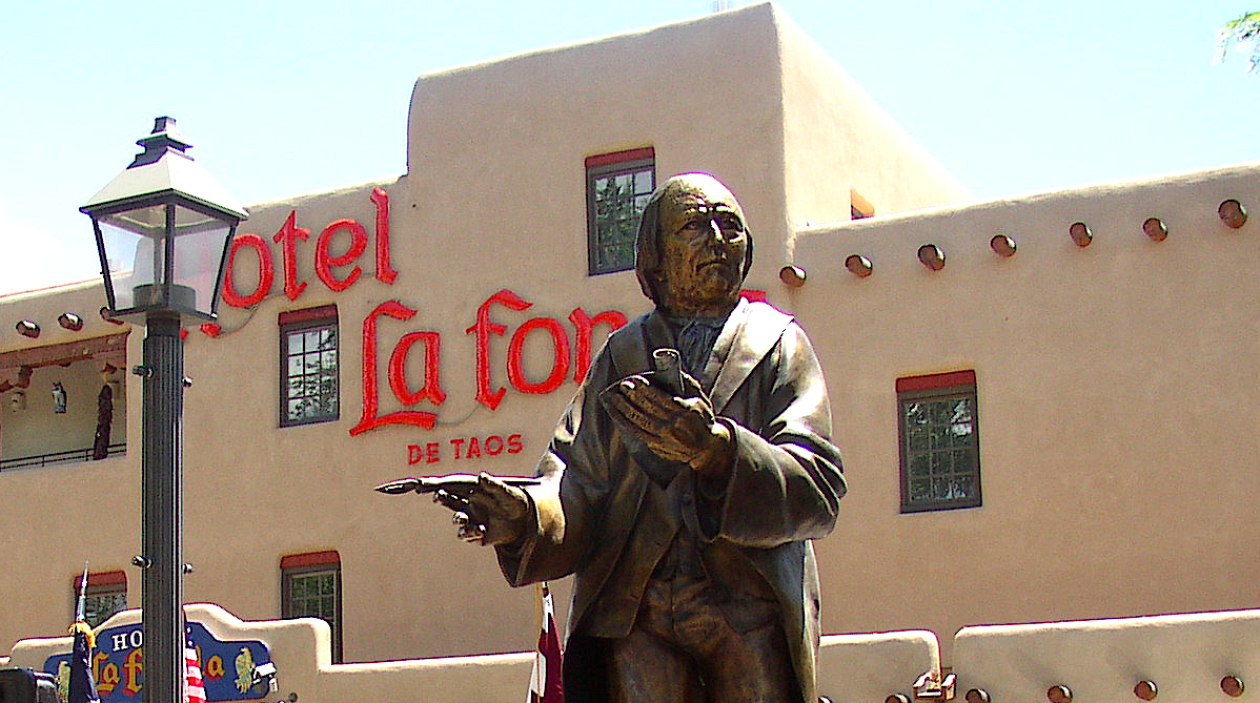
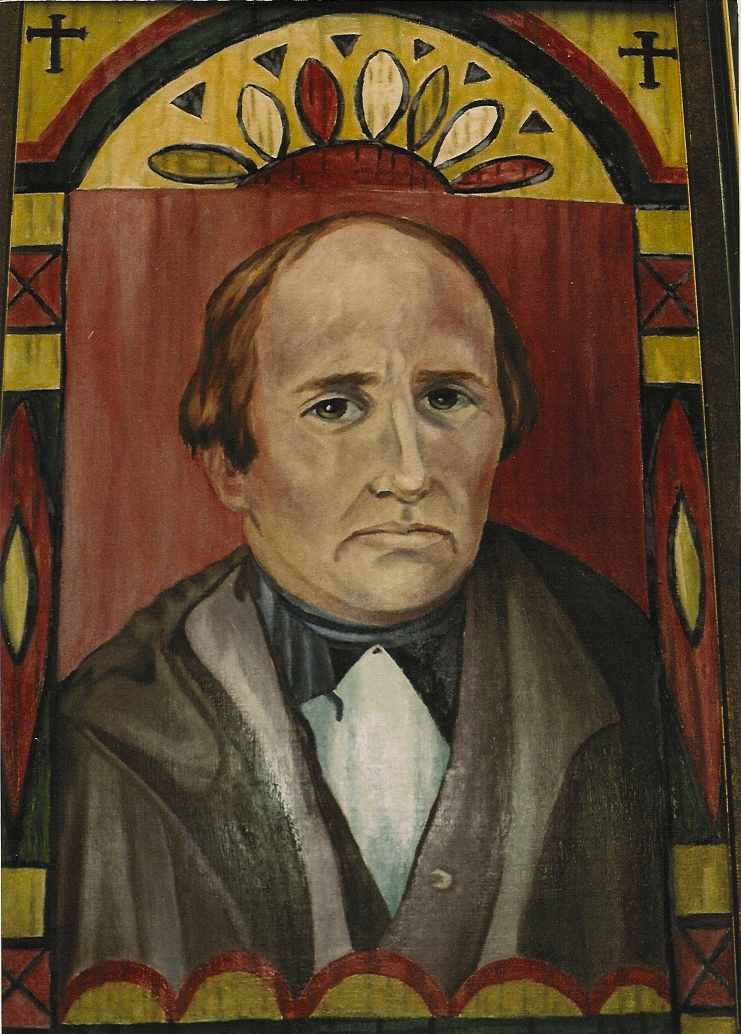
[Father Difouri notes that the short-lived El Crepúsculo was printed on Eitch (?) Blue Book. Although he credited the newspaper to Padre Martínez, Father Difouri fails to mention several other educational accomplishments of Padre Antonio José Martínez, Cura de Taos. In 1826, he founded at his residence an elementary school for girls and boys, a minor seminary in 1833, and a law school in 1846. In addition, the Padre published a speller for the children of the Martínez Family, and on his own printing press the first book in New Mexico (a Bilingual Ritual in Latin and Spanish), a variety of religious booklets and pamphlets, the first newspaper of the area (short-lived El Crepúscuo de La Liber tad), his autobiography, an account of the 1837 Taos Uprising as well as other items. Having been invited by General Kearny to become first citizen of NM in 1851, the Padre lent his printing press for the printing of the Kearny Code.]
In the meanwhile, New Mexico suffered greatly from the frequent revolutions and pronunciamientos, issued in the mother country. The provincial deputation had given way as a power; a President of the Republic was created in 1825 and Guadalupe Victorio was inaugurated April 1. He was succeeded by Santa Anna in 1833, and was himself overthrown in 1835 and a new constitution adopted. All these revolutions
were felt in New Mexico both by the Church and the State,
and religious as well as civil progress was retarded.
Much dissatisfaction was felt with the new constitution and it culminated in a conspiracy by the Indians in 1837, against the governor Albino Perez, and he was assassinated -by them as we have seen, and the half-breed Indian Jose Gonzalez, proclaimed provisional governor.
It was this dissatisfaction of a part of the people of New Mexico, which gave rise to the famous Texas-Santa Fe expedition, which terminated so disastrously for the Texans. The expedition started from the Valley of Brush Creek, near Austin, June 21, 1841, under General McLeod. Many of those who composed it had nothing else in view than trading and brought a great amount of merchandise. But this was not the
view of General Lamar, the President of the ” Lone Star Republic.” Texas claimed the Rio Grande as her western boundary; many in that eastern half of New Mexico, seemed to desire their coming and throw off the galling yoke of Mexico, and Lamar with his associates, who kept their secret, wished these young men to reduce Santa Fe under the rule of Texas.
All know how they were roughly handled by General Armijo, when, after untold hardships, they were met at Apache Canon, made prisoners and tied together like cattle, sent to Mexico City. It is not my purpose to write the history of the
Texas-Santa Fe expedition. It has been well-written by George Wilkins Kendall, although he is somewhat inimical to the Catholic church, but I think more through ignorance than malice. No book can give a clearer idea of General Armijo than Kendall’s “Narrative.”*
August 18, 1846, brings us to the American occupation of New Mexico by General S. W. Kearny, and to an era of both religious and political prosperity for the Territory. New Mexico was so far back, on that year, that it is asserted that ” adobe palaces,” alone in the Territory had window glass. The Church and the Territory gained nothing by the Mexican rule, and it cannot be said that the government was favorable to religion, and there is no doubt that many of the leading men enriched themselves out of the funds of the Church.
* Kendall’s narrative may be somewhat strained, but it is certain that on the occasion referred to Armijo showed himself to be a cruel and cowardly tyrant. When the poor prisoners were chained to march on foot to Mexico City, he ordered his cruel lieutenant to shoot down anyone who could not keep up with the others, “and bring him the ears,” and it was done to the letter; five of them were shot, and their ears brought as trophies to Armijo.
CHAPTER VII
Erection of the See of Santa Fe
*The Most Rev. J. B. Lamy, the first Archbishop of Santa Fe, was born on the 11th of October 1814 at Lempdes in the Department of Puy-de-Dome, France. His parents were Jean Lamy and Marie Die. His venerable father belonging to one of the principal farming families in the country, was for years Maire of Lempdes, his native parish, and gained by his piety, generosity and unflinching rectitude, the esteem of both his fellow citizens and the French Government. His mother was known as a woman of refined attainments and great piety.
Jean Baptiste was the youngest of eleven children, of whom eight died in infancy, three only remained, the joy and pride of their truly Christian parents, two boys and a girl. Etienne, the oldest of the three, entered the marriage state and handed down the religious traditions of the family, giving to the Church several of his children. Among them, we find the well-known Mother Francisca, the actual Superior of the Sisters of Loretto in New Mexico and the lamented Father Anthony Lamy, who in the vigor of his priesthood, died Feb. 6th, 1876, at Manzano, the victim of his untiring zeal, besides others who settled in the world and became ornaments to society
John Baptist’s sister was named Margaret. Early in life she entered the house of the Sisters of Mercy in her native land, and received the name of Soeur Marie. Later, in 1848, she was sent to America with her brother who had made a journey to France, and she died at New Orleans, Louisiana, in 1851 whither she went to accompany her holy brother lately consecrated Bishop of Santa Fe.
John Baptist was at an early date sent to the Royal College and petit seminaire of Clermont. His progress in that truly religious institution was remarkable, both for science and piety. He followed the studies of the college with great success, was loved both by his superiors and companions for his strict obedience and kind disposition of heart, and his college course was a happy time for him and a blessed one for his good parents. He was naturally so kind, so innocent, that his little companions had named him ” the Lamb.”
From the College of Clermont, where he successfully completed his course of philosophy, he passed to the Grand Seminary of Montserrad to commence his theological studies. If he had been a good and happy boy at college, he was at
Montserrad, no less a scrupulous and yet cheerful seminarian. The strict obedience to rule as practiced in French seminaries, and particularly in the seminary of Montserrad, is wonderful. The young seminarian followed all the rules with religious scrupulousness. It was there, amid retirement and meditation, that was developed that vocation for the
mission which he had already felt moving his heart at college while reading those wonderful acts of mortification, love of God and even martyrdom of Missioners, contained monthly in the “Annals of the Propagation of the Faith.” [At that time, these ” Annals” were called Zettres edifiantes.]
It was there that he perfected those virtues which were to make of him not only a good priest, but an untiring missionary in the West, and which culminated in his rising to the highest post of honor, and of labor as well — in the vast Territory of New Mexico.
The pious seminarian, having completed his theological studies, was called successively to tonsure, minor and higher Orders, until finally on the Ember days of December1838, he received the priesthood at the hands of the venerable
and ever to be remembered Mgr. Ferron, more than forty years Bishop of Clermont, who appointed the new priest vicar at Chapare, where he remained only a few months.
In 1839, the lamented Dr. J. B. Purcell, late Archbishop of Cincinnati, made a journey to France and Ireland, to supply with priests his new and vast diocese and increasing population. The burning desire for western missions, with all their sufferings and dangers, was revived in the heart of the young vicar; his zeal could not contain itself, he saw Dr. Purcell, applied for admission, obtained his Ordinary’s blessing, and in
the summer of that year started for the scene of his many labors, with his new Bishop, forming one of a large party of priests and levites. The holy band gave to America such men as Rev. de Goesbriand, Bishop of Burlington, Rt. Rev. A. Rapp the first bishop of Cleveland, Et. Kev. P. J. Machebeuf, bishop of Denver, Colorado, and those Fathers, who, without receiving the mitre, worked so hard in the American portion of the
Lord’s Vineyard: Fathers Navarron, Gacon and Cheymol. Some of these have received their reward in Heaven for leaving behind all they held dear, to work without ceasing for the glory of God, and the salvation of souls. The zealous young missionary was appointed to several missions in Knox, and three other counties in Ohio. For eight
years his labors were blessed by numerous conversions in Gambier, Mansfield, Ashland, Londonville, Wooster, Canal Dover, Massillon, as far as Canton and Mount Vernon, in particular, where he resided frequently, although he made his
home at Wooster. He was afterwards transferred to Covington, Kentucky, where he spent three years amid the most arduous duties. These missions were not, then, without much labor and danger. The settlements were extremely scattered, the means of traveling few and of primitive style, the rivers were bridgeless, and the people exceedingly poor and lonely. The Catholic church was viewed with distrust and even jealousy and anger by many non-Catholics, and its progress interfered with. It mattered not; the young missionary had come not io look back, holdingthe plow, but
to look steadily forward.
Eleven years were thus spent for the Lord, when in 1850, Father Lamy was created by the Holy See, Bishop of Agathon in part. inf. and Vicar Apostolic of New Mexico. No time was to be lost, and so, with his usual energy, the young Bishop, only thirty-six years of age, repaired to Cincinnati, was consecrated by Dr. Purcell on the 24th of November 1850, and immediately after, set out to ” conquer” his See, if I may use
the expression. His trials at New Orleans, his shipwreck in the Gulf, his sickness, and his hardships through Texas, and the difficulties he met after his arrival, justify me in calling him a conqueror.
Leaving his sister at the hospital of the Sisters of Charity, and his niece, Mother Francisca, then a young lady, at the Ursuline Convent in New Orleans–although these two were delayed and did not arrive immediately–he embarked alone on a vessel sailing for Galveston and went safely through the dangers of the deep sea. But when nearing the Port de LaVaca, a terrible northern windstorm arose, and the vessel was shipwrecked close to the shore. All on board were saved, but everything was lost; church articles, vestments, sacred vessels carried with much care for the missions, clothing, books— all were lost.
Once, while a guest of Dr. Lamy, I espied some volumes in his library, that seemed to have received a thorough soaking, and looked like veterans battered in war, amid new recruits. I inquired of the venerable Archbishop the meaning of it. His
eyes sparkled; a smile lit. up his kindly face, and he told me that they were fished out of the waters of the Gulf. With great kindness, and even joy at the remembrance, he described to me his shipwreck, his desolation at having lost everything, until spying quite near the shore one of his trunks drifting seaward, he offered a small sum of money to a young negro boy, who swam to the trunk, and, pushing it before him
as he swam shoreward, brought it to land. It was opened. Oh! in what condition! The books in my hands were of those saved in that one trunk; all else was lost.
Anxious to reach his destination and be at work in his immense field of labor, behold the young bishop, seated in a common cart, with his solitary trunk for baggage, driven by a Texan, starting for Santa Fe, on the then almost trackless desert, nothing daunted by the distance, the fear of wild beasts, rivers of brackish water, with precipitous banks, want of provisions, utter solitude, having to cross the haunts of wild Indians roaming over the prairies, always alert for booty and bloodshed.
Nearing San Antonio, the cart being about to upset, the bishop jumped to the ground; but alas! he fell upon brambles and badly sprained his ankle. Happily, only a few miles
away was San Antonio. He was conveyed there and thanks be to God, he was received in the house of the priest, Father Calvo. Nearby was the residence of the worthy family of Dignowity, well-known throughout Texas, a family of stanch Catholics, and keeping up to the letter all the Catholic practices of their old European home. There he lay for eight months before he could set his foot on the ground and restart upon his arduous journey. This worthy family were untiring in their attention to the noble guest of their pastor, and it is owing to the care of the good priest and to theirs that he got well at all, and does not still suffer from this painful accident. Had it not been for them he would have been, most probably, a
cripple for the balance of his life.
During his forced stay at the house of Father Calvo, an event happened which bound the Bishop still more closely to the family Dignowity. A son was born to them, and nothing would do but that he stand for the child. The Bishop assented and amid the rejoicings of the family and neighbors, Charles J. Baptist Dignowity, received the Sacrament of Baptism and the Bishop stood as godfather.
Finding himself getting tired [?] and anxious to take his flight towards his expectant flock, he resolved to resume his journey and soon set out amidst the regrets and blessings of his friends. I pass over the untold toils, hardships, and dangers Dr. Lamy went through during this perilous journey. He reached Santa Fe in the summer of 1851, after a journey of nine months since his setting out from New Orleans.
In Santa Fe, old persons relate a fact which shows their faith. The ground was parched for want of water, all the water courses and ditches were dried up, sheep and cattle were in a dying condition, and poverty was staring in the face of the people. But on the day of the Bishop’s arrival, a bountiful rain fell and animate and inanimate nature was refreshed, grass sprung up, and the year was one of plenty.
Though arrived at his destination, the Bishop soon found himself surrounded by great difficulties. Both the clergy and the people were unwilling to acknowledge the new prelate’s authority. The reason given by authors who have spoken of
this fact is, they say, that before its annexation to the United States, New Mexico being under the jurisdiction [ecclesiastical authority] of the Bishop of Durango in Mexico, the latter, had not had time to inform this distant portion of his flock of the action of the Holy See, in erecting the new diocese of Santa Fe. This is not quite correct,
and the facts are contrary to it.
[It is true, as Father Difouri asserts, that it “is not quite correct” to assert that Bishop Zubiria of the Diocese of Durango “did not have time to inform” the faithful of northern New Mexico about the change in ecclesiastical jurisdiction, i.e., change in episcopal authority.
American forces four years prior in August 1846 had occupied northern New Mexican territory under the church authority of Bishop Zubiria of Durango in the Republic of Mexico. After two more years, by February1848, this change was ratified in the 1848 Treaty of Guadalupe-Hidalgo between the United States and Mexico. Civil authorities of both nations accommodated to the new political situation within a brief period, but adjustment within the sphere of church-state took much longer. It was not for two more yars, in 1850, that the bishops of the United Sates met in Baltimore in1850. One of the items on the agenda was to petiiton Rome that New Mexico become a new diocese dististinct from its mother Diocese of Durango in Mexico and be attached to the Archdiocse of St. Louis, Missouri in anticipation of becoming a diocese in its own right. attached to the, and one of their actions was to promote a bishop for New Mexico now part of the United States. y had taken place in August 1846, four years prior to the arrival of had two years yy American forcess after 1848 Treaty pf Guadalupe Hidalgo and the occupaiton bthe occupation of Father Dufouri lays out a narrative]
The saintly Bishop of Durango,
Dr. Zubiria, had been advised in time, and had immediately
set out for New Mexico, visitig every mission of the diocese,
and performing everywhere his episcopal duties. But he had
not been consulted in the dismemberment of his diocese, and
he felt quite unwilling to quietly stand by it. The clergy bad
another reason, they had been living at ease, twelve hundred
miles from their Bishop, and they dreaded the presence of
the new prelate among them; I might add, that many of them
were utterly opposed to American rule, either civil or ecclesi-
astipal.
The indefatigable Dr. Lamy set out on horseback, with a
solitary guide, for the city of Durango; he had an interview
with its Bishop, and everything was settled amicably. With-
out taking time for rest, he returned, having performed a
journey of three thousand miles on horseback.
In his new diocese he found but few priests, while it was
destitute of educational establishments of any kind. The
young bishop put his hand to the grand work of building up
Catholicity with an energy that cannot be overpraised. His
adventures and long, journeys over the vast plains extending
from Kansas City to Fort “Union, plains with no inhabitants,
then, save wild beasts and roving Indians, border on ro-
mance. Though about nine hundred miles in extent. Dr.
Lamy crossed these plains twelve times for the welfare of his
vast diocese.
HG CATHOLIC CHURCH I» NEW MEXICO.
CHAPTER VIII.
Dr. Lamy 0BTAl^fs Sisters of Loretto. — Their arrival at Santa
Fe. — Their Success.
Bishop Lamy, ever anxious for the good of his diocese, de-
sired to enrich it with devoted Sisters, to teach the young,
knowing well that this was the best way to reach the people.
Having heard of the sell-denial of Father Nerinckx’s spiritual
children, and of the severe training they had gone through,
he concluded that they were the very ones whom Divine Provi-
dence had designed for the laborious missions which the Holy
See had confided to his care. He applied for a colony of Sisters,
and his request was cheerfully griinted. Faithful to its tradi-
tions, and to the injunctions of its founder, Loretto could not
refuse a mission which seemed to promise nothing but hard-
ships and privations,
Early in the Spring of 1852, the missionary Bishop left Santa
Fe to assist at the First Plenary Council of Baltimore^ cross-
ing for the first time the dreary waste called with reason, the
” American Desert.”* In tue commencement of Jane ‘he
reached Bardstown, and prepaiations were soon made. But
before returning to New Mexico, the Bishop went to New Or-
leans, to visit his niece who was still at the Ursuline Convent,
since his departure for Santa Fe.
“On Sunday,” says Mother Magdalen in her “Annals of Our
Lady of Light,” June 27, 1852. after Mass, the Sisters destin-
ed for Mexico, left the Mother house of Loretto; Mother Ma-
tilda Mills and Sisters Catherine, Mary Magdalen, Monica,
Hilaria and Roberta. The same day they arrived at Bards-
town, and on Thursday morning, July 1st, they reached St.
Louis, and were kindly received by Archbishop Kenfick. In
the meanwhile they visited the Convent of St. Ferdinand, at
Florissant, and spent a few days with their own Sisters. As
soon as they heard of the Bishop’s return from New Orleans,
* It was at that Council thatu petition was made by the Fathers to the
Holy See, to have Dr. Lamy appointed titular Bishop of Santa Fe. The
Bulls were not delayed, and the Bishop of Agathon became Bishop of
Santa Ffe.
CATHOLIC CHURCH IN NEW MEXICO. 37
they joined him at St. Louis, and on the 10th of July left
by the steamer ” Kansas,” which was to convey them as
far as Independence. Wi4h them traveled a family and
some other’ persons belonging to the Bishop’s suite.
The Sisters had accepted the mission in a true spirit of
self-abnegation; yet they little dreamed, as the spires of
the city receded from vieWj how soon Providence was go-
ing to put their virtue to a test. There had already been
some cases of cholera on board,when, on Friday, the 16th,
at two A. M., Mother Mathilda was attacked; her sufferings
lasted till about two o’clock in the afternoon of the same
day, when she gave her soul into the hands of her Maker,
after having received the sacraments of penance and Ex-
treme Unction at the hands of the Bishop. Two hours
later the steamer landed at Todd’s Warehouse, six miles
from Independence. In the meantime Sister Monica had
also contracted the disease, and the landing was truly af-
fecting, the Sisters following the couch of their dying Sis-
ter and the coffin of their dear Mother. The inhabitants
stood in such dread of the cholera that the Sisters were
not allowed to enter their houses, and were therefore ob-
liged to remain in the warehouse.”
The next morning, July 17th, three of the Sisters, with
the Bishop and some other persons, accompanied the car-
riage which conveyed the corpse of Mother Mathilda to its
last resting place, in the graveyard of Independence. But
on the way they were met by a Sheriff who had been de-
puted by the authorities to forbid entrance into the town,
for fear of contagion. However, the Bishop’s firm atti-
tude, and perhaps, too, compassion for the sad spectacle,
caused this official to relent. They continued their way to
the graveyard, and there they saw the cold earth receive
into its bosom the remains of her whom they had loved and
reverenced.
” The Bishop,” continues Mother Magdalen, quoted by
Bishop Maes, ” now took the three Sisters, Catherine, Hi-
laria and Boberta, to the town and left them there, Vhilst
Sister Magdalen remained in the warehouse with Sister
Monica. But on the night of the following Monday, July
18th, Sister Magdalen herself was attacked with the chol-
38 CATHOLIC CHUECH IN NEW MEXICO.
era, and made what she believed to be her last confession.
The place being ill-suited for Jadies, especially religious
ones, sick unto death; the Bishop, unable to make better
arrangements, had the two dying sisters removed to tents
about two miles from the town. The poor Sisters were
much better oflf than in the warehouse, although they had
many inconveniences to bear, and had nothing but the
canvas tent to screen them from the heat of July.”
After a few days Sister Magdalen began to recover. On
Sunday, July 23d, the three Sisters came from Independ-
ence, and heard mass said ^by Bishop Lamy in a tent. It
was impossible for Sister Monica to proceed any further,
her recovery being doubtful, and in spite of her great de-
sire to pursue the journey to New Mexico, she returned to
Independence until her health should be sufficiently re-
stored to return to the convent at Loretto. As Sister Mag-
dalen could travel in a carriage, although very weak, they
left Independence on Saturday, July 31st, to go into camp
some four miles distant, where the Bishop and part of his
suite (tor the others were waiting at Willow Springs) had
already encamped. There the Sisters went to confession,
and the next iporning received holy communion at the
hands of the Bishop.
After the death of Mother Mathilda, Sister Magdalen
was chosen to fill the office of Superior, and this election
was promptly approved and confirmed at Loretto. Thus
was Mother Magdalen chosen in the designs of Provi-
dence to guide this young colony-of Sisters to Santa Fe;
to protect them against all the blasts of trials and difficul-
ties; to build for then) the material and spiritual edifice of
their order in Santa Fe; to create schools and academies
to the honor of Our Lady of Light, the finest edifice in
America, a chapel which can compare advantageously with
any of the kind, even in Europe — but more about it later.
Dear Mother Magdalen, after thirty years of untold toils
and privations, has been stricken down by palsy, but her
head and her heart are as warm and as sound as ever, and
although she gave up the charge of the flourishing commu-
nity into the hands of another self. Mother Francisca Lamy,
she is still the guiding spirit of the institution — a broken
CATHOLIC CHUBCH IN NEW MEXICO. 39
flower, but keeping all the perfume of virtues and science
■which animated her active life.
On the evening of August 1st they reached Willow
Springs, a fine watering place a fe\y miles from Westport,
and there found the other party ready to start. So they
lost no time, and started all together; but they had pro-
ceeded only a few miles when one of the wagons broke
down, and there they were obliged to camp in order to re-
pair the wagon.
That night was a terrible one for the travelers. A fear-
ful storm arose; the wind blew with violence; the rain fell
in-torrenta; the tents could not be pitched, and all, tha
Sisters and other liEidies of the party, had to remain in the
wagons and prptect themselves as well as they could against
the beating storm. It lasted the whole night, and the
warring elements seemed to bid each other defiance.
Mother Magdalen, who records the fact, says that the Sis-
ters were much terrified at the fury of the storm, which at
times seemed ready to shatter to pieces their frail tenement,
and they sought protection in prayer.
The Bishop, regardless of the storm, was everywhere,
with his usual and untiring energy, now encouraging the
frightened Sisters, then giving directions to the muleteers,
saving the party from another dreaded accident, the stam-
pede of the animals; visiting the traveling party, never
taking any rest until every one was as comfortable as pos-
sible, thus acting the part of a father with all.
Some time was spent the next day to repair damages.
On the following Sunday, the 8th, the Bishop said mass
near an Indian hut on the banks of the Hundred-and-Ten
creek. Thence they passed Burlingame, and on the eve of
the Assumption reached Council Grove. All confessed
that evening, and on the next morning received commun-
ion at the hand of the Bishop. The Sisters,, according to
their rules, renewed their vows at the time of mass. The
next day the march was resumed, and no mass was said
until they reached Pawnee Fork, on the spot where now
stands the town of Larned, at the junction of the Pawnee
river and the Arkansas. For the first time, buffaloes were
killed by the party, and fresh meat enjoyed.
40 CATHOLIC CHDBCH IN NEW MEXICO.
Eesuming their march, on the 7th of iSeptem|)er they
passed the then existing Fort Atkinson, and encamped
some miles beyond, but still in Kansas, when a parly of
Indian warriors four jjiuadred strong fell upon them and
surrounded them. All were terrified, particularly the la-
dies. This was the Indians’ hunting grQund, and when-
ever they could do so with impunity, they would attack
caravans. On this occasion they seemed peaceable; the
Bishop was even enabled to baptize the child of & captive
Mexican woman. Still as their intentions were not known,
and the Indian is often treacherous, the Bishop thought
prudent not to make any move, hoping they would retire;
but as they seemed disposed to remain, he ordered his
company to march in the evening, and the caravan trav-
eled all night, as the Indians do not generally make their
attacks in the dark.
The Arkansas was crossed, and on Sunday, 12th of Sep-
tember, Cimarron was -reached. On the 14th Very Rev.
P. J. Machebeuf*, then Vicar- General, with a party of
men and animals, met the caravan near Red Biver. I need
not say how agreeable and affecting was that meeting, and
the assistance it brought. Near Fort Union they were sup-
plied with fresh meat and fresh bread, a most welcome
food after the hard tack of the journey, which was fre-
quently rationed. Las Vegas was reached on the 18th.
This was the first Mexican town reached. The next morn-
ing the’ Bishop said mass in a private dwelling, not far
from the town. There he stopped to rest, and sent Father
Machebeuf with the Sisters to what was then called the
Bishop’s rancho or farm, a little over fifteen miles from
Santa Fe. This rancho was subsequently sold to Hon. F.
Manyanarez, Member of Congress, and the A. T. & S. F.
has established there a station called after the Archbishop.
To show the zeal of the Bishop for the spiritual welfare of
those under liis care, I must say that during the journey
he said mass and preached every Sunday but one, when it
*Bt. Eev. P. J. Machebeuf, now Vioar Apostolic of Colorado, had
followed his friend Bishop Lamy to his western diocese, and had been
appointed Yicar-General. He also had labored in Ohio with great
success.
CATHOLIC CHUSCH IN NEW MEXICO. 41
was absolutely impossible; but prayers were said in com-
mon.
The Bishop set out from Las Vegas on Wednesday, and
on Thursday, 23d of September, quietly entered his epis-
copal city, to prepare the way for the coming caravan, en-
tirely unmindful of his own comforts. On Sunday, 26th,
the party left the ranch and started for Santa Fe, where
they arrived at four p. m. The people, led by Father Ortiz*’
and other Mexican priests, went several miles to meet
them. As they approached the city, the crowd increased
so much that the carriages could scarcely pass through the
streets of the ancient metropolis. Triumphal arches had
been erected, and the bells of the different churches were
pealing. They were received at the door of the cathedral,
presented with holy water, and led to the foot of the altar.
The Te Deum was sung, accompanied by Mexican mujic,
violin, guitars, etc., and the ceremony terminated with the
episcopal blessing. Thence the Sisters were conducted by
the Bishop, Vicar-General and clergy to the house pre-
pared for them, and the priests who had accompanied the
party were lodged in the house of the Bishop, and thus
ended this long and painful journey, full of accidents and
dangers. All felt glad at being finally at home in Santa
Fe.
” The Sisters,” continues Mother Magdalen, ” did not
open school immediately, as they needed some time to ap-
ply themselves to the study of the language of the’ country,
Spanish. In November they received their first boarders,
fwo children who had lost their mother. When these were
admitted the Bishop remarked to Mother Magdalen; ‘ It is
well to begin with an act of charity.’ The Sisters, how-
ever, were amply rewarded, for the two children were bap-
tized the next Christmas, in the convent chapel, and when
their father withdrew them from school he paid for their
tuition, whereas the teachers had not expected to receive a
cent.
*Pather Juan Felipe Ortiz had been Vioar-General for New Mexico
nndei Bishop Svbiria of Durango, and was then residing at the Ca-
thedral.
I
42 CATHOLIC CHURCH IN NEW MEXICO.
” The school opened iu January, 1853, with ten board-
ers and three day scholars, but at the close of August the
number had increased to twenty boarders and twenty-two
day scholars.
” The house which the Sisters occupied had been ceded
to them by Bishop Lamy, who lived in ths same building,
but in another square or ‘plazita entirely separated from
them. As their house was now too small, he, in October,
1853, gave up the whole to them, and rented a house for
himself.
Afterwards the Sisters obtained, on very reasonable
terms, a piece of property in a secluded part of the city,
and containing the best looking house in town, and called
La Gasa Americana, the American house, becabse it had a
•shingle roof, all the other roofs in town being flat and cov-
ered with earth. An orchard and grounds were laid out,
and -the Sisters began to occupy their new home in Sep-
tember, 1855. Since then the new province has prospered
beyond all humaa expectations, and besides the -house of
Santa Fe.in which is the novitiate, and which has been called
the Convent of Our Lady of Light, it possesses the follow-
ing houses: The Convent of the Annunciation, in Mora,
was established in 1854:, whilst Father J. B. Salpointe,
now Archbishop of Santa Fe, was parish priest at that
place. In 1853 the Convent of St. Joseph was established
in Taos under the care of the Rev. Gabriel Ussel, the par-
ish priest of Taos. The Convent of Our Lady of Guada-
lupe was first established in Albuquerque in 1866, but that
mission was given up in 1869. In the same year was es-
tablished the Convent of the Immaculate Conception, iji
Las Vegas. In 1870 the Visitation Academy was estab-
lished at Loa Cruces, through the generosity of the Kt.
Eev. J. B. Salpointe, then Vicar Apostolic of Arizona, in
whose diocese Las Cruces was included. The Convetit of
Our Lady of the Sacred Heart was established in 1875 in
Bernalillo. Later, in 1879, the Convent of Mount Carmel
was established in Socorro.
In 1864 the Convent and Academy of Denver was estab-
lished. The zealous and untiring Father Machebeuf, the
pastor of that rising city, and now its worthy Bishop, came
CATHOLIO CHURCH IN NEW MEXICO. 43
himself to Santa Fe, and brought a colony of Sisters to
the capital of Colorado. Since then the novitiate of Santa
Fe, being unable to supply them with a sufficient number
of Sisters, they are supplied from Loretto, and have them-
selves formed missions at Pueblo, Conejos and elsewhere,
spreading everywhere the light of the knowledge of God
and the sweet odor of the most exalted virtues.
Before closing this subject, I could not pass over in silence
the fine chapel and the Academy of Our Lady of Light,
built entirely by the eriergy of Mother Magdalen and the
self-abnegation of the Sisters, who many times deprived
themselves of the necessary wants of life, in order to be
able to erect a suitable temple to the Almighty and an
Academy worthy of the high renown of the sister institu-
tion of Our Lady of Light. The chapel, comm enced in
1873, is built of stone, with veins and arches of the purest
Gothic style, constructed entirely of native material. This
chapel cost thirtj- thousand dollars, and is a monument to
the devotion of all interested in that great enterprise — a
chapel which can compare favorably with the finest in the
largest cities of the land. The Academy was commenced
in the spring of 1880.
In May, 1881, the first symptoms of a rheu nlatic affec-
tion manifested themselves in Mother Magda ien, but she
was heedless of the pains, confident that her hitherto ro-
bust constitution would eventually resist the disease; but
on the 28th of August she was obliged to keep her be
which she has been unable to leave since, leaving ‘
younger hands the active direction of the Convent and No-
vitiate, and Sister Francisca was appointed Mother; but
still Mother Magdalen remains, by her piety and business
qualities, as dear as ever to the good Sisters.
M CATHOLIC CHURCH IN NEW MEXICO.
CHAPTER IX.
Bishop Lamy goes jo Eome. — He beings with him, on his
EETUBNj THE FiBST CaRAVAN OF FbBNCH PbIESTS.
Ever anxious for the good of his diocese, the Bishop
took no rest. One year was spent in correcting abuses
which had crept, unconsciously as it were, into the church
during the period of the Mexican rule, which — Grod be
praised for it — was of short duration. The MexicanG-ov-
ernment did not strictly speaking persecute the church,
but its want of care for both church and state was unpar-
donable, and, alas ! that we must say” it, the clergy did not
rise much above the governing powers in striving to pro-
mote the glory of God and procure the salvation of souls.
Dr. Lamy, ably seconded by his Vicar General and bosom
friend. Father Machebeuf, went everywhere to see for
himself, and set to work to correct abuses, to establish
schools, to form religious associations ; and thus they were
employed during the winter and spring of 1853. Then it
was time for Dr. Lamy to visit Kome to obtain the approval
and the blessing of the Holy See upon his work, and also
to obtain clergy a more careful of the work of planting faith
and virtues in the hearts of the people than were those
priests who for years had led their flocks in pastures of
their own choice, but reproved of God. In the fall of 1853
the energetic young Bishop set out from Santa Fe with a
caravan to cross those formidable plains, the American
Desert, the home of the Indian and coyote — a desert ex-
tending nearly nine hundred miles in breadth, from New
Mexico to the Missouri river. He rested only a short while
at St. Louis, Cincinnati and Bardstown, from whence -he
made a flying visit to Loretto to give news of the saintly
colony of Santa I^e and to petition for more Sisters. This
time also his- request was readily granted, and arrange-
ments were made to start for Santa Fe the following
spring. The Bishop, losing no time, embarked at New
York, soon reached France, and at once visited Monsignor
CATHOLIC CHURCH IN NEW MEXICO. 45
Ferxon, the old bishop of Clermont, who had ordained him
priest and had blessed his vocation to the missions of Cin-
cinnati. From him also he received warm and fair prom-
ises to permit young apostles from his diocese to help him
in his missions of New Mexico. The young clergy were
anxious to seer him and to converse with him. The levites
in the Seminary were favored with his presence, and their
vocation matured more and more in their hearts.
In the meanwhile, the Bishop, having paid a flying visit
to his brother Etienne and other immediate relatives, set
out for Rome, where he was kindly received by Pius IX
and Cardinal Barnabo, Prefect of the Propaganda. He
received great praise and encouragement, and also direc-
tion from the Holy 3ee. He soon afterward left Eome,
visiting several renowned cities on his route, and early In
the spring of 1854, reached the city of*Clermoht. A num-
ber of young levites presented themselves to him, and
to him expressed their willingness to cross the ocean and
work under his careful direction. Without , regrets they
were willing to leave behind them the fair shores of their
beloved France to come to the almost desolate part of the
field of the father of family. No hope of reward crossed
their minds, but the thoughts of the future buoyed up their
spirits. If they ever reflected over the privations they
were to -endure, they cast these thoughts far away, placing
such prospects in the hands of God.
Among the saintly men who heard the voice of God in
their hearts were the Reverends Taladrid, a priest from
Madrid, Spain, whom the Bishop had met in Rome ; Mar-
tin of. the diocese of St. Flour, France, an old missionary
in Africa, met also at Rome ; Anthony Galiard, from Cler-
mont, who stayed three years and then returned to France,
where he soon died ; Stephen Abel of Clermont, who sub-
sequently died parish priest of Moro ; Peter Eguillon, the
actual Vicar-General of Santa Fe and parish priest of the
cathed£al, also a priest from the diocese of Clermont.
Among the Seminarians were the Reverend Joseph Gue-
rin, yrho died recently, parish priest of Mora. He was then
deacon-, and was ordained priest on the 23d of December
of the past year, at Santa Fe, by Bishop Lamy; Eugene
46 CATHOLIC CHURCH IN NEW MEXICO.
Pallet, parish priest of Belen, then a Subdeaconi and X.
Vaure, a cleric in minor orders, who became sick with dys-
entery on the plains of Kansas, and died on the day of
their arrival at Santa Fe.
Forming the caravan were also the Eeverend Eulogio
Ortiz, a priest from New Mexico, who had accompanied
the Bishop to Europe ; Messrs. Jesus M. Ortiz and Floren-
cio Gonzalez, who had been sent previously to France for a
course in the Seminary of Clermont; an Irish family named
Covington; and Mr; Maearthy, a lawyer, who acted as
major domo for the Bishop on the journey.
Dr. Lamy and his band of priests and levites arrived at
Louisville, Kentucky, towards the end of May, 1854.
Without going to Loretto, they reached Ctncinnati , thence
by boat to St. Louis, and in the summer arrived at Kansas
■City and Westport, being thence directed to camp at Willow
Spring, a romantic spot,with a fine spring pf icy water gush-
ing from under a huge boulder surrounded by trees, particu-
larly willows of good size, with ah abundance of grass for
the animals. There they remained for six. weeks waiting
for the colony of Sisters who were to come and join them.
In this, however, the Bishop was disappointed, as the Sis-
ters were unable to send any of their number to the mis-
sions of New Mexico. The .Bishop had his hands full buy-
ing animals, wagons and provisions, and perfecting all ar-
rangements for” a speedy departure.
During their stay at, Willow Spring a f serious accident
happened to Father Equillon, which threatened to destroy
his right hand forever, and hinder his holy zeal for the
missions. While waiting for the arrival of the Bishop, who
was away, the party in camp had more than once been
obliged to supply their larder by~ hunting for game, which
was then abundant in Kansas. Father Equillon, with the
rest, strove to do his best for the common good. But,
“alas ! one day, after returning from a successful hunt,
while putting his gun into the Vagon, it slipped through
an opening in the bed, exploded, and the unfortunate
priest received the entire discharge in his right hand.
Another incident worthy of remark, which happened
during their stay at Willow ■ Spring, can throw a ray of
CATHOLIC CHURCH IN NEW MEXICO. 4T
light upon the life of the early missionaries in the wild
West. One day they were surprised by the arrival in the
camp of a lonely stranger, with beard unshaven, wearing a
summer linen coat and carrying a gun upon his shoulder^
The stranger was tall and muscular, and there is no deny-
ing that they felt ill at ease. He spoke French to them,
and they were glad lo find an American with whom they
could converse. He asked them who they were, whi’her
they were going, why they were camping there instead of
being on their journey while the weather was fine. He
asked them many more questions, and thus rendered them
more uneasy. They told him all. He finally smiled and
told them he was acquainted with their Bishop. ” Who
are you,” they said. Smiling still more, he said, ” I am
Bishop Miege^ the Vicar Apostolic of these Territories.”
Oh ! the joy then !’ the petition for blessings ! the kissing
of the ring ! -Bishop Miege at that time was purely a mis-
sionary bishop, without any fixed residence, for he did not
settle in Leavenworth till the 15th of August, 1855. He
was on his way from the Osage Mission to that of the Pot-
tawattomies, and having heard of our party, had l6ft the
ambulance with its solitary driver to go to camp, while he
made a little turn to see the young levites and cheer them
in their dreary solitude. Of course he had no other means
. to provide for his evening meal than his gun. Thence the
surprise of the party at seeing a Bishop in that accoutre-
ment and engaged in such a work.
Hardly had Bishop Lamy arrived at Willow Spring,
after completing his preparations, and being sure that the
Sisters could not come, than,- although late in the after-
noon, he resolved to move the camp. An order was given
to that effect. All was bustle in the camp. Muleteers
gathered their animals and hitched them to the wagons,,
and after a short delay all together took the broad road
towards Santa Fe, their destination. But they had pro-
ceeded but a short “distance when one of their wagons
broke down, and there they were obliged to stop without
water to allow the repairing.
The caravan consisted of four wagons and three car-
riages, and strange to say, as soon as they had left Willow
48 CATHOLIC CHDRCH IN NEW MEXICO.
Springs, Father Equillon, who was very sick, and whose
hand had been in such a terrible condition that the physi-
cians had nearly resolved to amputate it, felt at once bet-
ter. He had refused to stay behind in Kansas City,
preferring, should such be the ease, to die going forward
to his mission, than to die among strangers, far away from
all he held dear. So, a mattress was brought, and the
future Vicar-General was stretched upon it in a carriage,
as a victim for the sacrifice. They left Willow Springs on
the 18th of September, 1854.
I will not follow the travelers in that dreary journey
over the plains, so often described by writers of those
times. They suffered greatly for want of provisions, much
of what they had having spoiled, and also from want of
water, and later in the season from snow and from cold
winds which sweep so sharply upon the bare plains of
Kansas and Colorado. They had no especial adventures
during the journey. At Fort Union the doctor of the fort,
a good Catholic, sent them a wagonful of fresh bread, and
the blessings of the whole party were showered upon his
head. They were now nearer home; their hearts were
elated, and their hopes higher. Finally they entered
Santa Fe at four o’clock in the afternoon, on the 15th of
November, 1854, having spent two months in crossing the
plains. On that evening young Vaure died at ten o’clock, ■
and the next day the young travelers laid their late com-
panion in his grave. It was sad for them to thus lose their
companion after the young cleric had reached the scene of
his labors. But God was satisfied with his good will, and
took him to his reward before those who had already stood
the brunt of the day and the heat. The priests were soon
placed on missions, and the levites, after completing their
theological studies, followed, and have worked most faith-
fully for years.
CATHOLIC CHCECH IN NEW MEXICO. 4S^
CHAPTER X.
Neoessitt fob More ScnooLs — Arkival of the Chbistias
Bbqthebs.
The Vicar- General, P. J. Machebenf, had until now re-
sided in Sante Fe ; but at this time it was found necessary
to take possession of Albuquerque, and he was sent there.
In January, 1854, he was given Eev. J. Guerin, a newly-
ordained priest, for an assistant. They experienced mucb
difficulty in their office, but thanks to the activity and:
kindness of Father Machebeuf , he had there a very suc-
cessful pastorate; performing at the same time the duties
of Vicar-General. The greatest trouble for the young”
Bishop and his faithful Vicar, was the great necessity of
schools. The girls were provided for in Santa Fe, but thfr
boys! oh, in what ignorance were they growing! Some-
thing must be done to remedy the evil.
Schools had been established in New Mexico by the earljr
missionaries among the descendants of the first Spanish
conquerors and the children of the converted Pueblo Indi-
ans. It was the holy practice of the Franciscans to estab-
lish schools along side of the churches they erected. But,,
alas! during the Mexican rule, every vestige of s,chool hacl
vanished; churches and school-houses were in a crumbling:
state, and ignorance reigned in the land. It is sad to re-
late all this, but it is the truth. This could not last under
the rule of the active and zealous Dr. Lamy. Something
must be done. He cast his eyes upon the learned and pi-
ous Congregation of the Christian Brothers. He received
some fair promises from them. He s€t about to prepare
for them, without neglecting a single one of his many;
episcopal duties.
There was then in existence on the plaza of Santa ¥£],,
the church of the Castrense, as has been mentioned al-
ready before. This church, which had been used by the.
goyernors and troops of SpaiOi as well as those of Mexico»^
had been closed to public worship since 1846. It had beea.
50 ‘ CATHOLIC CHURCH IN NEW MEXICO.
for a long time the only church opened in Santa Fe, par-
ticularly under the Mexican rule. But Father T. J. Ortiz,
in 1846, after the annexation to the United States, opened
the. Church, now Cathedral,, of Sin Francisco, and it be-
came the parish church.
The Bishop obtained from, the Holy See permission to
sell the Yglesia Gastrense, and in the year 1859 he conveyed
it in a legal form to Don Simon Delgado ‘ and his mother,
Dofla Maria de la Luy Baca de Delgado, for the consider-
ation of one thousand dollars and a parcel of land with
building thereon, adjoining the old church of San Miguel.
The land had a frontage of three hundred and twenty-eight
feet on what afterwards became College street, and six
■hundred and twenty four feet upon the Camino Real, or
Alto street. Having by this transaction secured a spacious
house, well adapted by its situatio^i for a college, his next
step was to procure the necessary teachers.
In the summer of 1858, the Very Rev. Peter Equillon,
who had succeeded as Vicar-General to the Very Eev. P.
J. Machebeuf, then in Arizona, was sent to France with
orders to treat with the Superior-General of the Christian
Brothers, the venerable Brother Philip, on the subject.
He at first met with very little encouragement, but finally,
through the influence of Brother Arteme, visitoT to the dis-
trict of Clermont, several brothers were found: willing, with
their superior’s permission, to go on the far-distant mis-
sion. The brothers were appointed by Brother Arteme,
subject to the Superior’s approval. He chose the follow-
ing: Brothers Hilarien, Director of the schools at Billom;
Gondulph, Director of that at Bamagnat ; Geramius, ‘
teacher cf the school of the Clermont Cathedral, and Gal-
mier-Joseph, teacher in the Orphanage of that city. They
set out in the summer of 1859 with Father Equillon and
nine priests and ecclesiastics. Without accident they ar-
rived in New York, where they were given another com-
panion in Brother Optatien,^ belonging to the Second
Street Community. Making haste, they reached Kansas
City, then the outpost of civilization. They crossed the
plains in caravans, exposed to every kind of danger, and,^
after untold wants and sufferings, reached Santa Fe on
the 27th day of October, 1859.
CATHOLIC CHURCH IN NEW MEXICO. 51:
The first night after their arrival, they were the guests
of the good Bishop. The next day they took possession of
the house prepared for them, and slept on mattresses laid
on the ground, for the house had no floor. Bepairs were
commenced at once, and in the meanwhile they took their
meals at the Bishpp’s house. On All Soul’s Day they en-
tered their new home, ” finding,” says Brother Hilarien,
“the four walls.” To furnish the apartment they were
presented with five chairs, five mattresses, five blankets,
two tables, a few benches and some old carpets. Board-
ers were received on the 9th of November, 1859.
Brother Hilarien was unwilling to assume the responsi-
bility of debts in establishing a boarding school, as furni-
ture and almost all kinds of provisions were of exorbitant
price, owing to the remoteness of Santa Fe from all com-
mercial centers, and also owing to the failure of crops in
that year. The Bishop, with his ordinary kindness, as-
sumed all the responsibility, paying the five Brothers eight
hundred dollars per annum; furnishing them with board,
lodging, washing of linen, etc. In the written contract
the Brothers were to have for breakfast, bread, meat and
cofl’ee; for dinner, bread, meat vegetables, dessert and oc-
casionally wine. The Brothers, on their side, were to
work for the Bishop as if it were on their own account,
and this agreement was made for two years.
The day school was opened December 22, 1859. The
number of day scholars varied from one hundred and fifty
to two hundred and fifty from 1859 to 1869. The boarders
for the first year were thirty; thus the number reached,
with slight variations, as far als fifty, to 1868.
Brother Hilarien was recalled February 7, 1862, and was
succeeded by Brother Gondolph. The house, owing to the
good management of Brother Hilarien, was without debts;
even a small sum of money was left, with provisions, books,
stationery, etc., laid up for future use.
In 1863, Brother Gondolph had an adobe class-room put
up, erected porticos around the inner court, repaired the
roofs of the houses, and laid a floor in San Miguel Church.
Brother Geramius was appointed’ to succeed him Septem-
ber 10, 1867. Under Brother Geramius the boarding school
52 CATHOLIC GHUBCH IN NEW MEXICO.
of San Miguel took the title of San Miguel College. His
administration was a great success. But in June 1, 1869,
Brother Geramius was sent to Quito, South America, where
he is still working with great zeal. He was succeeded by
Brother Domitian to November 1, 1870, when Brother Bo-
tulph, the present incumbent, was Sent as Superior of the
House of Santa Fe and Yisitor of Kew Mexico.
It was under the wise direction of Brother Botulph that
the College took rapid strides, and became an establish-
ment of much not4 in the West. In 1875 it became appar-
ent that, owing to the unsafe condition of the roofs and
the great number of scholars, a_new building was abso-
lutely needed. So, after consulting with the Superior-
General, and obtaining the approval of the Bishop, the
untiring Brother went to work, collecting not only in
Santa Pe but through the Territory, at some places meet-
ing with success, at others with nothing but rebuffs. Every
locality wished the College to be built there, or would not
help in the good work. In Santa Fe Brothers Botulph,
Baldwin and Morinus ‘canvassed the city and met with
quite a success, the amount so collected being the sum of
five thousand dollars, the Bt. Bev. Bishop heading the list
with five hundred dollars. The clergy and the citizens of
Santa Fe were indeed very liberal, without passing by the
mite of the poor, which helped to raise the above-men-
tioned sum.
Early in 1878 a formal application was made to the Su-
periors; the desired answer came by a cablegram. The
contract was awarded Messrs. Monnier & Coullondon. The
work of tearing down th6 houses fronting on College street
began on April 1, 1878, and was completed in four days.
On the 11th of April the corner-stone was laid with little
ceremony, but great rejoicings in the College. The work
went on briskly; masons, carpenters and others industri-
ously plied their trades, and the classes and dormitories of
the new College were occupied by the scholars in Novem-
ber, 1879. The cost of the building, all told, was nineteen
thousand nine hundred and ten dollars.
The College has continued to prosper, and new addi-
tions became necessary. The number of boarders for the
CATHOLIC CHUKCH IN NEW MEXICO. 53
year 1883 was ninety-four, and that number was increased
in the two following years. In the year 1879 there were
twenty-two Pueblo Indians attending school in a separate
department of the College. I have examined them myself,
and, like many others who had visited them, was aston-
ished at their remarkable proficiency in reading and writ-
ing English and Spanish. Their progress in arithmetic
was astonishing. I mention this because it is thought and
said by many who know not what they say that the Indian
is sluggish and slow in learning, whereas the reverse is the
case, and this can be proved conclusively by every Catholic
school established in pueblos throughout the Territory.
If, instead of insisting on sending these boys and girls
to Carlisle and Albuquerque, under the special direction
of Presbyterians and Methodists, where they are made to
forget their faith, the Government’would help the Church
to form schools in every pueblo, the race would in a short
time possess the requirements of civilization. I wi^ men-
tion one case in point, that of the Pueblo of Tezuque,
where Father Equillon, V. G. , had kept a teacher at his
own expense for two years, against the commands and
threats of the pliant tools who abuse their little authority.
The children in so short a time could spell and read well
the Spanish second and third books.
The venture made at Santa Fe was not supported by
the Government, notwithstanding the fairest promises,
and all the expensesof board, tuition, washing, etc., etc.,
for twenty-two children, for one year, fell heavily upon the
shoulders of the Most Eev. Archbishop and the Col-
lege of San Miguel. Promises were made by the late
Father Brouillet; the Very Eev. Father Defouri had a me-
morial sent to Congress for an appropriation. All was
useless. Commissioner Price writing that he could not enter-
tain the idea, and for years the children were rounded up
for the benefit of anti-Catholic institutions, by the very
ones who should have protected both their faith and their
temporal affairs.
Since their establishment in Santa Fe, the good Broth-
ers have established several schools through the Territory.
As early as 1864, Eev. Gabriel Ussel, then Pastor of Taos,
54 CATHOLIC CHUBOH IN NEW MEXICO.
visiting Prance, was authorized by the Bishop to bring
priests and Brothers for the missions of New Mexico. It
was desirable to open at once two houses, one in Taos and
the other in Mora. He came back with a simple promise
from Brother Facile, the assistant, that as soon as circum-
stances would permit, arrangements would be made for
the opening of those schools. Several months afterwards
four Brothers were sent for the purpose. They came under
the conduct of Brother Gondulph, who had gone East to
meet them. After a toilsome journey over the plains, they
reached Santa Fe August 14, 1865, and were heartily wel-
comed by their Brothers in religion as laborers in the same
field. Owing to that accession, both schools were opened
at once; Brother Domitian being appointed Director of
the school of Mora, and Brother Osmund of that of Taos.
Many difficulties obliged the Brothers to close this latter
school in the year 1867; that of Mora still continued doing
good for years, although much cramped owing to the hard
times and to the monetary crisis of the few past years, and
finally closed in September, 1884.
Later, in 1872, was founded the Brothers’ school at
Bernalillo, and Brother Galmier-Joseph was appointed its
first Director. It has continued to prosper under the
directorship of Brother Gabriel, and the fostering care of
the good pastor of Bernalillo, Father Stephen Parisis, and
promises to have a bright future in a few years. Thus
boys were given a splendid chance for learning, of which
the youth of many other localities are deprived. It is only
just to record here that both the Sisters’ and Brothers’ es-
tablishments in Bernalillo owe a great debt of gratitude to
the late Don Leandro Perea and his family.
Saint Michael’s College, after many vicissitudes, has
continued to grow, the number of boarders has increased
to hundreds, and, under the wise supervision of Brother
Botulph, now for years at its head, every day has witnessed
some improvement.* Thus it has done good for years; thus
many who claim Saint Michael as their Alma Mater have
been heard in the halls of our Legislature ; others are
prominent in different callings, and others, though follow-
*A $;L5,000 addition is now building.
CATHOLIC CHURCH IN KEW MEXICO. 55
ing humbler vocations, have honored the Territory by their
integrity and staunch virtues.
On the 29th of October, 1«84, the Silver Jubilee ol the
College was celebrated with great pomp. Extensive prep-
arations had been made in order to render the occasion as
solemn as possible. The day was clear and cool, and early
after the morning devotions the College band discoursed
sweet music, and soon after the bell of old San Miguel of
three centuries ago was heard tolling the people to mass.
The Eight Reverend J. B. Salpointe, then Coadjutor of
Santa Fe, celebrated a pontifical mass, as-<isted by the,
Reverends Roily “and Gatignol, as deacon and aubdeacon,
Mr. Jennings acting as master of the ceremonies, while on
a throne prepared for the occasion, was his Grace the Most
Reverend Archbishop, assisted by the Very Reverend Fath-
ers Equillon and Defouri. At the gospel, his Grace left
the throne and advancing to the rail of the sanctuary, de-
livered a feeling exhortation to tbe numerous congregation
present. He recalled with happiness the great good done .
in the Diocese by the Christian Brothers since their estab-
lishment at Saint Michael twenty-five years ago. The heart
of the good Father expanded at thus beholding his spiritual
children growing up under his eyes and spreading knowl-
edge and virtue around them. He terminated by wishing
for the Brothers a continued increase of all spiritual and
temporal blessings.
The mass was sung beautifully by the College orchestra, .
made up of the pupils, under the direction of the Brothers.
In the evening, after the dinner, which was had at four
o’clock (being the very hour at which the Brothers took
their first modest meal in Santa Fe twenty five years be-
fore), a grand display of fire-works took place around the
College under the direction of Brother Amian. The College
band played sonie stirring selections, the whole College
was illuminated to the very roof, while rocket after rccket
was sent skyward only to explode in mid air and fall around
like many beautiful stars, to the great delight and repeated
applause of the thousands who assembled there to witness
the display. All went weir ; the whole affair was a great
success, and no one forgot the good Brothers in the heart~
felt praise they gave.
■56 CATHOLIC CHtjRCH IN SEW MEXICO.
CHAPTEE XI.
Missions in Arizona.
There was no rest for the yet young Bishop of Santa Fe.
In the year 1859 the missions of Arizona were annexed by
the Holy See to the diocese of Santa Fe. Immedi-
ately his Vicar-General, the Eev. J. P. Machebeuf, was
«eat to take possession of them, calling at the same
time the Eev. Peter Equillon from Socorro to the Cathe-
<iral, with the title of Vicar-General, and as such sent him
to France to bring priests and Brothers. Before entering
into a description of the hardships, experienced by the
Ticar-General in taking possession of the mission, as well
as of his journey to Sonora, it is just to premise a few
“words upon those then humble missions, but destined to
play a great part in religious and civil history.
What I call Arizona missions are those contained within
the Territory of that name, which, before the treaty. of
Cruadalupe, in 1848, formed a part of the province of So-
nora in Mexico. The history of these missions, as of those
■of New Mexico, is naturally divided into three different
epochs, according to the different civil governments which
bave succeeded one another — the Spanish, the Mexican
:and the American, and I shall divide th«se notes accord-
ingly.
Spanish or Colonial Government.
ArousT 13, 1521. .
It was under this government that were founded the
missions in New Mexico and Arizona, but at different ep-
•ochsi for, whereas, while what is now northern Texas and
New Mexico received the light of faith as early as the ex-
pedition of Coronado, but more strongly in 1550, eight
years later, Arizona does not seem to have been taken pos-
session of by the missionaries until 1682. The difference
CATHOLIC CHCECH IN KEW MEXICO. 57
between these two dates is explained by the progressive
march of the government after the conjjtiest of Mexi6’6.
The march of the victorious armies took plStce first on tlie
eastern slope of the Sierra Madre, as it was by far the
more settled, from south to north, and it was over a celi-
tury later when it reached the western slope, to the banks
of the Gila river, The missionary, an angel of peace, fol-
lowed the conquering armies, ” carrying,” as well says
Archbishop Salpointe, “the consolations of the cross to
those who had been conquered by the sword.”
The first missionaries of the gospel, on the eastward
slope of the mountains, were religious of the Order of
Saint Francis, and those of the western, priests of the
Company of Jesus. Both by dint of undaunted zeal and
at the price of the greatest sacrifices, including the lives of
many of them, they succeeded in establishing missions in
the countries into which they had penetrated. These mis-
sions, in the course of years, passed through terrible or-
deals and acute sufferings, on account ‘ of the frequent
revolts of the natives, who repeatedly expelled, here and
there, the missionaries for longer or Shorter periods. The
Arizona missions in particular had to stand without ceas-
ing, from 1751 to 1754, the attacks of two cruel and war-
like tribes united in the bloody work, the Pimas and the
Seris, who caused them great damages. In 1754 order
was somewhat restored, and the missionaries commenced
anew their labor of love and salvation. Some of the de-
stroyed missions arose phcenix-like from their ruinsj and
others were founded, but only by continually meeting and
successfully combating numberless difiSculties down to the
day when the cry of independence was heard over the
mesas of Mexico, announcing the overthrow of Spanish
rule and the succession of the Mexican Grovernment.
Mexican Goveknment.
FEBKUAEr 24, 1824.
The fall of the Spanish rule caused the expulsion of the
religious orders which this government had introdaced into
58 CATHOLIC CHUECH IN NEW MEXICO.
its newly conquered realms. At that time the missions
were confided to the secular clergy established in Mexico.
The Bishops, no doubt, did their best to encourage zealous
priests to take the places left vacant by the missionaries,
but it was much more than they could do. The priests re-
sponded but feebly, and many missions, particularly the
mpst remote, were forcibly deprived of their spiritual di-
rectors, or compelled to see them at rare intervals and only
on short visits. It followed that in a few years many of
these missions disappeared entirely, the whole population
went back to the free life of the wilderness, and the church
buildings crumbled down rapidly. Out of the seven flour-
ishing missions in Arizona, six have completely dis-
appeared, and possess now only an historical interest to
the archeologist, testifying by their ruins to the sublime
labors of ancient missionaries^ Things were at that point
when the Treaty of Guadalupe, quoted above, placed the
country into the hands of the United States Government.
United States Government.
August 18, 1846.
At this time Arizona was inhabited solely by Indians
and a few Mexican families, who had settled here and
there upon the lands of the old missions. However, the
discovery of gold in California brought many people from
Mexico, who in their emigration had to cross Arizona,
many of whom, later, when tired of mining or despairing
of rich finds, came back to settle there.
When, in 1859, Vicar-GenTal Machebeuf came to take
formal possession, in the name of the Bishop of Santa Fe,
of the Arizona missions, recently annexed to the diocese of
Santa Fe, this missionary, full of zeal, braved a thousand
perils. Nothing daunted, he fearlessly went without delay
to the missions confided to him by his Bishop. The only
place of any importance was Tucson ^ which numbei^ed
about four hundred inhabitants, and that city was chosen
by the missionary for his place of residence. He did not
stay there long, for in November of the same year he went
back to Santa Fe.
CATHOLIC CHUKOH IN NEW MEXICO. 59
Although comparatively short, the stay of Vicar-General
Machebeuf at Tucson produced great fruits for the good
of souls. His memory now is fresh in the minds of the in-
habitants; they tell even now how the good missionary used
to preach on all occasions, and of the many confessions
which followed those instructions night after night, some-
times at an advanced hour. I imagine I see the zealous
priest, in all the strength of his manhood, with that activ-
ity which he received as a gift from Heaven, and which we
have all admired in him! How little all these instructions
and confessions cost him, day and night, in a field of labor
entirely new, in the midst of a people so desirous of hear-
the word of God, and of strengthening their souls in the
sacraments, of which many of them had been hitherto de-
prived.
But, alas! the roses without thorns are few. One day,
in the course of his instructions, he had occasion to speak
against the crime of homicide, and he did it with his usual
force of language, intending to make an impression. He
spoke, however, in a general manner. By a singular dis-
grace, the night before, a murder had been committed in
the town, but the speaker knew it not, and the murderer
was in thenumber of his hearers. Imagining the sermon
directed to himself alone, and on the other hand thinking
he had killed a man in self-defense, he resolved to take
revenge upon the preacher for his words. But immediately
after the ceremonies, the missionary started for San Xavier
del Bac, nine miles south of Tucson. On his return, the
angered man met him in a wood, having gone there on pur-
pose to meet him. After a” few commonplace words, the
guilty murderer came to the subject uppermost in his
heart, to the utter surprise of the good Father, who knew
nothing yet of the murder, nor of the offense he had given.
Explanations became useless; the excited man would hear
nothing, and the good missionary, perceiving that with his
hand trembling with anger he was attempting to draw his
revolver from his belt, he came to the conclusion to see
whether his faithful beast would be able to run a race.
The idea was a good one. His assailant was in a carriage,
he on horseback. He lost no time, and was at a distance
60 CATHOLIC dHOBCH IN SEW ilEXlOO.
before the man had tiine to turn his carriage to piii^sue
him. He started to pursue him, but it is not known hd\r
far he went, as the fleeing missionary did not look back,
but used the spurs and used them so well that the heels df
his boots came off, and in his rapid course the wind ble*
off his hat. It thus happened that the words of the poet
were realized: “Pileum et talos calceaminis in fuga per-
didit” — ” He lost his hat and the heels of his shoes in his
flight.”
From that day forth, while he remained in Tucson, the
missionary, without knowing or even suspecting it, was
guarded day and night by a number of Mexicans, who
were afraid of some bodily injury being inflicted upon him
by those who pretended to be affronted by his instructions.
It was at this time that, owing to numberless diMculties,
the Vicar General left Arizona for Sonora, to settle all
difficulties with the Bishop of that place, who had, until
then, jurisdiction over the missions of Arizona, as the
Bishop of Durango had had over those of New Mexico. I
kao w that the active missionary passed through a thousand
difficulties, both in going and in returning, and that he
straightened out all difficulties with the Bishop of Sonora,
I have had the happiness of receiving the details of that
journey from the lips of the traveler himself, and many
facts are thus brought to light, showing full well the excel-
lence of the Bishop of Sants Fe and the fitness of Father
Machebeiif to be his Vicar-General. It will be the subject
bf the next chapter.
There was then no church. in Tucson, that of the old
mission having long since fallen into ruins ; but the good
missionary knew how to improvise a church, at least for
the present. A good Mexican Catholic offered for that
purpose a lot on which there was a house with two rooms,
each of about twelve by fifteen feet. It was a beginning,
and one day after mass he invited the congregation to go
with him to a neighboring wood, the men to cut and the
women to carry the material for the construction of a/acdZ
or Indian hut. The same day saw the completion of the
new addition. The jacal with the two rooms gave a space
of about thirty-five feet by fifteen. It was a modest edifide
it must be acknowledged, and yet it had the honor of being
C&IBOUO CHDRCH IN N£W MEXICO. 61
ihe ooly &h,4Fch in Tucson till the year 1866. It must be
said that at these times the houses of the people were of
very simple construction, and they did not think much
of adorning the house of God in any better manner.
The San Xavier Indian mission was the object of the
particular care of the Vicar General during his stay in
Tucson. He visited it a number of times, and caused the
exterior of the grand church to be repaired in the places
which had suffered most injury by winds and rains. He
was on the point of starting for a complete journey through
all the missions in the different pueblos upon the Gila,
when he was recalled to Santa Fe by his Bishop.
At his return the Vicar General gave a good account of
the disposition of the Catholics of Tucson to Bishop Lamy,
and it was determined not to leave these missions without
priests. Father Manuel’ Chavez was sent there, but stayed
only about four or five months. Father Donato, an Italian
Franciscan friar, succeeded him, and laid the foundation
of the present cathedral of Tucson. The Jesuit fathers,
Luis Bosco and Carlos Mesea, succeeded him on the 5th
of April, 1863. In March, 1864, Bishop Lamy, always
indefatigable, went to Tucson on a pastoral visit, and cele-
brated the ofl&ces of Holy Week and of Easter within the
walls of the new church adorned with evergreens and with
an impromptu roof only over the sanctuary. From the
Book of Baptisms of the Tucson cathedral the Eight Rev-
erend J. B. Salpointe copies the following document which
I insert here :
” Hoy, dia de la festividad de la Pascua y 27 de Marzo
” del ano de 1864, hamos visitado esta parroquia de San
” Agostin del Tucson, siendo encargado de la administra-
” cion el Padre Dn Luis Bosco, S. J. Dimos la Confirma-
” cion y habiendo visto y ecsaminado este libro de partidas
” lo hemos hallardo en buen orden. Sigue la firma,
” J. B. Lamy, Obpo de Santa Fe.” *
* To-day, festival pf Easter, the 27th gf March of the year 1864,
ire have vlsited’^h^’ Parish of Saint Augustine of Tucson, the Bev.
Don Luis Bosco, 8. J,, having the charge of its administration. We
have given Confirmation, and having seen and examined this book oi
i^ouonnt;, we find it in gpod order- Attested,
‘ J. B. Lamz, Bishop of Santa F^.
62 CATHOLIC CHURCH IN NEW MEXICO.’
After this visit the Bishop went to the mission of San
Xavier del Bac, and judging a priest needed there, ap-
pointed Father Carlos Mesea to that post, and left Father
Luis Bosco sole administrator of the parish of San Agos-
tin, Tucson. Probably on account of the bad health of
Father Bosco, both Jesuit fathers l^ef t their missions on the
8th of August, 1864. Both worked faithfully in their res-
pective missions without having accomplished a great deal.
Intending to dedicate a. chapter to this great pastoral vi»t
of the Bishop of Santa Fe, amid hostile Indians and in
want of everything, I will say nothing of it here, and continue
my narrative.
The departure of the Jesuit fathers from Tucson caused
the good Bishop much trouble of mind upon the future of
the Arizona missions. These missions being dangerous on
account of the savage Indians, the Apaches, who infested
the country everywhere, the good prelate did not wish to
impose them upon any one. He manifested his desire to
see some zealous priest accept them, and three presented
themselves. Two were accepted. Fathers Lassaigne and
Bernal. These two missionaries started for their missions
in the spring of 1865, but after reaching Los Cruces they
could find no means of travel for that hundred miles of
desert which separated them from Arizona. They could
find no one willing to risk his life in bringing them through
the camps of the Indians, who at that time massacred all
white men found defenseless. After three weeks of fruit-
less and patient waiting, they returned to New Mexico.
Dangers awaited still. The good Bishop of Santa Fe
was alarmed for that portion of his flock left thus so long
without shepherds. He made a new appeal to the good
wiH of his clergy; three presented themselves, were ac-
cepted, and left Santa Fe on January 7, 1866, for their dis-
tant missions. This time measures were agreed upon with
General Carlton, post commander at Santa Fe, who had
them conveyed as far as Camp Bowie, the limit of his de-
partment. At Camp Bowie Major McFarland, post com-
mander, offered the missionaries his services, and under
his escort they reached Tucson safely on the 7th of Febru-
ary, one month after their leaving Santa Fe. There were
CATHOLIrt CHURCH IN NEW MEXICO. 63
no reception ceremonies, they quietly entered the city, to
the intense joy of the population, who did not know the
precise day of their arrival.
Don Juan Elias, a good, kind-hearted inhabitant of Tuc-
son, received them into his house till one should be pre-
pared for them, which was done a few weeks after. The ■
three heroes, who had thus left New Mexico for the wilds
of Arizona, were the now Most Key. J. B. Salpointe, D.D.,
and Fathers Boueart and Birmingham. According to the
directions given by Bishop Lamy, Father Salpointe was
given the mission of Tucson with the title of Vicar; Father
Boucard went to San Xavier, and Father Birmingham to
Yuma.
When Father Salpointe reached Tucson, he found there
about six hundred inhabitants. The only church’ which
could be used was the one improvised by Vicar-General
Machebeuf, two rooms and a jacal close together. The
church commenced by Father Donato had the walls up,
nothing more; the temporary roof on the sanctuary, put
up for the Bishop’s visit, had long ago disappeared. He
resolved at once to have it covered and rendered fit for ser-
vice. – He met- much^ good will among the inhabitants.
Collections were taken up, which only sufficed for the re-
pair of the walls injured by the weather. Everything was
excessively, dear, and the contributions became smaller.
Father Salpointe begged the inhabitants to fetch timbers
from the Santa Eita Mountains, at a distance of forty-six
miles. The zealous shepherd went with three cars and five
men, but the expedition did not succeed, owing to the
snow which covered the mountain; the high and necessary
pines could not be reached, and the cars returned almost
empty. This happened on the last days of 1866. It was
proposed to go on another expedition in the spring, but
the ill success of the first caused it to be put off from day
to day, till it was completely abandoned. The discouraged
Father covered the sanctuary of his church with canvas,
and commenced to have the offices there, leaving it to Pro-
vidence to find the means of putting a roof on the edifice. ‘
In 1867 a house was built with the intention of obtain-
ing Sisters to teach the girls of Tucson. The building of
6i CATHOLIC CHURCH IN NEW MEXICO.
tl^f^ vifkUe was accomplished without d^ffic^ultj, bu^ a roof
w^^ nece^^arj, a&d it is here that the dispositions of Di-
vine Providence became clear. The school became t^e
hejp of the church from thQ very commencement. The
pepple, anxious to have Sisters in their midst as soon as
possible, collected some money, which they gave to the
priest to have wood cut and hauled for the roofs of both
the Bchoolhouse and the church. Father Salpointe hast-
ened to send a number of men into the mountains of Hua-
chuca, sixty-five miles from Tucson. The timbers vrere cut
and hewed, but the same difficulty presented itself; no cars
could be found to haul them, and the Apaches were lying
in wait to burn them, should the wood-cutters abandon
their post. Three hundred dollars was spent in hauling
these timbers to Camp Wallow, and two merchants from
Tucson offered to haul them when their cars should go in
that direction. The lumber reached Tucson in the fall of
1868, and work was soon commenced upon both church
and school.
When the young and zealous missionaries had reached
Arizona, they at once tried to follow the directions of the
Ordinary, and open schools for children of both sexes.
Education has always been the great desire of Bishop
Lamy, everywhere, and he did not fail here. San Xavier
had a population of about four hundred souls, divided al-
most equally between Mexicans and Indians. There a
school was opened and confided to a layman, under the
direction of the pastor; but for want of means two months
afterwards it was closed. The same reason obliged the
priest at San Xavier to retire to Tucson, to live more eco^
nomically with Father Salpointe. The schoolmaster fol-
lowed, and opened his school at Tucson. In 1866 a church
had also been erected at Yuma, at the junction of the Gila
and the great Colorado rivers. But the fever attacked the
priests, and Fathers Boucard and Birmingham left Ari-
zona, and in 1867 Bishop Lamy sent Father Jouvenceau to
help the only priest left in Arizona, Vicar Salpointe. Fa-
ther Jouvenc^aux was at once stationed at Tuma.
Under the wise direction of Father Salpointe, the mis-
sipQS inpreased rapid,ly in number. om$. became so import-
OATHOLia CHURCH IN NEW MEXICO. 65
ant that Bishop Lamy conferred with the Propaganda on the
subject, and Arizona was erected into a Vicariate Apostolic
in September, 1868, but the Bishop elect, the Bt. Bev. J.
B. Salpointe, received official communication of the fact
only in February, 1869. Ho immediately started for
France, and was consecrated at Glermont-Ferraud on June
20th of the same year.
It would be foreign to my subject, were I to write the
history of the Vicariate Apostolic of Arizona from 1869 to
1884. Its interesting history of the past was necessary
as long as it was a part of the vast diocese of Santa Fe.
Suffice to say that it is in a most prosperous condition, and
its ^yorthy shepherd, the Bt.-Bev. J. B. Salpointe, could
look with pride upon his clergy, his churches, his missions
and his schools, when in May, 1884, he received his bulls,
transferring him from Arizona to Santa Fe, as coadjutor
with the right of succession to the Most Bev. Archbishop
Lamy, an appointment according to the heart of the ven-
erable prelate of Santa Fe, and one that caused the clergy
to welcome him with the utmost sincerity and happiness.
May he live many years, sowing the seed of Catholic Faith
and reaping bountiful harvests in New Mexico, as he has
done in Arizona.
66 CATHOLIC CHURCH IN NEW MEXICO.
CHAPTER XIII.
The Very Eev. P. J. Machebeuf Goes to Sonoea.
Dr. Lamy, having sent his Vicar- General, Father Mache-
beuf, to Arizona to take care of the missions in that terri-
tory, newly ceded by Mexico to the United States, the
latter left Albuquerqae, where he had resided till the slim-
mer of 1858. But having arrived there, he could not take
possession of the missions without having an interview with
the Ordinary. The States of Sonora and Sinaloa, along
with Arizona, had formed the diocese of Sinaloa, that epis-
copal see being then occupied by the saintly Dr. Losa, and
Father Machebeuf had to communicate to him the decree
of the Propaganda annexing Arizona to the diocese of
Santa Fe. He left Tucson on the 20th of Deceriiber, 1858,
and arrived in Sonora on the 24th. There he was received
‘with open arms. On Christmas day he celebrated mass in,
three different places. The midnight mass was chanted at
San Ignacio, the second was celebrated at Ymuris, and the
third at Magdalena, in a private chapel. He performed in
those places all the duties of parish priest, by request of
the pastor. Father Piniera, who, knowing the arrival of
the Vicar-G-eneral, had made all the arrangements before
leaving for some far off missions at the head of the Santa
Cruz Valley.
At Magdalena Father Machebeuf found a number of
travelers and tourists who wished to go further southwest,
but were deterred by the news> spreading on all sides of an
uprising of Indians. Seeing the ever active and fearless
Vicar determined to proceed on his journey, they resolved
to join him and form a caravan. Thus they started, ten in
number, with carriages, wagons and horses, and on the Slst
of December they reached the town of San Miguel. On
the next day, January 1, 1859, a great festival was to take
place there. All things were prepared, the church was
CATHOLIC OHUBCH IN NEW MEXICO. 67
adorned and the altars covered with the choicest of flowers.
But the priest who was to officiate did not come; so Father
Machebeuf was invited to conduct the services. The good
people were delighted. The first vespers were chanted in
the most-solemn manner, and the next day all went in the
grandest style. The major domo thanked him in the name
of the people, and several gentlemen on horseback accom-
panied him the greater part of his way.
The next day our travelers reached an hacienda nine
miles south of ban Miguel, and slept there. The owner of
the hacienda made the request that the Sefior Vicario, as
he was called, should on his return celebrate their annual
festival on the 2d of February. The Vicario readily granted
the request, and started on his journey. It must be re-
membered ihat now he was accompanied on his travels by
a youDg man of good family .named Pablo Analla, and by
the driver, for at San Miguel all the other tourists had dis-
persed in various directions, the country west of that place
being comparatively free from marauding Indians.
Thence the Vicario went to the magnificent hacienda of
La Labor, the residence of Governor Gandara. This gen-
tleman, having no chaplain, invited Father Machebeuf to
celebrate mass in his old but beautiful chapel, and after a
day’s rest he started for Hermosillo^ where he arrived , on
the 5th of January. There he met the Messrs. Camon,
French merchants. They numbered seven brothers, who
had all acquired considerable wealth in trade and in carry- ‘
ing on one of the most extensive establishments in that
country. The best church at Hermosillo was a private
chapel belonging to an old lady. Dona Trinidad, but a new
parish church was building in the most magnificent style.
The Vicario stayed there for the day of Epiphany, the guest
of his countrymen. The resident priest was a young man,
humble and pious, lately ordained by Bishop Losa, yet
having the -title and performing the functions of Vicar
Forane.
Father Machebeuf was glad to meet there a French priest,
Father Devereux, who resided at Ures, then the capital of
Sonora, but was acting while there as assistant priest of
the parish. This kind priest accompanied the travelers as
68 ■ CATHOLIC CHURCH IN NEW MEXICO.
far as La Cueva, another fine hacienda five miles from Her-
mbsillo, belonging to Padre Lacara, then Secretaiy of the
Bishop. Going out after supper, they were surprised to
find all the population on the plaza, and to behold an im-
mense pavilion where every preparation was made for the
famous play of “Los Pastores,” ” The Shepherds,” being
adted every day during- the week of Epiphany. It is a very
beautiful play, taking in all the scenes of the shepherds
and the Magi, at the stable of Bethlehem, to adore the new
born Savior. It was acted with great decorum and in a
spirit of faith and devotion.
The next day the Vicario, bidding farewell to the French
priest and promising to visit him at Ures, set out for Guay-
mas, a distance of one hundred miles to the southwest.
The road was on an immense plateau, without water ex-
cept in two small valleys, where there are two ranches or
stock farms. But the most important was distant a\iout
five miles irom Guaymas, in a beautiful valley called La
Noche Buena. Pressing onward he reached the city, and
was most kindly received by General Stone, who held the
rank of Brigadier-General under General Sumner. He was
then chief surveyor for a large company, and was at the
same time under a contract with the Mexican government
to explore the coast of Sonora as far up as the Gulf of
California. He had with him a company of engineers, car-
, penters and others, also some soldiers for protection. Gen-
eral Stone received Father Machebeuf with the utmost
kindness, having been received in the fold of the church
while residing in California, several years before, and hav-
ing since remained a fervent Catholic.
Just then an American steame.- was expected from Maz-
atlan. The Sefior Yicario thought this a fortunate circum-
stance for him to sail on the vessel, and afterwards to cross
the mountains to the city of Durango, to show to the old
Bishop Sobiria the decree of the Propaganda annexing to
the diocese of Santa Fe all the missions of Arizona. But
the expected vessel came not. In this emergency, General
Stone generously offered a sailing vessel, the property of
the company, for the use of the Vicario. He fitted it out
at his own expense, with an officer and four men and pro-
CATHOLIC CHUECH IN KEW MEXICO, 69
visions for four months, and appointed Father Machebeuf
captain of the Tessel. They sailed as far as the mouth of
the Bio Santa Cruz. There they left the vessel, and a son-
in-law of Don Jose Maria Almada, who by permission of
the captain was on board the vessel, being well acquainted
with the people, engaged saddle mules.
That night they reached the house of another son-in-law
of Don Jose Maria Almada, where they received the great-
est kindnesses, and the next day arrived at the mansion of
the venerable patriarch, who was surrounded by fourteen
of his married children, all living within a short distance
of one another, and forming a most picturesque village.
The residence^ of Don Jose Maria Almada is an immense
hacienda, worked by four hundred men. He owns the
richest mines of the country. The house has a magnificent
front about four hundred feet long, run in all its length
with a portico supported by marble columns and sculp-
tured capitals. The furniture, carpets and curtains are ex-
ceedingly rich. The house has no China ware — all silver.
The gardens are simply immense, and produce every kind
of flowers and fruit. The country for miles belongs to the
family, all his children being married in the neighbor-
hood. It would be impossible to relate all the kindness
done by Don Jose Maria Almada and his worthy family to
the Senor Vicario.
The day after their arrival there. Dr. Losa, Bishop of
Sinaloa and Sonora, arrived at a place called La Villa de
Ids Alamos, some three miles in the north, in order to ad-
minister Confirmation. Father Machebeuf hastened to go,
and, after presenting to him his respects, to settle the
business that brought him to Sonora. The Bishop, who
was lodged at the house of a gentleman named Don Mateo
Ortiz, received him with the utmost cordiality, and prom-
ised at once to write a document delivering into his hands
all the missions of Arizona, which had hitherto belonged
to Sonora, aitd in the meanwhile granted him all the facil-
ities necessary to practice his ministry within the limits of
the vast diocese of Sonora.
The next day being a Sunday, all the population of the
neighborhood came to hear the Bishop, who delivered an
70 CATHOLIC CHURCH IN NEW MEXICO.
eloquent sermon and, administered the sacrament of Con-
firmation to a large number of persons. After a few days,
all the documents necessary for the cession of the Arizona
missions to the diocese of Santa Fe were placed by Bishop
Losa in the hands of Father Machebeuf .
As there was nothing now to detain him, the Yicario
resolved at first to continue his journey by the means
of the boat waiting for him at the month of the Santa
Cruz, in order to reach Mazatlan, but Dr. Losa dis-
suaded him from it, as Mazatlan was then in a state of
siege, the liberal and the conservative parties being at war
with each other. On the other hand, navigation by sail
being very slow up the Gulf of California, owing to the
strong current caused by the influx of the great Colorado
river, it was xesolved that he should leave the boat, give up
his commission as captain, and go by land, crossing the
magnificent valleys of the Eio Mayo and Yaqui, occupied
almost entirely by Catholic Indians. However, the prefect
and the commander of the fort there tried to dissuade- him
from that step, saying that it was a very dangerous journey
ani it would be better to return by boat to Q-uaymas.
The Yicario believed this, and determined to return; and
with this determination he went to say farewell to good
Bishop Losa and communicate to him what he had been
told by the prefect. The prelate smiled, and told him to
fear nothing, that there was no danger whatever in passing
through the Indian country; that, on the contrary, he
would be well treated, and that he would learn on the
journey why the prefect had endeavored to dissuade him.
He therefore bought from the family Almada’s horses and
mules at a moderate price, and Don Mateo Ortiz furnished
him with a guide and also with all kinds of the best provi-
sions for the road. The officer who had been with him
from Guaymas insisted upon accompanying him some dis-
tance. Forming thus a caravan, they bade adieu to their
kind hosts, and started on their journey.
When at some distance from the Kio Mayo, the guide
started ahead, to announce the arrival of the Vicario of
Santa Fe. At once all was stirring in the village, and
twenty Indians on horseback came to meet the travelers
CATHOLIC CHURCH IN NEW MEXICO. 71
five miles from the place. The chief, and after him all the
Indians, leaped from their horses and begged the blessing
of the venerable Yicar, after which each one kissed his
hand, and, re-mounting, escorted him to the village.
There the whole population were assembled, and all fell
on their knees and received the Father’s blessing. The
old chief, or governor, invited him into his house, and the
greatest Joy reigned in the pueblo.
The next day mass was solemnly chanted, and the Vicar
addressed words full of fire and love to the fervent congre-
gation, telling them he ha’d been commissioned by their
Bishop to announce to them the coming of the latter among
thera in a short while. At these words their joy knew no
bounds, and after mass all fiocked around him to thank
him. He was astonished and deeply edified by the fervor
of thBse Indians.
In a village half Indian and half Mexican, it was learned
why the prefect of Sonora did not wish the Very Rev. Vicar
to pass through those populations. During the preceding
war between the liberals and the conservatives, the liberal
party, to which the prefect belonged, had sacked these vil-
lages, profaned several churches, burnt their altars and
confessionals, and converted the churches into stables for
their horses. At the sight of these desecrations the Indi-
ans revolted, drove the intruders away, attacked the haci-
endas and villas of gentlemen of the neighborhood who
belonged to the liberal party, sacked and burned them,
and several soldiers were slain.
Traveling on, our party, consisting yet of the officer and
guide, accompanying the Vicario and his men, reached,”on
a Saturday evening, the banks of the Yaqui river, and soon
afterwards arrived at the village of Torin. The governor
came to meet them with his Indians, and the reception was
of the kindest nature. Mass was said on Sunday morning,
and the governor insisted on waiting on the padre at his
meals, which consisted chiefly of milk and dried fish.
The journey through these populations took two weeks,
after which the carriage, which had been left in Guaymas
under the charge of the driver, met the Vicario, and the
officer and the guide departed for their homes.
Presently he reached Hermosillo, and said mass in the
72 CATHOLIC CHURCH IN NEW MEXICO.
beautiful chapel of Dofla Trinidad, where he found all
things necessary for mass, and all the members of the fam-
ily approached the sacraments.
Remembering his promise to Father Devereux to visit
him at his home, the Vicario started for Ures district, about
forty miles to the north. The kind priest had left TJres,
and the parish priest, a very young man, begged of him to
enroll the greater portion of his congregation in the Sodal-
ity of the Scapular, for, strange to say, although every-
body was wearing the scapular, none had ever been en- «
rolled by a priest having powers to do so. The young
priest gave the greatest example of humility and devotion,
by being the first to be enrolled at the sanctuary rail, in
the presence of hundreds of his people.
Leaving TJres, the travelers took the road to San Miguel.
On their way they stopped at the hacienda of Governor
Gandora, who had been for eighteen years Governor of
Sonora, but was exiled by the liberals and lived in great
retirement. Father Machebeuf had letters and mementoes
for him from two of his sons residing in Tubac, Arizona.
The aged parents shed tears of joy on reading those letters,
and asked the Father numberless questions about their
sons. The chapel of the hacienda was magnificent. When
the Vicario passed there the first time the family were ab-
sent from home. The next day being Sunday, mass was
said at the parish church.
Journeying on, the Vicario soon reached the hacienda of
the gentleman with whom he had promised to celebrate the
feast of the Purification, and that gentleman was awaiting
him seated under the porch of his fine residence. But,
having noticed signs of drunkenness on persons of passage
there, he, notwithstanding the most earnest entreaties,
refused to enter, and continued his journey to San Miguel.
After the departure of the Vicario, the distressed gentle-
man sent his son after him, saying that he had guessed
the reason why the Vicario would not enter, but that it
was no fault of theirs, and the obnoxious persons would be
sent away from the hacienda immediately. Upon these as-
surances; and moved moreover by the tears of the young
man, he promised to return on horseback the next morn-
ing, for, being at the very gates of San Miguel, he would
CATHOLIC CHURCH IN NEW MEXICO. 73
stay and rest there for the night. He accordingly returned
the next morning, and performed the services to the great
joy of the inhabitants, who received the sacraments in
large numbers.
In a few days Father Machebeuf reached Fort Buchanan,
where he rested a while after his tiresome journey, and
soon after reached Tucson, where he stayed some time, as
detailed in the preceding chapter. Soon, however, he felt
the necessity of starting for Santa Fe, to deliver to Bishop
Lamy the documents given him by Bishop Losa concern-
ing the annexation of the Arizona missions to the diocese
of Santa Fe. Besides, traveling in swampy places, with-
out proper care or necessary cover, he had contracted a
malarial fever, and nothing could cure it but the genial
climate of Santa Fe.
Behold now the fearless traveler, seated in his carriages
with no other escort than the driver and a Mexican boy,
about to cross a country infested with warring Apaches.
The party camped on the first evening upon the banks of a
river called El Agua Escarvada, where only a few days pre-
vious several soldiers had been killed by Apaches. Cross-
ing the river, they began the ascension of the high moun-
tain of Ghericasca, through what is called Apache Canon,
ens of the most dangerous spots in the whole south v^est.*
Eain was falling in torrents, the mountain road was steep
and difficult, and Father Machebeuf, always active and
venturesome, took his saddle, horse and galloped in advance
of the party. At the summit of the mountain^ by large and
never-failing springs of cool and clear water, the station
for the change of horses had been built by the stage com-
pany.f
When Hearing the house he found it surrounded and
besieged by Indians. Fearlessly he approached; .the chief
came to him.
” Tu oapitan’?” said he.
• ‘ No capitan^” answered the Father, showing his crucifix,
*FoTt Bowie has been built there eince.
tThis station was called La Estacion de la Sierra de loa Burros.
Americans called it the Soldier’s Farewell.
74 CATHOLIC CHUECH IN NEW MEXICO.
“Tu padre?”
” Si, yo padre.”
“Bueno. Comoleva?” And he shook hands with the
priest, after which he called his savages, who all did the
same thing.
The chief then asked if he had seen soldiers on the road.
Certainly he had seen them, and even now a troop were
ascending the mountain. The savages hurriedly consulted
among themselves, and then saying, “Adios, padre,” they
galloped away and were seen no more.
The besieged inhabitants of the station opened the doors,
and, coming out, looked upon the Vicar as their savior.
There were only three Americans there as station keej)ers.
They invited the Vicar into the house, and gave him the
best they had for the journey, and insisted on his passing
the night there, as it was late and the rain was pouring.
After breakfast he started for Las Cruces. He soon
reached Dona Ana, crossed the Jornada del Muerto, and
passing through the different missions of the lower Eio, be
arrived at Santa Fe in good spirits, the fever having-left
him on the way. He was received with open arms by the
dear, kind Bishop Lamy, who congratulated him heartily
upon his successful undertaking.
CATHOLIC CHUECH IN NEW MEXICO. 75 ,
CHAPTER XIV.
Missions of Coloeado — Journey op Bishop Lamy to Denver.
Colorado was contained within the Vicariate Hast nf the
Eocky Mountains, a limitless expanse of territory wisely
ruled over by the Eight Reverend J. B. Miege, S. J., who
was appointed by the Holy See in the Pall of 1850, and
consecrated in St. Louis March 25, 1851. In the Summer
of 1860, Bishop Miege made a long and tedious journey to
the gold diggings of Pike’s Peak and the newly laid out
town of Denver. On account of the immense distance from
Leavenworth, the difficulties of travel over the plains, the
vast deserts that separated Bishop Miege from the new
populations, the scarcity of priests in his own Vicariate,
Colorado was annexed to the Diocese of Santa Fe by
order of the Holy See, so that the Vicariate bacame a part
of what now forms the Province of Santa Fe.
Already Vicar-General Machebeuf had made a journey
to Colorado, immediately after his return. from Arizona,
and as soon as Colorado was annexed to Santa Fe he was
sent to open missions in that Territory. A man burning
with zeal, possessed of an undaunted courage, and of a
steady nerve’ and tireless activity, with a strong frame of
body, he at once started, obedient in all things to the voice
of his superior, and taking with him only one companion,
in the person of his worthy Vicar-General, Father J. B.
Raverdy, he set out for his far-distant charge, the future
scene of his hard labors, his mortifications and patience,
and finally of his amazing success and triumph.
In a very short time Colorado saw numberless mining
camps arising suddenly within her Territory; Denver also
grew in population. The indefatigable Vicar-General was
everywhere, preaching, hearing confessions, saying mass,
and administering the Sacraments. Thus passed the years
1861 and 1862. In the Summer of 1863, Bishop Lamy re-
ceived a letter from his Vicar-General, which brought a
great fear into the heart of the good prelate. The date of
he let’er was old, the postal service in the West being^
76 CATHOLIC CHURCH IN NEW MEXICQ.
slow. It related a terrible accident of a fall on precipitous
rocks from a carriage drawn by fiery steeds. The letter was
very inexplicit, and left the good Bishop in mortal fear
that Father Machebenf was no more. The letter, too, was
from a strange hand. The good Bishop could not remain
idle; he set out from Santa Fe atonce to bring help to his
missionary, in the hope he could yet find him alive. The
prelate went directly to Mora, to invite the Pastor there,
now the Most Rev. J. B. Salpointe, to accompany him in
his journey to Denver. To-day the journey can be made
■with ease, in a Pullman car, and in a very short time, but
in those times all journeys were made in a being primitive
manner, were very slow, and attended with many dangers.
No time was to be lost. The next day after his arrival,
with his traveling companion, the Bishop set out from
M ora, forgetting that the country he was to travel through
was almost uninhabited, and without taking provisions,
which were qiost necessary for such a long journey. From
the evening of the first day it was easy to see that their
supper had not the proportions of what Americans call a
square meal. In the morning the breakfast was still lighter;
infact, so light’that it would have required a deep philos-
opher to determine the parts appropriated by each one of
the guests. In the afternoon of that day the Bishop and
his companion, with a servant not mentioned above, reached
the distance of four or five miles from the village of Eayado.
There the travelers halted, and it was voted by acclama-
tion that the . servant should go to the nearest houses and
procure the necessary provisions, the Bishop being unwil-
, ling to derogate from the established custom of travelers
in those countries where the hostelries were few and far
between — that is, camping out, cooking your own victuals,
and sleeping under the wagon. The servant said a word
for Don Jesus Abreu, and it required no more. Soon after
the little camp was furnished with all the provisions
necessary to bring the travelers as far as the Rio de las
Animas, to-day the city of Trinidad.
The Animas River was reached on Saturday evening, and
the nest morning the travelers, having called together the
few inhabitants who had commenced to settle there, eel-
CATHOLIC CHUECH IN NEW MEXICO. 77″
ebrated mass, Tiook breakfast, and started at eleven o’clock
on their distant journey. On the same day, at ten o’clock
at night, they reached a place called LasTimpas.’ There
was some water, and it was the only place where it could
be found before reaching the Huerfano Eiver. ” The water
was there,” says Archbishop Salpointe, in one of his finest
descriptive moods, “but it was to be found at the very
bottom of a deep ravine and in the cavities of the rocks
which form its bed, a thing not only difficult but danger-
ous in the darkness of the night. I undertook to follow
the ravine, but without descending into it, being satisfied
to sound its depth and its contents by throwing down
rocks now and then. After a while the splashing below
told me that the rock had fallen into a pool of water, but
where to find a path and descend to it without exposing
one’s self to a fall of twelve or fifteen feet ? The Bishop was
the first who had the courage to run down the precipitous
bank of the ravine, and who, little by little, helpinjf him-
self with his hands and feet, reached the coveted spot. But
vain hope ! The water was in small quantity and so cor-
ruga’ted that it was impossible to drink it. However, we
were on the way, and, following the ravine higher, we
found a spot where .the water was of easy access, abundant,
and fit to drink.”
The next day the travelers reached the Huerfano Eiver,
and stopped at the rancho of Mr. Doyle . There the Bishop
and his companion learned with unspeakable joy that the
life of Vicar-General Machebeuf was out of danger, although
it was almost certain, according to the opinion of the phy-
sicians, that he would remain a cripple for the balance of
his days. Alas! that opinion was but too true, and the
missionary who • has since- become Vicar- Apostolic of Col-
orado has remained lame for life. But his natural activity
and his great mental energy make one forget that he is
crippled, and to a certain extent hide an infirmity which
in other men would appear much more unsightly. From
that time Bishop Lamy, reassured upon the actual state of
his Vicar-General, took more leisure in his rapid march.
Leaving Doyle’s rancho, it was agreed that the travelers on
78 CATHOLIC CHDKCH IN NEW MEXICO.
that day would go no further than Pueblo, about twenty-
five miles. /
” Wb had promised ourselves,” continues Archbishop
Sali)ointe, ” to take a good view of that city, so recent and
already so much talked of. We had a map of the city, a
second New York, with splendid streets and blocks, banks
and public buildings, parks and public gardens, all with
high-sounding names. Eager to see the wonderful city,
we hasten our march. What deception ! What do we see ?
A few miserable huts of frame. On one of them was writ-
ten, in large letters’, with charcoal, upon a board, the word
Saloon. By whom were these huts inhabited ? We knew
. not. So we left the city behind us and went about two
miles further and for the night camped in a cool place
on the low and grassy banks of the Fontaine-qui-bouille,
a limpid little river which rises north of Pike’s Peak, forms
the Ute Falls, just above Manitou, and rushes madly over
its pebbly bed until it loses itself in the Arkansas Eiver
.east of Pueblo. The place was indeed v^ ry beautiful, and
far better than the city we had just left.”
The journey was continued the next day, but no habita-
tion was to be found before reaching Cherry Creek, close
to Denver. All was a waste where now stands Colorado
Springs and all rising stations along the D. and E. G.
Kailroad.
The travelers, although in constant fear of robbers and
Indians .who then infested that country, nevertheless met
with no accidents, and were subject tp no inconveniencies
excepting the trials incident to their laborsome mode of
travel, the crudeness of camp cooking, and sleeping under
the stars of heaven. After several days of travel they
reached safely the end of their journey and knocked at the
house of their sick friend^
Vicar-General Machebeuf, who has never known what it
is to remain. idle, was already on his feet, and, hobbling
on crutches, came along himself to open the door of his
modest dwelling. What was bis surprise at beholding his
Bishop? He had had no advice of his coming, and.
hardly expected to see him. His joy was great, and
expressed itself in exclamations of joy and thanks. He
CATHOLIC CHUECH IN NEW MEXICO. 79
said he felt so much the better since their arrival; in fact,
saw to everything himself, as Father Raverdy had to attend
to the missions. The travelers remained five days with the
sick Vicar and then thought of their return journey.
This was made more at leisure than in going. They
took time to visit TJte Pass, the Fontaine-qui-Bouille, or
as it is now called, Fountain river, they saw Monument
Rock and the Garden of the Gods: Nothing disturbed
them but the reports about Indians, which all proved false,
but still deprived them of sleep. In the return as well as
in the coming, provisions were scarce; the gun was then
put into requisition and the hares and rabbits of the neigh-
borhood had to make up the dificiency in provender.
” I never shall forget,” says Archbishop Salpointe, “how
the Bishop seemed to enjoy those meals consisting only of
a rabbit roasted at the end of a stick, eaten without salt or
pepper. I thought this mode of life exceedingly hard,
because I was still young in the missions, whereas they
seemed of familiar occurrence to my Bishop.”
Thus did good Bishop Lamy forget himself and at all
times care for those who were under him in this vast field
of New Mexico, confided to his paternal ministrations.
80 CATHOLIC CHURCH IN NEW MEXICO^
CHAPTER XV.
Bishop Lamy .Undertakes a Journey op Four Thousand
Miles, with Ebv. J. M. Coudert for a Companion.
In the year 1859, .as I mentioned before, the missions of
Arizona having been annexed to the Diocese of Santa Pe,
Bishop Lamy had sent there his Vicar- General, Father
Machebeuf, to settle the missions of Arizona, with the
ordinary of Sonora, under whose directions they had been
up to the transfer made by the Holy See to the Bishop of
Santa Fe. But the Vicar-General having contracted ma-
larial fevers was obliged to return to Santa Fe, and the
missions were left without shepherds. Hence the anxiety
of the father for his remotest, as well as for his nearest
children. He must see them himself, he must encourage
them, strengthen them in the faith, and procure pastors
for them. To these ends he had applied to the Fathers of
the Society of Jesus at San Francisco, and a promise of
to send Fathers was made. But who can tell the anxiety
of a Father? These were the two great objects of a journey
of more than four thousand.miles, made aglmost altogether
on horseback^ amidst a thousand difficulties, open to the
brutal savagery of war-like Indians and of the wild beasts
of the forest. But all this was as nothing to the zealous
Bishop. He must go, he must comfort his children, he
must procure for them the means of salvation.
On the 26th day of September, 1863, Bishop Lamy left
his Episcopal city, with his traveling companion and sec-
retary, the Eev. J. M. Coudert. They started on horse-
back; two servants followed with covered wagon, for pro-
visions. Their first stay was at La Isleta, where the
Bishop administered the Sacrament of confirmation to a
number of Indians. This excellent parish was -then in
charge of the Rev. Felix Jovet, who died there in 1865.
From Isleta the ^Bishop and suite went to Ciboyeta, and
there also on October 1st, he administered confirmation,
the Parish Priest being Eev. Augustine Redon, at present
CATHOLIC CHURCH IN NEW MEXICO, 81
Rector of Antonchico. Six days afterwards he left Cibo-
yeta for the Fort of El GallOj’fsubse’quently changed to
San Bafael. Don Francisco Chaves was then in com-
mand of the Fort, as Lieutenant-Colonel. The Bishop
and suite remained the guests of the commanding officpr
for several days, awaiting the departure of three compa-
nies for the west, to accompany the Bishop. It can only be
justice to say that Don Francisco Chaves, did all in his
power to receive and entertain the travelers with becoming
dignity. The three companies of soldiers were placed
under the command of Major WilliSj^and thus escorted the
travelers set out on their long journey.
The first camping ground was at Aguafrtcucanyon, from
which they made the ascent of the steep and rugged moun-
tain of Zuni, and then descended to camp at the foot of
Inscription Rock, where they spent one whole day visiting
the curiosities of the place. This rock is located at the end
of the range, and forms, as it were, the opening of a large
cave in the shape of a church with arched ceiling of great
altitude. A wall extends from the entrance towards the
north about one hundred feet high and six hundred fe»t
long. Its name come from being, covered with inscrip-
tions. Some of them are quite old. One, under the date
of 1626, runs thus: “Aquipasso N. con los carrcs del rey,
en caminopara Zuni.”*
One under date of January 25th, 1729, is of a Bish-
op of Durango, whose name, is effaced, on his way
t6 visit the Zunis. Early the day after, the travelers
reached a large and beautiful spring called M
Oyo Del Pe&cador, which is situated at the head of
the great valley of Zuni and forms the head of the fine,
though small river that waters the valley. Close by on
each side are the well preserved ruins of two ancient
Pueblos, probably of those which formed the famous seven
cities of Ciboya, of which the capital was undoubtedly Zuni,
where it is,’Snd as it is.
The next day, the Bishop, eager to do good wherever he
went, left his companions at the Pescado, and, escorted by
• Here passed N. with the king’s wagoas, on his way to Zuni.
82 CATHOLIC CHURCH IN NEW MEXICO.
four soldiers, started for the Pueblo of Zuni, si^ miles dis-
tant. There he was received with great demonstrations of
joy by the Indians, and the four soldiers came back to their
companions who, more leisurly, with Father Coudert and
the servants, traveled a few miles more and encamped on
the banks of the Zuni river two miles from the Pueblo.
The next day Father Coudert, accompanied by two Indians
sent iDy the Bishop, went up to the Pueblo. The travelers
were received in the house of one of the Chiefs named
Juan Septimo. This Indian, who was very rich, had a large
mansion in which Was an extensive hall paved with flag-
stones, which he put entirely at the disposal of the Bishop
and Secretary. Not only the hall was at their disposal, but
also the flagstones, for these were to be their only bed for
the seven or eight days they remained at Zuni. Spreading
upon them their buffalo-robes, wrapping themselves in their
blankets there they had to sleep on a hard and cold bed
which brought on the pains of rheumatism. Their stay at
the Pueblo was occupied in administering the sacraments.
One hundred children were baptized, about three hundred
were instructed and confirmed, for the Pueblo of Zuni was
very much populated.
Among the reminiscences of the Bishop and Father Cou-
dert is this amusing oije. They relate how kind the Pue-
blos were in bringing them food prepared in their own
way, “However,” says Father Coudert, ” we bought a
carnero for seven dollars,- not to impose ourselves too much
on the Indians, but still more for the apprehension under
which we labored that the meat offered us was dbg
meat. Those Indians had then and have jet the name of
being very fond of that kind of meat. In fact, one of the
first days after our arrival at the Pueblo, we had
occasion to return to the camp, in order to bring from our
ambulance some necessary clothing. On the road we met
an Indian dragging with a cord a dog dead, or killed in
the camp. The name they bore, added to the reason of the
dragging of the dog to the Pueblo, the conclusion made
was easy; hence the stomach would not retain the meat
offered.”
During his sojourn at Zuni, the Bishop witnessed the
CATHOLIC CHUECH IN NEW MEXICO. S3
famoKS dance of the scalp, which these Indians celebrated
night and day for eight days, on the occasion of the scalp-
ing of a few Navajos whom they had surprised and killed.
I will not describe Ihait dance because it is too complicated
for the limited knowledge I have of it, never having wit-
nessed but one, danced at Denver by the Utes, after they
pretended to have scalped an-Arrapaho Indian, on the
plains of Colorado at the head of the Eepublican river.
Leaving the Zunis who were pleased with the visit of the
great Tata, the traveling party set out through a long
stretch of country without water, it being thirty-six miles
distant. But there, in the middle of arid plains, without
sign of creek, river or water-course of any kind, God’s
providence bad looked down upon His traveling children
oh earthrand had placed there an unfailing spring called
Jacob’s Well. Both men and animals made haste for the
well, which could not be seen until close to it. It had no
vegetation around it— notliing to distinguish it from the
bleak prairies. Imagine a large, round cavity, in the shape
of an inverted cone, in the center of an arid desert, all
around, the -sides being almost perpendicular, except on
one side where a tortuous path leads to the water, so that
not only man but even animals can go and drink of the
icy water at the bottom. The opening is about three hun-
dred feet in diameter, and the water is one hundred feet
below the surface. On the north side, near the bottom,
bubbles up a small spring which fills up the cavity below
with the best kind of water. This sheet of water is said to
be very deep ; but our travelers did not have the time to
test its depth. How great is God’s providence!
The party remained there two days to give rest to the
animals; but there, also, they learned their first lesson in
cold ; If or, sleeping on the ground, and not being able to
have much fire, they were first aroused by a deluge of
water,) and they rose in the morning covered with four
inches of snow. Still they suffered not of this acci-
dent, as the cold was not intense. The party, starting
in the snow, which soon melted, traveled west for five days
without any especial incident, and reached the Little Col-
orado Eiver. There the good Bishop, meeting a train of
84 CATHOLIC CHUBOH IN NEW MEXICO.
provisions belonging to Don Prefecto Armijo, of Albu-
querque, bought a wagon with its mules, and all its mer-
chandise, for the purpose -of procuring funds for the
journey, but particularly in order to. travel with more
celerity, as the soldiers, having to stay here ‘ and there,
according to the commands received from their military
superiors, caused the Biehop much delay, which became
painful to him in his desire of visiting his flock. Of course,
the drivers of the wagon entered the service of the Bishop.
They therefore left the soldiers on the banks of the Little
Colorado, and proceeded with two saddle horses, an ambu-
lance with two mules, a wagon with eight mules, two men
also with mules, who were to do the service agreed upon,
the Bishop and his Secretary, A tent had been added to
their baggage. ” There,” says the good Bishop, with a
laugh, ” we commenced to travel in good style.”
The spot where the travelers stood opened bsfore them
the maghifieent vista of a bearftiful valley, watered by the
Little Colorado. This little water-course, runs almost
directly west ; it is a sandy, muddy, dangerous stream.
They fpllowed it for sixty miles, when, thinking they had
a good crossing, they undertook the passage. But lo!
nothing was seen of some of the mules but their ears; all
were under water and mud. and the river formed several
such beds, so that they consumed a whole day in that
frightful work. The next day the party reached the foot
of the valley, where they were to bid adieu to the Little
Colorado and turn to the northVest. Before leaving it
they resolved to give a rest to their’ jaded animals and re-
pair the wagon and ambulance. The spot was delightful
and comfortable; shaded by fine alamos and other trees,
with an abundance of water and grass. There was only
one drawback to all this — from one end of the country to
the other, over all the lomas and mesas, as in the most
shady nook, the Indian war-cry had been heard, and should
they surprise a (party, all were cruelly put to death and
‘scalped, their provisions stolen and beasts stampeded. , It
became an absolute duty, therefore, to have a constant
watch kept, with arms in readiness, at all times.
An incident worthy of remark must be mentioned here.
CATHOLIC CHUKOH IN NEW MEXICCi. 86
for the Bishop and his companion nearly lost their lives.
It was the first time that the new tent was put in use. To
make it comfortable for the dear prelate and his com-
panion, the servants raised an embankment around the
tent and warmed it with live coals placed in a pan. After
having slept a while the two tired travelers -were aroused
by a terrible sensation in the breast and lungs. Only
by degrees did they realize the danger they were in of
being asphyxiated. They could not raise themselves, they
could with difficulty leave their couch; but, going on all
fours, and little by little, they reached the aperture of the
the tent, where the fresh air completely revived them and
they- were saved. “
There they met a small caravan of Mexicans bound for
Canon del Diablo. As this was their route, they joined
the caravan for the sake of having more security against
Indian attacks. They first crossed a high plateau, in which
they suffered greatly from cold. Father Coudert, in his
own witty way, says : ” I really believe that if this be the
Devil’s Canon it must be far from Hell, for it was terribly
cold.”
This cafiion, which is now crossed by the Atlantic and
Pacific Bailroad, was then a totally unexplored region.
It is a deep cha^m of several hundred feet,- narrow, with
a dry, sandy bed, without a tree or a shrub to announce its
close proximity. How the waters ever cut such a bed in
the rock is a mystery, for by the configuration of the land
about it, it could never have been a great water-course . A
probable theory is that it never was a water-course, but a
crack’in the soil and rocks after the cooling of the immense
volcanos, now extinct, of the Boeky Mountains.
” I remember well the encampment near the Canon del
Diablo,” says F. Coudert, ” for the good Bishop suffered
so much from cold that he could not sleep, and had to
walk about in order to warm his frozen feet. Fire, we
had none. The wind was terrific; the storm lasted the
whole night. I slept quite comfortably by the means of
a little ingenuity. I had on furred boots; I drew a box
under the wagon, placing the bottom towards the wind;
I put myself in it, so that it covered my head and should-
iSG CATHOLIC CHUECH IN NEW MEXICO.
ers; I put both feet in one boot, and suffered little from
the storm. It was not Diogenes in a barrel, but Father
Coudert in a box. I have kept a vivid remembrance of
that night on the brink of the Canon del Diablo.”
The Bishop and his suite had to cross the famous
canon. At ooe spot there is a narrow road, partly nat-
ural and partly cut into the rock, and with immense
labor and danger they reached the bottom, went down the
arroyo for half a mile where the other side was rather easy
of ascent. Turning south, they commenced ascending the
valley, which gradually rises, and forms, as it were, an im-
mense base to the peak of San E’raucisoo, which had. loomed
up before them for over two hundred miles. Late at night
they reached the foothills of the famous mountain, and en-
camped at the Gasnina Caves, where the soldiers had pre-
ceded them and awaited their arrival. They found an
abundance of water there, which was frozen, and they were
obliged to cut the ice with hatchets. The next day, leaving
the soldiers there, they went up the flank north of the
San Francisco, and at nightfall reached the summit of the
foothills. There, strange to say, is’ a large spring called
El Ojo de San Francisco. It. is directly at the foot of the
peak. The party suffered considerably from. the cold. This
peak appears to be of lava, dried, up quickly and cracked
by the process of cooling. It is an immense cone, rising up
thousands of feet in the air, and forming the greatest
needle in the world. The camp of the Ojo de San Fran-
cisco Was in a romantic spot. Surrounding the spring, but
at some distance, arose a perfect forest of majestic pines.
On the west side of the camp was a deep trough, not made
by water, but by th« breaking asunder of immense beds of
lava, which in the course of time had permitted pines to
take root in the crevices. All was silent at night, men and
beasts alike were asleep, when a terrible noise was heard
no further than fifty steps from them; it was the cry of a
solitary lion. The camp animals strove to break loose, and
were cowed down at having such an enemy near and yet
invisible in the darkness of night.
Hastening to leave this dangerous spot, the party again
descended . the foothills, continuing their jouraey to the
CATHOLTC CHURCH IN NEW MEXICO. 87
south, going directly towards the Walkor Mountains, stop-
ping at the mining camp of Walker, to-day the city of
, Prescott. This journey took the travelers .twelve days,
with nothing extraordinary to note except the difficulties of
travel upon the plains. They passed El Ojo de Venado, or
Deer Spring — the Turkey Canon — El Canon de la Vivora,
or Rattlesnake Canon — the Valley ot the Cienega, where
was establijhed- old Fort Whip ple, twenty-five miles north
of Prescott.
An incident happened at Turkey canyon worthy of men-
tion, and is quite laughable. The soldiers had joined the
party again as that country was infested with Indians. The
whole party was under military discipline; the tattoo and
the reveille were sounded over the trackless expanse, as it
is done at the forts-. Immense flocks of wild turkeys had
their roosts upon the trees of the canyon. The turkey al-
ways chooses a dry tree if he can find it. The Bishop and
his companion took their guns, but after much fatigue in
the heat of the day, not a single turkey rejoiced their
sight. At night, after tattoo, Father Coudert, with one of
the servants, secretly determined to surprise the party with
an iibundance of game, and they took up their position
under a roost. The turkeys could be seen and heard oa
the dry branches. All was silence in the camp situated
close upon the canyon, when all were startled by repeated
firing from the bottom of the canyon. It was Father-
Coudert’s work; he had not hit the turkeys, but had
broken a big limb of the tree which came down and fell
upon his head. At the same time a volley was heard from
abuve, bullets whistled around his ears ; he crouchejl down .
beliiud a rock with his companion and the bullets passed
over their heads. In vain they shouted, the firing con-
tinued, but after a while ceased somewhat so that our two
hunters, crawling on their bands and knees scaled the
ruo-ged side of the canyon and emerged on the level
ground at quite a distance from the camp. There every-
thing was astir.
The inmates believed that it was an Indian surprise and
were making preparations for a siege. It was soon hinted
about the camp how the shots h^d been fired; the Bishop
88 CATHOLIC CHURCH IN NEW MEXICO.
scolded, the officers laughed, and everyone prepared to
return to his repose. But a party of officers datertnining
to continue the hunt, went down the canyon and set
fire to the grass to see the turkeys better, but instead of
hunting they had to run for their lives on account of the
flames, and the camp aroused by the danger of the spread-
ing flames, was only saved from destruction by the united
efforts of the soldiers and the travelers.
The day after leaving Turkey canyon they fell in with- a
large party of Apaches called Apaches Tontos, to distin-
guish this clan from a number of other Apaches called by
different names. They came through curiosity and also
for plunder and murder, but seeing that the party was too
strong for them, they contented themselves by extending
their hands and saying in broken English: “How do ye do,
tobacco?”
The canyon De La Vivora had also one thing very re-
markable; the side on which they came was very steep, so
that they had to tie cords at the rear wheels, and forty
soldiers and men were detailed to hold the wagon and
keep it from falling upon the mules; the same was done
for the ambulance and other wagons. So the good Bishop,
always kind and even gay under trying circumstances,
jokingly remarked that they had crossed the Rubicon, and
nothing was left them but to go forward, return being im-
possible by that road. He therefore gladly sold his ambu-
lance to an old officer who was journeying with his family
to take the command of the new Fort Whipple.
There the Bishop and partyremained until December 20,
1863. Ke sold there not only his ambulance but his wag-
on, mules and merchandise. He was again on horseback
at the start with two servants to wait on him and his
companion. They spent a great deal of those days hunt-
ing buffaloes which abounded there. The fishing was also’
excellent and they had the satisfaction of killing an ante-
lope. On Christmas eve they reached the camp of miners
located on Granite Creek, near the summit of the moun-
tain, in the immediate neighborhood, if not on the very site
of Prescott. A large quantity of snow fell and the cold
was intense. : A miner offered his cabin to our travelers;
CATHOLIO OHUKCH IN NEW MEXICO. 8&
it was about eight feet square, cut in the side of the moun-
tain, the front was made up of pieces of dry goods boxes,
the roof of the same material which left the snow free ac-
cess into the cabin. There they had to sleep, eight men
all counted. But this was Christmas, so the cabin was
turned into a chapel; the ceremonies of Christmas were
performed; the miners stood partly within the cabin,
others shook with cold outside ; the Bishop and his
Secretary both celebrated mass. It is said by both
of them with smiling faces that this Christmas on the town-
site of Prescott was the coldest they had ever celebrated,
having been obliged several times to bring the chalice to
the fire to thaw the ice, and at the same time snow fell
over the altar, so that now and then it had to be brushed
off. They reflected truly that this birth of the Lord upon
the Prescott mountains was by far worse than his birth in
the stable of Bethlehem. There they left their vestments
and other Church things, with two horses, in the custody
of a good Mexican named Don Manuel Irrisarri.
The Bishop resolved to visit the Mojave Indians ; to do
this he had to cross a desert of two hundred miles, without
roads, and surrounded by Apache Tontos, ready to fall on
belated travelers at the first occasion. He therefore bought
horses from the miners and procured enough provisions to
last for six days. He relied on Divine Providence for the
rest. The dangers they had to encounter were the Indians,
who were oti the war-path everywhere, the imperfect roads,
the scanty provisions, and the bad quality and scarcity of
the water. Instead of six days, they were thirteen days in
reaching the Mojave Village.
They were very nearly doomed to perish in that deserl.
A bad young Indian of the tribe of the Hualapai’s
came bearing a paper recommending him as an inof-
fensive Indian, excellent at taking care of horses, and
generally useful. The Bishop and party did not believe
all that, and yet put more confidence in him than they
ought to have done. He was given employment. On that
day it rained, and afterward snow fell, the wind blew and
the cold was intense. The Indian slept with the other men
on horse blankets near the camp-fire. The horses were in
90 CATHOLIC CHUKCH IN NEW MEXICO.
a thicket close by. When all slept, the Indian, arising
noiselessly, like a fox, went to the thicket and stole all the
horses, leaving the mules tied up to trees. Not long after
the departure of the Indian was noticed, the alarm given,
and the men, with the mules, started after him. His route
was quite plain on the recently fallen snow. He was soon
overtaken, when the coward jumped his horse to hide in
the woods. It was one o’clock in the morning when the
pursuers returned to the camp with the horses. In the
morning they gave notice to Col. Torres, who was camp-
ing at a short distance with a party of engineers and sur-
veyors. The Indian had reached the camp with his
usual paper. The Colonel had him tied up and he
received twenty-five lashes with a blacksnake whip for
what he had done to the Bishop, and was ordered out of
the place, which, however, did not binder him from re-
turning at midnight and stealing the very best horse in
camp.
Leaving this camp, which they named Dry Camp, on
account of the want of water, our travelers took to a
vast plain before them, and soon found a canon called
Eailroad Canon, resembling perfectly the bed’of a railroad.
They camped at the head of it. They had water, but of
a very poor ‘quality. The want of water and scarcity of
feed had’ rendered several of the animals unfit to be used
for the travel. The following day they continued their
journey through that valley, surrounded on a,^ sides by
high hills, and re.’iembling a basin. They crossed an old
road made by Mexicans crossing Arizona in 1858 to go to
the geld fields of California. There they came in sight of
brt)ken stoves, plates, wagon wheels, and other furniture.
They were on the. spot of a terrible massacre done by In-
dians, whom the Mexicans call Garroteros. That name is
given them from using in war a club crooked at one ex-
tremity exactly like the club used by the Mexicans in base-
ball-playing, which they call la garrota; hence the name of
Garrottros, because these Indians use it as a powerful wea-
pon, in imitation of the mace of the ancients. This
maseacre was done upon defenseless emigrants going, in
1858, frc m Mex.co to California. This knowledge rendered
CATHOLIC CHUKCH IN NEW MEXICO. 91
the travel somewhat painful and dangerous, but they saw
no Indians. ‘
At night they camped on top of a high hill west of ihe
basin they had crossed, upon a bed of the finest carneliaus
and agates in the world ; some were quite large and of a.
great variety of colors. There the prelate left hislitii^
band to start with a guide for Fort Mojave, sixty miles
distant. The others followed, and three days afterwards
reached the fort without accident.
At Mojave they took several days’ rest, camped close to ‘
the fort, and were well cared for by the officers. They bought
provisions and horses in abundance, for the Bishop had
resolved to push on as far as Los Angeles, in California,
and even to San Francisco, regardless of fatigue and dan-
gers, in order to procure priests of the Society of Jesus for
his poor but interesting missions in Arizona.
Port Mojave was then a small station built on the very
banks of the great river of the West, the Colorado, about
three hundred miles from its mouth, in the Gulf of Cali-
fornia. To-day the Atlantic and Pacific Railroad crosses
the river at Mojave. Having met a gentleman from Cali-
fornia ready to start on his return journey, the Bishop
made arrangements with him to take their provisions in a
wagon he had ; he procured two horses, the provisions were
placed in a boat and safely ferried across the great Col-
orado. There they are on the march again, well provis-
ioned for themselves, but in Ihe hurry the provisions for
the horses had been left out, relying upon an abundance of
grass. But, sad disappointment! not a blade of grass is
seen — all is burnt by the beat of Summer or blasted by the
the cold of winter, which even there is sometimes severely
felt. By chance they met a Californian on his way to Mo-
jave. Upon much solicitation he consented to sell the
Bishop fifty pounds of corn for twenty-five dollars.
Before them was a high plateau, or rather a succession
of plateaus, which they gradually ascended, so that they
believed they were crossing a high part of the land anrd.no
more. At their right they beheld five ranges of moun-
tains, which at first they thought to be one and the same.
But each one was separated by a vast plain and each was
92 CATHOLIC CHUECN IN HEW MEXICO.
different in aspect and vegetation. They left these ranges
and plains to their right. ‘ One of these plains was a forest
composed of a peculiar kind of palm tree, called the Palm
of Saint Peter; many of them were fifty feet high, with
trunks entirely bare, and with bare branches also, while at
their extremities were tufts of green leaves, long and pointed
like that of the palmilla. In another they saw an incredi-
ble amount of hares and rabbits; so plentiful and so tame
were they that they could easily be caught with the
hand.
They finally reached the summit of the so-called plateau,
when they beheld an immensity before them, extending to
the veiy waters of the Pacific. They were on the summit of
the San Bernardino mountain, which is very high and very
abrupt on its western slope. Before them in the valley
they beheld a city of considerable size and importance and
a good road leading to it from their mountain summit.
They took the road leading from the acclivity of the moun-
tain, so that the descent was comparatively easy. The road
was through a canon called the Toll Gate, for there was a
toll gate towards the bottom, close to the residence of a
gentlemaUi whose name they did not learn, who had built
the road, and took a toll from travelers who went over it.
Soon after they encamped close to San Bernardino, a town
built by the Mormons, and a road diverging from the
one they had followed, put the San Bernardino Mor-
mon settlement in correspondence with Salt Lake.
There the good Bishop had a most pleasant surprise. An
Irish gentleman, named Quinn, who had been. years before
one of his parishioners in Ohio, having heard of his arrival,
hagtened to him and quickly brought the whole party to a
good hotel in the city, where he placed them at his charge,
and all kinds of good ofiSees were bestowed upon them.
Mr. Quinn could not do enough to make them forget the
lung and tedious journey they had gone through, and the
hardships and wants they had experienced. Still, not sat-
isfied with this, he brought them to his own residence, and
th^se they passed several days in repose, after their severe
fatigue:
OATHOLie OHDEOH IN NEW MEXICO. 93 ‘
It was now the 27th of January, 1864. The Bishop
could not delay, so leaving his men in the care of Mr.
Qainn, he took the coach with Father Coudert and started
fi.)r Los Angeles. There they remained eight days, the
guests of the good Bishop of Los Angeles, Monsignor
Amat, who was untiring in his hospitality. With him
they visited the whole city and neighborhood. They saw
at leisure the port of San Pedro, the Mission of San Gab-
riel, and other places. The Priests of the Cathedral were
very kind to them. They recall with pleasure the names of
Fathers Adams, Mutt, Duran and Laster. The pastor of
the Cathedral, now Bishop of Los Angeles, the saintly Dr.
Mora, was absent.
At Los Angeles, the Bishop, having learned that the
Jesuits who had been promised for the Missions of Arizona
had already reached their destination by another route, did
not go to San Francisco, as was his intention, but con;-
menced preparing for the return journey. They passed
again the San Gabriel, and as the coach rolled by, admired
at their -leisure the splendor of tljie magnificent orange,
olive and lemon trees, which seemed to’ spread with
pride their triple crop of flowers, green fruit and luscious
ripe ones. They reached San Bernardino without acci-
dent.
Beturned to San Bernardino, the Bishop, helped by the
good Mr. Quinn, commenced preparations at once for the
tedious journey home by purchasing horses and provisions.
In their return, according to the Bishop’s written notes,
they were to visit La Paz, White Water, Aguas Calientes,
and Indian Wells. It is not necessary to say that this
part of the country is very hot and unhealthy, being con-
siderably lower than the waters of the Pacific. Thence
our travelers reached Tres Palmas, a place having then a
name for its hot springs. Thus they journeyed without
special incidents, or forgotten ones, for this is written upon
reminiscences of what they saw and heard, they having
kept no journal of the roiite.
The Bishop relates with pleasure, however, that at a cer-
tain station, the name of which he has forgotten, owing to
a terrific rain, they had to find shelter under a tent ten feet ‘
94 CATHOLIC CHUKCH IN KEW MEXICO.
square, where ten men found refuge, it being the only cov-
ered spot in the whole station ; so that the men employed-,
in the station and the travelers were all huddled together
in that narrow space, where they had to pass the night.
Tlie horses had no better fare. Tbey had been placed at
■some distance in a stone corral, in some parts covered with
the skins of animals left there on posts to dry. During the
night an army of coyotes came, stole the skins, scattering
over the hills the sacks of corn, and stampeded the horses.
The day was nearly all spent in bringing back the horses
and gathering up the corn.
But, how admirable are th« ways of Divine Providence!
Close by were two really Christian families, the Gallardos
and Bevenos. They soon learned the adventure of the
Bishop, and at once brought him and his suite to their
houses. A large room was improvised for a cbapel in the
house of Gallardos. The next day was Sunday; all was
astir in those mansions. They prepared for the Sacraments,
of which they had been deprived so long. Mass was cele-
brated; all approached the Sacraments, and Confirmation
was administered after Mass. It was a day of grace and
joy in that settlement of two families, and the heart of the
good shepherd expanded amidst these sheep lost in the
desert. They had there a strange system of chimes, which
resounded near and far, and were echoed by the surround-
ing hills. It consisted of three bars of steel of different
lengths, fastened by a wire, within an iron triangle, making
music not at all disagreeable to the ear. Early in the
niorning they were aroused from their sleep by one of the
family striking lustily upon the steel bars and calling every-
one to Divine service.
/ There a valuable acquisition was made to the small com-
pany, by the arrival of Mr. Leon Pambeuf, who joined
the travelers. Mr. Pambeuf is now residing at Antonchico,
]Sew Mexico. Leaving Gallardos they proceeded towards
Weaver, a mining camp having a great name at that time.
Weaver is fifty miles south of Walker, and one- hundred
miles south-east of La Paz. A vast desert, little known
and difficult to travel, separates the two places even to this
day. The days were warm; the mar jh went on, but slowly.
CATHOLIC CHURCH IN NEW MEXICO. 95
The Bishop bought an ambulance at La Paz but it could
hardly proceed. It was perhaps the first time that such a
vehicle essayed to cross the desert.
All arrived without any mishaps at the mining camp at
Weaver. As the party were to be detained there two weeks
by urgent business, it was decided that Father Coudert,
with Leon Pambeuf for a companion, should go north to
Walker and bring back the church vestments left there
during the previous December. They were soon ready and
the day after the arrival, early in the morning, while the
caravan formed a more permanent encanapment under a
rock, near a spring of water, the two travelers set out for
their adventurous journey of fifty miles and return. The
country was then overrun with politicians on a tour among
the various camps. Some of them deaired to join themselves
to the traveling party, and it was agreed that they would
wait for them at the first water, seven miles distant. As
the day advanced and the politicians did not make their
appearance, our two heroes set out by themselves, because
the place was too favorable for a surprise by Indians. They
traveled the whole day without rest, and yet could not cross
the breadth of the valley. High hills surrounded them,
they felt that they were watched by the Indians, so they
stopped only late at night, and went into a thicket at some
distance from the path’, the night being dark, hoping thus
to deceive the scalpers; they slept on the ground, supper-
less and fireless, one standing guard while the others slept.
At the dawn of day they left their cold bed, and knowing
that they were in the neighborhood of the redskins, for
they saw recent tracks of them, they did not turn from
their road to reach some water that was about two miles
distant, but spurred on their horses to reach a spring that
was in the next valley. They had to pass at the foot of a
high hill, from which the whole valley could be surveyed
at a glance. On that hill were the Indians; it had even
seemed to them that they had perceived some heads. They
reached the water on an open and high prairie which could
be watched on all sides. Mr. Pambeuf lit a fire and pre-
pared breakfast, while thepriestwithagun on his shouldei*.
attended to the horses.
96 CATHOLIC CHURCH IN HEW MEXICO.
After breakfast the two men started and in the same creek
found a camp of miners, six in number. They had formed
some paths going from one mine to another. They lost
sight of their route, traveling then upon rocks and took a
by-path, which disappeared after two miles. Not wishing
to turn back, they faced north and for the whole day
ascended the mountain they had before them. They
reached its summit after dark. They were on a vast divide
running east and west, and throwing the water courses
north and south. They found there a hollow place where
there was good wood and frozen snow. They started a large
fire, thawed the snow and took a comfortable supper, after
which they had a sound sleep till daylight, when Father
Coudert could recognize Granite Creek, on which was
Walker’s mining camp. At nine o’clock they reached the
house of Don Manuel Irrisarri, where the vestments had
been left more than two months before. The first question
of their host was^ ” Where do you come from?” “Prom
Weaver.” ” What news have you of the massacre on the
road?” ‘We heard of no massacre.” The evening before,
news had been brought to the camp of the killing of eight
men, three Americans and five Mexicans, who had left
Walker to go to Weaver, and had been surprised by a party
of Apache Tontos and all murdered and scalped. The same
news had been brought to Weaver, and this was the reason
why the politicians did not start and had failed to reach our
travelers. But why did they know nothing of the massa-
cre ? For a very simple reason. From Weaver to Walker
are two roads, one passing west of the hill mentioned
above, the other on the east, quite close to its base and
meeting a few miles further. Father Coudert and com-
panion had taken the east side road, and the massacre had
taken place on the west side.
Who can depict the^ anxiety of the good Bishop when
such news was brought to the camp ? He mourned his
priest whom he considered as already put to death by the
Apaches. As usual he found relief in appealing with tear-
ful prayers to heaven. No doubt his prayers were heard,
for his secretary was safe at the house of Don Manuel.
He found the church vestments, but the Bishop’s horse
CATHOLIC CHTJECH TN NEW MEXICO. 9T
and his own, with all the mules of Don Manuel had
been stolen by the Arabs of the American desert of the
west.
After one day of rest, the travelers, with three Mexicans,
who desired to go to Weaver, left the hospitable roof of
Manuel Irrisarri and set out for the return journey. When
they arrived at the forking of the roads, they deliberated a
moment to know what path they should follow. The opin-
ion broached by Father Coudert, that the path of the mas-
sacre was more secure, prevailed. It became|clear to all who
knew anything about Indians, that having committed a
crime on the path, they were hid at some distance from it
to avoid a surprise. In ascending the western slope of the
dangerous hill, they met about sixty miners who’had come
there to avenge the death of the travelers, and bury the
dead. They were returning to their mines having failed
to meet the enemy. When they reached the place of the
massacre they could see close by the road the graves of the
victims.
” We have been told,” said Father Coudert to me, “that
one of the victims, a Mexican, was horribly mutilated.
They cut his arms and legs in pieces, opened his breast and
ate his palpitating heart. The reason of this particular
cruelty was that he defended himself more bravely than
the others, and also because they found on his feet Indian
mocassins, he having taken, some time before, a prominent
part in an expedition of United States soldiers against the
Indians, whom they had routed and cut to pieces. “
On the seventh day after their departure the travelers
reached Weaver, to the great joy of the good Bishop and
amid the congratulations of the whole camp. There was
now no reason for delaying in Weaver, and they proposed
to start for Tucson, two hundred and fifty miles distant.
No rest was taken. The tent was folded the next morning,
the wagons were made ready, and at night they camped on
the very place where to-day is located the town of Wicken-
burg, close to a spring called elj^nto del Agua, the Point
of the Waters, because after this they had to travel eighty
miles without water on a dry and arid plain. In order to
suffer less from the want of that element, the Bishop an-
P8 CATHOLIC CHURCH IN NEW MEXICO.
nounced the departure at four o’clock in the afternoon.
They traveled the whole night, and in the evening of the
next day reached el Rio Salado, near its junction with the
Gila. It is a large and deep stream, but the- bed being
rocky, it was crossed without difficulty, and “the caravan
encamped on the banks of the Gila, the water of this
river being far better than the brackish water of the Salado.
There they remained two days to rest the animals after the
hard drive from Funto del Agtia.
The Bishop, preceding his party, left them to follow
at leisure, and went directly to the station of the Casa
Blanca, situated at the forking of the roads to Yuma and
Prescott. . This station adjoins the village of the Fimas.
The Maricopas are located two miles lower, also on the
Gila. Leaving their place of encampment, they ascended
the right side of the river. The Maricopas flocked around
them to sell them some provisions and mares. Among
other objects for sale they had the finest kind of wheat,
which was remarkably clean. Thes.e Indians, as well as
the Pitnas, were then good Indians, clean and decently
clothed. Tradition said that the Pimas and Maricopas,
about twenty thousand strong, although not Christians,
were of an irreproachable morality; but alas! tradition, re-
lates, too, that there is a disastrous change in their morals
since the close approach of civilization.
These Indians are remarkable for their dexterity in ball-
playing. Their ball is a round stone, of the size of our
common baseball. They throw it with the bare foot at
incredible distances, always on the run, without stooping
to take the ball, but passing their toes under it and throw-
ing it while on the run, while the adversaries run as swiftly
as they can to precede the thrower, their best man taking
the lead. Thus they go on a perfect run over the smooth
road and return. Their hair is fine, glossy as silk, and
curly. The reason of this is that they keep their head cool
by smearing it with mud, thus having a plaster which
covers their head. When afterwards they wash their head
they have the finest kind of hair, glossy, but invariably
curly, in both men and women.
From Casa Blanca the travelers hastened through El
CATHOLIC CHURCH IN NEW MEXICO. 99
Zaritan, on tbe Gila, El Agua Azul, on the plain, south of
the Gila, El Picacho, renowned for the numberless attacks
made upon its inhabitants by almost every tribe of the
desert, reaching in good time El Charco del Yuma, thir-
teen miles from Tucson. There the Bishop was met by
Father Messea, S. J., with a troop of horsemen, who, with
great demonstrations of joy, firing of guns, etc., escorted
the prelate to Tucson. Two miles from the city, Father
Bosco with a numerous company came to meet their pastor.
The reception was grand and was carried on with as much
pomp as the city could afford. All formed in line, men
and women on foot, with their children, led by Father
B.osco, the horsemen led by Father Messeg. ; all entered or
stood around the new church commenced by Father
Donato, the Sanctuary having been covered with a canvas
by Father Bosco, while the balance of the church remaineii
uncovered. This- solemn entrance of the first pastor into
Tucson, which in the near future was to become an epis-
copal city, took place on the Feast of St. Joseph, March
19, 1864. The Bishop, with his usual kindness, addressed
words of blessing to the multitude eager to see and
receive the blessing of their first pastor. Fathers Bosco
and Messea, of the Society of Jesus, were the two mission-
aries sent .from San Francisco, and who had arrived about
two months before. Father Messea being pastor of San
Xavier del Bac and Father Bosco remaining at Tucson.
Three weeks were spent at Tucson and vicinity. The
Sacrament of Confirmation was administered at Tucson
and at San Xavier. This magnificent church, built of
burnt adobes, stones and bricks, keeps to-day all the splen–
dor of the antique Moorish architecture. It will repay the
reader to peruse a pamphlet, admirably written by Arch-
bishop Salpointe, telling the history of San Xavier del
Bac. The deserted towns of Tubac, Tumacacori and
Casa Blanca, on the Sonoita, near old Fort Buchanan,
now on the very line of the railroad to Sonora, are all
in the neighborhood of Tucson.
On the Monday of the second week in April several
companies of soldiers started en route for !New Mexico,
under the command of Captain Johnson. The Bishop and
100 CATHOLIC CHUKOH IN NEW MEXICO,
suite put themselves under their protection. Both of&cera
and soldiers were kind to the Bishop, and rendered him ■
many services on the way. Oq the route, without any spe-
cial notice, were passed Cienega, San Pedro, Sulphur
Springs, Dragoon Springs, Apache Pass, or Fort Bowie,
Cienega San Simon, El Agua Escarrada, La Estation de
la Sierra de los Burros, the Cow Springs, Rio Miembros,
Fort Cummingg, and finally the Pecacho and La Mesilla.
From thence the Bishop let the soldiers go their way, and
went to Las Cruces, where he spent a few days, ad-
ministering confirmation, as also at Dofia Ana and Fort
Selden. As the Jornada del Muerto was to be crossed, the
Bishop procured two fresh horses from Father Donato,
who was then stationed at Las Cruces. As we have seen, ‘
Father Donato was a Franciscan friar, who had com-
menced the church in Tucson; but, compelled by sickness,
he removed to Las Cruces, and in 1866 was massacred with
great cruelty by the Indians between El Paso and Chi-
huahua.
Starting in the evening from Selden, at about midnight
they encamped at Perrillo ; early in the next morning
they reached El Aleman^ but– as there was not enough
water they went out of their course to the Ojo del Muerto,
where the balance of the day was passed. They visited
Fort MacCrea, in the neighborhood, and the next morning
they reached San Marcial, Fort Craig and Socorro, which
was reached at three o’clock in the morning. The kind
Father Benito Bernard, since dead, was absent from home,
but returned during the morning. The Bishop reached
Socorro much weakened by wants of every kind; in fact, it
was feared for his life on the road between Fort Craig and
San Antonio. He became so weak that he could not stay
on horseback, and was in a kind of comatose sleep, hardly
breathing, and unable to proceed, notwithstanding all the
careful attention and ministering anxiety of his traveling
companion. From San Marcial the Bishop was alone with
Father Coudert, the others having been left behind to pro-
ceed at their own leisure. Having left Socorro in the
afternoon, they passed the night at Jojita, fording the Rio
Grande at Alamillo ; thence they made a flying visit to.
CATHOLIC CHUBCH m NEW MEXICO. 101
Father Ealliere at Tome, and, spurring on, they reached
Albuquerque for the night. The next day they went to
Bernalillo, and late on the same day they reached Santa
Pe, April 28, 1864, having spent six months and two days
in the entire journey.
Thus did the good shepherd, at his own peril, go and
search for his sheep scattered upon the desert; thus did he
reap holy fruits from his wants and sufferings. Eternal
honor to such men, who are willing to sacrifice their lives
. for the well-being of those confided to their pastoral care.
102 CATHOLIC CHUKCH IN NEW MEXICO.
CHAPTER XVI.
Bishop LiMr PfiocaKES Sisters op Chakity.
The good Bishop has returned from his long and tedious
journey, but his mind is not at rest; the zeal of the House
of God burns his heart; the good of the souls and bodies
of those confided to “his eare stands now before him. There
is no house for the fatherless, no house for the poor orphan;
no asylum for him who has been struck with sickness, no
hospital. This want must be supplied. So the kind father
of all goes to work at once. It will coat him large sums —
it matters not ; th’e asylum, the hospital, must be had for
orphan and the infirm. He is needed in his diocese — he
cannot absent himself; but he knows the charity and kind-
ness of the daughters of Saint Vincent. He at once opens
• a communication by letters with the Superior of the Sisters
of Charity at Cedar Grrove, near Cincinnati, Mother Jo-
sephine, whom Divine Providence had again placed at
the head of that community for the good of all.* His terms
are accepted, and on August 21, 1865, four Sisters bid
adieu to the mother house and to their dear companion
sisters to start for the extreme West in search of new fields
of labor — in search of new wounds both of soul and body,
that they might staunch them and alleviate their pain.
The four heroines who thus left all they held dear to go
far away at the command of duty did not seek notoriety;
but their names are framed in the hearts of many a hard
toiler, who recovered under their modest roof the health
of both soul and body. Their names were: Sister Vicenta,
as Superior, and Sisters Theodosia, Pauline and Catherine.
They left Cedar Grove on the 21st of August, as already
mentioned, and traveling by rail, they went to Omaha,
* Mother .Josephine has since gone to her jeward. She was a woman
of superior qualities, and as a Beligious her humility and unostenta-
tious piety were models for all.
CATHOLIC CHURCH IN NEW MEXICO. 103
Cheyenne, Denver, Pueblo, without taking any rest. At
Pueblo they took the stage, and reached Santa Fe in the
middle of September, 1865.
As soon as the Sisters reached Santa Pe they were gi^ en
possession of the house destined for them, and named it
St. Vincent. They at once opened both the hospital aud
the asylum with a good number of patients and orphans,
but for several years they had considerably more of the
latfer than of the former.
The number of patients and orphans increased steadily,
and in a few years as many as seventy-three patients and
sixty children received shelter at once under their hospit-
able roof. It was thought necessary to build a larger hos-
pital with ampler accommodations. Many adobe houses,
classrooms, wards, etc., had been added from time to time,
but these were insufficient, ‘jod had sent a true help iu
Sister Blandina. She collected everywhere, and, with the
permission of the Bishop and the Superiors, and under the
guidance of the local Superior, work was commenced on
the new hospital on the feast of St.’ Blandina, 1877. It
went slowly up. Collections were made and donations re-
ceived, fairs were held, and concerts, etc., given in order
to raise money to finish the hospital. It was roofed in in
1880. The interior work was finished in 1882, and the Sis-
ters took charge on the 15th of March of that year.
It is a large brick building completely furnished with all
modern improvements. It is heated by steam, but the
steam power and the kitchen are in separate buildings, leav-
ing the hospital perfectly free of all danger of fire, and
nauseous smells. It is three stories high, with a fine cupo-
la. The wards and the private rooms, as well as the various
passages, are kept scrupulously clean, which adds much to
the comfort of the patients. The orphans remain in the
old adobe buildings.
The Superiors who have been at the head of the commu-
nity since Mother Vincenta, are Mothers Theodosia, Augus-
tine, Cephas, Eulalia, Sebastian, and Gabriella, the pres-
ent incumbent. Only two Sisters have died since they
came to Santa Pd. Sister Martha, who went to the Lord
March 18, 1884, having received the Sacraments of the
104 CATHOLIC CHUBOH IN NEW MEXICO.
church on the day previous, St. Patrick’s day; and Sister
Josephine, who died at Albuquerque the 28th of August,
1885. ■ ,
Many improvements to the house and grounds have been
made in the last few years. The improvements in front of
the hospital commenced in February, 1883, and are not
yet completed, but even in their unfinished state they add
greatly to the beauty of the hospital. It will be shortly a
delightful place for convalescents to rest their weary limbs.
To the small band of four who came first many have been
added since. On the 18th of February, 1870, Father Man-
necani obtained two Sisters from Cedar grove, and two
from Santa Fe. He had prepared for them a large and
convenient house, and schools were at once started, which
are even now in a most prosperous condition. Sister
Augustine was appointed Superior.
Albuquerque needed schools, and the late Father Donatp
Gasparri called the Sisters to teach schools in his mission.
Mother Josephine, accompanied by three Sisters, went
there in September, 1881, and at once opened a large
school. Under the fostering care of Father Salvador Per-
sonne,a new school-housewas commenced in what is called
the old town, and is now finished, ready to receive pupils;
whereas a fine academy has been erected in the new town.
Not only Albuquerque and Trinidad desired the services
of the good Sisters of Charity, but Pueblo having a large
body of workmen in the rolling mills started there by the
A. T. and S. F. E. E., could not expose them to the
dangers of machinery without having a place to go in case
of an accident. The Jesuit Fathers built a fine church
close by, and Sister Theresa was sent to preside over the
house. They have built a large hospital, and the commu-
nity is in a flourishing condition .
Thus the work goes on. The Sisters have accepted the
Parochial Schools of the Sacred Heart Church in Denver,
where they have also a large select school.
In 1885 they took hold of the schools of San Miguel,
and through the kind efforts of Father Fayet, the pastor,
they have already another bright page to add to the history
of the labors of the Sisters of Charity in the West. So it
CATHOLIC CHUKCH IN NEW MEXICO. 105
is true that when a master hand sets the machinery in mo-
tion it goes on every day improving and turning out fine
work. The master hand of the venerable Archhishop has
set in motion the whole religious work in this vast territory,
left almost stagnant under the Mexican occupation, and
the good work goes on and will go on, and the many helped-
by him in every way will call blessed his venerable but not
decrepit old age.
106 CATHOLIC CHURCH IN NEW MKXICO.
CHAPTEE XVII.
Council of Baltimore. — Bishop Lamy Brings to Rome the
Acts of the Council. — His Fight with In-
dians on the Plains of Kansas.
The Second Plenary Council of Baltimore was to take
place in the year 1862, but owing to the difBculties caused
by the Civil War it could not take place. Peace having^
been restored in 1865, Cardinal Barnabo, Prefect of the
Propaganda, in a letter to the Most Bev. Archbishop of
Baltimore, Dr. Spaulding. ordered him to convene a Coun-
cil for the year 1866. The Archbishop of Baltimore, in a
letter to all the Archbishops, Bishops and others in the
United States entitled to a seat in that Council, convoked”
them for the first Sunday in October of that year, feast of
our Lady of the Eosary.
Bishop Lamy, with the Theologian he had chosen, the
Eev. J. M. Coudert, left Santa Fe in the middle of Au-
gust, 1866, and taking in on his way, Leavenworth, St.
Louis, Alton, Cincinnati, Louisville and Loretto — in all of
which places he stopped some days — finally arrived at Bal-
timore three days before the convening of the Council.
The great work of the Second Plenary Council of Balti-
more is known to all. Its praises have been sounded by
eloquent pens, and it would be out of my purpose to speak
of that venerable and holy assembly, following the voice
of the Holy Ghost for the good of the people. Saffice it
to say that Bishop Lamy took, a deep interest in it. His
voice was heard on several occasions to the edification of
all, and his suggestions had great weight with the Fathers
of the Council, He was so much appreciated by them that
he received the singular honor of being intrusted alone to
bring the Acts of the Council to the Holy See for its appro-
bation. Bishop Lamy, whom we have seen lately so great,
BO noble, in the poor cabin of the miner or the hut of the
CATHOLIC church: in new MEXICO. 107
Indian in the deserts of Arizona, was as much in his place
in the halls of the Vatican, at the feet of the holy Pontiff,
Pius IX.
Having performed his duty so well as ambassador of the
Plenary Council of Baltimore to the Holy See, he now
thinks of his dear Santa Fe. His heart longs to be again
with his flock. But he will not return empty handed. He
must bring more laborers into that far distant field of the
church. He must endow his diocese with those men who
forever stand .foremost in the battles of the church against
Satan and the world — the Jesuits. Having an interview
with the late lamented Father Beckx, the Superior General,
the account of whose death is- still fresh in the minds of
most of my readers, things were easily settled, and three
Fathers and two Brothers, of the Province of Naples, were
to come and found a mission in the Far West. The three
Fathers destined for the mission were Fathers L. Vigilante
as Superior, Kafael Bianchi and Donate M. G-asparri. The
two Brothers were Prisco Caso and Rafael Vezza.
Never before had the Company of Jesus penetrated into
New Mexico. The Jesuits had possessed houses, however,
and others had been offered them, but all on the frontiers,
and never in the interior, for the country had been con-
fided by the Holy See to the F-athers of Saint Francis.
Indeed, in 1842, if I remember right, a petition had been
sent to General Santa Anna, President of the Republic, to
obtain Jesuits, and by a presidential decree he had per-
mitted them to enter into several provinces, particularly
into New Mexico, as the decree says, ” to civilize and con-
vert the Indians.”
The Jesuit Fathers and Brothers, having been called;
from their different places of residence, met their Bishop^
in France. There a large accession of priests and laymen,
was made to the travelling band. The Bishop sailed from-
Havre on the steamer ” Europa,” of the Transatlantic
Company, May 9, 1867. The company consisted of Rev.
J. M. Coudert, his Secretary, Father Paoli, a priest from :
the island of Corsica, the Jesuit Fathers Gasparri and Bi–
anchi, Father Stratigo, an Italian clergyman, and the-
Jesuit Brothers Oaso and Vezza ; alao the students in mi-
108 CATHOLIC CHURCH IN NEW MEXIJO
nor orders, J. B. Brun, A. Fourchegu, F. Lestra and
Noverfc, L. Remuzon and Chabrier, who had received ton-
sure only, Masters Anthony Lamy and J. B. Lamy, nephews
of his Lordship, the Bishop. There were also the father,
mother and sister of the Eev. J. B. Brun. May 19th, being .
a Sunday, the Bishop celebrated Mass on ship, and deliv-
ered an instructive sermon to his hearers, upon the sancti-
fication of the Sunday. On the next day, near Newfound-
land, the vessel entered into a kind of gulf called by the
sailors “The Devil’s Place,” They suffered a terrible
slorm and nearly perished. All suffered greatly from the
effects of the storm.
Early in the morning of May 23d, the young band saw
for the first time that American land, the future theater
where was to be acted the stirring scenes of their apostolic
labors. They landed at New York at four o’clock in the
afternoon. Leaving that city as speedily as possible, they
spent the Sunday of May 25th at Baltimore. There the
Bishop left under the care ofvFather Dubreuil, Superior of
the Seminary of St. Sulpice, Messrs. Fourchegu, Lestra,
Novert, Eemuzon, Chabrier, Ant, Lamy and Romulo Ei-
chera, a young Mexican who had completed his classics in
Montreal, and at 9 o’clock, P. M., May 30th, left Baltimore
for St. Louis, where he arrived with his suite on Sunday
morning, June 2d. In St. Louis he was joined by three
Sisters of Loretto and two Brothers of the Christian
Schools. On the 6th of June they went west to Leaven-
worth, where they were all lodged at the Bishop’s house
and were most kindly treated by Bishop Miege, while the
Sisters were entertained at the Academy by the Sisters of
Charity. There they met with Fathers L. Vigilante and
J. De Blieck, S. J ., who were also destined for the missions
of New Mexico. They had also in the party Paul Beau-
bien, a young Mexican from the St. Louis University, en
route for New Mexico, Jules Masset, the Bishop’s business
agent— finally, Antonio and Antonito, two Mexican serv-
ants, the whole party consisting of twenty-six persons.
“On Friday, June 14th,” says Father Gasparri in his
narrative of the journey, “we started from Leavenworth
in caravans, that is to say, in wagons and carriages, for
CATHOLIC CHUECH IN NEW MEXICO. 109
New Mexico. We were in the carriages and the provisions in
the wagons.” They started by what is called the Lecomp^
ton road, passed the Stranger creek without difficulty, and
on the 18th of June they camped on the banks of Grass-
hopper river, at what is called ” Indian Mills,” close to the
house of James Quaney, an excellent Irish Catholic. On
the 19th they passed through Indianola, in sight of Topeka,
the capital of Kansas, and on the 18th reached St. Mary’s
of the Pottowatomies. The good Jesuit Fathers of the
mission, with all the boys, came to meet the party several
miles from the college. They greeted the good Bishop and
preceded him with banners and music to the gates of the
hospitable mission, where they were welcomed by the
Fathers. The Sunday was spent at St. Mary’s, to the
great joy of all.
The Bishop and party left St. Mary’s on the 24th of
June. On the 29th, feast” of St. Peter and St. Paul,
they camped a few rniles fr,om Junction City. Towards
noon four peaceable Indians— perhaps spies — came to visit
them, and remained awhile with them. Having, near
Junction City, crossed the Smoky Hill river, they bid
adieu to civilization. They were now left to their own
resources against Indian attacks. Now commenced the
life of the plains. Now they began to se^ve their severe
apprenticeship at Western missions. Now was the time to
strengthen their- nliids and hearts, as well as their bodies,
in order to successfully encounter a thousand privations
and a thousand dangers.
On the 1st of July they came up to a Mexican caravan,
eighty wagons strong, and the men, who were well armed,
received the Bishop of Santa Fe with every demonstration
of joy and veneration. The caravan formed two lines bet-
ter to resist any possible attacks from Indians, and the
Bishop’s caravan was placed in the center for the sake of
protection, whether on the line of march or in camp. Every
precaution was taken against a surprise. Guns and pistols
were loaded, and knives were made ready for a hand-to-
hand fight. The captain of the whole caravan, Don Fran-
cisco Baca, was all over, seeing to everything. He sent
out scouts who reported that there were a thousand Indians
110 CATHOLIC CHURCH IN NEW MEXICO.
in the neighborhood, who all manifested a desire for mas-
sacre and pillage. The party encamped near a pool of dark
and muddy water, the sole drink for both men and animals.
There two Mexicans having gone out of camp to seek their
oxen which had s’trayed during the night, became them-
selves lost in the immensity of the desert. Men were sent
after them and brought them back fo camp only after
twenty-four hours of, hard searching. There, also, they
met the buffalo in large herds and killed quite a number of
them.
On the 14th (Sunday) the good Bishop celebrated mass
and delivered a pathetic address to his hearers, in which he
impressed upon them the necessity of bearing with forti-
tude the evils of this world, and of giving strict obedience
to orders. It was an impressive and solemn sight_to see
that band of travellers prostrated on the desert, sur- ■
rounded by enemies, raising their hands and hearts to
Heaven for grace and protection. -About this time symp-
toms of cholera were noticed, and for two weeks it raged .
in the camp, carrying off a number of victims, but sparing,
through God’s interposition, the great majority of the
band.
On the 16fh they camped about three miles below Tort
Dodge. Several times in the journey they had sighted
little bands of Indians, but now they gathered closer’to the
travellers, not unlike those wolves which a,re said to gather
far and near to attack strayed sheep in the desert. On
the 17th, at dark,^while the animals were being unhar-
nessed from the wagons, they were attacked for the first
time by about fifty Indians. The day, before they bad at-
tacked a train a few miles further west. This train was
coming from New Mexico. The Indians, in that affray,
killed two, and wounded three, men, and stampeded five
hundred and thirty oxen. Another train, composed of-
fourteen wagons and twenty-five men, all Americans, five
of whom were soldiers sent from Fort Dodge as an escort,
■ were two miles before them. There some renegades, lying
in ambush behind some brush, fell suddenly upon them as
they were preparing to encamp, and discharged a vol-
ley in upon them. The Americans, nothing daunted, pur-
CATHOLIC CHUKCH IN NEW MEXICO. Ill
sued them upon the hills near the camp, and for two hours
fought them determinedly. It is not known how many In-
dians fell, but in the travelling party a young American,
sixteen years old, was killed by being stabbed in the heart,
and a soldier was severely wounded, while several of the
Americans received slight wounds, and an ox was Jjilled.
After two hours combat the Indians disappeared, and the
next day attacked the caravan of the Bishop. It was near
the Arkansas river that these fifty mounted Indians ap-
peared suddenly upon a hill at a short distance and rushed
madly upon the party, shouting and discharging their fire-
arms. The good Mexicans of the caravan turned upon
them and chased them some distance without loss.
Every one knows the Indian’s war tactics. He never
fights in regular battle. He tries to surprise his enemy, if
he be not constantly on the look out ; to harrass him ; to
kill any man or animal lagging- behind. He comes with
all the fleetness of his steed, discharges his arms, (and he
is generally a good shot,) and retires with the same fleet-
ness, his body entirely hid behind his horse, so that you
hardly see his foot and hands. He returns on the first
favorable occasion to renew his peculiar skirmish.
On the 18th twenty soldiers from Port Dodge came with
an ambulance to carry away their wounded comrade. They
took ten men from the caravan to follow the Indians and
chase them from their dens, but after travelling five or six
miles, they returned without having encountered them.
The 22d day of July was a memorable day for our trav-
ellers. At ten o’clock in the morning Jules Masset was
seized with cramps, an infallible symptom of the cholera.
He was taken care of by the band of levites, and his body was
rubbed. The poor boy called in vain for his mother, and
at three o’clock he was no more. But at two o’clock, while
he was dying, they camped closer to the Arkansas river, at
a place called Cimarron Crossing. About fifteen men, who
had been detailed to ascertain the whereabouts of the sav-
ages, returned at full gallop, pursued by more than four
hundred Indians. Two of the men escaped being made
prisoners by going at a distance to turn around to camp.
Two Indian spies had been seen awhile before by the sen-
112 CATHOLIC CH0KCH IN NEW MEXICO.
tinels. The Mexican caravan had already crossed one
wagon from the left to the right bank of the Arkansas.
The Indians were lying down upon their breasts in the
weeds, like snakes, when they were seen by the scouts.
Their idea no doubt was to let other wagons cross, and then
attack without danger the balance of the party in camp,
and seize the booty left defenceless upon the other bank.
But the wary sentinels discovered them to soon.
“The Indians,” writes Father Brun in his journal,
stopped a short distance from our camp, and forming into
a batallion, held a council of war. After a few moments
of apparent hesitation, the Indian batallion, mounted on
fine horses, approached, but a general discharge from our
American rifles, which were of very long range, forced
them to retreat. Soon, however, they returned and were
driven back again. Then ten Or twelve detailed from the
batallion paraded a few yards from us. They passed before
our camp with an incredible celerity, discharging their
firearms as they rushed by. Some even came on foot, in
order to induce us to pursue them, and then to fall upon
us, who had not more than thirty horsemen.
” With the same intention they had placed on the hill,
in sight of the camp, the five hundred and thirty oxen
stolen a few days.before, from the outgoing Mexican train.
They hoped we would leave camp to go and fetch them ;
but they were frustrated iii their design, for the Bishop
and the captain of the caravan gave express orders that no
one should go outside of the stockade, which was made of
wagons bound together, forming an oval figure, with the
animals in the center. The good Bishop was everywhere
encouraging the men to fight bravely and defend themselves
to the death if necessary. He held a gun in his hand, and
gave orders with great coolness and deliberation, showing
to all an example of courage and calmness. Every one
was at his post behind the wagons, and when the Indiana,
in single file, passed before us, shaking their bucklers
made of buffalo skins, and discharging their guns or shoot-
ing their arrows, we returned their fire, and observed sev-
eral fell from their horses, and immediately, dead or only
wounded, were surrounded by their companions, replaced
CATHOLIC CHDRCH IN NEW MEXICO. 113
on their horses and taken away. “We could hear the bull-
ets whizzing over our heads, several were imbedded in the
wheels of the wagon, but fortunately none of us were
wounded.
” Father Coudert distinguished himself among all by his
coolness and valor.”
Here I must interrupt for a moment the interesting jour-
nal of father Brun, to relate an incident that was told me
about this melee with the Indians. My informant stated
that an English speaking Indian came nearer than the
others to the camp. Father Coudert shot at him alone.
He fell, but was surrounded at once by his comrades.
Father Coudert had hit him in the shoulder as he arose
from behind his horse, and this proved to be the decisive
point in the battle. Who could he be ? Keport said that
it was Charley Bent, the son of Governor Bent, and one
of the principal chiefs. This young man had been thor-
oughly educated in the Catholic Universities, but he
strangely enough, preferred the wild life of the Indian to
the sedentary Jife of a whlteman. It was said also that he
was soundly berated by the Governor, his father, for par-
ticipating in this skirmish, and had to promise liim never
again to attack any caravan in which there were Bishops or
priests. How true all this is I know not.
” After more than three hours of such a fight,” continues
Father Brun, ” the Indians iVent off in small bands, sep-
arating from one another in order the better to avoid our
bullets. Some of them on horseback stayed behind the
others, as if to dare us to follow them. This is a trick of
the Indians, who thus simulate a, flight, and then suddenly
return to attack the camp, which may be exulting over its
victory. About thirty of us, forgetting this ruse of war,
left the camp in order to explore the battle field, examine
the five dead or mortally wounded horses; the spoils of the
Indians, saddles, bridles, the beautiful slippers adorned
with precious stones of the principal chief, arrows, bows
and quivers, pistols and guns, etc. Suddenly an Indian
troop, with the swiftness of the wind, turned back on the
imprudent men, who, however, noticed the movement soon
enough to flee back to the camp. The Indians, frustrated
114 CATHOLIC -CHURCH IN NEW MEXICO.
there, turned back and joined their main body about a
mile away. Then they crossed the river to rest, and to
lob at leisure the wagon left alone on the other side of the
stream. There they remained facing us on the right bank
of the river till nine o’clock, when they set the wagon on
fire.
” Daring that time some Indians lurked around our camp
screaming, ‘ Amigos !’ a new tjick of the enemy to draw
lis to them. But we took care not to notice them, and a
fusillade was the only answer to their ‘Amigos !’ We were
now shooting in the dark, but it is to be believed that some
never uttered a cry any more. During’ the night, having
placed the animals between the camp and the river to let
them graze a while, some Indians swam the river stealthily
to stampede them. But our sentinels were on the alert
and could not be caught by any such stratagem. In a
moment the whole camp was on foot, a volley followed the
swimmers, and the Indians, whether in the river or on its
banks, finally abandoned their designs.
” We learned sometime after that three of the principal
chiefs had been killed and one severely wounded. As for
us, we were protected in a visible manner by Divine Prov-
idence. Having for hours fought an enemy five times as
numerous as ourselves, and more accustomed to fight, we
did not have a single member of our party wounded. Our
good Mexicans attributed this wonderful protection of Grod
to the presence of Bishop Lamy and the missionaries, and
showed still more zealously, if possible, their respect and
devotion to him.
” Some days later, when we reached Trinidad, we read
in the Denver ‘ Gazette’: ‘ The caravan of Dr. Lamy, Bishop
of Santa Fe, composed of fifteen missionaries and five Sis-
ters, have been attacked by the Indians. Monsignor and
his priests have’ been massacred and the religieuses led
away captive by the savages.’
” It is thus that histpry is written.”
” On the 23d,” writes Father Gasparri, ” we continued
our journey, and toward evening Sister Alphonsa Thomp-
son, a native of Kentucky, fell sick. Night setting in, we
camped, and she being very ill, received the Last Sacra-
ments. The other Sisters waited on her all night, and the
CATHOLIC CHUKCH IN NEW .MEXICO. 115
next day we had to continue our journey. She was put into
a wagon with the four other Sisters, and when we had
halted, she died at ten o’clock July 24th, being not quite
twenty years old. We all felt most sensibly the death of
that Sister, so much the more as no remedies could be
procured in these desert plains to relieve her. On the other
hand the Indians would not let her die in peace. She was
buried in the evening, near the road, in a place well
marked and known to the Mexicans. A coffin, the best
that could be had under the circumstances, was made for
her, and all accompanied the body in procession, a Jesuifc
Father performing the funeral ceremony, and the Bishop
assisting. Before leaving the place a cross was planted
over the grave. The poor Sister had expressed a desire
not to have her body left there, but to have it taken on
with us to New Mexico, fearing perhaps that the -wild In-
dians, finding it, would desecrate it. But this was not
done, above all because the cholera had broken out among
us, but also because it is said that the Indians always
-respect dead bodies. God, moreover, would protect in a
special manner that body, in which had dwelt a soul as
pure and innocent as Sister Alphonsa’s.”
Referring to the sad deatji of Sister Alphonsa, Bishop
Lamy wrote : ” The youngest Sister of Loretto died on the
24th of July, from fright, as I consider it, caused by the
attack of the savages. She was eighteen years of age, well
educated, and a model of virtue.” *
The following lines written by an unknown friend in
the Ave Maria, were handed to me. Let them be the epi-
taph of dear Sister Alphonsa :
* Three yearj afterward, while pastor at Topeka, Kansas, I received
a note from Bishop Lamy, requesting me, on my frequent yisita on the
plains, to find the grave of Sister Alphonsa. Aoaompanied by two
men of those who were cmplfoyed by. the Eailroad near Cimarron
Crossing, I forded the rirer and following the old track, quite plain *■
yet, we saw, or thought we saw, the grave by the roadside, the spot
being marked by a higher tuft of grass. The cross, however, had dis-
appeared, burnt probably by the Irequent prairie fires. We could not
delay long, as the evening was advancing, and we had strict orders
fronfthe camp not to stay long for fear of the Indians. The fact is
the track layers were working with tools as usual, but having a gun
close by to repulse attacks, which were quite frequent. The grave
was in good condition.
116 CATHOMC CHURCH IN NEW MEXICO.
TBE DESEET GE.4.VE.
[Suggested by the death of a Sister o( Loretto, while crossing the
plains in the train of Bishop Lamy, which was attacked by Indians.]
A lonely grave on the desert plain,
Where the howling winds and the driving rain
Chant their wild requiem over my head,
As if I were one of their early dead —
Here is the chosen spot for me
To rest in my virgin purity.
Till the Bridegroom cometh ‘to call me hence
To be crowned’ in his heavenly i esidence.
Hush ! a footstep over my head !
I remember the hurried and stealthy tread.
‘Tis the savage Indian- tracking the train
That is passing across this desert plain.
I knew by the sound of the warlike shriek,
‘Tis one of tribe I came to seek.
Oame to this howling wilderness,
With a sister’s love to redeem and bless
Their outcast life ; by uq hope enticed.
Save to win their savage souls to Christ ;
One of the tribe for whom I gave
My life in return for this desert grave.
They met us passing the lonely road :
” Ho, ho ! ” they cried, ” ’tis the white man’s code ;
” Let us murder and rob the pale faced crew,
“And do unto them as they also do.”
Sick unto death with the fever’s blight,
I heard the sounds of the deadly fight.
Visions of foul dishonor rose
In my woman’s fear, and with terror froze
My virgin blood. Too weak to fly
From the dreaded fate, I prayed to die.
Then my soul fulfilled its virgin vows
And escaped to the arms of its heavenly spouse.
When God shall call for His martyred dead,
From my desert grave I will lift my head.
CATHOLIC CHURCH IN NEW MEXICO. 117
On the 26th it was resolved to leave behind the Mexican
caravan because- it was too slow, and also to free them-
selves from cholera, which continued raging among the
Mexicans. It was a touching separation. The chiefs of
the caravan came to the missionaries, all together recited
the Litanies of the Saints in^thanksgiving for their wonder-
ful preservafion. All having knelt down on the bare
ground, the Bishop gave them his benediction, which they
received with great faith and devotion. At four o’clock in
the evening, leaving their companions, they travelled the
whole night for fear of attracting the attention of the In-
dians.
The travelers were looked upon by all whom they met as
ghosts from the other world, the news of their massacre
having spread everywhere. On the 3d of August they were
in sight of Trinidad. Father Yermare, the Priest of
the place, came a long distance to meet his Bishop and
confreres. On the 5th, having crossed the Eaton, they
were met by Father Guerin of Mora, with Fathers Bousset
and Bourdier, then in minor orders.
From that time the coming of the Bishop to his Episco-
pal city appeared as a triumphal march. “From all the
parishes processions of men with their pastors at their
head came out to welcome him. They came five oi; six
leagues distant to meet their father. As soon as they saw
him they gave shouts of joy, then falling on their knees,
they kissed his hand asked his blessing. The women and
children came afterward on foot. Thus they crossed Mora,
Sapello, Las Vegas and San Miguel.
On the 15th of August, an auspicious day, from the hills
they beheld Santa Fe. There the demonstrations of joy
surpassed anything witnessed elsewhere. More than two
hundred horsemen went to meet their Bishop at a distance
of twelve mil^s. They served as an escort. The Christian
Brothers, with their bands, were the first ; other bands of
music followed ; the Bishop entered the Cathedral, at the
door of which the Vicar (3-eneral welcomed him in the
name of the clergy, after which the Bishop solemnly gave
his benediction to the people. Glorious Prelate, amidst a
well beloved clergy and a well beloved people !
118 CATHOLIC CHDEOH IN NEW MEXICO.,
His heart was now full. He had brought with him a
new and powerful element of education for that dear
people whom he so much loved. He had enriched his dio-
cese with a religious Order that was to do so much for the
cause of religion. In one word, he had brought with him
the Jesuits.
CATHOLIC CHURCH IN NEW MEXICO. 119
CHAPTER XVIII.
The Jesuits in New Mexico. ,
The Jesuits in New Mexico date the history of their la-
bors from the 15th of August, 1867, Feast of the Assump-
tion of the B. V. Mary.
The Bishop, in his ijiterview with the Father General,
had promised to give the Jesuits a property in their own
name, with a church and a house. On the journey he told
them that he had determinecl what church he would give
them, and after reaching Santa Fe, he informed them,
through the Vicar General, that the place he had deter-
mined upon was Bernalillo, and that while Father Vigilante
should stay some days in Santa Fe to arrange matters, they
would proceed at once to Berna,lillo, and there be installed
by the Vicar himself.
On August 20th, after a few days rest, accompanied by
the Vicar Eguillon, Fathers Eafael, Bianchi, Donate, M.
Gasparri and the two Brothers, Caso and Vezza, started for
Bernalillo. Father de Blieck had come only for his health,
and did not belong to the mission. The travellers passed
one night at the Pueblo of Santo Domingo, and early on
the second day they reached Bernalillo, and Father Eguil-
lon brought them to the house of Don Pedro Perea ; but
in the evening they insisted on going to their own house,
no matter in what condition it should be. The Vicar Gen-
eral solemnly installed them on the following day. The peo-
ple were called by the sound of bells to divine service, and
the Fathers were presented to the people as their pastors.
Father Eguillon afterwards returned to Santa Fe. Father
Vigilante, the Superior, arrived on the 1st of September,
and the Company commenced work among the faithful.
Their life in Bernalillo was not different from that of any
otherparish priests, attending to all the spiritual needs of
those’ confided to their care. Besides Bernalillo and its
missions, they had for the present the charge of Pefia
Blanca and its missions, and Jemez and its missions.
120 CATHOLIC CHURCH IN NEW MEXICO.
Besides the administration of theSe missions, the Bishop
had confided to them the care of teaching moral theology
to a young seminarian. They commenced in September,
and two more were added in October. They remained till
the commencement of December, when the Bishop called
them to Santa Pe to ordain them. In the meantime many .
among the Mexicans who knew the Society and her col-
leges in the East, were anxious that they should open’
schools of some kind. On the other hand”, the clergy de-
sired that they should take good and virtuous young men,
with capacity for study, so that they might be prepared for
the priesthood, and have thus a native clergy, and not to
depend entirely upon priests from Europe, who could not
always be obtained. But besides those ideas, thus ex-
pressed, nothing more was done on the subject.
The Bishop at that time desired that a retreat should be
given to the clergy. Father de Blieck, who had been placed
at the service of the mission by the Father General, was
charged with it. The retreat took place at Santa ie in
November ; after which another was given to the Sisters of
Loretto, and a third to the Christian Brothers. Afterwards
sermons and lectures were given for a while at the Cathe-
dral to 8,11 persons who spoke the English language. These
lectures took place on Sundays and Thursdays.
In the meantime Father Eguillon, V. G., expressed the
desire that a mission. should be given to the people of Santa
Fe. Fathers Bianchi and Gasparri were accordingly sent
to take charge of it. A triduum was given first to the
children, commencing on the 8th of December and lasting
to the 12th, when they all started in grand procession from
the Cathedral to the church of our Lady of Guadalupe.
An immense concourse of people were present, and Father
Gasparri addressed them with much unction, producing
the best effects. On the evening of that day commenced
the mission, which lasted to the 25th, the great day of the
Nativity of our Lord. The two missionaries spared no
means, no labor, to produce fruits of virtue in the souls of
their hearers. And indeed these fruits were wonderful,
and the number of those who took part in the general com-
munion on Christmas day was incredible. Cold and indiff-
CATHOLIC CHURCH IN NEW MEXICO. 121
erent hearts were warmed up to fervor, persons Jiving a
bad life perhaps for years, gave up their evil ways, mar-
riages not” sanctified, by the blessing of the church were
redressed, many evil habits were given up, so that really
the population of Santa Fe, always animated by a religious
spirit, on account of the zeal of its clergy, became a model
people, anzious to frequently receive the Sacraments, in
an edifying spirit of faith which characterises the Catho-
lic population to this day. Both the Bishop and his Vicar
Oeneral expressed themselves as highly satisfied with the
mission. .
Besides the actual gopd of the mission in casting out
evils from among the people, a permanent effect was pro-
duced by inculcating a great devotion toward the B. V.
Mary, establishing the practice of the Eosary, enrolling all
or nearly all, in, the Scapular, so that the zealous priests
afterwards not only continued these practices, but ladded
others, such as the devotion to the Sacred Heart, the So-
dality of the Children of Mary, and the various Sodalities
for both males and females, which in their way increase
the devotions of the people of Santa JPe every day, and
make the parishes in which these pious societies are fos-
tered the models of all others in the diocese.
These missions, almost unknown before the advent of
the Fathers, were now asked for everywhere. “When that
of Santa Fe was given, the Legislature was in session, so
that the greater part of the Senators and Representatives
took part in the exercises. Afterwardsj on returning’ to
their homes, they spoke to all of the happy fruits produced
by the rnission, and. kindled in the hearts of those who had
not attended the desire of enjoying the same benefits. The
Fathers commenced at home in the first months of the
year 1868, they gave missions at Pefia Blanca, Santo Do-
mingo, Jemez, Los Corrales and Bernallilo. At that time
— it being Lent — Father Gasparri started to visit all the
missions. He confined himself to Bernalillo and Jemez
because a priest had just been appointed pastor of P^fia
Blanca. His success was great. But before he could visit
them all, it was thought of transferring the Jesuits to Al-
buquerque. The affair thus came to pass.
122 CATHOLIC CHURCH IN NEW MEXICO.
The Bishop had promised the Father General to give the
Jesuits a church, with a house and a piece of land, as their
own property. When he sent them to Bernallilo, which
contained these three requisites, of course he promised to
give them the title thereto as soon as possible. ”But
there arose difficulties which hindered him from it. The
church, house and land were within the property of a cer-
tain Dona Dolores Otero, the deceased wife of Don Fran-
cisco Perea, who at his death left it to his two children yet
minors. When the church and house were built the title
of that property had been given to the Bishop, as also the
possession of it. But the title had bfien lost before being
registered. The children being minors neither they nor
their guardian could either sell or give. Now the Bishop
could” not give to thej Fathers a title before he obtained it
himself, consequently he desired to transfer them to an-
other point, Albuquerque. For that purpose the Bishop,
on March 16, 1868, went personally to Albuquerque. The
next day he returned to Santa Fe, and soon after had an
interview with Father Augustine Truchard, then parish
priest of Albuquerque. Whether he was the first to offer
bis resignation, or simply gave his consent, is uncertain,
but before leaving Albuquerque he made some conditions.
But for ■ this transaction it will be better to quote Father
Gasparri’s word in his ” Historia de la Compania de Jesus
en Nuevo Mejico,” a work never yet printed, but kept in
the archives of the Society. Here are his words, trans-
lated from the Spanish :
” The conditions were that we should assume his debts,
leaving in eur favor a property belonging to him, that he
should remain in Albuquerque until after Easter, and that
we could not enter it until after his departure. The first
condition was the heaviest. The debt amounted to three
thousand six hundred dollars, a part of which was to be
paid in silver. The property which he gave us — the house
and the land — had not cost him more than two thousand
dollars in paper, and he sold it to us at that price . The
sixteen hundred dollars were to be paid thus : eleven hun-
dred in paper and five hundred in silver.
” All appeared well to Father Vigilante, who desired
CATHOLIC OHUBOH IN NEW MEXICO. 123
this change more than all, and accepted all the conditions.
He went to Albuquerque during Holy Week, bought the
property for two thousand dollars, obligating himself to
pay the balance, and, perfectly satisfied, wrote to the
Father General and to the Patner Provincial what he had
done. It is certain that he received answers very little
satisfactory, but he never manifested it. At the time ap-
pointed, Father Truchard left Albuquerque. He came to
^Bernalillo on the 20th of April, and on the following day
Father Vigilante, accompanied by Father Bianchi, went to
Albuquerque in order to take possession of the new parish.
Father Gasparri and the. Brothers remained in Bernalillo
one week more to settle all business.”
Being now established in Albuquerque, the Fathers sol-
emnly celebrated the exercises of the month of May, and
on the last day — Feast of Pentecost— a great number of
people approached the Sacraments. , F. Gasparri gave, in
the month of August, a retreat to the Sisters of Loretto, .
to the clergy, and to the Christian Brothers. While in
Santa Fe the Rev- J. Guerin, parish priest of Mora,
asked him to give also the exercises of a retreat to the
people of hig parish. The Rev. F. Gasparri agreed” to
give it .in December. So at that epoch he and Father
Bianchi started, passing through Santa Fe and San Miguel.
At Las Vegas the pastor took them in his carriage to Mora.
That mission produced great fruits of piety in that place
and neighborhood. It eommeneed on the morning of the
8th of December by a short mission to the children, which
terminated by a general communion on the Feast of Our
Lady of Guadalupe. That evening the great mission com-
menced. After a few days Father Bianchi felt ill, but he
continued as usual, to preach and hear confessions. It was
so very cold that the Precious Blood froze in the chalice j.
but despite all climatic severities he was at his post. On the
18th he preached a remarkably eloquent sermon on Death..
After the sermon he went to bed, never to rise from it
again in life. He grew fatally sick. Two doctors were,
called, and said he was attacked with pleuresis. Father
Guerin and Father Bourdier, were unremitting in their
attentions to him. A third physician was called, but it
124 CATHOLIC CHDKCH JN NEW MEXICO.
was of no avail. On Christmas Day he received Holy
Communion with unusual devotion. Soon after, the symp-
ptoms grew alarmingly worse, and on the 29th — Feast of
the Holy Innocents — a little after five in the morning,
he gave up his beautiful soul to God. In the afternoon
his body was carried to the church, where ail the people
flocked to see the dead missionary. The concourse was
immense. News of the event was spread at once. Father
Fialon, of Sapello, and Fathers Coudert and Peyron, of
Las Vegas, came in due time to take part in the solemn .
ceremonies.
Tuesday, December 28th, 1868, the good missionary was
buried in the church of Mora, i”n the sanctuary, on the
epistle side. Father Gasparri celebrated mass, assisted by
Fathers Fiallon and Lujan, retired priests in Mora. All
the stores remained plosed on that day; an immense con-
course of Protestants and Jews, as well as of Catholics,
were present. Everyone felt that a saint had died. Even
•the two legislative bodies, in session at Santa Fe, passed
appropriate resolutions’, and put on mourning to the end of
the session; a fact so much the more remarkable, since it
is seldom done, and moreover several of the members, both
of the Senate and the Assembly, were not Catholics.
Father Eafael Bianchi was born at Casentino, Province
of Aguila, in the Kingdom of Naples, December 19, 1836.
He studied the classics in the schools of the Society at
Aquila. He entered the novitiate at Conochia, August 7th,
1852. He studied rhetoric and philosophy while teaching
grammar at Naples. Expelled with other Fathers from
Italy in 1860, he was sent to France to study theology. He
was ordained priest at Laval, September 19, 1863. The
following year he was sent to Spain, passed one year at
Maurega, taught philosophy at Tartosa, and started for
New Mexico, April 18, 1867. In a word, he was a man of
as great regularity as the most fervent novice. He was
held in great esteem by all who knew him.
The mission of Mora finished on the day of the Nativity
of Our Lord. Ijb produced much good among the people.
There the first mission cross was planted in New Mexic6.
The death of Father Bianchi was the seal of that mission,
CATHOLIC CHtJBCH IN NEW MEXICO. 125
and confirmed many in their good resolutions. Afterwards
Father Gasparri, assisted, now by the pastor, then by his
assistant, Yisited all the missions of that parish, and the
number of those who did not approach the Sacrament was
exceedingly few.
In the meanwhile, another mission was preparing at
Taos. This parish needed a mission, ‘especially on account
of a certain schism which existed there. This schism had
started in this wise: Father Jose Antonio Martinez had
been appointed parish priest of Taos in the year 1826. He
governed that parish till 1856, when he spontaneously re-
signed his palish into the hands of Bishop Lamy, and
another priest was sent to administer the parish. Subse-
quently, owing to some difficulties between him and the
new pastor, he regretted having resigned, and claimed to
be the rightful pastor of Taos. Not having the use of the
church, he built a chapel in his own dwelling, and there
performed all the duties of parish priest. As he had been
many years parish priest of Taos, and his family being one
of the most noted in that district, he drew to himself a
party, either in Taos or in the missions that were attache.d
to Taos.
For many reasons Biehop Lamy, after the accustomed
canonical admonitions, was compelled to suspend him,
along with Father Lucero, who acted as his assistant. This
exasperated him and strengthened the spirit oi schism,
which the zealous priests who succeeded one another in
Taos have not been able entirely to destroy. Thus re-
mained affairs to the death of Father Martinez, July 28th,
1867, who gave no sign of submitting to the Bishop, and
demanded, before dying, to be buried in his own chapel,
and Father Lucero buried him, acting as pastor of the
schismatics.
The Bishop, being at Taos in October of the year 1868,
proposed to Father Gabriel Ussel, the parish priest, to have
a mission given to his>people. Then Father Gasparri was
in Mora; he was communicated with at that place. Father
Ussel himself coming to Mora. Both went to Sapello,
where was the Bishop, in order to take his advice on the.
subject. By that time Father Bianchi was dead, and it
126 CATHOLIC CHDKCN IN NEW MEXICO.
wa8 decided that F. Gasprarri would go alone and preach
that mission. He left Mora with Father Ussel on the 12th
of January, 1869. The mission forthe people commenced
on the 17th and lasted two weeks. The difficulties and
prejudices were great, but happily the family of Martinez,
the most notable in the parish, gave a bright example of
obedience, and was one of the first to ask to be reconciled
with the Church. After this the difficulties were much
less, and the mission produced abundant, fruits among
the population.
In Albuquerque affairs continued as usual. Father Vigi-
lante, being alone, asked for Father Boucard, but he be-
came sick and left, and Father Foui’chaigu, who was then
in Santa Fe was sent to him to help in the best way he
could, as assistant. On the return of F. Gasparri, Father-
Fourchaigu returned to Santa Fe. The Bishop in the
meanwhile reinstated Father Rodriguez, who lived close to
Albuquerque, and gave him permission to say Mass, and
also to administer the Sacraments, so that he could help
the Fathers.
In March, 1869, the Jesuits commenced paying their
debt. Things became more prosperous. At once schools
were started, the church was improved, and much needed
work was done, both at Albuquerque and in the missions.
Soon after. Fathers Leone and Tomassin came to give
their help, and enabled F. Gasparri to start on a Mission
among the Navajoes, in July, 1870, with a view to establish
a permanent mission among them; but the promises made
by the Government failed, he was obliged to abandon the
mission, and it was passed over to the Methodists.
In the Spring of 1871 great preparations were made, to
celebrate with becoming pomp the Feast of the Sacred
Heart. At the same time took place the Jubilee of Pius
IX. The alms given for the Jubilee were employed in
making a silver heart with a gold cross. The names of
the donors were placed in it, and the whole was sent to the
Sovereign Pontiff.
In the same year the Rt. Rev. P. J. Maehebeuf, Vicar
Apostolic of Colorado, offered Conejos, a beautiful location
in the San Juan Valley, to F. S. Personne, who had lately
CATHOLIC’ CHCTECH IN NEW MEXICO. 127
come from Europe, and in the next year Father Pinto,
also recently arrived, was given the mission of Pueblo. In
the meantime the Fathers in Albuquerque were not idle. A
far more convenient place fof a cemetery had been pur-
chased, three miles from the city, on elevated ground, and
there the corpses of thousands who had been buried for
centuries in a low, swampy place were removed in a most
solemn procession.
In the year 1872 also that Father Gasparri commenced
to print books for the benefit of the church and mission.
Soon after was established a novitiate, which later on
was removed to Las Vegas, and finally discontinued alto-
gether for want of means — the young novices being sent
since that time to Florissant, near St. Louis, the great
novitiate of the Province of Missouri.
In 1873 was formed a new parish from missions belong-
ing to Mora, Sapello and Antonchico, located at La Junta,
and dedicated to the Sacred Heart. Eev. F. Tomassini
was appointed its first pastor.
The year 1874 was occupied in giving a number of mis-
sions to the various parishes of the diocese. One given in
Las Vegas produced such fruits that the whole population,
through a select committee, desired the Fathers to estab-
lisha college there and remain among them. Don Manuel
Romero offered a house for that purpose until such time
as they would be able to erect a suitable college. The
offer was accepted; and soon after several of tlie Fathers
removed to Las Vegas, while F. Baldassare, the new Su-
perior, remained at Albuquerque with the others.
The, first number of the Revista Galolica was published
January 2d, 1875. It was then severely handled by all the
papers, impious and malicious, published in Colorado and
New Mexico. It nevertheless withstood their attacks, and
has continued to increase and prosper, till now, under the
editorship of learned Fathers, and the carefulness and pa-
tience of Father Ferrari, its publisher, it has become one
of the foremost weeklies published in New Mexico.
The generous population of Las Vegas continued asking
for a college ; offers of help were made; land was pur-
chased, and in November, 1877, Eev. Salvador Personne
128 CATHOLIC CHITHOH IN NEW MEXICO.
was installed as first President of the institution in the
house of Don Manuel Eomera, which answered the pur-
pose for a while. There the President, and his faculty
dwelt for one year, commencing with twenty-five boarding
pupils and about one hundred day scholaTS.
On the 2l8t of June, 1878, the foundations of the new
college were laid, and in November of the same year it was
blessed and made ready for occupation. The faculty con-
sisted of Eev. Salvador Personne, President, with the
Keverends Alphonsus Rossi, S. J.; Lawrence Pede, S. J.;
A. Minaci, S. J., and two auxiliary Brothers. God alone
knows the privations and sacrifices which the little band
had to endure. Three thousand dollars were given by sub-
scription, but where the balance came from is the secret of
God; but we do know that they built and paid for their
building.
‘ In December, 1882, the Rev. Dominic Pantanella, S. J.,
was appointed President of the College, and Father Per-
sonne was called to replace the lamented Donato Gasparri
in Albuquerque. His work there was great. He com-
pleted the new Church of the Immaculate Conception in
New Albuquerque begun by Father Gasparri;, and built
with brick and of beautiful interior finish. The church in
Old Albuquerque was also rendered one of the finest of the
Territory. ‘ ‘
In August, 1874, Father Pantonella, having beeii called
to establish a new college in Morisson, near Denver, Col.,
Father Personne returned to Las Vegas as President, being
replaced in Albuquerque by the Very Key. Father Balda-
sare, S. J.* ,
The college is increasing yearly. It had, in 1883, as
many as ninety boarding pupils and two hundred and
seventy-five day scholars. The year 1884 was more bright
than ever. W-hen classes commenced there were seventy
pupils present They came from various places— ‘Mexico,
Chihuahua, Sonora, Texas, Colorado, each furnishing
* Father Baldasare was afterwards stricken with paralysis and went
back to Sunny Italy to recover his health, but in vain. He has gone
to his reward.
CATHOLIC CHUECH IN NEW MEXICO. 129
separate contingents — and some even came from Phila-
delphia.
I never would finish this interesting subject were it not
my space is limited. I must mention two great losses
suffered by the Society and I will have done. I allude
to the deaths of the Eevs. , Diamare and Gasparri.
The JRevista Catolica of the 29th of April, 1882, speaks
in the highest terms of the virtues of the Rev. James
Diamare, S. J. It says:
“At 10 o’clock A. M. of the 25th of April, the Eev. P.
James Diamare returned his beautiful soul to God; he was
over 43 years of age, and had been over 17 years a member
of the Society of Jesus. He was boin in the city of Naples,
on the 22d of February, 1839. He studied the classics in
the Jesuit schools of Naples. Pious always, he felt at-
tracted to the priesthood, and entered the Urban Seminary
in his native city. In 1863 he was ordained priest secular,
and a year after entered the Society of Jesus. He entered
his novitiate at Rome, and soon after was sent to Reggio,
in Calabria, as secretary to Monsignor Ricciard, Bishop of
that city. Later he was sent by his superiors to Sezze, in
the Pontifical States, to teach theology. He came to New
Mexico in October of the year 1873. ‘ On the 2d of Feb-
ruary, 1876, he took his final vows, and made his solemn
profession at Las Vegas. He was charged with the busi-
ness of the Bevista, which he rendered every day more
attractive. Sent to give missions, he took no rest; and
Santa Fe, Albuquerque, Mexico and Texas heard in turn
his powerful voice. He returned from Texas overworked
and sick, and a few days later returned his innocent soul
to God.”
Father Donato Gasparri, S. J., died at Albuquerque on
the 18th of December, 1882.. He was 48 years of age, and
was born at Bicarifc, in Italy, and educated at Salerno under
the tuition of the Fathers of the Company of Jesus, enter-
ing into the Society at the age of sixteen. He studied and
taught in several colleges of the Society till the civil
troubles of 1860. The revolution reached him as it did
others, and he was sent to Laval, in France. Ordained
priest, he was sent to Spain. Calatzud, Balaquer, Sara-
130 CATHOLIC CHUKCH IN NEW Me6c0.
gosa and Valencia were the various fields of his labors.
Chosen by the Superior-General to accompany Bishop
Xiamy to New Mexico, he hastened to Prance, and was soon
on his way to this land that was to be the field of his labors
and his tomb. I need not speak of his great works — they
are emblazoned in the minds and hearts of all Catholics in
New Mexico. May the faithful servant enjoy now the glory
of his Master !
CATHOLIO CHURCH IN NEW MEXICO. 131
CHAPTER XIX.
Erection of the Province of Santa Fe — Archbishop Lam?
Receives the Pallium.
I pass over several years consecrated by the good Bishop
J. B. Lamy to the advancement of the Catholic cause in
New Mexico. I say nothing of his constant journeys through
hU diocese, the foundation of new parishes, the establish-
ment of schools, nor of his voyages to Europe for the good
of the people. All these things are sacredly recorded in
the hearts of both clergy and people. I hasten to s^Deak
of the honors conferred upon the zealous prelate by the
Holy See after a quarter of a century spent solely for the
glory of God and the salvation of souls.
In the Consistory held by Pious IX, Monday, December
21st, 1874, along with several others. Bishop Lamy was
raised to the dignity of Archbishop, and Santa Fe was
erected into a province, with Colorado and Arizona,
although yet vicarates, as suffragans.
It may not be amiss to say a few words upon the dignity
and insignias of an Archbishop. I hope it rhay interest
my readers, as some Catholics may read it who are una i
quainted with the government of the -church, and who are
sincerely anxious to learn something about the Church and
those appointed by Heaven to guide it.
In the Catholic Church the Episcopate is one, if we con-
sider it under its general aspect; no one is, by Divine right,
greater or less than another. The Roman Pontiff alone
received of our Lord Jesus Christ himself, the founder of
the Church, supremacy over all; not only over the flock,
bu,t- also over the shepherds— so that he is forever the head
of the whole Church — the Bishop of the Bishops — the chief
of the Christian society. For the facilitation of the uni-
versal government the Church established degrees in the
Episcopate, and hence arises the beauty and the greatness
of the ecclesiastical heirarchy. The Sovereign Pontiff, who
132 CATHOLia OBTTBCH IN NEW MEXICO.
holds the plenitude of jurisdiction in the whole Church,
ceded, so to speak, a part of it, and among the bishops
elevated some to a higher degree, and created thus the
Archbishops, the Primates and the Patriarchs.
Two things are to be noticed here. The first, which is a
consequence of what has been said above, is that the de-
grees in the Episcopate are of ecclesiastical right, although
in one sense it can be said of Divine right, since Jesus
Christ gave to the Church all the powers necessary for its
government, and the degrees referred to are not only con-
venient bjit necessary. The second thing, which is also a
consequence, is that the Sovereign Pontiff can increase,
diminish, or, even remove entirely the functions conceded
to Patriarchs, Prinjates, and Archbishops: in one word, he
can abolish these degrees in the Episcopate whenever
the good of the Church demands it.
The attributions granted to these degrees haye not been
the same always and everywhere. In our days we call an
archbishop a prince, or chief of bishops, in an ecclesiasti-
cal province. Different bishops, called suffragans, form a
province, and the archbishop at their head, is called
Metropolitan; Many archbishops have no suffragans over
whom to preside, nor ecclesiastical province, without for
that cause ceasing to hold their name and rank as such.
Also the primates hold the first rank in a nation, and the
patriarchs over several, but in the same manner as the pri-
mates without any jurisdiction, there are patriarchs who
hold that nama only as a pure honor.
In the United States, there never were, until lately, arch-
bishops of pure title, but all were with the metropolitan
dignity, over a corresponding province, We have now
twelve such provinces, and no doubt, with the increase of
Catholic population, new ones will be formed.
Passing over what concerns patriarchs and primates^ I
will mention that the dignity and title of archbishops arid ,
metropolitans are very old in the Church. The name of
metropolitan comes from the ancient civil right of the Eo-
man Empire. In it we find that the title of metropolitan
was given to some distinguished cities, as it were cities,
mothers of others, which enjoyed certain honors and pre-
CATHOLIC CHURCH IN NEW MEXICO 133
rogatives, and whose governors were of a higher catagory
and jurisdiction. The Church adopted the institution, and
hence the bishops who were appointed to such cities were
called metropolitans^ or bishops of the metropolis, andin
the course of time the metropolitan bishop was naturally
given a certain rank” over the bishops of the neighboring
cities, and thus were formed the provinces. Many councils
afterwards confiimed this natural division. To these me-
tropolitans, or bishops of metropolitan cities, was given
subsequently the honorific title of archbishops, a title
which seems to have been used for the first time to address
Saint Athanasius, Bishop of Alexandria, in Egypt.
Archbishops, in quality of metropolitans, enjoy a pre-
eminence of honor and some prerogatives over the bishops
of their provinces, as can be seen in the canon law, but it
is purely a matter of ecclesiastical discipline.
The insignias which in our days distinguish and ennoble
metropolitan archbishops, as well as the primates and pa-
triarchs, are the carrying of the cross and the pallium.
These insignias in olden times were proper to the Sovereign
Pontiff alone, as a mark of the plenitude of his power — in
those prelates it is the mark of their greater authority. The
privilege of the cross consists in this, that the metropolitan,
the primate, or the patriarch can b3 preceded by the cross
in all the territory of his province.
As to the pallium, as it is in use in our days, it consists
in a collar made of white wool, with two bands hanging
over the breast and shoulders, and three black crosses on
the front band. On the Feast of St, Agnes, January 21st,
two white lambs are blessed in Eome, and from their wool
some religious women weave the palliums. The Sovereign
Pontiff himself afterwards blesses them upon an altar con-‘
tiguous to the toihb of the apostles Saints Peter and Paul,
and they are deposited over the same tomb in a che.st, from
which they are taken to deliver them to the prelates.
Without entering into a discussion of the antiquity of the
pallium, which would be very uninteresting, I “will say .a
few words about its use. A metropolitan archbishop
can perform no function of his degree and positi^on
without having received first the pallium froip the Sov
134 CATHOLIC CHUECH IN NEW MEXICO.
ereign Pontiff. In olden times the metropolitans were
obliged to visit the tomb of the Holy Apostles, in Rome,
and there were invested with the pallium.
At the present it is petitioned in the consistory in
which the Pope preconises the bishops, by themselves or
-by some one delegated for the purpose. The pallium is
used on certain festival days, marked by canon law— it is
personal, and serves only for the See to which the arch-
bishop has been appointed. If the archbishop is trans-
ferred to another metropolitan See, he needs another
pallium; and when he dies he is vested with it, and it is
buried with him.
On March 16th, 1875, Cardinal Franchia sent this official,
letter to the Most Rev. Archbishop-elect, J. B. Lamy, pre-
conised first Archbishop of Santa Fe, in the consistory £eld
on Monday, December 21st, 1874:
” Illustbious and Most Reverend Sik: — The Rev. Mon-
signor Roncetti, Chamberlain of Honor of His Holiness,
and officer of this Holy Congregation, sent in the quality
of Abligate to present the red beretta to the Most Rev,
Father and Archbishop of New York, who has been ad-
mitted by the Holy Father in the Sacred College of the
Cardinals, will deliver to your Lordship the apostolical let-
ters by which his Holiness has been pleased to appoint you
Metropolitan of the new province of Santa Fe. At the
same time your Lordship will receive the faculties which
His Holiness has granted you and the sacred pallium.
“In the meanwhile, I pray God to keep you in health
for a long time.
” Given in Rome, at the house of the S. C. Propaganda.
-Filed March 16th, 1875.”
The ceremony for the imposition of the pallium was fixed
for the J.6th of June, 1875. Mgr. Salpointe, then Vicar
Apostolic of Arizona, being in New York when Monsignor
Roncetti, Chamberlain of His Holiness, delivered the beretta
to Cardinal McClosky, had an interview with him. The
Roman prelate, already fatigued with the journey from
Rome, was much pleased to delegate Mgr. SalpOinte and
charge him with the delivery of the pallium.
CAIHOLIC CHUECH IN NEW MEXICO. 135
The prelate returned from New York on the 7th of June,
and as his many duties recalled him to his- diocese, which
he had left only for urgent reasons, it was determined that
the ceremony should take place on the 16th. Mgr. Mache-
beuf, Vicar Apostolic of Colorado, hastened from Denver,
and if we consider the difficulty of travel in those days,
and the circumstances in which the country was, the assist-
ance was absolutely immense. The people had several
meetings, in which were organized the various committees
who were to give more splendor and order to the ceremony.
The old cathedral being entirely inadequate for the
occasion, and, on the other hand, timorous persons, fearing
some accident, it was resolved to have the ceremony per-
formed at the house of the Christian Brothers, or College
of Saint Michael. The place is very large, and the whole
range of houses having porches, was thought convenient
against the rays of the sun. All preparations were there-
fore made for the purpose, and in the afternoon of the 15th
all was in readiness. The greatest part “of the clergy of the
diocese were present — a few hsld not, on account of the
distances, been apprized of the ceremony.
The 16th of June was as one of our spring days here,
clear and quiet. At the break of day the roar of the cannon
aroused the faithful. Immediately after the band of the
College of Saint Michael was in the garden of the Arch-
bishop’s residence and discoursed fine music, which was
wafted upon the morning breezes. At nine o’clock the pro-
cession was formed at the cathedral, the clergy, the Bishop,
and the Archbishop arrived, and all the societies proceeded
down San Francisco street to the plaza, thence turning to
the left, went up College street and reached Saint Michael
— all that multitude of people found room in the vast
grounds of the College.
At ten o’clock solemn Pontifical Mass was commenced by
Mgr. Machebeuf, while before the altar stood the Arch-
bishop-elect, assisted by Fathers Equillon and Gasparri.
Mgr. Salpointe, delegated to deliver the pallium, had an
elevated seat on the epistle side. After the Gospel, the
Very Rev. P. Equillon addressed the people in Spanish,
and after Mass Mgr. Machebeuf spoke in English. These
136 CATHOLIC CHDRCH IN NEW MEXICO.
sermons produced a great effect at the time ^upon the
hearers, both Amiericans and Mexic^ans.
Immediately after communion, according to the rubrics,
the pallium was placed on the altar, covered with a veil of
red silk, and the Archbishop put on the Pontifical vestments.
The reading of the Pontifical briefs and letters followed in
Latin, Spanish and English, in order to give more satis-
faction to all. After the reading of these documents, the
new Archbishop, vested in bis Pontifical vestments, ap-
proached the altar, and there, kneeling down, pronounced
his profession of faith, took the oath of office according to
the ceremonial of the bishops, in the hands of Bishop Sal-
pointe, delegated for the purpose of imposing the pallium;
after which the Bishop, standing, placed the pallium on
the shoulders of the new Archbishop, saying, at the same
time :
“For the honor of Almighty God and the Blessed MaPy,
ever Virgin, of the holy apostles. Saints Peter and Paul,
of our Lord Pope Pius IX of the Holy Roman Church, and
of the Church of Santa Fe confided to your care, we de-
liver you the pallium taken from the tomb of Saint Peter,
which signifies the plenitudes of the episcopal power, with
the title and “name of Archbishop, which you shall use
within your church on certain days, as is determined in the
privileges granted by the Apostolic See. “
After this, the new Archbishop, having on the pallium,
arose, and turning to the people, directed to them words
arising from his very heart. They were expressions of
gratitude towards the Holy -Father, of confusion for him-
self thus raised without any merits of his own, of thanks
to the clergy and people, who had taken so much interest
in the ceremony in his honor. The Benediction was then
given while all that multitude, be they Catholic or not,
bared their heads under the blessing hand.
All the people returned in procession to the ArchiepisT
copal Palace, preceded by the band of Saint Michael, and
that of the city, and after repeating with one voice, ” Long
live the Archbishop!” retired. The clergy, as an expres-
sion of their love and veneration, had invited the two
suffragans, all the clergy, and many gentlemen of the Ter-
CATHOLIC CHUECH IN NEW MEXICO. 137
ritory to a bountiful banquet. A pavilion was erected in
the garden, that never-failing monument of the Arch-
bishop’s taste and care, and there they assembled. Speeches
in honor of the Archbishop were made by a number of the
most prominent gentlemen, boih. Americans and Mexicans.
In the evening a general illumination took place in the
city. Before the cathedral were four beautiful transparent
portraits of Pius IX, Archbishop Lamy, and Bishops
Marohebeuf and Salpointe. Music was played on the
plaza; the people flocked thither from all parts of the city.
Seats had been placed for the prelates and the clergy. A
speech was delivered in English by Mr. W. Breeden and
another in Spanish by Major Sena. These speeches were
much applauded. After this a torchlight procession was
formed, and the Archbishop and his guests Were conducted
to the Archiepiseopal residence, and the celebration termi.
nated, the memory of which remains fresh in_the minds of
those who witnessed or participated in it.
138 CATHOLIC CHUECH IN NEW MEXICO.
CHAPTER XX.
Episcopal Jubilee or Aechbishop Lamy — Eeview of the
Situation.
On the 24th day of November, 1874, a few months only
after the erection of Santa Fe into a proTiiice, was cele-
brated the Episcopal Jubilee of the great Archbishop, he
having been consecrated Bishop of Agathon and appointed
Vioar Apostolic of New Mexico on the 24th of November,
1850.
We call a shcerdotal qr episcopal jubilee the happy anni-
versary of twenty-five or fifty years since the ordination of
apriest or his consecration as bishop. It is not rare for
priests to celebrate the twenty-fifth anniversary of their
ordination, but it is rare to see a bishop celebrate the
twenty-fifth anniversary of his consecration. For this
reason it is the cilstom to celebrate it with pomp and
rejoicing.
Of late years it has become a practice in the Catholic
world to celebrate these occasions with solemnity, and it is
just — it is the expression of the devotion of the people for
their pastors. We call these celebrations jubilees in imi-
tation of those which the Church celebrates every twenty-
five and every fifty years. To distinguish them the first is
called the silver jubilee and the latter the golden jubilee.
In many countries they are called silver wedding and gold ‘
wedding, and it is not without reason nor without mystery
that Christian people here preferred the latter name to the
former. And truly the people are right in, their preference.
The ordination of a young priest, the consecration of a
bishop, are greatly like a marriage ceremony. Both Sacra-
ments have been instituted by Jesus Christ for the creation
and raising of men to God — one is a material creation, the
other a spiritual creation. Why do the people call the
priest by the sweet name of Father? Because, by the
Socrament of Baptism he begets them spiritually into the
CATHOLIC CHOKCH IN NEW MEXICO. 139
Church, and by the “Word of God which he dispense^ to
them he raises them in faith and spiritual manhood.
In the present economy of Divine Providence, although
Jesus Christ placed His vicar, the Pope, to represent Him
on earth, He has no less decreed that the Christian family
should be divided into fractions under His bishops, and
subdivided under the priests. And the Church, the Im-
‘ maculate Spouse of Jesus Christ, has confided to all these,
according to their rank. — to the Pope, the whole Church
his spouse; to the bishops, their dioceses; to the priests,
their parishes — so that the faithful of a parish acknowledge
their father in their pastor, those of a diocese see their
father in the bishop, and those of the whole world recog-
nize the Pope as the common father of all the faithful.
If, on the one hand, it is right for children to present
their respects and offer their good wishes to the beloved
. father who has been for so many years in this elevated
pastoral ministry, it is, on the other, no less an obligation
to give thanks to God, who -gave suet a father and has
preserved him, and beg a prolongation for many years of
that precious life, as the Church .chants with so much joy :
Ad multos annos.
The administration of Dr. Lamy in those twenty-five
years is a bright page in the history of New Mexico, and
has produced beneficial effects on that simple, loving
people. The state of the Church in New Mexico when the.
venerable Archbishop took possession of it in 1850 was
certainly not over prosperous. But for the love of truths
I “say that it could not be otherwise, because the spiritual
center was so far away, at Durango, whereas the civil center
was still further away, at the City of Mexico. The great
distances of the two places, with their diflSculty of holding’
communication, permitted the true principles of both spir-
itual and civil life with difficulty to reach the itola^ed
population of New Mexico. >In the same manner that a
star gives much less heat if it be far off, and if its rays^and
light are to pass through denseisloadb, iti the same manner
the light pf faith will’ be-iJireaker, and its heat will be
‘greatly diminished by being too far removed ttota. ita
spiritual center.
140 CATHOLIC CUTECH lif NEW MEXICO.
But darkness was to give way to light in this Terri-
tory; it was to enter into a new phase, both civil and
religious. Leaving out the civil side of the question, I will
say a few words in review of the situation from a religious
point of view. The bishops assembled at Baltimore, soon
after the annexation of ^ew Mexico to the United States,
made it a point to advise the Vatican to separate the newly –
annexed province from the Diocese of Durango. The Holy
See entered plainly into these views, and the separation was
resolved upon; and the first bishop of that diocese was then
zealously working among the Catholics of Ohio, his mind
and views far away from the thorny crown, under the guise
■of a mitre. How inscrutable are the ways of Divine Provi-
dence !
Holy Scripture calls Our Saviour a Sun which gives light
to the whole world, and He is essentially the light of the
world. The same is said of the Apostles and their suc-
cessors, certainly in a manner far inferior and by essence.
They are suns but by participation, in so far as they re-
ceive from the essential Sun, sind reflect in the various
parts of the world the splendors of Jesus Christ. Now,
from the sun two great effects are appearing, light and
heat. As soon as the sun rises in the east he at once dis-
sipates the. darkness of the night, and throws light upon
all things, and shows all things in their true colors; but, at
the same time, by the means of the heat, he gives life to all
things, and raises them, as it were, from death to life.
These two effects are the part of the administration of a
bishop, as also in due proportion of any true minister of
Jesus Christ. Among the parts or effects of that admidis-
tration are, first, the instruction given the people upon the
truths of our holy religion, and afterwards the administra-
tion of the Sacraments. With the instructions is dissi-
pated the darkness of ignorance, errors fall to the ground,
evangelical virtues are propagated — in one word, the light
of revelation is poured out. With the administration of
the Sacraments men are given a new life, life is given
the sinner through the means of grace, and in all is devel-
oped charity, which unites him tb-God. Am I, then, not
right in saying that the twpnty-five past years of the ad-
CATHOLIC CHURCH IN NEW MEXICO. 141
ministration of the Most Kev. Archbishop Lamy in this
Territory have been an epoch of light, an epoch which has,
seen from uncertain rays, the regal suns of justice, truth
and Catholic civilization spread over this diocese, continu-
ally widening their mighty prestige and increasing their
effulgence?
And so shall these praiseworthy plans of the saintly
Archbishop continue to bless the pious children of his
” diocese.
. As regards religious instruction. Dr. Lamy has created
and developed it in every way, and he has seen that his
zealous clergy did the same in every part of the diocese.
He summoned religiouSj both men and women, to instruct
the little ones of God, and when this could not be. done,
he procured good and competent teachers to instruct the
young. For what purpose did he make so many journeys,
both to Europe and the United States, if not for the diffu-
sion of knowledge in his diocese ? to bring there bodies of
religious whp would help in the great work ? He increased
wonderfully the number of parishes and provided good and
zealous pastors for them. He brought the Fathers of the
Society of Jesus particularly to give missions and renew
the spirit of fervor which lay latent in the people. In all
the schools and colleges under his direction religious in-
struction formed the basis of all education, and with the
principles of sciences the young of both sexes received,
what is far more precious, a knowledge of the eternal
principles upon which are planted the solid foundation of
Catholic faith.
Visit the classes of the Christian Brothers, of the Sisters
of Loretto, Sisters of Charity, and others, and you will
find the truth of this.
He helped to found the Mevista Catholica for the diffusion
of the same principles, and to convey religious instruction
at the very firesides of the people. The people of New
Mexico have great reason to give thanks to God for the
good done among them in those twenty-five years by His
faithful minister, Dr. Lamy.
And another point, equally important, must be noticed,
which has been caused by the wise administration of the
142 CATHOLIC CHURCH IN NEW MEXICO.
venerable Archbishop. With instruction and the frequent
reception of the Sacraments, immorality has been removed
from the family; morality, virtue and religion have been
made to flourish in the desert of past passions. Certainly
all are not virtuous — there are some yet found vicious, but
where is the wheat field that does not contain some
cockle? where is the .garden in which, amidst the most
brilliant flowers, a serpent may not lie hidden? There is
no doubt that vices have diminished, and in the same pro-
portion virtues have increased, public opinion has been
corrected and reformed in many ways, and scandals can-
not be created as easily as of yore.
Finally, in those twenty-five years New Mexico has felt
many beneficent influences, both of the spiritual and the
civil kind. When Congress was organizing it as a Territory
Kome Organized it as a Diocese. The civil Government
formed counties, districts, etc. — the Church formed par-
ishes, colleges, hospitals, schools, etc. It is a question
whether the Government could have done as much as it
did were it not for the Church. May the venerable Arch-
bishop see many years more, and continue to see his work
progressing and bearing heavy bunches of fruit in the Lord’s,
vineyard. He has stood the heat of the day in that vine-
yard, may he also gather its delicious fruits and be com-
forted with the heartfelt gratitude of his spiritual children.
He has spent twenty-five years as Bishop of New Mex-
ico, may he spend twenty-five more years as Archbishop,
so that all may* celebrate his golden jubilee. This is all
we can desire, and that our desire may be consummated
we shall fervently pray to Heaven.
CAIHOHO CHUKCH IN NBW MEXICO. 143
CHAPTER XXI.
Aeohbishop Lamy Builds Hi i Cathedeal. .
One of the greatest monuments of the zeal of Arch-
bishop Lamy is the Cathedral of San Francisco. Ii is not
completed yet, for want of the necessary means. This
great structure has been in- progress for many years. The
corner-stone was laid on the 14th of July, 1869. The cere-
mony was very solemn, and all the inhabitants of every
denomination were present. The stone contarined the
names of the President of the United States, General
Grant, of the Governor of the Territory, and other Terri-
torial. ofScers, together with some coins of gold, silver
and copper, and also some documents and newspapers..
Three days afterwards some miscreant, for the sake of lucre,’
stole the corner-stone, with its contents, and nothing has
bten heard of it since.
The Cathedral was at first commenced by an American
architect, whose name has escaped me; but he did not
understand the work, and the contract was rescinded and
given to two very good French architects by the name
of Antoine Mouly and his son, Projectus Mouly. Thei
foundations being irregular, and not well constructed,
they had to be recommenced, and for four years the work.
went on wfthoufc ceasing, carrying the walls as high as the
top of the windows. In the meanwhile Antoine Mouly
commenced, little by little, to lose his sight.
The Sisters of Loretfo, on the other hand-, desired for
a long time a chapel near their Academy. Projectus
Mouly, undertook the work, made the plans, and after
five years finished a chapel that will stand favorable
comparison with any other in the United States. He
carried out himself his. own plan, and made of this a
monument for himself. Shortly’ after its completion he
died, a real loss to the Church in Santa Fe.
144 CATHOLIC CHURCH IN NEW MEXICO.
-In 1874, Antoine Mouly became totally blind, and.
Father Equillon brought him to Prance, and in Paris a
successful operation was performed- upon his eyes. The
Cathedral remained in that State from the summer of
1873 to the fall of 1878. On the 1st of November of that
year the Very Rev. Equillon, V. G., was appointed parish
priest of ‘the Cathedral, and Father Fiallon was joined to
him to prosecute the work upon the Cathedral, which he
did for two years. Fatigued, and growing sick with much
labor, he resigned and went to Europe, and the work upon
the building was somewhat slackened. However, the cut-
ting of stones, under the care of Michael Machebeuf, was
continued without interruption, and a large quantity of
blocks were prepared. Father Fiallon had carried the
outside walls as far up as the cornice. After his departure
Father Equillon gave the contract of placing the cornice,
raising the north tower, and completing the front, to
Vicente Digneoand Cajetano Palladino. They were helped
by several artists who cut the front window, or rosace, at-
least partly, being completed by Machebeuf , who had the
sole direction of the whole work, and acted as architect,
builder and stonecutter.
In 1882 a contract was made by the church authorities
on the one side, and Messrs. Moflnier and Machebeuf on
the other, to complete the church as far as the arms of the
cross, for the sum of nearly forty thousand dollars, the
window-glass not included. The contractors obligated
themselves to complete it. in three years, they finishing the
inijer walls, the ceilings, roofing, flooring, plastering and
painting, in one word making the church ready for use,
as far as the arms of the cross. When the cross and the
sanctuary will be built is a question of time, but it will be
done.
The old cathedral, built about one hundred and fifty
years ago, has been demolished, and its adobes and rocks
are now doing other public work. The people of Santa Fe
have shown a great spirit of kindness. Under the super-
vision of the untiring Don Carlos Couklin, .who did it
simply for God, the people came during the whole month
of August, 1884, some tearing down, others taking out the
CATHOLIC CHDBCH IN NEW MEXICO. 145
timbers, while others were loading and driving wagons .
Not one cent was asked for either the use of wagons or the
labor of the same.
The windows are the gift of a few persons. They have
been put in position and produce a grand effect. They are
very fine, and came from the stores of Felix Gaadin, Cler-
mont “Perrand, Prance. The one in front represents Christ
sending His Apostles to preach. The six on each side are
filled bythe twelve Apostles. The window over the door
is filled by a beautiful stained etching representing Christ
among the doctors in the temple, expounding to them the
Scriptural law. This is in honor of the city of Santa Fe,
the city of the Holy Faith. There will also be paintings of
San Francisco, the Patron of the Church, of the Blessed
Virgin Mary, and St. Joseph.
– The part of the church completed to the arms of the
cross is one “hundred and twenty feet long, and sixty .feet
broad, while the height of the ipiddle nave is fifty -five feet.
The ceiling is arched in the Roman style, as is also the
whole church. The walls are all of native rocks, quarried
in the neighborhood of Santa Fe, except the inner walls,
which were taken from Lamy Junction, eighteen miles
away. The whole structure is of cut stone and presents a
fine appearance. The ceilings have this peculiarity, they
are made of red volcanic lava, exceedingly light, some
weighing less than common hard wood. There are im-
mense quarries of the same on the summit of Cerro Mogino,
a small mound twelve miles from Santa Fe. The towers,
also of cut stone, are now eighty-five feet high from the
ground, and the spires, which will crown them will be
seventy- five feet more, in all one hundred and sixty-feet.
The cathedral thus far has cost one hundred and thirty
thousand dollars. Almost all this has been collected in
New Mexico. Santa Fe at first gathered in nine thousand
dollars. The clergy helped everywhere, but the greatest
part comes from his Grace the Archbishop and his worthy
Vicar General, Father Eguillon, who many times hardly
permitted themselves the bare necessities of life in order
to advance the great cathedral. It would be wrong, how-
ever, not to mention some gifts offered for God by
146 CATHuLIC CHURCH IN NEW MEXICO;
Duna Maria Ortiz, whp, although not rich, presented the.
Archbishop with five thousand dollars, and some rich and
costly sacred vessels. Dona Maria was the sister of the^
ever to be rpmembered Rev. Juan Felipe, who was Vicar
General when Dr. Lamy took possession of his diocese in
1851.
God alone knows the acrifices made to advance thus far
the building. For months the venerable Archbishop
was far away in the dioceses of Mexico and Puebla, in
Mexico, fulfilling the duties of a simple bishop in those
parts, laboring constantly and sending home the alms he
received, in order to pay for his cathedral. God bless him,
God bless his labors ! May he be preserved a long time,
and have the happiness of beholding the consecration of
this great monument of his sacrifice!
Behind the altar of the old cathedral are two treasures
that ought to be recorded here, and will he kept most,
sacredly in the new. Behind the wainscoting on the north:
side, is a double headstone covering a sepulchre in which-
are contained the bones of the body of the venerable Ger(j-».
nimo de la Liana — an apostolic man of the Order of Saint
Francis — which were brought from Gnarac de las Salinas
on the 1st of April, 1759j at the cost of the Governor
Francis Antonio Marin del Yalle, and placed there. Also;,
the bones of-the body of the venerable Aseneio Zarate, of the
Order of Saint Francis, brought from the ruins of -the old
.church of St. Lawrence of Picuries, on the 8th of April,.
1759, and located in the parish of the city of Santa Fe on
the 31st of August of the same year. It is known that .
■whenever the saintly Zubiriaj Bishop of Durango came to
Santa Fe, he ordered the opening of the sepulchre to ven-
erate the relics brought there from afar.
The whole of the wall of the old sanctuary is a stone
monument of this same Governor DelValle and his spouse.
It is a rare monument and worthy of the utmost care.
CATHOLIC CHURCH IN , NEW MEXICO. 14:7 ‘
• CHAPTER XXII.
The Akchbishop Receives the Sistees or Meect.
It would be doing a wrong to the zealous prelate who
has ruled so wisely for years oyer the great Archdiocese of
Santa Pe were I to omit the introduction among us of the-
Sisters of Mercy, who supply a want long felt in this popu-
lation. The Sisters of Loretto have established many mis-
sions; so have the Sisters of Charity; but they could not
supply all the demands for Sisters, and therefore recourse ■,
was had to- the Sisters of Mercy, who happily heard and
answered the call.
In the northeast part of the diocese, between Las Vegas ,
and Mora, and the rivers of Sapello and Las Manuelitas,
some years ago, many families from Santa Cruz and other,
p’aces in Rio Arriba, formed a colony, and moved upon
the Sapello, forming the settlements called Los Alamos,
Soon they asked for a priest, and after several petitions, ,
the Right R6v. Bishop gave them as pastor the Rev*
Francis J ouveneeau, late Vicar-General of Arizona. This
was as far back as the year 1859.
The first di£6.calty was to find a suitable location for the
church. The Vicar-General of the diocese, the Very Rev.
Father Machebeuf, chose the place where it now stands as,
the most likely to be surrounded by a large population.
He was disappointed in’ this, and the settlement of Los.
Alamos increased the most. The people were generous;
they loved their pastor, and both with money and hard
work built a fine church, which was the first in New Mex-
ico with a shingle roof. The same year the church was
dedicated to God under the name of Our Lady of Guad-
alupe. This church is said to have cost six thousand dol-
lars. Father Jouvenceau was removed Jaly 19, 1866.
Rev. John Paure succeeded him for only a short timsj
and then it was attended from Las Vegas to Septmebep
148 CATHOLIC CHUECN IN KEW MEXICO.
23d of the same year, when the Eev. Alexander Mathonet
was appointed pastor. He remained only to September 1,
1857, when he was relieved of his duties by the Rev.
Joseph Fiallon. The debt upon the church was paid by
him, the population increased and spread as far down as
the junction of the rivers, now called lia Junta, yet the
parochial work was done by the pastor, with an assistant
priest.
Later on La Junta was formed into a parish and given
to the Jesuit Fathers, who built thers a fine church, dedi-
cated to the Sacred Heart. The work was too hard for
Father Fiallon, whose health began to fail, and he there-
fore asked to be relieved of his duties, which was done on
the 16th of November, 1875, by the appointment of the
Eev. Anthony«Fourchegu, now pastor of Mora.
Father Fourchegu did much for the church. In Sep-
tember, 1875, a terrible storm had destroyed one of the
towers, and the roof was in bad condition, but nothing
could be done before 1879 for want of necessaty funds,
when the church was repaired almost anew, to be thrown
down again on the 29th of January, 1883; the walls, how-
ever, withstood the storm. For awhile it was thought it
would be entirely abandoned. However, thanks to th«
efforts of Father Fourchegu, both by his own labor and
monej’, it was again repaired, so that it is said now to be
in better shape than ever.
What precedes shows how willing are priests and people
under the hand of a prelate so revered as Archbishop
Lamy. Such a priest and people could not be satisfied
without schools, and therefore application was made, and
it was granted with pleasure.
At Los Alamos, in 1854, Don Jesus Maria Montoya had
built a small chapel at his own cost, but it had become
too small, and was in a ruinous condition, when, in 1879,
it was thought prudeiit to build another. People came
generously forward, and thanks to their offerings, and
more still to those of their pastor, a far larger and better
chapel was built at the cost of twenty-two hundred dollars.
There was to be the new convent, there the new school,
because there was really the people. Pastor and people.
CATHOLIC CHURCH IN NEW MEXICO 149
as soon as they had the approbation of the Archbishop,
went to work, and soon a large convent was built. The
Sisters of Mercy were invited to take possession of it, and
in the fall of the year 1881 the schools and academy com-
menced their work. Numerous young ladies flocked to
the new academy. Day scholars hastened to place them-
selves under the direction of such kind and learned teach-
ers, and the school has been a complete success.
Father Fourchegu wrote to me :
“We cannot help congratulating ourselves on such a good
success, and without wishing to give the Sisters of Mercy
more praise than they deserve, we must say truly that we
congratulate them for the success so far obtained. We are
proud of them!”
This Convent of Los Alamos is for the present the
mother house of the Sisters of Mercy in Nejv Mexico.
There they have their novitiate, and the vocations are not
wanting among those pious Mexican young ladies who, be-
sides being raised piously at home, have learned at school
the worth of the Sisters; and thus, leaving all behind them,
enroll themselves n the, ranks of these followers of Christ,
whose aim is to imitate the mercy of the Divine Master by
supplying the necessary wants to both, soul and body of
those who come in contact with them. Their existence as
a training body in New Mexico is of but yesterday, and
already their influence is felt and the blessed soil of virtue
which they brought with them produces great fruits in this,
the Lord’s western vineyard.
150 CATHOLIC CHFKCH IN NEW MEXICO.
CHAPTEE XXIII.
Archbishop Salpointe is Appointed Coadjtjtoe — Resigna-
tion OF Aechbishop Lamy.
The work so well begun in the vast dioceae of Santa Fe
has progressed every day. A number of new parishes have
been formed of late years, so that they now number thirty-
four; churches and chapels have been built everywhere,
and to-day, besides the parish churches, they number two-
hundred and thirty-eight. From a small number the clergy
have increased to more than sixty. New schools have been
established wherever possible. Now the good soldier, who
for thirty-five ye.ars has fought the battles of the Lord,
feels the need of resting his tired limbs and place a part of
the burden upon younger shoulders, hence Archbishop
Lamy applies to Bome, the tender Mother of all, for a
Coafljutor.
Still, before getting his needed rest, much is to be done.
All the Fathers-of this flourishing Church of America are
called in solemn council to Baltimore. Advanced in years
as he is, the venerable Archbishop did not refuse the duty.
Accompanied by his two suffragans and bosom friends, he
starts for the extreme East, to bring his learning and his
experience into the councils of the Catholic Prelate of
America.
The venerable Archbishop, with Bishops Machebeuf
and ^alpointe, the latter lately named Coadjutor, with
right of succession, left Santa Fe on the 30th of October,
1884, to take their part in the labors of the Plenary Coun-
cil. Arrived in Baltimore, the venerable Coadjutor- re-
ceived from Bome the notification of having been raised to
the dignity of Archbishop, with the title of Archbishop of
Anarzaba.
. I need say nothing of the weight and learning brought
in that august assembly — all this is a matter of official
CATHOLIC CHUHCH IN NEW MEXICO. 151
history. Keturning in haste from the Council, Arch-
bishop Salpointe went to Tucson, his episcopal city, –
while Vicar Apostolic of Arizona, in order to settle all
business in that Territory and bid adieu to his faithful
flock before assuming higher but no less arduous duties.
On the 19th of February, 1885, His Grace made his
entry into Sfnta Fe to assume the responsibilities of his
office.
The Friday, 1st of May, was the day assigned as the
day for the consecration of Rt. Eev. Peter Bourgade,
D.D., the Vicar Apostolic of Arizona, “chosen by the Holy
See to replace Archbishop Salpointe. The ceremonies
were conducted with solemnity; His Grace^Most Eev. Arch-
bishop Lamy being the consecrator, assisted by Arch-
bishop Salpointe and Bishop Machebeuf , of Denver. The
Cathedral was beautifully decorated, and at nine o’clock
the procession was formed. An immense number of peo-
ple took part in it. All the religious societies of Santa Fe,
with their banners and’ with the sweet music of three
bands, were present.
The procession having enter ed the Cathedral the im-
posing ceremonies of consecration commenced. The
venerable Archbishop himself addressed the vast assembly
in Spanish, and Rt. Rev. Bishop Marchebeuf in English.
•After the ceremonies the procession returned to the Archi-
episcopal residence, and the, balance of the day was spent
in festivities, terminating in the evening, as on the eve, by
a fine display of fireworks and the booming of the cannon.
A day never to be forgotten in Santa Fe, as it was the
first ceremony of the kind that ever took place in the
ancient city. ‘
iKow we come to the resignation of the Most Rev.
■Archbishop Lamy, a breaking of the bonds so long bind-
ing together the Pastor and his people, the Father and
his childreri. Nothing could compensate us for such
a loss, were it not that, like Christ to St. John, he points
his worthj successor to us and says: “Behold your
fatherl ” Never tired of doing good, his very last official
!♦ct■w^B 6ne of th^ gi’eateAt kindness, in giving us such
a paetor as , Archbishop Salpointe. He will be cherished,
152 CATHOLIC CHDKCH IN NEW MEXICO.
not only for his own well-known arid distinguished merits,
but also because he is j to , his children the gift of a
Father.
On the first Sunday of September, 1885, the following
circular was read in all the parochial churches of the arch-
diocese:
” For some years past we had asked of the Holy See a
coadjutor in order to be relieved of the great responsibility
that rested on our shoulders since the year 1850, when the
supreme authority of the Church saw fit to establish a new
diocese in New Mexico, and in spite of our limited capacity
we were appointed its first Bishop. Now our petition has
been heard and our resignation accepted. We are glad,,
then, to have as a successor the illustrious Archbishop.
MoHs. Salpointe, who is well known in this bishopric,
and wortty of administering it, for the good of the souls
and the greatest glory of Grod.
What has prompted this determination is our advanced
age, that often deprives us of the necessary strength in the
fulfillment of our sacred ministry, though our health may
apparently look robust. We- shall profit by the days left
us to prepare ourselves the better to appear before the
tribuual of God, in tranquility and solitude.
We commend ourselves to the prayers of all, and par-
ticularly those of our priests who, together with us, have
borne and still bear the burden of the day, which is the
great responsibility of directing the souls in the road of
salvation. Let the latter remember that, in order that
their holy ministry be of any benefit their example must
accompany their instructions, It is with pleasure that we
congratulate the most of the clergy of this diocese for
their zeal and labors; and we desire that those who might
have failed in- their sacred duties may give, hendefortb,
better proofs of being the worthy ministers of God.
We also commend ourselves to the prayers of the faith-
ful, whose lively faith has edified us on many an occasion.
We exhort them to persevere in this same faith, in their
obedience to the Church, in their faithfulness to their daily
obligations, in the religious frequence of the Sacraments,
CATHOLIC OHCBOH IN NEW MEXICO. 153
and in the devotion to the Blessed Virgin Mary, which
is one of the most efficacious means of sanctification.
Finally, we hope that the few religious communities that
we have had the haippiness to establish in this new diocese
will offer some momento in their prayers for our spiritual
benefit. t
We ask of all to forgive us the faults we may have com-
mitted in the exercise of our sacred ministry, and, on our
part, we will not forget to offer to God our humble pray-
.ers for all the souls that the Lord has intrusted to us for
so many years.
f J. B. liAMY, Arehbishop.
Given at Santa Fe, N. M., on the 26th day of August,
1885.”
One consolation is left his venerable successor, his clergy
and people, the firm resolution taken by the venerable
Archbishop not to leave the Territory, the land of his
adoption, the scene of his labors and struggles, th^ witness
of his virtues and of his triumphs.
The new title of Archbishop Lamy in retirement is
Archbishop, of Gisicus, •
154
CHAPTEE X»XIV.
The Most Eev, J. B Salpointe, D.D., Akchbishop op
Santa Fe.
Archbishop Salpointe assumed his title of Archbishop of
Santa Fe on the Feast of St. AugustinOj August 28, 1885.
Archbishop J. B. Salpointe was born at St. Maurice de
Pionsat, a parish of the Diocese of Clermont-Ferrand, in
France, on the 25th of February, 1825. His parents be-
longed to one of the best families of the place. Thoroughly
Christians, they cultivated from his earliest infancy the
desire he manifested for the priesthood, and those fine
dispositions of the mind and of the heart which have made
him beloved by all who came near him.
At*an early age he was sent to study classics at the petit
Seminary of Agen, in the Department of Creuse, after-
wards he completed his preparatory studies at the College
of Biom, and finally, after passing the most creditable
examination, entered the Seminary of Montferrand, where .
he studied theology, canon law, and all those other branches
which are necessary for the ministry. Always of a pious
tendency, he matured that disposition more and more
in the silence of that retreat of Montferrand, known to
have produced so many shining lights in the Church. He
was ordained priest in 1851.
Soon after ordination. Abbe Salpointe was sent as assist-
ant priest successively at SoUedes, Menat and Clermont,
and rising constantly, according as his merit was better
known, he soon after was appointed Professor of Natural
Sciences in the Diocesan Seminary of Clermont, acting at
the same time as the Procurator of the Seminary. Thus
in a few years he had risen, filling one of the most im-
portant offices of the Diocese, with the well-founded hope
of rising still higher in a very few years.
CATHOLIC OHUEOH IN NEW MEXICO. 155
But Providence had decreed it otherwise, and those
bright qualities of the young priest were to be developed
in a far away country that needed them more. In 1859,
Father Eguillpn, Vicar-General of Santa Fe, was sent by
Bishop Lam’y to get new recruits for his vast dioaese,- Nat-
urally he went to Clermont, the nursery of missicfnaries,
for the New World. Father Salpointe, giving up all worldly
hopes in his native land, offered his services, and having
obtained the necessary permission from his Ordinary, the
venerable Mgr. Ferron, embarked for America on thelTth
of August, 1859. In that holy band were Fathers J. E.
Eaverdy, actual Vicar-General of Denver; Francis Jouven-
ceau, pro- Vicar-General of Arizona, under Bishop Salpointe;
Bernard and Bernol, both dead, the one at Socorro and
the latter at Sinaloa. In their company were also a num-
ber of Christian Brothers. After a long and tedious jour-
ney on the plains, they reached Santa Fe in November of
the same year, 1859.
In Santa Fe, also, the young priest rose rapidly, and ,
after a short time in the diocese we find him parish priest
of Mora, one of the rnost important positions of the diocese.
But what were these things to the young priest ? He had
come to work, in the vineyard of the Lord, it mattered not
vFhere. Thus disposed, thus always ready for the call, it
is no wonder that we see him giving up his large parish,
with all its advantages, to follow the voice of his Bishop.’
There are missions in the district, Arizona, withput shep-
herds — the faith of. those Christians is in danger. It mat-
ters not whether there are vast, deserts separating New
Mexico from Arizona, that the Apaches are on the war-
path, that other apostles have been slain, and that others
more fortunate have fled with their bare lives — Father
Salpointe hears the voice of his Bishop calling on devoted >
men, who count dangers as nothing, who are willing to
make ihe greatest sacrifices, and the ddsiim of his ordina-
tion resounds sweetly in the ears of Bishop Lamy. The
good Father does not command — he only appeals to his
children. The dangers are great, the sacrifices immense; .
but there is the man of heart; he presents himself, Ja
accepted at once, and on the 7th of January, i8§6, he
156 CATHOLIC CHURCH IN NEW MEXICO.
leaves Santa Fe for his distant and dangerous mission,
aocompani^d by Fathers Boucard and Birmingham -and
an ecclesiastical student, Mr. Vincent. After one month’s
journey across the deserts of southern New Mexico and
eastern ^Arizona, then infested with Apaches, the generous
missionaries reached Tnceon. The metropolis of Arizona
^as then a small Mexican town, without church or priest’^
residence.
Father Salpointe, before leaving Santa Fe, had been
appointed Victor-General for the missions of Anzbna, with
Tucson as his residence. The young vicar went to work
at once, and, after three years of hard work as we
have seen elsewhere, he succeeded in building a substantial
edifice, used to this day as the Cathedral.
Under his supervision a large convent was erected’, ^ere
to-day a great number of young persons receive a thof&ugh
Catholic education.
During bis stay in Arizona as Vicar-General, several
churches were built, particularly one in Yuma, where a
priest took up his residence. Saint Xavier del Bac, that
monument of art, was not forgotten, and there also resided
a priest, and a school was established.
Now the Church had her motherly eyes fixed upon the
generous priest. At the close of the Second Plenary
Council of Baltimore, Arizona was separated from the
Diocese of Santa Fe and erected into a Vicariate Apostolic,
and Father Salpointe, as everyone could foresee, was ap-
pointed-by aPapal Bull, of September, 1868i Bishop of
Dorzla and Vicar Apostolic of Arizona.
He resisted such honors, but on receiving the order
from the Holy See humbly submitted, and, starting for
France, was solemnly consecrated in the Cathedral of
Clermont.
The consecrating Bishop was the same venerable Mgr.
Ferron who had confirmed the boy, ordained the priest
and consecrated the Bishop. The heart of the venerable
ptelate wanhisd up again in bis old age at such an honor
conferred upon him by the Almighty, as he used to fre-
quently express it.
!^rom France the new Bishop went to Borne, the foun-
CATHOLIC CHPECH IN NEW MEXICO. 157
tain of all good, and after receiving the commendations of
Pius IX, started at once for his Vast field of labor, accom-
panied by sis students, who were in holy orders. The
Vicariate of Arizona had then only two priests on the
missions.
His life and labors in that post of duty are too well
known to speak of them extensively. Suffice it to say, that
during his sixteen years’ administration several parishes
were formed, churches were erected, convfents built, and
schools established in all the larger settlements. It is
enough to say, that when he left Arizona, at the voice of the
Sovereign Pontiff, the Vicariate counted fifteen churches,
fourteen priests, seven convents and two hospitals.
The Indians were not forgotten or neglected, for the
good shepherd gave his special attention to those poor
children of the forest. Several times he visited the
Apaches on their reservation, and on various occasions sent
priests among them.
The school he established at San Xavier del Bac was for
the Papago Indians. The struggle was long and hard,
but by his perseverence he had the happiness of seeing
restored to the Catholics the Agency of the Catholic In-
dians of Arizona. But it was of short duration, for the
Agency was lost again through the intrigues of the Gov-
ernor of the Territory. – Father Salpointe was the first to
establish free Catholic schools for boys at several points of
his Vicariate.
His labors and toils can be appreciated only by those
who have labored under his guidance, and his memory
lives to-day in Arizona in the hearts of all, be they Cath-
olics or not. All saw in him a public benefactor, a noble
citizen, a worthy minister of Jesus Christ.
Events succeeded one another rapidly. In 1885, Bishop
Salpointe was transferred to Santa Fe. In the beginning
of the Third Plenary Council of Baltimore he was raised to
the dignity of Archbishop, and only a few months after-
wards he was again transferred to the See of Santa Fe, left,
vacant bythe resignation of Archbishop Lamy.
Archbishop Salpointe received the pallium in the chapel
of the Sisters of Loretto at the hands of Archbishop Lamy
on the 21st of November, 1885.
158 CATHOLIC CHORCH IN NEW MEXICO.
CHAPTER XXV.
The End.
The work so well commenced in this diocese is progress-
ing every day. New parishes are formed, churches and
chapels are built, new schools are established everywhere;
the. zealous clergy are enlarging their missionary labors;
the religious are improving their aeadamies, colleges and
schools, so that from a religious point of view the diocese
is making rapid strides toward* perfection.
It is improving, also, from a temporal point of view.
Eailroads are entering more and more into every recess
of our mountains and valleys ; new towns are built; a
new population enters daily into the Territory; the mines
are developing fast, many new mining companies are
formed and manufactures of all kinds are being established
everywhere.
One subject, dear to the heart of Dr. Salpointe, is the
Indian question. Much has been done for them in the
past years. The Archbishop has. been unceasing in his
labors to get those poor, benighted children of the prairies
under the civilizing and sanctifying influences of the Cath-
olic Church. Towards the accomplishment of that pur-
pose he has undertaken journeys to Washington and
elsewhere in the East, to plead his case with the country’s
Representatives.
He has visited every pueblo, has spoken to the fathers
of families’, has written letters after letters, has given,
money of his own, notwithstanding his poverty, to start
schools, and thank God he has succeeded admirably.
Taos, San Juan, Santo Domingo, San Felipe, Jemez,
‘ Isleta Orcom a, Zuni, have their schools,while a large school
is put up m Banta Fe for the boys of pueblos too small
to be able to have schools, and the Sisters of Loretto, in
Bernalillo, take care of a large number of giils.
CATHOLIC CHUECH IN NEW MEXICO. 139
The Indian is very apt in learning, and makes rapid
progress. It is a mistake with many to think that the
Indian child is dull of comprehension, and cannot learn
science and art. He learns fast ; he learns well. Alas !
that we should have to say so ! Under preceding Ad-
ministrations the po«r Pueblo child was placed in non-
Catholic schools, qp-called ” unsectarian.” But neverthe-
less his faith was tampered with, names were changed, and
often the child returned home neither an Indian nor
a white man. He returned home ashamed of his father!s
Indian name. How could such* boys as Washburn Col-
lege, or, Diode, the Kid ever be able to know their father’s
names ?
Thanks be to God, all this is changed; the efforts of
Archbishop Salpointe are partially covered with success;
we have every reason to be hopeful ; journeys, time,
money, Dr. Salpointe gives all, and he is well seconded
by Father Antonio Jouvenceau, who has imbibed for
years the spirit of self-denial which is so characteristic
of his Bishop.
The civil administration, too, is more favorable, and
with the uncompromising Father Stephan in the Bureau
of Indian Affairs, and the worthy Agent, Williams, all is
well. The times are passed when an Indian Commis-
sioner upon representations made in the name of Arch-
bishop Lamy, would answer and say that he could not
entertain our views or our offers.
It must be noted here that there are nearly twelve
thousand Catholic Pueblo Indians in the Territory, with
many Mescaleros, baptized in the Church.
These historical documents are far from being •omplete,
from want of the necessary means foi’ reaching all points.
However, what has been written is history, and no fiction.
I invite with all my heart any document that might conduce
to a better understanding of the history of New Mexico, a
a vast mine far from being developed — an immense field
only partly plowed.
The idea of writing these notes is not mine, it comes
directly from Eome. In 1884, the Congregation de Propa-
ganda Fide desired a succinct history of New Mexico in a
160 CATHOLIC CHURCH IN HEW MEXICO.
religious point of view. Archbishop Lamy charged me
^with the work. I wrote it as briefly as possible. It was
sent as written, with its erasures and corrections. The
venerable Prelate received a letter of thanks, which, how-
ever, contained the desire of seeing something a little more
developed. This desire was a command, and it has been
a labor of love. ‘
These remarks are my preface and conclusion. May
this little work prove useful to religion find science, and in
time receive more facts, more documents, and thus form
the nucleus of a history of New Mexico.
CATHOLIC CHtlRCH IN NEW MEXICO. 161
NOTES.
The foliowiug documents, certified as correctly copied
from the original Spanish journal of Vargas, by the actual
librarian, the venerable Samuel EUison, is of great impor-
tance to show the antiquity of the Church of St. Michael.
The said Governor and Captain-General de Vargas, as 1
read it in his own journal, makes an entry under the form
of a mariginal note, thus: ” The said Governor .and Cap-
tain-General orders the the Captain and Governor of the
walled pueblo, as also Antonio Bolsas, and together go to
examine the Hermitage of St. Michael, so that it, being
repaired, it may serve as a church till the coming of sumr
mer.”
I will now lay before my readers this command of Vargas,
as well as the other, which refers to the burial of the re-
mains of the Eev. Father John, of Jesus, martyred at
Jemez in 1680, at the time of the revolution of the Indians.
Following these documents is the certificate of Mr. Elli-
son, which will serve, no doubt, to give authority to these
documents, the original of which may be seen by any
inquirer in the archives of Santa Fe.
A. D. 1692, December 18,
On the said . day, month and year of the date, I, said
Governor and Captain-General, very much grieved on
account of the severity of the weather and the cold (suf-
fered by the Indians) who in troops while away the time
visiting the (ranch) huts in the plain. And, in order to’
act in everything with necessary prudence, I mounted on
horseback, and with a few military officers and the Cap-
their patron, the Archangel St. Michael. And having
tains Francisco Lucero de Godoy and Eoque Madrid, I
went to examine the church or hermitage which was used
as a parish church for the Mexican Indians who lived in
the said town (villa) under the title of the invocation of
examined it, though of small dimensions, and not for the
accommodation of a great number; notwithstanding, on
account of said inclemency of the weather, and the urgency
162 GATHOLIC CHURCH IN NEW MEXICO.
of having a church in which should be celebrated the
Divine Office and the Holy Sacrifice of the Mass, and in
order that Our Lady of the Conquest may have a becoming
place, I, said Governor and Captain-General, recognized
that it is proper to roof said walls, and to whitewash and
repair its skylights (windows) in a manner that shall be the
quickest, easiest, briefest and least laborious to said na-
tives.
The parties alluded to being present, and the said Gov-
ernors of aforesaid pueblo, JToseph and Antonio Bolas, I
ordered that they should send said natives; having taken
measures in respect to lumber aforesaid, and having offered
them axes, and mules for its fast conveyance, that those
who were adapted to hewing said, lumber should do so,
and that those who were fit for the trade of masons in re-
pairing said walls should be ordered in like manner, and
that I, on my part, should have the Spaniards whom I had
with me to assist thereat.
And that said work should be immediately executed, I
went with them to aforesaid pueblo, and being within their
village square (plaza), I ordered the natives who were there
in the manner before described. And I also exhorted them
to go with cheerfulness to said labor, and that such it really
was not, to make a house for God and Ms Most
Blessed Mother, our Virgin Lady, who was enclosed in a
wagon; and that if a lady came they were obliged to furnish
her with a house, and that such was their duty; and mine
it was to issue ^ch orders with much force, because that
the Lord our God might punish us, seeing that, being
Christians, we did not make the church immediately, which
they promised to accomplish, as I had ordered; and they
(afterward) sent for the axes which I gave unto them im-
mediately and a hide to make a ladder.
And for the authenticity of these proceedings, I have
had an act thereof drawn up and signed it, with my secre-
retary in civil and military “ffairs.
D. Diego de Vaegas Zapata Ldjon Ponoe dh Leon.
KoQUB DE Madrid.
Before me, Joseph de Contkeeas.
Antonin Balverde,
Military and Civil Secretary.
CATHOLIC OHUECH IN NEW MEXICO. 163
On said tenth day of August, aforesaid date, having
heard Mass and the sermon, on the feast of the holy martyr
Saint Laurence, of this day, theEev. Father Vice-Guardian
Fr. John Munos de Castro and the other Eeverend Fathers
Missionaries Apostolic, came to bid me welcome. Governor
and Captain-General as aforesaid, and presented their
congratulations for my success and triumph, and most of
all in that in which they were so interested, the investure
of the bones which were judged to be, and are undoubtedly
considered to be those of the Eev. Father Friar, John of
Jesus, missionary, who was Apostolic? Preacher in the Con-
vent of the Pueblo of Jemez, who, on the eleventh day of
August, one thousand six hundred and eighty, was in-
humanly killed. And having in my room said bones, with
the scull, I exhibited and showed them to them in a box
of medium size, witk lock and key. They were arranged
in two (parts), the nrst of damask mandarin of two colors,
crimson and yellow, the other of Brittany, with a large
ribbon, and in this form said bones were collected and
enveloped in said box, the key thereof being given to
aforesaid Eev. Vice- Guardian; and it appearing that it was
his wish to bury them the next day, which is to-morrow,
the eleventh of month aforesaid; and they (meantime)
remain in my said room, thence to be carried forth for in-
terment.
And for the authenticity of the aforesaid, I have signed,
with my aforesaid secretary in military and civil affairs.
D. Diego de Vargas Zapata Lujon Ponce de Leon.
Before me,
Alfonso Eael de Aguilae,
Secretary in Civil and Military Affairs.
On the eleventh day of said month of August, of the
date (aforesaid) and year, to carry forth for burial the
bones and skull which are judged to be those of the de-
ceased missionary, Father John of Jesus, which are in my
room where I sleep, there came the Eev. Father Commis-
sary and Vice- Guardian of said Kingdom, Friar Juan
Munos de Castro, in company with the other discreet
164 CATHOLIC CHURCH IN NEW MEXICO.
Fathers who are in this town (villa), and he asked me, as did also said Bev. Fathers, Missionaries, to proceed to the translation and interment of the bones and skull aforementioned, and that I should give them the certificate relating therein the circumstances in the manner narrated by me
authentically in said acts, which I gave unto them immediately, and my civil and military secretary having transcribed it, I ordered it to be entered in said acts. And they proceeded to translate and inter said bones and skull, placed in said box, closed and fastened, in the chapel
which is used as a parish church for this garrison; which they did on the gospel side of the high altar, I, said Governor and Captain-General, having been present with a concourse of soldiers and vassals who were present in this aforesaid town.
Witness my hand, with that of my military and civil military secretary.
D. Diego de Vargas Zapata Lujon Ponce de Leon.
Before me, Alfonso Bael de Aguilar – Secretary in Military and Civil Affairs.
I do hereby certify that the foregoing two pages contain a true and correct copy taken by me from the original journal of Diego de Vargas Zapata Lujon Ponze de Leon, then Governor and Captain-General of the then Kingdom and Provinces of New Mexico.’ Said journal remains
among the Spanish and Mexican archives in my charge as Librarian and ex-officio custodian of said archives.
This19th day of November, AD 1885.
Samuel Ellison, Territorial Librarian.
* * * * *
THIS HISTORICAL SKETCH OF THE CHURCH IN NEW MEXICO IS TO THE MOST REV. ARCHBISHOPS LAMY AND SALPOINTE, THIS LITTLE SKETCH IS DEDICATED BY THEIR HUMBLE SERVANT AND DEVOTED SON IN CHRIST, JAMES H. DEFOURI, PASTOR of GUADALUPE (Parish in Santa Fe)
* * * * *
First Published by McCormick Bros. – San Francisco, CA 1887
Available through MUSEUM OF THE AMERICAN INDIAN
George Gustav Heye Center – Alexander Hamilton Custom House, NY
Huntington Free Library – Native American Collection
The original of this book available online CORNELL UNIVERSITY LIBRARY.
There are no known copyright restrictions in the United States on the use of the text.
http://www.archive.org/details/cu31924100742869