
ON
PADRE ANTONIO JOSE MARTINEZ, CURA de TAOS
by
Sylvia Rodriguez
Recorded for Radio by Robin Collier – 2006
Edited (Redaction and Notes) by Fr. Juan Romero – 2025
SYLVIA
Welcome to our show: PEOPLE, CULTURE, AND PLACE. We bring you conversations with community-based people as well as university scholars who are doing interesting and important work related to culture and the human condition. Cultural Energy produces this program in Taos, New Mexico. Robin Collier is recording today’s program at the Alfonso Ortiz Center for Intercultural Studies of the University of New Mexico. I am your host, Sylvia Rodriguez.
Our distinguished guest today is Vicente Martinez, an old friend and fellow Taoseño, a photographer and a community scholar of northern New Mexico history, especially that of El Cura de Taos, the famous, controversial, and enigmatic Padre Antonio José Martínez. He was the first pastor of the Nuestra Señora de Guadalupe Church in Taos, the oldest parish in the USA dedicated to Our Lady of Guadalupe.
Padre Martínez is a major figure in 19th-century New Mexico, perhaps best known through the villainous and defamatory portrait that Willa Cather created in her novel Death Comes for the Archbishop. Historians, especially revisionist historians, acknowledge that Cather’s portrayal of Padre Martínez is biased and inaccurate. However, there can be no doubt that the priest was a complex and seemingly contradictory character who wielded considerable power in his day.
There have been several works about the Padre, a modernizing figure in many ways. A definitive scholarly biography that fully addresses the many questions about his role in politics, religion, and New Mexico’s social history has yet to be written. Perhaps the most uniquely positioned Martínez scholar is Vicente, who happens to be a great-great-grandson of the Padre. Vicente grew up in the Padre’s house, now a national and state historical property. He first began to hear about the Padre as part of family lore. Vicente, I ask you, who was Padre Martínez, and why is he important?
VICENTE
BEGINNINGS
Padre Martínez was the Cura of Taos from 1826 to about 1856, a period of about forty years.[1]
His parish extended from San Luis, Colorado, all the way down to Picacho Peak [?] and east to Mora County. The area included all of Taos proper, an extensive and dangerous area that he covered on horseback. His role as a religious leader began four years after the death of his wife in 1813. Four years later, in 1817, he entered the Tridentine Seminary in Durango, Mexico. He excelled in his studies for the priesthood, was ordained in 1822, and returned to New Mexico as one of a handful of native-born Catholic clergy.
POLITICAL LEADER
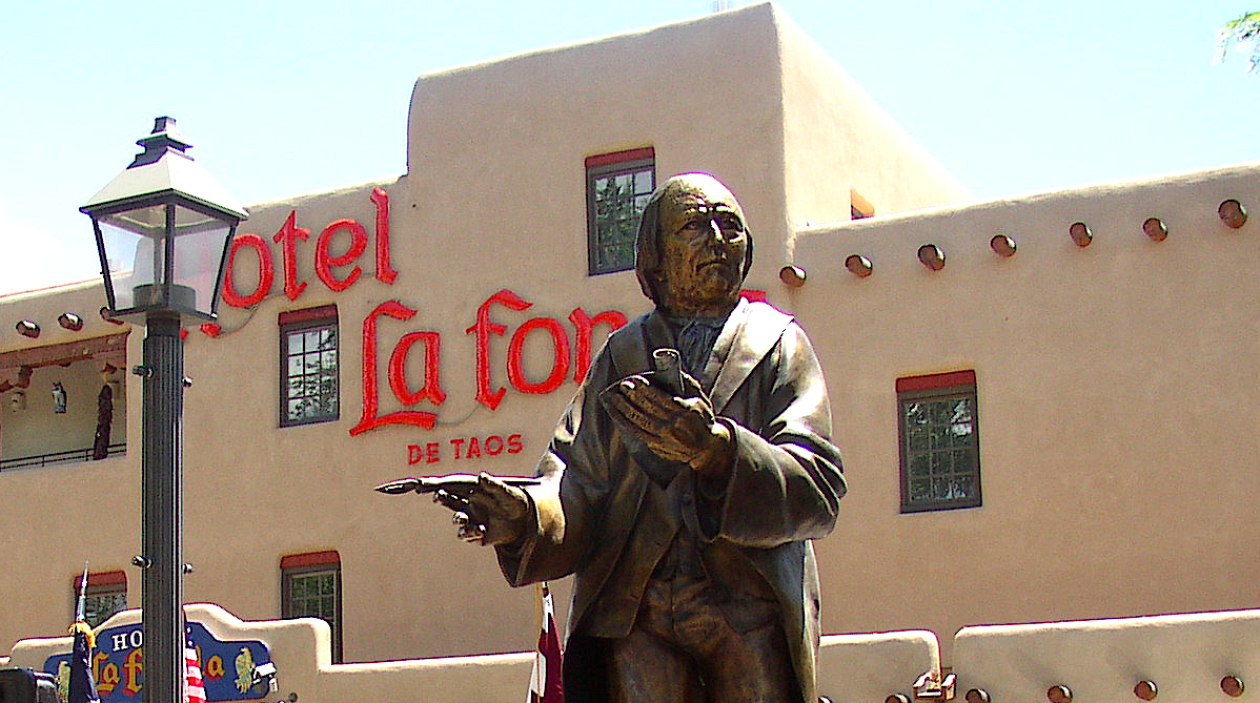
Martínez’s career as a political leader was also impressive. Under the Mexican government, he was elected to the New Mexico Departmental Assembly and served in the assembly in 1830, 1831, 1836, 1837, 1845, and 1846. In 1848, he presided over the Convention to Organize and Establish New Mexico as a U.S. Territory. He was, of course, a leader in both the Upper and Lower Houses. On his death on July 27, 1867, the New Mexico Territorial Legislative Council issued a proclamation recognizing Padre Martínez as “el Honor de su País”, the Honor of his Homeland. This tribute was etched on his tombstone at the Campo Santo at the eastern edge of Kit Carson Park. Reprising that tribute is the larger-than-life-sized bronze memorial, recently dedicated in 2006, and standing in the middle of Taos Plaza.
EDITOR, PUBLISHER, AND EDUCATOR
As an educator and publisher, Padre Martínez established the first coeducational primary school in Taos in 1826. He established a college preparatory Latin school for prospective native New Mexican seminarians in 1833. After the American occupation in 1846, he changed his seminary to the first law school in New Mexico. I think he realized that the American invasion of New Mexico was imminent and prepared his students by expanding his curriculum to include courses in civil law. The Padre’s students went on to become some of the most important New Mexico Hispanic leaders of the second half of the 19th century. His alumni included the first Hispano federal judge in New Mexico, leading legal scholars, numerous territorial legislators, and even U.S. congressional delegates. In 1835, Padre Martínez obtained the first printing press in New Mexico. He printed a spelling and grammar booklet for children, and later printed other books for his school on topics such as mathematics and law. He also printed circulars on issues of popular discourse and resumed publishing the regional newspaper, El Crepúsculo De La Libertad. His leadership in the field of education was most appropriately recognized when the Taos Municipal School Board of Education and Advisory Board to UNM Taos voted to name a building in his honor on the Klauer Campus.
SYLVIA
Oh, wow! When did that happen?
VICENTE
In 1998.
SYLVIA
Oh, I didn’t know that. So, he does have local recognition.
VICENTE
Finally, yes. And that makes me very happy. So that’s why he’s such a significant figure of that period.
SYLVIA
So, here is this extraordinary figure, but we don’t know what he was really like. He was a controversial figure after the Americans came, and after Lamy became the archbishop. Let’s talk a little bit about that phase of his career when he undergoes a difficult time at odds with the powers that be. But let’s start with how you happened to get into the Padre since you have a unique avenue into his story, a very personal connection. You live in his house; you occupy his home. Talk a little bit about how you, Vicente, came to know the Padre, and what he means to you.
VICENTE
ROOTS AND REPERCUSSION
I came to know the Padre through my family’s oral history and was raised to believe that we were his direct descendants. I knew enough about him even when I was in grade school to brag about being a descendant until some of the Anglo students started calling me a “bastard”. It kind of hurt, and I didn’t know how to take it, so I stayed away from the topic for a while. However, family lore was always much stronger than any insults could have been. Living in that house was, of course… well, his spirit was always present. I feel that it is, and I grew up with that.
SYLVIA
Where is his house located?
VICENTE
The house is located on Padre Martinez Lane in the center of town, about two blocks west of the Taos Plaza. It’s a short block south-southwest from the current church and a half-block southwest from where the old Guadalupe Church was located until it burned in 1961. The new church was rebuilt to the north and across the road. He lived very close to his church and was its first pastor. The house was probably built in the early 1820s and occupied by the Padre since 1826. It has undergone some changes over the years, but it is essentially the same home.
SYLVIA
What were some of the things that your family had to say about the Padre?
VICENTE
EDUCATION AND POLITICS
They always recognized his leadership in education and politics. I mean, we always knew that he had a co-educational school, apparently unusual for that period. However, there were likely other schools.[2] As we explore history, we begin to uncover parallel universes, so to speak. Maybe the Padre Martinez school wasn’t the only one. The same is true with the newspaper. Gabriel Melendez, in his book, discovered the existence of a printing press in California around the same time as the one in Santa Fe. Santiago Abreu, a magistrate in Santa Fe, initially purchased the printing press that showed up in 1834. Antonio Barreiro, an attorney, bought it in Santa Fe and hired Jose María Baca to operate it. Padre Martinez used it to print a children’s spelling and grammar book. By 1835, Padre Martínez purchased the press and brought it together with Sr. Baca to Taos.
SYLVIA
And the press? I’ve read that it was used to print the Kearny Code.
VICENTE
When [Stephen Watts] Kearny took over Santa Fe in 1846, Padre Martinez brought the press from Taos back to Santa Fe. He loaned it to General Kearny to print his new Code.[3]
SYLVIA.
Do we know where the remnants of that press are?
VICENTE
No, we don’t, but there were some interesting articles in the New Mexican a while back about that. I think it was called a Ramage press, but they’re not sure where it ended up. Some thought it might have ended up in a gully somewhere around Cimarron, but we don’t know for sure.
SYLVIA
So, why is the Padre so controversial?
VICENTE
CONTROVERSIAL
The Padre passed through some tough times. I’m sure there was some friction between the Church and the Mexican government during the period of “secularization” lasting from the 1820s to the 1830s.[4] In early 19th-century New Mexico, there was no “wall of separation” between Church and State. In 1826, during the period of secularization, Padre Martinez was appointed administrator of the Taos parish of San Geronimo. The parish included Nuestra Señora de Guadalupe, built near the Taos Plaza about 1804, as a mission extension of the Pueblo parish.
In another area: I don’t think it was unusual in the 19th century, especially in Latin America, for priests to be involved in politics. So again, there would be friction there too.
POLITICAL CAREER
His political career started in the 1830s. At the time, in November 1831, he wrote an incredible Expocisión, a detailed explanation, or setting forth of facts or Catholic social theory, that he addressed to the Mexican National Congress. In that document, he deplores the condition of New Mexicans. It’s a rather incredible document about New Mexican life. The biggest issue at the time was fending off attacks from nomadic tribes. And it was constant. He also speaks about the poverty, lack of education, and lack of services in New Mexico. Most importantly, Padre Martinez addressed the lack of sound government. Of course, New Mexico was a territory of Mexico during that period, so government services were never forthcoming.
SYLVIA
Now, he was at odds with the church over the issue of tithing, correct?
VICENTE
TITHING
He didn’t believe in tithing and carried his opposition to it throughout his life. People paid[5] for marriages, debts, with whatever they could. Remember, during that time it was a barter economy for the most part, so cash was not available. He also made an appeal to the Mexican government about tariffs. So, it wasn’t just tithing; it was also tariffs, and he requested that goods not be taxed when they came to New Mexico.
By the 1850s, a USA-style Catholic Church entered New Mexico. I call that “confrontation with an ancestor”– the old church encountering the new American church. I think that’s where a lot of the friction for him began. One of Bishop Lamy’s concerns was that parishes were not generating sufficient money to operate. Like any institution after a conquest, there’s going to be friction.
SYLVIA
Another area that seems unclear is Padre Martinez’s relationship to the Hermandad, or what today we call the Penitentes.
VICENTE
PENITENTES
That’s something that I’m not an expert but I think it’s being explored. I’m working on a book with Father Tom Steele and Father Juan Romero, that will address many of those issues. Father Steele has a better take on that than I do, and I think Rowena Rivera wrote a book on Penitente self-government. We do know that Padre Martinez was very involved with the brotherhood of the Penitentes in New Mexico. In some earlier letters from 1831, Los Hermanos (Penitentes) still identify themselves as the Third Order of St. Francis, considered a lay organization. The First Order would have been the priests, the Second Order would have been the brothers and the nuns, and the Third Order would be the laity.
So how it transitioned from the Third Order to the Hermandad as we know it today is something that’s being explored. Padre Martinez certainly played a role in that transition. His Excellency José Antonio Laureano de Zubiría y Escalante came to New Mexico in 1833 as the new bishop of Durango. At the time, he expressed grave concerns about the practices that he thought were too extreme.
SYLVIA
And didn’t Padre Martínez call Bishop Zubiría’s attention to the existence of this organization?
VICENTE:
He did. The Taos Padre also angled for the Durango Bishop to appoint him as the spiritual leader of the Penitentes.
SYLVIA:
Right. The Morada in Taos was recently signed over to Guadalupe Parish. The property is east of the Mabel Dodge Lujan estate, a property that may once have belonged to the Padre. It is at least near where the Padre had property. As the son of Severino Martinez, he was a substantial landowner. Say a little bit about the Padre as a landowner within the context of his powerful and mercantilely involved family.
VICENTE
ABIQUIU BIRTH AND MOVE TO TAOS
All right. In 1804, when Antonio was eleven, the family moved to what is now known as the Martinez Hacienda here in Taos. Don Severino was a trader and was much involved in the Chihuahua Trail. They may have moved here to better participate in the business of the Santa Fe Trail, which was beginning. Padre Martinez grew up in the Ranchitos area but maintained connections to Abiquiú. The family was involved in livestock– sheep, cattle, and so forth, so they needed and acquired lands. I believe the Padre’s father, Severino, was the recipient of the land grant in San Cristobal.
The Martinez family acquired holdings in the Taos area and was an economic power. I’m sure they were involved in commerce with Anglos who began coming into the area [in the early 1800s] and the French-Canadian fur trappers about the same time. There was also some friction among them.
I am trying to understand how Padre Martinez acquired so much land through family inheritance. The land he had is presently located at Kit Carson Park, its cemetery, and in the entire area. I suspect he also had land where the Morada was. However, it’s stated that the land belonged to Taos Pueblo, and it may well have been the case. I don’t dispute that.
SYLVIA
Yes, it’s said to be the only Morada that sits on Indian land.
VICENTE
But as we know, the relationship between the Pueblo and the family of Padre Martinez is unclear at this point. Severino Martinez was also the Alcalde of Taos.
SYLVIA
He was the Alcalde of Taos, so they were most definitely both a political and economic force in Taos. Right?
TAOS UPRISING OF 1847
Another unclear area is Padre Martinez’s role in the 1847 Taos Revolt, when some people of Taos and the Pueblo conspired to kill the first territorial governor, Charles Bent. Some of the rebels[6] moved out to Turley’s Mill [at Arroyo Hondo] and wiped out some folks there.
And we hear different stories about Padre Martinez, on the one hand, being in alliance with the rebels. And then we also hear about him giving shelter to Americans and others who were caught up in the revolt. This is another area where he has an almost contradictory image. Was he involved? He saw the coming of the Americans and, as you say, was trying to prepare his students for that change. He was in many ways a modernizing figure. So, how do you see the transition, or what do we, in fact, know about what happened?
VICENTE
CHIMAYO REVOLT OF 1837
Well, I think it goes back further than that. You first need to look at the uprising of 1837 and the War of the Chimayoses, or La Guerra de Los Ganaderos or Chimayoses to understand that he was blamed for that. Everybody seems to blame Padre Martinez for anything that went wrong.
IMPACT OF MEXICAN INDEPENDENCE
Padre Martinez was in Mexico during the time of Mexico’s liberation from Spain [after 821]. He was influenced by the likes of Padre Guadalupe Hidalgo and was exposed to the constitutional form of government, which much influenced him. He spoke about these ideals when he was a priest in Taos, but was not laying the groundwork for rebellion or insurrection. He was merely expounding on the ideas of a constitutional form of government that he felt would be a much better form of government. The ideas he brought and how people interpreted and acted on them may have been quite different. However, in 1837, a rebellion occurred over a minor court case between people from Santa Cruz and Taos. It resulted in the killing of Governor Albino Perez [who had been sent by General Santa Ana to quell the uprising]. José Ángel González, a native Indian of the Taos Pueblo, succeeded Albino Perez as the new governor of New Mexico. Native New Mexican Armijo arrived at Chimayó and Santa Fe to try to quell the uprising, and Padre Martinez sided with him. However, Armijo was blamed for many things and fled. Some say he fled cowardly.
Ten years later, by 1847, the Padre was also blamed for fomenting the insurrection against Governor Bent. Most telling is the biography on Padre Martinez that my great-grandfather, Santiago Valdez, wrote in 1877. He records a dialogue between Padre Martinez and the people who instituted the insurrection. According to Valdez, Padre Martinez admonished the insurrectionists, and I offer this paraphrase of the wisdom of my great-grandfather, “You know you’re not going to win this battle. It would be best to put down your arms. This government is much bigger than you are.”
William Lee, one of the persons who escaped the massacre of [Governor Charles] Bent and his family, came to Padre Martinez for refuge, and Padre took him in. A delegation of neighbors and Pueblo Indians came to visit Padre Martinez to ask him about that support. They wanted to know why he was siding with the Americanos. In my opinion, it was because he opposed the violence.
SYLVIA
Is it true that the trial was held in his house?
VICENTE
The trial was held in his house, and he was there. He sent two letters asking that the trials be stopped. One letter was sent to the Mexican Consulate Manuel Alvarez in Santa Fe, and the other to Colonel [Sterling] Price. Padre Martinez sent the letters because Narciso Beaubien was killed during the massacre. Narciso was the son of Carlos Beaubien, judge at the trial that Padre Martinez characterized as nothing but revenge.
SYLVIA
Yes, according to historical records, forty to sixty people were in jail. I have no idea where the jail was located or how big it was, but that was a lot of people, and the leaders of the revolt were Mexican.
VICENTE
Yes, they were, and there were also Indians, a very mixed group. The Padre wrote letters on behalf of all, and he asked [the prosecutors] to please quit the trials.
SYLVIA
There are two more things I want to touch on about the Padre. One is about his household and children, offspring, adoptive children, and how it is that you would be the great, great-grandson of a priest. The other is his schism with Bishop Lamy. Even after the Bishop excommunicated him, Padre Martinez continued to have a significant following.
VICENTE
CHILDREN OF THE PRIEST
To the first question: My great-grandfather, Santiago Valdez, was born in 1830. Padre Martinez, in his last will, acknowledges him as a son and says to Santiago, his factual heir, “I’m the only father that you have ever known, and I’ve educated you and looked after you.” Santiago was placed to live with the Valdez family, and I’m still researching that whole relationship. As far as [the mother of] Santiago Valdez is concerned, the jury’s still out. We’re doing DNA testing, and I’m waiting to hear the results.
About a year after Santiago was born, another child, George Antonio Romero,[7] was born to the Padre’s housekeeper, Maria Teodora Romero. Other children were born between 1831 and 1844. I believe there were five altogether. Furthermore, based on my research, I have determined that the Padre revealed himself in the Baptism Register as the father of the first three Romero children. Listing paternity, he wrote his name “Antonio Martinez” without a title, and he listed his parents as the children’s grandparents. I think that proves the three children were his. He does not claim paternity so clearly for the other two children purported to be his. However, marginal notes in the Baptism Register have the notification “father unknown” and/or “mother widow”.
SYLVIA
And then, finally, what becomes of Padre Martinez after Bishop Lamy arrives? What about their conflict and his last years?
VICENTE
BISHOP LAMY AND SANCTIONS
Lamy’s conflict with Padre Martínez? I see it the other way around–the Bishop’s conflict with Padre Martínez. In my opinion, the conflict primarily concerned the lack of fees generated–the tithing issue. It also had to do with the Padre’s age and health. In 1856, Padre Martinez sent Bishop Lamy a letter saying [paraphrase], “Look, I’m getting old and tired, and am thinking about retirement. I have a young priest in mind, a former student of mine, with whom I can work if you send him to Taos.”
However, Bishop Lamy took the Padre’s letter as his intention to retire, or more likely as a definitive statement. Instead of sending the priest Padre Martinez had requested, the Bishop sent to Taos, a Basque priest, Father Damaso Taladrid, whom he had met in Rome. The new priest arrived and basically took over the parish. The two priests clashed from the start, and their relationship deteriorated over time.
Father Taladrid barred Padre Martinez from celebrating Mass in the church. Padre Martinez’s response was to build a chapel[8] next to his house and he dedicated it to La Purísima, the Immaculate Conception.[9]
After the wedding in 1856, Bishop Lamy censured Padre Martinez[10] “suspending him from divine things”, i.e., forbidding him to celebrate Mass, preach, hear Confessions or give absolution.
Two years later, in April 1858, for an article he had published in La Gaceta de Santa Fe, Bishop Lamy excommunicated Padre Martinez. The priest’s article excoriated the prelate for his newly promulgated legislation that revived the policy of tithing.[11] Excommunication was a much more severe ecclesiastical censure than suspension.
Until his death, Padre Martinez continued his quite extensive ministry. The youngest of his putative sons from Teodora, Jose (Vicente) Ferrer Romero, saw himself continuing the Padre’s ministry as a Presbyterian layman.
SYLVIA
Has he been reinstated into the good graces of the Church? He was originally buried at his chapel by his house, but later reburied at the Kit Carson cemetery in what used to be his property. Could you say a little bit about that?
VICENTE
DEATH AND BURIAL
In his Will, Padre Martínez requested to be buried in his oratory, and in fact was buried there when he died in 1867. However, twenty-four years later in 1891, his remains were taken from the oratory and placed where they are today.[12] I am not sure what was behind that.
SYLVIA
And wasn’t the Hermandad very prominently in attendance in either or both of his burials?
VICENTE
Very much so, in both of them. I think they always recognized him as their leader.
SYLVIA
No doubt your research will continue.
VICENTE
There is new scholarship in the works, and you’re part of that.
SYLVIA
I suppose there are still many unanswered questions.
VICENTE
RECOGNITION
There are. Hopefully, a book to be published will answer a lot of these questions. The naming of a building at the UNM campus may have been the first modern recognition of the Cura de Taos. He has not been sufficiently acknowledged for his huge role in New Mexican history. Perhaps that’s beginning to change since 2006 when the heroic bronze memorial of the Padre was erected in the middle of the Plaza.
SYLVIA
Well, thanks a lot, Vicente. I could go on as we always do for hours about this, but this will at least tantalize people to look more deeply into this incredible figure of Taos history. Thank you very much!
VICENTE
Thank you, Sylvia.
SYLVIA
You have been listening to an interview with Vicente Martinez, photographer, and community scholar of northern New Mexico history. He is a specialist on El Cura de Taos, the famous, controversial, and enigmatic Padre Antonio Jose Martinez, the first pastor of the Nuestra Señora de Guadalupe Church in Taos. Our show is “People, Culture, and Place: Conversations from the Ortiz Center”, produced by Cultural Energy in Taos, New Mexico. You can hear this show and others in the series online. This is Sylvia Rodriguez at the Alfonso Ortiz Center for Intercultural Studies at the University of New Mexico.
[1] Antonio José Martinez was born on January 17, 1793—the feastday of St. Anthony Abbot, patron of Western Monasticism. He was baptized at the church of Santo Tomás in Abiquiú. When he was eleven years old, he moved to Taos with his parents and siblings. As a young man, he returned to Abiquiú, where he had grown up, got married, and then became the father of a daughter whose mother died in childbirth. Over a year later, the young Antonio José decided to study for the priesthood. He embarked on a thousand-mile journey to the seminary in Durango, where Antonio José Martínez excelled in his five years of seminary studies. In 1822, a year after Mexican Independence was achieved, he was ordained a priest at Durango. During his last year of studies, he became sickly, likely from asthma, so he returned early to Taos to recuperate at home with his parents. He studied privately for a couple of years to complete what he had missed during the last part of seminary formation.
After a couple of years of recuperation at home, during which he engaged in further study and some ministry, the young Padre was appointed to serve for another couple of years at parishes at Tomé and Abiquiú. By 1826, Padre Martínez was appointed as priest-in-charge of the church of Nuestra Señora de Guadalupe in Taos, his home church where he had grown up. He was appointed administrator of the Church of Our Lady of Guadalupe, built in 1804, which would remain a mission of San Geronimo parish but not become an independent parish until l842. In any case, in 1822, Padre Martinez was going home, would become administrator of Guadalupe Church in Taos by 1826, and by 1842, eventually and officially became pastor, Cura de Taos, as he is best remembered.
[2] As a young boy growing up in Abiquiu, Antonio José attended the parish school of Santo Tomás established by the Franciscan Friars.
[3] The Kearny Code was New Mexican law revised for the territory under the US.
[4] Padre Martinez was a “secular” or diocesan priest under the authority of the bishop. This contrasts with a religious-order priest, such as a Franciscan, who would be directly responsible to his religious superior. The Mexican government was removing and replacing Franciscan priests from parishes.
[5] For a priest to charge for a sacrament (Baptism, Marriage, Eucharist, Penance, etc.) would be to traffic in sacred goods by which he would commit simony, a sin of sacrilege named for Simon Magus in the Acts of the Apostles (8:9-24). It is legitimate for a priest to receive an “offering” on a religious occasion, but this is not to be considered “payment”.
[6] The Indians and New Mexicans certainly would not have considered themselves as ”rebels” insofar as their lands were wrongly invaded and occupied by a foreign force from the United States.
[7] Some opine that the second son was given his name in English in homage to George Washington, the first president of the United States.
[8] The Padre’s favorite niece wanted to get married in 1856 at Guadalupe Church. It would have been most normal for her uncle to be the presiding priest, but Father Taldrid refused the request. As a result, Padre Martinez arranged to use his house chapel for the occasion, but that merited the ecclesiastical sanction of “suspension” Bishop Lamy imposed. Padre Martinez, on canonical grounds, challenged the sanction’s validity.
[9] Vicente Martinez showed me an heirloom he revered: an image of La Inmaculada Concepción de María owned by the Padre and painted on tin.
[10] Suspensio a divinis — Padre Martinez, an expert in Canon Law, contended that the suspension was invalid because it lacked the necessary three canonical warnings.
[11] Under Spain and Mexico, Church and State in New Mexico used to collaborate for the collection of taxes, aranceles (tariffs) for military and clergy expenditures, and diezmos (tithes) such as the offering of an animal or fruits given to the priest upon a service performed, e.g., a wedding, funeral, baptism, or marriage. Padre Martinez looked after people who couldn’t afford a monetary donation for these services, and he opposed taxes that he deemed an excessive burden on the poor. He strongly opposed such taxes imposed by the government through the church. As a young priest and legislator, he opposed these taxes, and through his efforts, they were eventually eliminated by law. However, after New Mexico became part of the United States, Church and State were no longer united, and Bishop Lamy revised taxation policy, still an excessive burden on the impoverished.
[12] Padre Martinez is buried at the northeast edge of Kit Carson Park in Taos that serves as a campo santo, a burial ground or cemetery. This land used to belong to Padre Martinez, and he willed (some of) it, including the cemetery portion, to Theodora Romero, by whom he had children. After the Uprising of 1847, many of the deceased Americans were buried at this campo santo. When Kit Carson died in 1868, a year after the Padre, he was buried a short distance to the north of the Padre.