TWO DAYS IN THE LIFE OF THE CHICANO AND THE CHURCH
IN SOUTHERN CALIFORNIA
(Prepared for CEHILA)
by
Rev. Juan Romero
December 5, 1986
Retrieved from JR PADRES Archives in January 2026, and
DEDICATED TO THE MOST REV. GERALD R. BARNES
on occasion of his eight decades of life and three as
Bishop in the Diocese of San Bernardino
INTRODUCTION
Fifty thousand Hispanos from throughout the Archdiocese of Los Angeles filled Dodger Stadium on June 1 of this year for Celebración ‘86. It was the local culmination and cloture of the national process of consultation among Hispanics which was called El Tercer Encuentro Nacional Hispano de Pastoral. The new Archbishop, Roger M. Mahony told the people, to their great applause, “I am your bishop,” and proceeded to declaim for the local church the Pastoral Plan that had emerged from the collective consultations on the national and local levels. It was a glory day that throbbed with excitement and life! Frank del Olmo of the L.A. Times called it the largest gathering of Hispanics for any event in L.A. history. 1 It was the celebration of a pilgrim journey of a people who were now taking possession of their own destiny in collective fulfillment of the Lord’s will.
What a contrast to that Christmas Eve of 1969 when a group of Chicano activists calling themselves Catolicos por La Raza demonstrated outside of St. Basil’s Church on posh Wilshire Boulevard during Midnight Mass. They were denouncing James Francis Cardinal McIntyre and the Church of Los Angles for being insensitive and unresponsive to the needs of Mexicans and Mexican Americans in the Church. Although those allegations had been made in anger, and received in great pain, the polarizations that once existed were now symbolically healed. The Catholic Church was now clearly and publicly seen to be on the side of the Hispano.
Two seminal events, eight years apart, very strongly mark important moments for the life of the Catholic Church in Southern California as it relates to the Chicano. Both events have had impact on subsequent events and therefore qualify as historic moments. The first is the National Chicano Moratorium that took place in East Los Angeles on August 29, 1970. The second was the appointment of the bishop for the new diocese of San Bernardino-Riverside on November 6, 1978.
DAY ONE:
THE NATIONAL CHICANO MORATORIUM
August 29, 1970
The late ‘60’s and early ‘70’s were characterized by the shrill rhetoric of various movements such as those promoting civil rights and peace. With the impetus of the Civil Rights movement, and under the leadership of Rev. Martin Luther King, Jr., Black people had made significant strides along the path of justice and equality. Under the leadership of César Chávez, California farm workers who were mostly of Mexican and Filipino heritage were also improving their lot. Various priests’ councils or senates were forming within dioceses throughout the country as an expression of collegiality, a practical reform of the Second Vatican Council. These clerical groups certainly aspired to use their solidarity as a power base to further their own agenda, but also to work together for the good of the whole church, especially in in its relationship to the world. The national Chicano priests’ organization called PADRES became an important support group for Mexican American priests, as well as an instrument to help move forward the social agenda within the Church and in society.
The Vietnam War was becoming ever more unpopular. Various demonstrations throughout the country protested the high toll of American soldiers and Vietnamese victims: soldiers, women, and children. The American Bishops issued a letter clarifying that a Catholic could be a conscientious objector to a specific war. American government policy, however, continued to insist that a potential draftee could be deferred from military service only if he objected in conscience to all wars.
The anti-war movement sharpened critical awareness about the war and affected the lives of many people living in the United States, especially college-age students. An excessively high proportion of American soldiers killed on the battlefields of Southeast Asia were Chicanos, but a critical consciousness had not yet penetrated very deeply into the Mexican American community.
The National Chicano Moratorium was precisely designed to remedy that. Rosalío Muñoz, former student body president of UCLA, together with Gilbert Cano, began to organize students and communities to protest the genocide of the Vietnam War. Bumper stickers on cars, home meetings, and campus rallies invited people to the first National Chicano Moratorium that was scheduled to take place in East Los Angeles on August 29, 1970. Rosalío and Gil were operating out of the Episcopal parish of the Epiphany, which at this time was known as “The Parish of East L.A.” They sought the support of other church people for the moratorium.
Rosalío and Gil met a couple of times with about five Mexican American priests at my family home in Lincoln Heights, not far from the church of the Epiphany, and we hesitantly decided to participate. At the time, I was stationed in a parish in north Orange County that was still a part of the Archdiocese of Los Angeles. Originally the parish had been a citrus and avocado community with many of the workers Mexican Catholics. Over time, the area had become a bedroom community of Los Angeles, and most of the parishioners were upper middle class. My experience in the parish was burying Chicano soldiers almost once a month, but at the same time I found myself frequently signing a statement attesting to the sincerity of an Anglo college student seeking deferment from service based on conscientious objection. This was one of the factors that impelled me to take part in the moratorium.
I invited about eight parishioners to join me for that day. One of parishioners was a young Mexican American woman, accompanied by relatives, whose Anglo husband had recently been killed in the war. Others who came were the brother of La Habra’s Mexican American City Councilman and Mike Clements, a seminarian of the parish who later became a community organizer for the Chicago-based Industrial Areas Foundation. Several thousand people from all over the country came together for the march on the morning of August 29, 1970. The gathering place was at the park next to the L.A. County Sheriff’s buildings within the confines of Belvedere Park on Third Street, just west of Atlantic Boulevard.
Original estimates of the turnout for the Moratoirum hovered around 10,000. However, a current Library of Congress “Latinx Resource Guide“ estimates the turnout for the Chicano Moratorium on August 29, 1970 was between twenty to thirty thousand! The day was bright and the mood was festive. The people who gathered were a mostly Mexican Americans, but there was a healthy and respectable mixture of others as well: young widows with children strapped to their backs or on walkers, student activists challenging the draft system, and several middle aged and older marchers who were sympathetic to the purpose of the moratorium. Young people wearing Brown Berets were serving as security guards and accompanied the marchers along the way. Well-wishers and the merely curious lined the sidewalks along both sides of the parade route. Many waved Mexican and/or American flags as the marchers shouted, “Chicano Power!” and variations of the anti-war chant “Hell no, we won’t go!” The total number of people involved was reported as over 10,000. There was a sense of solidarity, and the spirit was upbeat.
The organizers of the moratorium had negotiated with the Sheriff Department so that they would keep a low profile. The parade route was about eight miles, and in the shape of a large “U.” It proceeded about a half mile eastward to Atlantic Blvd., and then turned right, southward on Atlantic towards St. Alphonsus Church, the primer parish of East Los Angeles. As the march passed in front of the church on this Saturday morning, a wedding was just finishing up. In a spirit of solidarity and in extension of their own marriage celebration, the newlyweds joined the march for a couple of blocks. Upon coming to Whittier Blvd., the marchers turned right, i.e. westward, and walked about four miles: passed the Silver Dollar Bar, corner of La Verne, and Calvary Cemetery to the park that was then called Laguna Park.
The beautiful August morning turned into a hot afternoon as the march proceeded. Participants marched behind various banners that announced their origin or allegiance–––Fresno, San José, San Diego, Utah, New Mexico, Texas, Arizona. Colorado was well represented by delegates of Corky Gonzales’ Crusade for Freedom based in Denver. A variety of very different groups, including the United Farm Workers of America and the Socialist Party of America, were there together with organizations from all over the Southwest and beyond. Our group of eight from my parish in La Habra in Orange County felt most comfortable to march immediately behind the UFW flag. Walking with us was Fr. Frank Colborn, then professor of moral theology at the Archdiocesan seminary.
About a mile before coming to the park where the rally was scheduled to take place, the monitors of the march asked us to keep a respectful silence as we passed Calvary Cemetery. Upon arriving at the park, Green Peace people handed marchers a sandwich and a cool drink. Rosalílo Muñoz and others took turns speaking through the public address system. I could hear the voices but could not yet see the speakers. One of them was saying that, in view of its location amid the largest concentration of Mexican and Mexican American population in the United States, the name of this park should be changed from Laguna Park to “El Parque Benito Juarez.”
Almost all the marchers were enjoying the opportunity to sit down and rest, listen to the speakers and enjoy the music. People were very tired, but their morale was high. The gathering was not characterized by either anger or hate. Although the mood was still festive, there was, a collective sense of the seriousness of what we were doing: publicly bearing witness to our protest of the excessively high number of Mexican American soldiers killed in Vietnam. Further away, there seemed to be the beginnings of some kind of disturbance. I was now close enough to see Rosalío trying to ignore the distraction and dissuade others from giving it too much importance. He gestured and told people not to pay attention to whatever was going on over there.
The distraction continued in a corner of the park, along Whittier Blvd. It was Saturday afternoon, about 3 pm, and time for me to be getting back to the parish in time for Confessions. As I began heading back, retracing the steps of the route, I saw fourteen black and white Sheriff vehicles pouring out of a side street onto the Boulevard. Their sirens were wailing. “Something must really be going on!” I thought to myself.
Mike Clements, large of stature, and at the time a seminarian formally dressed in the cleric’s Roman collar, was asked to help cool the rising temperature of hot tempers involved in the disturbance. Father Henry Casso from San Antonio, Texas—another person in a Roman collar— volunteered to do the same. The disturbance was taking place at a convenience store across from the park, on Whittier Blvd. Sheriffs soon arrived en masse. Brown Berets, acting as marshals and internal security for the march, together with others including Mike Clements and Father Casso, helped to form a human chain to try to keep marchers and police from clashing and hurting each other. Skirmishes intensified. Youth were throwing bottles and sheriffs were using their batons and tear gas as they broke through the human chain. Intense confrontation ensued. An old lady was knocked down, and the arm of a farm worker was broken. Within a matter of minutes, there was panic and pandemonium. Kiki, the brother of our City Councilman, was consumed with rage at the explosion of what he perceived as the “police riot.” He incredulously asked himself over again, “Can this really be happening in the United States, and right here in East LA?” It was! With his own internal assent, he witnessed the overturning of a sheriff’s car and the burning of an American flag. Some people tried to get away quickly by escaping towards the east from where sheriffs had come, but that whole section had been corded off. Nevertheless, the area was soon cleared, and people began running in all directions. Mike Clements remembers being tear gassed and then invited into the home of a Mexican family for refuge. The father of the household, in the calm eye of the hurricane raging around, recalled own memories of being harassed by Texas Rangers during the days of his youth.
Later in the day, news broadcasts announced the death of Rubén Salazar, a well-respected Chicano journalist for the Los Angeles Times. What a tragedy his death was! He had the ability to articulate the joys and sufferings of the Mexican and Chicano people, and to communicate effectively with dominant community. All mourned his loss. Someone from the LA County Sheriff’s Department indiscriminately fired from a projectile containing tear gas into the Silver Dollar Bar. The bazooka-type armament that caused Salazar’s death is explicitly prohibited from being used in crowd control. Although there was an investigation, no member of the Department went to jail for this killing. There were no law-enforcement casualties.
The name of Laguna Park was eventually changed, but to honor Ruben Salazar instead of Benito Juárez. Salazar, the Mexican American journalist, was eloquent in interpreting the experience, reality, hopes, and aspirations of his people.
As a result of the day’s events, the community was feeling sentiments of hurt, anger, frustration, and anxiety. Panic gave way to fear as East Los Angeles became like an armed camp. The eerie quiet that followed the riot accompanied the empty streets of East LA for the next few days. The occasional Chicano youth who ventured out of his house and into the street was stopped by a sheriff and asked to put his hands on the roof of the Black and White, while being searched.
From the pulpit the next day at Our Lady of Guadalupe parish in La Habra, I spoke of my participation in the moratorium the previous day and explained my motivation. As often as monthly, I was burying many Mexican American soldiers who were returning home from Vietnam in body bags, while at the same time writing letters on behalf of Anglo college students, testifying to their sincerity in conscientiously objecting to the war. We prayed for justice and peace in Vietnam, and for civil tranquility at home.
I had made plans to celebrate my birthday the next day, August 31, with some friends and with Bishop Patrick Flores Flores of San Antonio who was planning to be in Los Angeles. I had met him in San Antonio a few months earlier when he was made Auxiliary Bishop on Cinco de Mayo, 1970–the first Mexican American Bishop ordained in the United States. Fr. Henry Casso was one of Bishop Flores’ chaplains, attendants, for the ordination ceremony. He was now “in residence” at a Los Angeles parish rectory while working for MALDEF, the Mexican American Legal Defense and Education Fund based in San Francisco.
After the luncheon in honor of the new Bishop, Padre Casso took me with him and introduced me to some members of the newly formed San Antonio PADRES members. Bishop Flores had been present in Tucson during the prior February for the founding convention of more than twenty-five clergymen from across the Southwest for the nascent national Chicano Priests’ association. At that meeting, this newly formed Chicano priests’ group called for a Mexican American Bishop to be named. Until then, there had not ever been a Hispanic bishop anyplace in the United States despite that more than half of the Catholic population in the country was Latino.
The next national meeting of the organization was scheduled to take place nine months later in August at Delano, California, the center of UFW organizing activity, as a gesture of solidarity with Cesar Chavez and the struggle of the farm workers. Bishop Flores had made plans to come to that scheduled second national PADRES meeting, but the meeting had to be postponed because of the Salinas lettuce strike. The Teamsters Union had made “sweetheart contracts” with the growers to represent the workers, but without any voice or vote of the farmworkers. Seven thousand (7000!) UFW workers walked out of the fields in what the LA Times called “the largest walk-out in U.S. labor history.” Upon learning that Bishop Flores was planning to come to California, I invited him to visit with some LA people of the Cursillo and Moviemiento Familiar Cristiano. He accepted, and at the same time, he informed me of the postponement of the Delano meeting.
Bishop Flores visited with the MFC couples and Cursillistas at a home on the fringes of East Los Angeles. Amazingly, there were no references to the events of the previous days. The next day, Bishop Flores made a courtesy call on Archbishop Timothy Manning, the new Archbishop of Los Angeles, who had recently returned from Fresno where he had spent two years. Their meeting was cordial, relatively brief, and again there were no references to the recent explosion in East Los Angeles.
Father Henry Casso was now residing at a rectory in Los Angles while working for MALDEF6 of which he was a founder. Right after the meeting with Archbishop Manning, Bishop Flores met for lunch with Father Casso at Olvera Street. Over tacos and beer, Father Casso asked Bishop Flores to go and check out the scene in East Los Angeles, and to console the widow of Rubén Salazar who was lying in state at Bagues Mortuary on Brooklyn Avenue. Father Casso reminded Bishop that it was through Salazar’s syndicated column that many people throughout the country came to know about him as the first Mexican American Bishop. The mortuary was located less than a mile from where the Moratorium had begun. Bishop Flores accepted the invitation, went to visit Salazar’s body and console his widow.
The three of us, Bishop Flores, Fr. Casso and I, arrived at the mortuary at the same time as another clerical trio also consisting of one bishop and two priests. Episcopalian priests Father John Luce and Oliver Garver accompanied the Episcopalian Bishop of Los Angeles. Father Luce, pastor of Epiphany Parish at the time known as “The Parish of East L.A.” in northeast Los Angeles, was a major supporter of Chicano activism in Los Angeles during the late ’60’s and early ’70’s. His parish was the base for Rosalío Muñoz, coordinator of the Moratorium. Father Garver later became an Auxiliary Bishop of the Episcopal Diocese of Los Angeles.
After most visiting clerics had signed the Guest Book, Father Casso did so with a particular flourish. Bishop Flores complied with his mission to console the widow and visit with various mourners. He and Father Casso sang De Colores, the Cursillo and UFW anthem, as part of a spontaneous prayer service that KMEX, local Channel 34 captured, an early Spanish language television station. Besides working at the LA Times, Salazar had also worked at Channel 34.
George Crook, former seminarian and present-day lawyer, was at that time a teacher of Chicano Studies at Salesian Catholic High School on Soto Street, intersection with Whittier Blvd. The highly committed Mexican American Salesian priests and blood-brothers, Fathers Roger and Ralph Luna, both held positions of influence and responsibility at this ELA school. Crook approached Bishop Flores and asked if he would be willing to meet that evening with some community members to listen to their collective trauma. Although the Bishop was supposed to be returning that evening to his residence at the Cathedral Church in San Antonio staffed by Claretian priests, he delayed his return to accede to the request. Flores had been hoping to greet the Claretian priests in Los Angeles before returning home and agreed to meet with representatives of the community at the newly opened Claretian Center on Westchester Place on the Westside of L.A.
About thirty people gathered for the meeting that night. It was an interesting cross-section of student activists, businesspeople, Catholic and Episcopal clergy, and Mexican American lay leaders. Ricardo Cruz was one of the persons with whom Bishop Flores spent some time before the meeting. A law student at Loyola University, Cruz had been one of the main instigators of the Catolicos Por La Raza demonstration that had taken place at St. Basil’s Church on the previous Christmas Eve 1969.
Father Henry Casso chaired the Claretian Center meeting that served as a catharsis for those who had been involved in the Moratorium. It was also an opportunity for all to reflect on some positive action in which we could collectively engage as people of faith. All expressed a desire that the Church somehow speak to this historical moment and witness to justice and peace. The inhabitants of East Los Angeles were experiencing great fear, and Chicano activists were feeling anger at the death of Salazar and the three others who had died because of the violence. Church people wanted to proclaim Gospel values as they related to this specific situation, and to exercise the ministry of healing. After a couple of hours, the group consensus was to call a press conference as a means of accomplishing some of this. Father Casso then, in the name of the group, asked Bishop Flores if he would lend his name to convoke the press conference. After minimal hesitation, and with eyes cast down, Bishop Flores silently nodded his head in the affirmative. “With that,’’ Father Casso dramatically proclaimed, “Bishop Flores has just given up ever being named as ordinary [bishop in charge] to any diocese!” It truly was a gutsy thing to do, especially because only three months previously he had been named an auxiliary bishop! Nevertheless, the people of El Paso and San Antonio can thank God that Father Casso was mistaken in his prophecy.
Father John Luce suggested that the spokespersons for the press conference be priests, and moreover Chicano priests. “After all,” he protested, “I’m from Massachusetts!” The Fathers Luna offered the facilities of Salesian High School to make the necessary preparations. Bishop Flores, meanwhile, postponed his flight to San Antonio so that he could stay and work with those, including five Chicano priests, getting ready for the next morning. We ended the meeting at Claretian Center, and a decent-sized contingent proceeded to Salesian High School in East Los Angeles where we arrived at about 10 pm.
Bishop Flores got right to work. He took off his clerical shirt and collar to his T-shirt, sat down and typed his introductory remarks. Students associated with La Raza Unida party started making calls to the media including the City News Service and other media representatives, to alert and invite them to the press conference scheduled for 10 AM the following day. I was one of three Chicano priests, with the help of Father Garver and in consultation with Father Casso, who drafted the statement that we were to speak with one voice. I was selected as spokesperson and took the statement back to the rectory to translate it into Spanish for the media. It was almost 2 AM before I got to my room in North Orange County. We were scheduled to be back at Salesian High seven hours later, so it was a fast night!
Within the year, Armando Morales wrote and published Ando Sangrando in which he chronicled the events of the Moratorium and critically contrasted the deployment of law enforcement personnel in densely populated Mexican communities and Anglo communities. The statement of the Chicano priests was forged within days of the disturbance and anticipated some points enunciated in Morales’ book. The priests identified themselves as participants in the Moratorium and as members of the local chapter of PADRES. It was the first time we had gathered or spoken as a group, or publicly identified ourselves with PADRES, the relatively new national Chicano priests’ organization.
Seasoned reporter Sal Halpert together with novice-reporter Henry Alfaro, a schoolmate, were among those who covered the press conference at which we stated that the intention of the Moratorium was to focus attention on the “disproportionate number of Mexican American soldiers killed in Vietnam”. We affirmed the right of more than 10,000 people in the streets of East LA to freely express themselves by means of the march and rally. We described the initial mood of the assembly as festive, and asserted that the internal security, provided by the Brown Berets who took their responsibility seriously, seemed adequate to the large crowd. Furthermore, we contended that the force that the Sheriff Department used to quell the disturbance was disproportionate and itself provocative. From our various vantage points, different locations along the parade route and at the park, that is what it looked to us. We denounced the violence and the deaths and demanded a thorough Congressional investigation of the circumstances surrounding the death of Rubén Salazar.
The Los Angeles priests together with Bishop Flores wanted to be sensitive to ecclesiastical protocol. They delegated Father Casso to advise the Archdiocesan authorities that there would be a press conference in which some LA priests and Bishop Flores would be participating. Father Casso said he would take care of this but failed to do so—either by omission or on purpose. He may have gotten too caught up in the rapid pace of the events or merely chose not to do so, and this was subsequently perceived as a lack of proper ecclesiastical protocol.
It is usual for the media to paraphrase and summarize the highlights of a press conference. With good fortune, a soundbite of a particularly significant statement is sometimes included. Much of our statement was televised, but there was no visual or spoken reference to the participation of Bishop Flores in the press conference that in fact was convoked under his credential. It was as though his contribution was deliberately censored or deleted, perhaps through local ecclesiastical influence on the media. This may have been done to deprive the press conference and statement of any semblance of official approval.
At the U.S. Bishops’ meeting in Washington the following November, Archbishop Manning communicated to Bishop Flores both his surprise and displeasure at the San Antonio prelate’s participation in the LA press conference following the Moratorium. That reaction was understandable there had been no mention of the press conference at the proforma morning meeting between the bishops. At the time, I had writtten a six-page letter to my Archbishop detailing the events that lead to Bishop Flores’ involvement. In an aside, I mentioned having received an invitation to work for a couple of years in Guatemala with LAMP (Latin American Missionary Program, based in San Francisco). A very brief reply from the Chancellor of the Archdiocese gave me permission (for which I had not formally asked) to go to Latin America.
Bishop Patrick Flores, pastor of the San Antonio parish of St. Patrick , in a sincere gesture of goodwill, invited Archbishop Manning to preside at a special Mass on the Feast of St. Patrick, March 17, 1971. By then, +Timothy Manning had been named a Cardinal, and he graciously obliged. Episcopal fences were on that day thereby mended.
DAY TWO:
NEW BISHOP FOR SAN BERNARDINO
November 6, 1978
In the fall of 1978, eight years after the upheaval of the Moratorium, the events surrounding the selection of the first bishop for the new diocese of San Bernardino-Riverside, once again strained the relationship between the Chicano and the Church in Southern California.
The ecclesiastical jurisdiction of Los Angeles-San Diego divided into two dioceses in 1936. Forty-two years later, in 1978, San Diego was again divided to create the new diocese of San Bernardino-Riverside. The growth and development of the northern regions of the San Diego Diocese, as well as similar growth in the Inland Empire (Riverside-San Bernardino) some fifty miles east of Los Angeles, made this area not only ripe for the division, but also imperative.
Shortly after Bishop Leo T. Maher arrived from Santa Rosa in 1969 to succeed Bishop Francis J. Furey as Bishop of San Diego (who had gone to San Antonio), a group of Chicanos identified as Católicos por La Raza took over a diocesan camping facility. They then made certain demands that again included the appointment of a bishop of Mexican descent. Soon afterwards, in 1970, Bishop Maher established an Office of Ethnic Affairs, and appointed Father Juan Hurtado as its first director.
Father Hurtado was already in relationship with the newly established organization of PADRES. Together with Father Gilbert Chávez and Father Pat Guillen, Father Hurtado established the Mexican American Commission in 1971 to help respond to specific needs of both the northern and southern regions of the diocese in its effort to better serve the Hispanic. By 1972, El Centro Padre Hidalgo was functioning well at the heart of San Diego, established at a large building in Logan Heights near National City. The Centro developed programs of adult education, social welfare, citizenship and language study, and leadership formation. All this was done with non-patronizing compassion for people and with a passion for justice. Under the leadership of Sr. Rosa Marta Zárate and others, evangelization through the promotion of Comunidades Eclesiales de Base, and leadership formation through the Escuelas de Ministerios became priorities, especially in the northern (San Bernardino-Riverside) region of the diocese. With these expanded activities, the need for a Hispanic auxiliary bishop was more keenly felt.
By personality and temperament, Gilbert Chavez is shy and humble, with no personal ambitions. He accepted the nomination as auxiliary bishop of San Diego because he recognized that he was a tool or vehicle to reach not only Mexicans but all people. Upon his ordination, Gil gave credit for his selection as bishop to his fellow priests who wanted a Mexican American as auxiliary of San Diego. He also recognized the influence of PADRES in the process. Hopes were high: “The Church can now relate to that large segment of its membership which has been largely ignored,” said Father Hurtado, his long-time friend. “He will be like a catalyst––bringing people together and back to the Church” added the priest.
Father Gilbert Chavez saw himself in the role of service and was willing to respond to the call of the community with the confidence of the whole Church in him. To become bishop was not something that he sought personally for himself, and he indicated a certain reserve in accepting the position. Nevertheless, he saw the need for such a role. He would not refuse the call and would be ordained auxiliary of the Diocese of San Diego.
On the spring day April 16, 1974, the Apostolic Delegate Archbishop Jean Jadot announced that Msgr. Gilbert Chávez had been appointed as Auxiliary Bishop. Bishop Maher hailed the appointment as “most welcome news,” and praised him as “a church man of exceptional qualities of sincerity and earnestness.” The Bishop continued, “His appointment is a precious grace, and will be the means of touching and enriching the lives of thousands of Mexican American people and deepening their love for Christ.” In an atmosphere of jubilation and great rejoicing, Gilbert Chávez was ordained as new auxiliary for the diocese of San Diego on the first day of summer in 1974. However, Bishop Chavez’ own fall and winter were only a scant three years away.
Bishop Chávez proudly identified with the PADRES organization. Shy by nature, he was nevertheless always strong in his denunciation of injustice wherever he found it. Some of his prophetic stances put him at odds with other voices in the Church, especially within his own diocese. For instance, despite the discomfort he knew it would cause to some in the agriculturally rich Imperial and Coachella Valleys, he allowed his name and prestige to further the aims and goals of the United Farm Workers in their struggle for justice. Another example was his forthright promotion of women’s rights within the Church and society, even when his expressed views seemed to be at public odds with those of his bishop. The media reported that he disagreed with his bishop’s excommunication of the Catholic president of NOW (National Organization of Women).
By 1977, there was word that the northern portion of San Bernardino and Riverside counties would be divided from the southern portion of the San Diego diocese. A delegation from the north region, including the priest-cousins Manuel and Pat Guillén, on separate occasions visited with Archbishop Jadot and Cardinal Manning to request that a Hispanic be named ordinary in the new diocese. The most obvious candidate was Gilbert Chávez born in Ontario in San Bernardino, territory of the new diocese. Two other clearly potential candidates were the two Hispanic auxiliaries of the Archdiocese of Los Angeles, Manuel Moreno and Juan Arzube. The Guillen cousins reported that Archbishop Jadot was open to the idea in principle but learned Cardinal Manning—Metropolitan of southern California, a title of honor and some influence—expressed reservations.
Six members of the PADRES Board of Directors met with Apostolic Delegate Archbishop Jean Jadot on the occasion of the Segundo Encuentro Nacional Hispano de Pastoral that took place in Washington, D.C. during mid-August 1977. Padre Roberto Peña, OMI (Oblate of Mary Immaculate) was President of PADRES at the time, and the meeting took place at the residence of his religious order near Catholic University where the Encuentro was taking place. The purpose of the meeting was to get the reaction of Archbishop Jadot to the proposal by the Canon Law Society of America that recommended a process for the Selection of Bishops that would be adapted to the circumstances and culture of the Church in the United States. The delegation also wanted the Apostolic Delegate’s reaction to the proposal that in the search for episcopal candidates, Hispanic religious order priests be considered as candidates. There were some Black bishops who were members of religious orders, but up until that time, there were no Hispanic religious order bishops in the country. Our third point was to emphasize the need for Hispanic ordinaries. Father Peña expressed the three concerns, and PADRES Executive Director Father Manuel Martínez, OFM gave a brief historical overview of our interest in the process for the selection of bishops as it affected the Spanish speaking. The meeting generally went well—cordial but firm, candid and focused, some tension but no anger—and yielded some positive results.
We expressed our solidarity with the recommendation of the Canon Law Society of America regarding the Process of the Selection of Bishops. They proposed that the Roman Norms for the process for the selection of bishops be adapted for the circumstances of the United States. The Society’s aims, with which the PADRES agreed, were to allow a greater lay voice in suggesting special qualities needed in a candidate for a particular diocese and a voice in suggesting specific names for consideration. Bishop Jadot surprised the PADRES with his immediate and strong negative reaction to the recommendation of the Canon Law Society which we affirmed. “Don’t talk to me about that! Present norms are sufficient!” Carmelite priest Vicente Lopez of Arizona later described Archbishop Jadot’s response as “testy” on this point.
However, he was much more open to our second recommendation that Hispanic religious order priests be considered as episcopal candidates. “Yes, we have been weak in that regard.” Our third point affirmed that Hispanic ordinaries (in charge of a diocese) are needed more than are auxiliaries. The Delegate was sympathetic, but assured us that there would not be a Hispanic bishop in every diocese of the Southwest. At the suggestion that Bishop Pat Flores become the ordinary of the Archdiocese of San Antonio, the Delegate simply replied, “It’s not [yet] open. Four more years.”
The Apostolic Delegate spoke to us about our reputation as a pressure group and said that we were dealing with “a hot potato, and hot potatoes burn.” He mentioned that Rome’s usual reaction to pressure is to stop everything and just wait. Archbishop Jadot reminded us that according to the Roman Norms, any bishop had the right to bring before the Regional Episcopal Conferences suggestions of names for episcopal candidates.
Archbishop Jadot challenged us: “Are you contacting Major Religious Superiors [for names of potential candidates to the episcopacy]? What are you doing to promote women religious? Are you doing anything to promote vocations from among adults?” He suggested that we visit on a one-to-one basis with bishops [we might deem as a suitable place for a possible Latino bishop]. It would be helpful to forge a positive relationship with such bishops, not meet them as a delegation. On a positive note, he mentioned that Bishop Bernardin, NCCB President, and Bishop James Rausch Chairman for the Episcopal Committee for the Spanish Speaking, were particularly open to our concerns.
There was yet no mention that a division of the Diocese of San Diego was being contemplated, but the PADRES already had a suggestion for a candidate. For several years, Father Chavez was pastor of a parish on the international border between San Diego County and Tijuana, Our Lady of Mt. Carmel in San Ysidro, and was transferred to the northern region as pastor of of Our Lady of Guadalupe parish in San Bernardino. Even for some Anglo priests, Father Gilbert seemed to be the logical choice for bishop of the proposed new diocese of San Bernardino-Riverside in the north.
There was a conventional wisdom among some observers of ecclesiastical politics that Bishop Chávez would not be named as the first bishop of the new diocese. This was based, in part, on the perception that he would not be able nor willing to “control” the Mexican American activist-oriented priests who had been moved to the north in anticipation of the division of the diocese. Some of the activist priests together with lay people—men and women— were part of his informal Equipo Pastoral promoting coordinated Hispanic ministry in the diocese. The Equipo challenged and even made demands of him but also served as a personal support-reflection group for him and the other participants. Bishop Maher, for his part, never really accepted the Equipo Pastoral as an advisory body in the diocese and gave it no juridical status whatever.
Bishop Chavez came to feel cut off from effective decision-making in the San Diego Diocese, including anything pertaining to Hispanics, and this inhibited his leadership potential and stunted his growth. He began to become depressed, and his leadership style became much more passive as he withdrew much more into the retiring dimension of his personality. For the next six months before the split of the diocese, Bishop Chavez had difficulty in communicating not only with Bishop Maher, but even with his own Equipo. His depression was noticeable, and he was perceived as somewhat unfocused and confused regarding the direction of the diocese, Hispanic ministry, and his own leadership role.
At this time there was no strong coordinated push for him to become ordinary of the new diocese about to be formed, and the Hispanic priests gave the impression of being divided among themselves. Movimiento activist Armando Navarro wanted to fill this leadership vacuum but was disappointed that no one rallied behind him. He complained in Spanish that he did not have the support of the priests. He questioned how, without unity, he could put himself up front if there were no army to follow him.
Some of the enemies of Bishop Chavez used the excuse of his relationship with Navarro, known for leftist politics, as a basis for the allegation that he was consorting with Communists. Chávez did not react to that baiting, but during this period he was not reacting to much of anything. He began to distance himself even more from his friends and advisors. Bishop Chavez wrote to the Apostolic Delegate to ask for a meeting, and made public statements that he did not want to serve as the new Bishop for San Bernardino-Riverside diocese about to be formed.
Bishop Juan Arzube and Bishop Manuel Moreno, both Auxiliary Bishops of Los Angeles, were considered by some observes of Church politics to be good candidates for the new diocese opening. There was a great expectation that Juan Arzube, senior Hispanic bishop in the country after Bishop Flores, would be named as the new ordinary. In fact, The Southern Cross, diocesan newspaper for San Diego, requested his picture and biography, and even interviewed him. However, he was not named, nor was Bishop Moreno who later became ordinary for the diocese of Tucson, Arizona.
Father Philip Straling, like Bishop Chavez a native of the San Bernardino-Riverside area, was ultimately named as first bishop of the new diocese. He is a talented and well-liked pastoral bishop who speaks Spanish well. However, it provoked indignation among many that, instead of any of the three Hispanic auxiliary bishops of Southern California being appointed, a non-Hispanic priest was chosen for the new diocese so densely populated by Mexicans and Mexican Americans. Not only Chicano activists, but also many of the general Mexican community took it as a rejection. None of the Hispanic auxiliary bishops were deemed as sufficiently qualified, moreover it was stated that no other qualified Hispanic priest could be found for the position at the time.
PADRES and Hermanas for the first time held a joint national meeting in 1977 from August 14 to 17 in Mesilla Park, New Mexico near the borderlands of El Paso, Texas. This was the first instance of national Catholic organizations of men and women meeting together; their theme was the sensitive topic “Partnership in Ministry”. By then, Bishop-elect Philip F. Straling had been announced as the new ordinary for San Bernardino-Riverside but would not yet be ordained for three more months. Over fifty of the members of both organizations signed a letter expressing their disappointment and indignation that the three Hispanic auxiliaries had been passed over in favor of an Anglo priest. This letter, signed by over fifty PADRES and Hermanas, including Bishop Patrick Flores of San Antonio and Archbishop Robert Sánchez of Santa Fe, was sent to the Apostolic Delegate. Copies were sent to various Roman ecclesiastical entities charged with the process for the naming of bishops in the United States. The letter not only denounced the dismissal of three Hispanic auxiliary bishops of California for the new position, but announced some recommendations:
The fact that the nomination of one of the three [Hispanic] auxiliary bishops who are already in California was not named to head the new diocese was an insult to the Hispanic community of California and to the whole country. It is incredible that the high quality of these Hispanic bishops was not considered, but they have been considered too inferior to serve their own [people as Ordinary….] Therefore, we ask the following:
1. In all dioceses of the United States wherein exists a Hispanic Catholic population of 50% or more, a Hispanic ordinary committed to the development of all the people be named as there be an opening.
2. Hispanic religious order priests truly committed to the development and liberation of the people be considered and named ordinaries for some of these dioceses.
3. Any diocese with 20% or more Hispano Catholic population have a Hispano episcopal vicar for the Spanish Speaking who has true authority over personnel matters and financial resources insofar as they effect the quality and effectiveness of Hispanic ministry.
4. In the process for the selection of bishops, the voice of the local people be heard and have influence, especially regarding the qualities and characteristics they desire their next bishop to possess.
During the PADRES-Hermanas joint board meeting that followed, a motion relative to this situation was made and passed: That the joint boards of the organizations request a meeting with the Apostolic Delegate within the month. Former PADRES executive director Father Juan Romero of Los Angeles and Sister Sara Murietta of Padre Hidalgo Center in San Diego were tasked with helping to organize such a meeting with the understanding that they were accountable to their respective organizations. This mandate developed into a meeting that took place with four California bishops immediately before Bishop-Elect Straling’s ordination.
The PADRES-Hermanas leadership had originally wanted to schedule a meeting with the Delegate within the month, on September 16 if feasible. Father Roberto Peña, PADRES President, made the first request, and then in mid October re-negotiated a date to meet in early November. Meanwhile, a joint committee of nineteen PADRES and Las Hermanas arranged to meet with four California bishops just prior to the episcopal ordination of Philip Straling. Two of the of most influential of these bishops were Bishop John Quinn of San Francisco, then President of the National Council of Catholic Bishops, and Timothy Cardinal Manning of Los Angeles, the Metropolitan of the dioceses surrounding Los Angeles that included San Diego as well as the new San Bernardino-Riverside Diocese. Other bishops invited to the meeting were John Cummings of Oakland, President of the California Catholic Conference, and Roger Mahony of Fresno who was perceived as a strong ally in the promotion of the Hispanic agenda as well as a close friend of Cardinal Manning.
Pablo Sedillo, Director of the USCC Secretariat for the Spanish Speaking, used to live in Fresno when Bishop Manning and Msgr. Mahony were there. It was Bishop Manning, at the recommendation of Msgr. Mahony, who hired Mr. Sedillo as the diocesan Director of Catholic Charities. PADRES now asked Mr. Sedillo to use his influence with Bishop Mahony to deliver Cardinal Manning to the meeting. Moreover, Cardinal Manning felt “summoned” by the insistent letters of PADRES executive director Brother Trinidad Sánchez, SJ.
The month before the division of the diocese of San Diego, Moises Sandoval explored the reaction of priests and laity to their situation in the northern part of the diocese that was to become the new San Bernardino-Riverside ecclesiastical jurisdiction.
There was a total of four very distinct actions that took place in the brief two-day span of November 5 and 6, 1978. From the blurred viewpoint of the casual observer and of some bishops, these were all fused into what seemed like one coordinated assault on Church leadership. Taking place practically simultaneously were the following:
1) A rally-procession at the Carmel Retreat House where the bishops were staying the night before the episcopal ordination of Father Straling.
2) The PADRES-Las Hermanas meeting with the four California bishops.
3) A demonstration outside the arena of Rain Cross Square, location of the ceremony at which Bishop Straling while the ordination was taking place.
4) A separate meeting that same evening took place between Archbishop Jean Jadot and a contingent of PADRES and Las Hermanas, distinct from the one that met with the California Bishops.
1) RALLY-PROCESSION
The California Bishops had had their business meeting during the day at the Mt. Carmel Retreat House in Riverside and were relaxing in anticipation of the ordination of Father Straling as their new brother bishop to take place the following evening. Armando Navarro, Director of Congreso Para Pueblos Unidos, led a rally and demonstration at Ford Park near the Carmel Retreat House. It included a procession to the retreat house and a prayer service that culminated in the public reading of the August letter of PADRES/Hermanas over a public address system. Organizers of the rally had previously voiced a request for a small group to meet with the bishops, but no such meeting took place. Permission was required to enter the retreat grounds where the bishops were staying, but the demonstrators did not receive such permission. Some of the demonstrators choose to sleep that night outside on the grounds of the retreat house. In addition to the activists, some were older people and religiously pious persons not usually involved in such demonstrations. Authorities of the retreat house called the police, but this caused tension and fear. It served to deepen the resolve of the demonstrators and afforded an opportunity to learn more about the issues involved. The presence of the police was probably a mistake, and certainly a negative factor that occasioned a sense of disappointment for the demonstrators and high anxiety for the bishops. The rally at their doorstep prevented the bishops from resting well that night, and it provided an unexpected edge on the bishops who would be meeting the following afternoon with the delegation of PADRES and Las Hermanas.
Most of the nineteen-member delegation of PADRES and Hermanas who were scheduled to meet with the four California Bishops had no idea of the demonstration the previous night that Mr. Armando Navarro helped orchestrate. He was the main local organizer for the demonstration at the retreat house the night before and highly involved with another demonstration planned to take place that evening on the plaza of Rain Cross Square where the ordination would be going on. However, having been purposefully eliminated, he was not part of the official delegation to take place with the bishops. He had been present at one of the planning meetings some weeks before, and inferred that provided him with a ticket of entry. Nevertheless, he made himself present as a self-invited observer, camera in hand. On his own, he later made statements to the press, interpreting the meeting from his own perspective, and wrote articles putting Cardinal Manning in a negative light.18
2) PADRES-HERMANAS MEETING WITH BISHOPS
The meeting began promptly at 2:45 PM as planned, and within the hour it was over. Archbishop Quinn was positive about the meeting and promised to follow up on some of the points brought up in his capacity as leader of the National Conference of Bishops. He also showed that he was not personally threatened by the meeting since he subsequently promoted Father Richard Garcia who was a member of the delegation and one of his San Francisco priests.
Bishop Cummings felt out of place at the meeting, and after the formal part expressed his curiosity as to why he had been invited. The reason: he was president of the California Catholic Conference od Bishops. Cardinal Timothy Manning of Los Angeles, Metropolitan of the Southern California Dioceses seemed quite nervous, somewhat frightened and anxious during the entire meeting as well as afterwards.
Most of the members of the PADRES-Hermanas delegation were unaware of the demonstration that had taken place at the retreat house the previous evening. That would certainly account for a large part of the nervousness of the Cardinal who by temperament was uncomfortable with conflictive situations. Bishop Mahony made no contribution during the meeting but seemed generally positive about it afterwards. He seemed a good bridge, endeavoring to live out his motto, “To Reconcile All,” and spoke informally with the PADRES-Hermanas delegation as well as with Archbishop Manning. Bishop Rausch of Phoenix, formerly a Secretary to the National Conference of Bishops whose office was in Washington, was not one of the Bishops invited to the meeting. He saw it closely tied to the demonstration the night before at the retreat house, and to the demonstration that took place that evening during the ordination ceremony. He strongly objected to all these tactics, and in protest renounced his associate membership in PADRES.
The focus of this meeting between the bishops and the delegation was to harness the anger, frustration, and hostility felt by so many Hispanic Catholics of San Bernardino and elsewhere and try to give that negative energy a positive direction. Ms. Sara Segovia of San José, recently selected as one of the team leaders of Las Hermanas, was part of the delegation. Other laypersons present and who had speaking parts were María Guillén—sister of Father Pat— and Gustavo Ramos of the new diocese. The delegation presented the four points contained in the letter sent to the Apostolic Delegate the prior August. The delegation was seeking the reaction of the bishops to the letter and looking for agreement with the concerns expressed.
Father Roberto Peña, OMI, President of PADRES, chaired the meeting. He thanked each of the bishops for meeting with us and then distributed copies of that letter. Fathers Anastacio Rivera, SJ of Orange and Ricardo Garcia of San Francisco made tight presentations around the four points of the PADRES-Hermanas August letter to the Apostolic Delegate.
Archbishop Quinn was spokesperson for the bishops and responded for himself and in the name of the other bishops. The others were explicitly invited to comment but declined in deference to their spokesperson. Archbishop Quinn, San Francisco Archbishop and President of the US Catholic Conference of Bishops, used the still standard reply that he was not aware of any qualified Hispanic candidates available for the dioceses of Sacramento, Monterey, Stockton and Fresno that would all be coming open within the next three years. Archbishop Quinn, however, did pledge to consult with the Conference of Major Religious Superiors to help implement our recommendation that Hispanic religious priests be considered in looking for qualified episcopal candidates.
The recommendation of Hispanic episcopal vicars was also fruitful. We asked that there be such vicars (who did not necessarily have to be a bishop) in those dioceses with heavy concentrations of Hispanics. Furthermore, we asked that these vicars have effective voice over matters of personnel and finance since they so powerfully affect the effectiveness of Hispanic ministry. We asked that a job description for the role of an episcopal vicar be established on a regional level, and guidelines developed for implementation within the several regions within the country, each comprising several states and dioceses within them.
Finally, we asked that PADRES, Las Hermanas, and the USCC Secretariat for the Spanish Speaking be consulted in formulating these regional guidelines. Archbishop Quinn promised to put this matter on the agenda for the next meeting of the California Catholic Conference so that a regional policy could be ratified and implemented within the year.
The matter regarding the process for the selection of bishops was predictably the most sensitive and met with the most resistance. We again advocated adoption of the adaptation of the Roman Norms for the United States as proposed by the Canon Law Society of America. We were especially concerned that the voice of the local people be heard about the qualities and characteristics they desire in their next bishop. However, again there was little sympathy for advocating lay consultation. The greatest tension during the meeting came at this point when María Guillen, in her search for greater clarity, engaged Bishop Quinn in heated dialogue. Archbishop Quinn seemed somewhat defensive but unmoved.
Mr. Gustavo Ramos, a layman of the newly formed diocese, introduced the principal exchange. Ramos spoke of his frustration at being “invisible” as a Hispanic lay Catholic, and of his hopes for the Church and expectations from the bishops as men of “prayer…action…and vision.” Mr. Ramos identified himself as a representative of the lay organization known as Congreso Para Pueblos Unidos. He pointed out that despite that over four million (almost 30%) of U.S. Hispanics live in California, there was not one Hispanic ordinary in the whole state. He charged that it was “white racism” at the religious level that has purposely promoted division among Hispanics to “exploit them in every possible way.” Ramos called upon the bishops to find and appoint Mexican American bishops and vicars for the Spanish speaking who would be committed to establish and implement a variety of religious programs and services for Mexican American youth and adults.
As the bishops left the meeting with the PADRES-Las Hermanas, another group calling itself Hispano Catholics for Equality were distributing two sheets of paper to them. This is the group for which Father Guillen offered a disclaimer while at the same time supporting them. The papers announced the demonstration to take place that evening during the ordination and promised to later picket the diocesan offices and liturgical celebrations of Cardinal Manning, Bishop Maher, Bishop Straling, and Archbishop Jean Jadot. They further threatened to promote a nation-wide boycott by the Hispanic community of financial contributions to the Church. They promised to seek an audience with Pope John Paul II to ask that he intervene to eradicate racism in the church against Latinos. They alleged that Hispano Catholics have not been given the proper status and representation within the United States Catholic Church, and that this constitutes traces of racism and discrimination. The group stated they would not carry out the threatened actions if the following terms were accepted:
1. That the California bishops agree to implement the proposals submitted by PADRES/Hermanas.
2. That the bishops agree to fill the first vacant diocese in California with a Chicano, and that the next ten ordinaries reflect the ethnic constituency of the majority in the diocese.
3. That PADRES/Hermanas be responsible for nomination of potential candidates, considering the input of local people to be served. The PADRES and Hermanas were also to be involved in the screening of candidates.
3) RAIN CROSS SQUARE
A demonstration held at Rain Cross Square before and during the ordination of Bishop-elect Philip Straling stepped up the heat engendered by the rally the PRIOR EVENING and meeting the following day. Rafael Hernandez coordinated about thirty people taking part in this demonstration. Father Patricio Guillén was aware that there would be such a demonstration but clarified to PADRES executive director Trino Sánchez that it was a “separate group.” Nevertheless, the PADRES of the former San Diego Diocese, now at the brink of being divided into two dioceses, were supportive of this group’s activity as a genuine expression of anger. “WE will not participate [in the demonstration during the ordination],” said Father Guillen, now belonging to the new diocese, “but we will not counter or oppose their activity…. We do respect their action.”
Brother Trino Sánchez published in the PADRES/Hermanas newsletter ENTRE NOSOTROS that “the bishops would not make a written commitment to the four points addressed to them in the letter from Mesilla Park. They preferred to surround themselves with police armed with rifles, guns, and full riot gear–––actions which spoke louder than any words of concern.” Observers and participants of the demonstration felt that the presence of the riot squad was “Ridiculous! Their fearful response to the frustrations of the Chicano is the Swat Team. There are none so blind as those who cannot see.”
4) MEETING WITH APOSTOLIC DELEGATE
To fulfill the original mandate from the joint Boards of Directors of PADRES and Las Hermanas, the fourth action during this full two-day period was the meeting of a small delegation of PADRES/Hermanas with the Apostolic Delegate. It took place right after the ordination of Bishop Straling, but by this time it was anticlimactic. About four persons perfunctorily met with the Delegate, but nothing much came of the encounter. The purpose of the dialogue was to evaluate progress since the meeting with him a year and a quarter before, and to reflect on the points raised in the letter of the prior August. The status of national Hispanic leadership in the Church was to be the focus of the discussion, but the agenda was dwarfed by the succession of events during the past few days.
The day after Christmas, almost two months after the division of the diocese and the ordination of Bishop Philip Straling, the Washington Post featured a 1,400-word article headlined “Church Upheaval: Mexican Americans Seek More Hispanics in Clergy.” The piece reported that a coalition of Mexican American laity, women religious, and priests would be sending a delegation on January 27 to Puebla, just outside of Mexico City. The delegation was to seek an audience with Pope John Paul II and take him their concerns about the turn of events in San Bernardino, a microcosm of the fate of Hispanic ministry and leadership within the United States. This would be the Holy Father’s first transatlantic appearance as pontiff, and the inauguration of the third meeting of the Latin American bishops. The article in the Washington Post quoted Bishop Straling at the end:
We are not perfect, but I think the bishops are dealing with the problem. Out of all this pain has come a lot of awareness, a lot of good for the Hispanic people. Sure, anytime you have divisions there are bound to be bad effects, and maybe some of the actions are a bit extreme, but at the end you do get at the problems.
In the past eight years, the objective of a greater voice in the Church for Hispanics has certainly been achieved. The most dramatic evidence of this is the successful II Encuentro Nacional Hispano de Pastoral. This historic consultation process, primarily of the laity, was convoked by the American Bishops, and was both deep and broad.
The painful experiences during the days of August 29, 1970, and November 6-8, 1978, served as a graced time of learning for both the frustrated faithful Hispanic Catholics as well as for Church leadership that was also groping to find the best ways to serve most effectively. The memories of those times are still vivid in the minds and hearts of those who lived through them. However, upon reflection, they can now be viewed more objectively and be better understood within their historical context. Through the eyes of faith and moreover of hope, those seeds of pain and hurt can blossom into the joy and victory for both the country’s Hispanic peoples and their Church leadership. Shared experiences together with common vision of faith inspired by mutual respect and love, is the basis for any joint pastoral planning. This kind of coordination from the base level to the hierarchy, previewed by the Encuentro, holds the key to future effective Hispanic Ministry in this country.
A full Dodger Stadium, on September 16 of the coming year, will once again be the scene for a climactic ecclesial event. The whole American hierarchy will gather around our Holy Father Pope John Paul II when he visits the West Coast of the United States. The thrust of the liturgy will underscore the multilingual and universal dimension of the Church and her mission. A majority of the laity present will be Hispanic, and the significance of that message will not be lost on this anniversary day of Mexican Independence.
The Pope will most certainly point our attention to five years in the future that will mark the 500th Anniversary of Evangelization in the new world. It will be a healthy reminder of the fact that our Catholic Faith that we love is ours by heritage and tradition. However, it is not ours only to keep, but also to share. We have done this already in the past as persecuted peoples, and at this moment of history are again called upon to fully participate as pilgrims in the future mission of a new evangelization until the Lord comes.
Category Archives: History

TERRITORIAL GOVERNMENT OF NM: 1821 – 1831
1831 Exposición by Padre Martínez
[An English translation of this document is found online on the website of Vicente M. Martínez of Taos who died in late February of this year 2016. He was a close relative of the Cura de Taos who lived in and owned the Padre’s house in Taos. In later years, Vicente resided in Florida and more recently in the state of Washington with his son Dr. Antonio José “junior” named for his illustrious ancestor.
Since the early seventies, we were were close collaborators on Padre Martínez lore, and became good friends. I still mourn his death, and miss him much. Check out the Padre’s 1831 Exposición on Vicente’s website:
<http://padremartinez.org/exposition_of_padremtz.php>
Commentary by David Weber
Translation by Juan Romero – Introduction
On the tenth anniversary of Mexican Independence from Spain, Padre Antonio José Martínez of Taos wrote and presented Exposición, a treatise on the Territorial government of New Mexico dated November 11, 1831. In his presentation made to his fellow delegates of New Mexico, Padre Martínez attempted to clarify the meaning of their representative body called La Diputación, the legal body of elected “deputies” or representatives of New Mexico under the government of the Republic of Mexico that lasted from Mexican Independence from Spain in 1821 until the occupation of New Mexico by the United States in 1846. In his treatise, Padre Martínez also advocated that the limited powers of the Diputación be broadened. After its members received, read, and ratified the Exposición, they sent it for enactment to the representative of the federal government in Mexico City.
David Weber (1940-2110), first-rate scholar of things and people New Mexican, authored a classic Padre Martinez-related work in 1996–On the Edge of the Empire: The Taos Hacienda of Los Martínez. While teaching at San Diego State University in 1975, Weber wrote his commentary on the 1831 Exposición by Padre Martínez for the journal of El Colegio De Mexico, and it was published as El Gobierno Territorial de Nuevo México: La Exposición del Padre Martínez de 1831.
The actual Spanish text for the Padre Martinez document Exposición de 1831 is from the H.H. Bancroft Library at U.C. Berkeley. It is rerpinted in the second part a fourteen-page article by David J. Weber published in Spanish by El Colegio de México, “El govierno territorial de Nuevo México: La Exposición del Padre Martínez de 1831” in the journal Historia Mexicana Vol. 25, No. 2 (Oct.-Dec., 1975), pp. 302 to 310. The first eight pages are a commentary by Weber, and a facsimile of the original Padre Martínez text follows.
One may read the article for free, or download and purchase it for $19. Access JSTOR through one’s educational institution OR join <REGISTER & READ beata Program> online for free. An indiidual scholar or researcher may register at the following link: <https://www.jstor.org/action/showLogin?redirectUri=%2F>. Write in and SELECT “El govierno territorial de Nuevo México: La Exposición del Padre Matnez de 1831”. To read the full text, add the article to your “reading shelf”.
David Weber, familiar with my English version of the Santiago Valdez 1877 Biografía del Presbítero Antonio José Martínez, Cura de Taos, encouraged me to publish it–something yet to be done. With this blog item, I present my English adaptation of Weber’s commentary on the Padre’s Exposición, but without accompanying footnotes that may be found in the Spanish online version cited above. The accompanying blog item is my English translation of the Padre Martínez Exposición de 1831.
My Adaptation in English of David Weber’s Commentary
In October of 1830, the District of Taos elected their parish priest and “home boy” Padre Antonio José Martínez to serve for two years as a member of the Diputación de Nuevo México, the local legislative delegation of seven representatives. The New Mexican territorial legislature of the republic of Mexico was convoked about a month later, and on November 7, 1830, Martínez traveled south sixty miles or so toward Santa Fe where the sessions were about to begin.
After about a year of service in the Diputación, the Cura de Taos became convinced that the most urgent problems of New Mexico would not be resolved unless the Diputación would come to have greater authority. Padre Martínez left some writings about this matter in an essay or treatise entitled Exposición dated November 11, 1831. He addressed it to José Antonio Chavez, Governor of New Mexico who at the time was also President of the Diputación. Martínez held that the Diputación was so weak that it would end up dissolving on its own. He wrote that the Diputación was in practice charged with only three functions: supervising primary schools, granting land, and maintaining relations with the Supreme Congress in Mexico City through the Deputy (representative of the Diputacion) of New Mexico. Martínez held that the Diputación was lacking sufficient power to effectively be in charge of the three areas, and that they would be better managed by various local town governments (ayuntamientos) together with a political chief of a territory, a mayor or an equivalent.
Of greater importance, moreover, Padre Martínez argued that the Diputación lacked the power to resolve the more urgent problems of the territory: juridical inefficiency, necessary church reform, and military defense in the face of depredations of New Mexicans by so-called uncivilized Indians. The priest was also bothered because members of the Diputación did not receive any salary. The seven Deputies had attended the sessions at their own expense, and without attending much to their own business affairs. Martínez insinuated that unless the Diputación became an important body with real power to obtain significant reforms, it would not be worth wasting the necessary time and money to continue its activities.
Padre Martínez gave his presentation (Exposición) before the territorial Diputación on November 11, 1831. The Deputies, the other six elected representatives of New Mexico, voted in favor of his presentation, and decided that the document be sent to the Congress in Mexico City. The next day, the Diputación addressed a letter to Anastacio Bustamonte, Vice President of the national Mexican legislative body, but who wasat the time functioning as its President. The Deputies asked him to present the Exposición of Padre Martínez to the Mexican Congress in the hope that the governing body “would wisely take more energetic steps …to remedy the positively difficult wrongs that…afflict this forsaken land” of New Mexico.
The Diputación sent the presentation (Exposición) of Padre Martínez together with the Padre’s cover letter to Mexico City where it arrived, but did not result in any political reform for New Mexico. Historians are aware that Martínez wrote a cover letter, but none have ever seen it. However, the Exposición de 1831 has been preserved at the Archivo General de La Nación (Mexico), and U.C. Berkeley has copy of the text in its own archives.
The Exposición de Padre Martínez is worth becoming better known for its early expression of the viewpoint of one of the most important and controversial historical figures of New Mexico. Antonio José Martínez from a well-to-do family was born in Abiquiú, New Mexico in 1793. He studied at the seminary of Durango where he was ordained a priest in February 1822, a year after Mexico’s independence from Spain. He was one of the few native New Mexicans who was ordained to the diocesan priesthood in a Province in which the majority of clergy belonged to the Franciscan order. A few years after returning to New Mexico after his seminary studies, Martínez in 1826 became the parish priest in charge of Taos and its environs. However, he did not technically become pastor until several years later. Taos was his boyhood home where he had moved with his family in 1804 when he was eleven, and where he remained until his death in 1867.
A man of great energy, and one of the few sophisticated persons of that remote and sparsely populated province, Padre Martínez became a dominant figure of the political, religious, and cultural life of New Mexico. He founded educational institutions on the primary level–a school for girls as well as boys–and a preparatory seminary helping other New Mexicans prepare for the priesthood, and after the American occupation opened a law school. From 1835 until the War of 1847, he operated the only printing press of the territory, and occasionally lent it to officials of the government. As a dedicated nationalist and admirer of Padre Hidalgo, Padre Martínez fought to obtain political and ecclesiastical reform in his own jurisdiction. He also called attention to the growing influence of Anglo Americans, and helped many integrate into the life and culture of New Mexico.
Padre Martínez continued his interest in politics, especially as it might be helpful in improving the lot of his fellow New Mexicans. Although his 1831 essay decried the weakness of the Diputación, Martínez served in subsequent legislatures. The political status of New Mexico, under the Constitution of 1836, changed from a territory of the Republic of Mexico to a “Departmento“–analogous to a state in the Republic. By1837, Padre Martínez was elected to the Junta Departamental, at the time called La Legislatura. He was elected to that same position again in 1845, but the post was now called the Asamblea Departamental. Either within or outside of the Provincial Departmental Assembly, Padre Martínez was involved in many political battles. For example, in 1837, he tried to pacify popular uprisings against the new taxes that arose in Taos and in Chimayó, and that had been imposed by the Departmental system introduced by Governor Albino Perez. He wrote his own autobiography at this time, and the following year of 1838 published it on his printing press as Relación de Los Méritos del Presbítero Antonio José Martínez, Cura de Taos.
During the last decade of his life, Padre Martínez found himself involved in a complex struggle with native Frenchman Jean Baptiste Lamy who served as the first bishop of New Mexico after it became a political entity under the American flag. The priest’s public opposition to his bishop’s reinstatement of tithing as church policy became the tipping point of the conflict that led to the Padre’s ecclesiastical censures. Through suspension in 1856, Bishop Lamy deprived Padre Martínez of his license (faculties) to function as a priest. Two years later and nine years before his death, Bishop Lamy officially excommunicated Padre Martínez in 1858. However, in order to serve family members and parishioners loyal to him but inadequately served in the new ecclesiastical regime, the Padre continued to minister from his own private chapel and from other similar chapels in the vicinity.
The Exposición de 1831 offers a window into the insights of Padre Martínez’ political thinking. It sheds important light on the situation of New Mexico and indirectly also upon its whole northern borderlands. In the document, Padre Martínez publicly laments the weakness and limits of the Diputación of New Mexico, and adamantly contrasts those limits with the power of the legislatures of states in the young Mexican republic.
The Diputación was, in a sense, a precursor to the state legislature. The Diputaciones in Spain were established as centers of resistance against Napoleonic invasion of 1808, and they remained formalized by the liberal Spanish courts that authorized their establishment in the New World. In Mexico, the Diputación rapidly evolved to become a vital force within regional politics, promoting the fall of the Iturbe regime, and playing an important role in the tumultuous business affairs conducted with the adoption of the federal constitution of 1824. Under that constitution, the Diputaciones matured to become transformed into relatively autonomous state legislatures whose responsibilities remained expressed in the respective state constitutions. These legislatures generally had more power and greater autonomy than the Diputaciones. They were also much larger bodies whose members generally were supposed to receive a salary during the time they were in session.
Meanwhile the rest of Mexico was experimenting with representative government on the state level, but the situation of the territories was different. New Mexico was one of five territories created in 1824, together with Alta California, Baja California, Colima and Tlaxala. Under the 1824 Constitution, the Mexican Congress expedited laws for the internal administration of its territories. Nevertheless, the weight of other more urgent matters did not allow the Congress to act. Under the Constitution of 1824, the territories remained in a kind of political limbo in spite of the protests of functionaries on all levels. Without approval or guidance from Mexico’s national Congress, the Diputación of New Mexico established in 1822 continued to function without authorization under the Constitution of 1824.
Lacking in any current legislation regarding its responsibilities, the Diputación of NM continued its procedures established by the Spanish Constitution of 1812 (Title VI, Chapter II) and by a Spanish decree of June 23, 1823. Spanish law granted it powers to supervise the collection of taxes and expenditures of funds of its province in order to promote public health and public education, to foster agriculture, industry, and commerce, and to ensure the welfare of the missions, monitor the abuses of the clergy, and finally to take up the census and collect statistics.
These powers were apparently ample, but were limited by other regulations that permitted the Diputación to be nothing much more than a consultative body. Both the Constitution of 1812 and the Decree of June 23, 1823 made it very clear that the Governor exercised ultimate authority. All communication between the Diputación and the central government had to be channeled through the governor in the same way as any other communication with municipal governments. The Governor was the only one who could promulgate laws and decrees in the province. Moreover, it was required that the Diputación consult the central government and wait for its approval in order to be able to act on important questions. Even routine plans to promote agriculture, industry, commerce or the arts—for example—had to be sent to the government for approval.
While continuing to act according to Spanish laws, the Diputación of New Mexico was converted into an anachronism for the young federal republic. The complaints of Padre Martínez were, then, not exaggerated, and other new Hispanos agreed with him. Juan Eestevan Pino, in 1829, referred to the Diputación saying that it functioned “without initiative”, although it was “representative of this territory”. Antonio Barreiro, its elected leader at the time Padre Martinez penned his Exposición, wrote in 1832 that the power of the Diputación “is null and insignificant, because it does not have enough authority to be able to work for itself”. Moreover, Barreiro signaled that under the decree of June 23, 1823, the attributes of the Diputación “were absolutely ideal because it made for some tension with our system and others since they do not agree with the circumstances of the country.”
In this way, the federalist dream of autonomy and local government that would respond to local conditions was a failure for the territory of New Mexico. In the preamble for the Constitution of 1824, a committee headed by Lorenzo de Zavala had been enlarged in favor of a strong regional government, bringing together questions such as “what relationships of convenience and uniformity can there be between the warm earth of Veracruz and the frigid mountains of New Mexico?” The question was never answered in any satisfactory way. New Mexico, left with an antiquated territorial government with little room for local initiative, was isolated with two separate issues of defense: one against autonomous Indian tribes who are mounted and well armed, and the other against Anglo-Americans who are advancing toward the west.
It is worthwhile to note the fact that the federal system also failed in its intent to provide representative governments in the other two provinces of the distant northern border of Alta California and Texas. Just as in New Mexico, the Diputación of the territory of Alta California continued to function under Spanish laws. One of the proofs for the little importance of the Diputación of Alta California is the fact that over a period of several years, it would not meet for anything. One French observer who visited California in 1827-1828 noticed that its Diputación “only met to applaud any opinion of the civil and military chief”. That judgment was probably not very far from the reality. The attitude of the military governor of Alta California with respect to civil authority was summarized by the acting governor Lieutenant Colonel Nicolas Gutierrez who is known to have said that he “had no need for deputies (elected representatives) “with pen and voice” so as long as he had a sufficient number of deputies “with sword and pistol.”
Texas completely lost its Deputación upon being merged with Coahuila in 1824. In one of the first sessions, on August 28, 1824 in Saltillo, the legislature of Coahuila and Texas abolished the Diputación of Texas. Moreover, the delegate for Texas did not come to express his opinion on this question, and the decision was not well received in San Antonio. Nevertheless, the resistance seemed futile. In the Departamento de Texas, therefore, the only bodies of elected officials that existed between 1824 and 1836 were on the municipal level. In 1832 the city government of San Antonio deplored the failure of the [Mexican] Congress to establish in Texas a government that understood local conditions, and blamed this failure on the “paralyzing” of Texas.
In this way, under the Constitution of 1824, the furthest provinces of the northern frontier–Alta California and Texas, in the same way as New Mexico–were able to count themselves among the weakest links of the federalist system. At the same time, there did not exist other provinces in the nation that were more exposed to the danger of being absorbed or conquered by the United States or by another outside power. As the men of the frontier used to know so well, the political weakness of the provinces used to contribute to its vulnerability.
El Crepúculo de la Libertad, a short-lived newspaper founded by Padre Martínez and published in Santa Fe at the end of 1834, expressed its opinion on the ultimate consequence of the [Mexican] federal abandonment of New Mexican territory and of the rest of the northern borderlands. In one of its editorials, El Crepúculo asked, “What other consequences ought this deplorable abandonment bring to the nation?” The answer: “The loss of New Mexico and its dismemberment from Mexican territory.” El Crepúsculo, mistakenly, began to predict that the United States would not use force to conquer New Mexico. “No,” it editorialized, ” the [18th] century ended, and cast to the ground this manner of subjugating peoples: the empire of brutal force has been substituted by the strength of the conviction of reason….” If the United States were to conquer New Mexico, it would be with “its industry, its ideas of liberty and independence, and the stars of the capitol of the north would undoubtedly shine brighter in New Mexico insofar as its darkness is thicker because of the deplorable state in which the politics of the Mexican cabinet holds it.” El Crepúsculo could not have been more mistaken about announcing that brutal force had ceased being in vogue. However, its prediction concerning the failure of the (U.S.) federal government in attending to the necessities of the borderland could not have been more on target, and would have to lead to the “dismembering of Mexican territory”.

ARCHBISHOP-ELECT JOHN C. WESTER: Utah-NM Connection
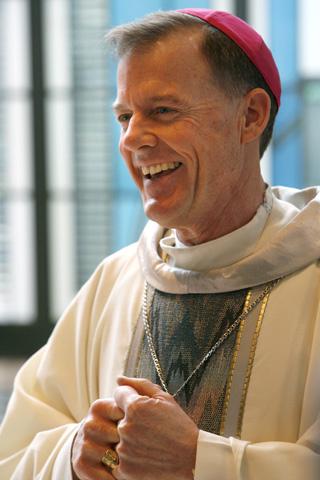 From one “S.F.” to another “S.F.”: On June 4, after having served as Bishop of Utah (Salt Lake Diocese) for eight years, San Francisco-born John C. Wester will become the new Archbishop of Santa Fe. “When Papal Nuncio Pietro Sambi called me from DC to inform me of the appointment, I was stunned, startled, and humbled,” said Bishop-Elect Wester to an American correspondent on a Vatican Radio interview in late April.
Utah and New Mexico for centuries have been linked, and that connection will deepen when the new Archbishop will be installed. The Ute peoples, for whom Utah is named, have lived in the area for over a thousand years. The Spanish visited some five centuries ago, and New Mexicans migrated to and settled in Utah for the half-millennium up to the present day, including some of my relatives who worked there seasonally as sheepherders.
In the sixteenth century, the Viceroy of New Spain claimed the great swath of land, including what is now the state of Utah, as part of the Kingdom of Spain’s La Nueva (Custodia de) Mexico. With Mexican independence from Spain in 1821, Utah as part of New Mexico was incorporated into the Federal Republic of Mexico, and remained so for a quarter of a century. The Mormon people came into Mexico’s Utah in 1847, and within three years—without their moving a step– they came to belong to a territory of the United States of America. Forty-six years later, in 1896, and sixteen years before New Mexico, Utah became the forty-fifth state of the Union.
With the appointment of John Charles Wester as the twelfth Archbishop of Santa Fe– succeeding retiring Archbishop James J. Sheehan–the connection between New Mexico and Utah becomes deeper and stronger. The episcopal motto of Archbishop Wester is “Abide in Christ.” Upon his arrival in NM, he will encounter, especially in the northern regions of the Santa Fe Archdiocese, a series of small independently owned adobe buildings called moradas. The Penitent Brotherhood of Nuestro Padre Jesús Nazareno uses them for their religious rites especially during Lent and Holy Week. Some believe the Spanish word morada refers to the color purple in deference to liturgical vestments worn during Lent. Not so. Its true meaning is ABODE–from the Latin verb morari: TO DWELL. In these final weeks of Eastertide, the daily liturgical readings from the Gospel of St. John are replete with references to the theme of “…abide in me…” (e.g., Jn. 15:9-11). To “abide in Christ” is the invitation and challenge of anyone who calls her/himself Christian/Catholic.
In his April interview on Vatican Radio, Bishop Wester acknowledged the deep roots —over four centuries– of the Catholic faith in New Mexico, and its present dynamism. “With forty seminarians, committed lay leadership, the great variety of important activities, the wonderful community of faith is very alive!”
Archbishop Wester is a good fit for Santa Fe. He knows Spanish, and relates well with a variety of ethnic and religious groups such as Filipinos and Vietnamese. His multicultural and interreligious talents include serving on a U.S. Bishops’ Committee on Ch’an/ZEN-Catholic Dialogue, as well as having chaired the Bishop’s Committee on Immigration from 2006 to 2007, and currently chairs the Committee on Communication.
He has been a consistent advocate of social justice and immigration reform. “Resolution to issues of documentation will be found only by respecting cultural diversity while advocating unity. This remains a challenge toward true integration.” In his Vatican Radio interview, the Bishop said, “The Church has a special role to advocate on behalf of immigrants. We are involved at every point: their origin, transit, and destination. The Church is able to counteract negative stereotypes, and can help put a human face on the issue and to highlight its moral and ethical dimensions.”
Bishop Wester’s experience has been broad, and his credentials are excellent. A fourth generation Californian, he was born in San Francisco in 1950. He went to high school seminary, and was ordained for the Archdiocese in the bicentennial year of 1976. First assigned to parish work and then to the work of Catholic formation: campus ministry, high school teacher and president, then Assistant Superintendent of Archdiocesan High Schools. In 1988, then Archbishop  of San Francisco and President of the U.S. Bishops’ Conference, Archbishop John Quinn appointed Msgr. Wester to be his priest-secretary.  Archbishop Quinn named him in 1993 to his first pastorate of a parish. Four years later, the succeeding Archbishop of San Francisco William Levada appointed Msgr. Wester to be the Vicar for Clergy. The following year in 1998, Pope John Paul II named Wester Auxiliary Bishop of San Francisco, and at the same time Archbishop Levada appointed him as Moderator of the Curia and Vicar General. In March 2007. the next Archbishop of San Francisco,  George Niederauer (former Bishop of Salt Lake),  installed Bishop Wester as Ordinary (Bishop in Charge) of the Diocese of Salt Lake that encompasses all of Utah.
This San Francisco native brought to Utah an abundance of human qualities that make him as well a good choice for his new post in New Mexico. Priests of his former diocese of Salt Lake praised him.  Msgr. T. Fitzgerald said the Bishop is “…kind, compassionate, most generous…[and] open to every person” Fr. Martin Diaz described him as “a passionate shepherd, truly ecumenical, intelligent, and articulate.” Some lay people described him as relaxed, but with a track record of helping the poor and lifting up those in need.
His accomplishments as Bishop of Salt Lake Diocese bode well for his ministry as Archbishop of Santa Fe. He certified sixty-four lay Spanish- speaking ministers last year, and is responsible for the formation of seventeen Spanish speaking permanent deacons who are expected to be ordained within two years. He has addressed the growing number of multi-ethnics within his diocese by bringing in a greater number of multi-cultural clergy. Maria Cruz Gray, Director of Hispanic Ministry in the Diocese, states that Spanish-speaking Catholics populate 95% of diocesan missions! Bishop Wester has responded to the growing number of Hispanics in the Diocese not only with more Spanish or bilingual Masses, but–more importantly–with his “wonderful pastoral outreach and bridge-building between Anglo and Hispanic members of his flock.” His great love for the people is manifested in such things as his support for traditions and a formation program called Instituto Congar (named for progressive French theologian who in the mid-Twentieth Century wrote brilliantly on the role of the laity).
Now Pope Francis has called John Charles Werster to serve as the new Archbishop of Santa Fe. Skills yet to be sharpened for coming challenges include relating well with the unique cultural aspects of Native Americans and the proud Spanish heritage of native New Mexicans. In an interview with Vatican Radio, Archbishop-Elect John Wester projected a properly humble attitude for coming into his new Archdiocese. “I recognize their dynamism in the faith, and my first priority will be to LISTEN.” Father Javier Virgen, Vicar for Hispanic Affairs of Salt Lake Diocese, vouched for the new Archbishop’s “incredible capacity to listen,” and lauded his great compassion as well as disposition to always be with the people.
I sincerely hope those qualities will incline the new Archbishop of Santa Fe to encourage long-time efforts–since the early episcopate of +Robert Sanchez– to posthumously rehabilitate Padre Antonio José MartÃnez from ecclesiastical censures that I believe were unjustly imposed in 1856 and 1858.
Archbishop-Elect Wester, appointed as new Archbishop of Santa Fe at the brink of 65 years of age, will have a full decade before being obliged to offer his resignation to the Holy Father. May his assignment be a blessed and fruitful time during which our loving Lord will bless his new ministry. We invoke the Holy Spirit to illumine and strengthen him in all of its aspects. We pray that Blessed Mary–through the double invocation of Nuestra Señora de Guadalupe y La Inmaculada Concepción, both so dear to Padre MartÃnez–be with him “for the whole ride” to serve well the local church of Santa Fe. “So far, I have been on an emotional roller coaster, but will do my best,” he said during his late April interview with Vatican Radio.
You may Tweet congratulations to the new Archbishop-Elect of Santa Fe (@BishopWester ) or write to him in care of either his present or future address: Most Rev. John C. Wester – 27 C Street – Salt Lake City, Utah 84103/or at 4000 St Josephs Dr, NW – Albuquerque, NM 87120.

Census map of 1830: Territory—together with most of Latin America—that the Viceroy of Spain in the sixteenth century claimed as New Spain. From 1821 until 1846, after Mexico’s independence from Spain, the Federal Republic of Mexico claimed these extensive territories. Through “Manifest Destiny” and by war ending with the 1848 Treaty of Guadalupe Hidalgo, Mexico ceded the large swath of almost half its territory to the USA. The land includes all of Alta California, Nevada, Utah, Arizona, New Mexico, and the great state of Texas. It also includes the western half of Colorado, a piece of southwestern Wyoming, a sliver of southwestern Kansas, and the Panhandle of northwestern Oklahoma.
GUERRA MEXIO AMERICANA; POPE IN BRAZIL; BABY GEORGE
GUERRA MEXIO AMERICANA
Benjamin Maurice Read,
pioneer native New Mexican historian, in 1910 wrote from his perspective a history
of the US-Mexican War waged from the occupation of Santa Fe by US forces on
August 18, 1846 to the treaty of Guadalupe Hidalgo of February 2, 1848. A century and a half after the occupation, my
Uncle Tom (my father’s younger brother by seven years) helped me translate
eleven chapters from Spanish to English.
Recently, Antonio José Martínez (it’s no accident this Harvard-trained
lawyer for Amazon Books has the same name as the famous Cura de Taos) nudged me
hard to finish the work. With the help
of his father Vicente, with whom I have for years been collaborating about the
Padre, the work of translation is almost completed. UNM Press has shown interest in publishing it.
Stay tuned!
POPE FRANCIS IN BRAZIL
For the past six weeks, I have been helping to celebrate Masses at Big Bear Lake,
CA (almost the same altitude as Taos!) while the pastor has been away. It has been a welcome relief from the
desert’s summer heat where I reside, but am now returning to help out at a
parish in Cathedral City.
This past weekend has been
especially busy for me: four weekend Masses and two sessions of Confessions
that is pretty routine. What made it “busier” than usual, but at
the same time so JOYFUL and ENJOYBLE, was trying to keep up with Pope Francis
and the THREE MILLION PLUS young people with him in Brazil. What an
extraordinary event! Through the miracle
of wi-fi and computer, I was able to keep tabs on what was happening. My
guardian angel woke me before 5 AM on Sunday, on time to watch what led up to
the Mass and its celebration on Copacabana Beach below the giant image of
Christ the King. I was reminded of the final scene in Slum Dog
Millionaire that has about a hundred young people doing a dance routine between
two long lines of stationary railroad cars. MULTIPLY THAT to equal
3,000,000 plus! Before the liturgy began, Pope Francis viewed that choreographed
homage from a TV in the sacristy. All banners were lowered, and a
reverential silence ensued immediately preceding the Mass.
The Pope’s most historic and well-received visit to Brazil was strong in both
style, but more importantly in substance. I commend Canadian Catholic
media outlet Salt and Light for their
excellent live coverage in the U.S. and throughout the English-French speaking
world and beyond http://saltandlighttv.org/live/
 Congratulations
to the parents of the newly born royal baby!
By the way, the infant has the same
name (besides that of several of his ancestors) as our new American pope (from the continent of America) given at
his baptism—JORGE that means Geroge.
A few coming dates important to me personally:
August 31 – my 75th birthday; October 23 – my dad’s hundredth birthday; he died in 1996; April 30, 2014 – my 50th anniversary as a priest
E-mail
address for The Taos Connection: juanrvi@aol.com

PADRE MARTINEZ: COMING ATTRACTIONS
Next year, 1912, New Mexico will celebrate its centennial as a state of the Union. In his book My Penitente Land, Fray Angelico Chavez called Padre Antonio José Martínez (1793-1867) New Mexico’s greatest son. Upon his death, the NM Territorial Legislature called him “La Honra de Su País”/THE HONOR OF HIS HOMELAND.” In 2004, the NM state legislature unanimously reprised that encomium and provided funding for a more-than life sized bronze memorial in his honor that was placed in the center of the Town of Taos Plaza in 2006. His life traversed three distinct eras–the Spanish period until Mexican Independence from Spain in 1821, the Mexican period until the United States’ occupation of Santa Fe in 1846, and the American period until the present. His life of 74 years was replete with both great contributions to church and state as well as great controversies. He was a pioneer printer and journalist, author and publisher printing on his own press a newspaper, religious and political tracts as well as books. He was a priest of the people serving in his parish of Taos for forty-two years. He was an educator starting a school for girls as well as boys in 1826, a seminary in the 1833, and a law school in the 1846. He was an accomplished politician who served six terms in the Mexican legislature for the Mexican Republic’s Department (equivalent to a state) of New Mexico, and seven times as a representative for the Territorial Legislature of New Mexico after it became part of the United States.
The last decade of his life was clouded by serious controversy with his French Bishop who came to New Mexico in 1851. The conflict dealt with the policy of tithing that Martinez successfully opposed as a young priest–begetting a change in Mexican civil law–but that Bishop Lamy reinstated shortly after his arrival when church jurisdiction was transferred to the hierarchy in the United Sates.
Martinez was wrongly suspected of being complicit an 1837 rebellion against the Mexican government because of taxation. Ten years later, he was falsely accused conspiring to assassinate the new American governor Charles Bent–for whom there was no love lost.
It is true the Padre Martinez had a child before he became a priest, and had some illegitimate children afterwards. However, either he was very discrete about this or his bishop chose not to make that an issue. Nevertheless, Bishop Lamy censured Padre Martinez first with suspension from the exercise of his ministry and then by excommunication for publicly disagreeing with his bishop on the question of tithing.
Authors Father Tom Steele, S.J. (RIP), Vicente Martinez, and Father Juan Romero have been collaborating on MARTINEZ OF TAOS to be published sometime in 1912. Paul Espinosa, the award winning film maker of Espinosa Productions, has been preparing a film documentary on the Padre that is expected to be completed about the same time. To keep up on on these events, and to read documents and essays pertaining to the life and times of Padre Martinez, subscribe gratis to <thetaosconnection.com>.
Fr. Juan Romero – May 27, 2011